Titanium & Nickel FAQ: 30 Buyer Questions Answered
This page answers the 30 questions international buyers actually ask before placing a titanium or nickel order — with numbers, not "please contact us". We hold 800+ tons of physical stock, accept a single cut-to-size plate as a minimum order, dispatch stock items confirmed before 3 PM Beijing time on the same day, reply to technical inquiries within 4 working hours, and issue a written quotation within 24 hours. Every shipment carries an EN 10204 3.1 material test certificate. Where a question has a technical answer, we give the boundary condition — the temperature, the concentration, the standard clause — and where titanium is the wrong material, we say so.
A European fabricator once sent us a purchase order that read only "TA2 Titanium Plate 6 mm, cut to size, for reactor shell". The plate arrived, passed incoming dimensional checks, and was rejected at welding: the mill certificate showed a nominal 6 mm sheet whose actual thickness ranged from 5.58 mm to 5.72 mm — fully compliant with the thickness tolerance the buyer had never specified — while the vessel design required a 6.00 mm minimum after forming. The order was worth about USD 14,000. The re-order, the re-work and the delayed shutdown cost roughly six times that. Nothing was wrong with the material. The buyer had asked for a product instead of asking the four questions that would have protected the design: minimum or nominal thickness, applicable standard, surface condition, and certificate type. This page is organised around questions like those.
How to use this page: the first section covers ordering from us, the second covers grade and standard equivalence, the third covers the conditions under which titanium fails (this is the section most supplier FAQ pages omit), and the fourth covers inspection documents and claims. If your question is a detailed product-specification one, our 100-question export FAQ goes one level deeper. For a price, use the quotation form.
| At a glance | Shaanxi Qianyi Tuoda Technology Co., Ltd — Baoji, China |
| What this page answers | 30 questions in four groups: ordering (Q1–Q12), grades and standards (Q13–Q20), application limits and failure modes (Q21–Q27), inspection and claims (Q28–Q30) |
| Stock and MOQ | 800+ tons ready stock; no strict MOQ on stock items — one cut-to-size plate is acceptable; custom forgings may require a minimum heat lot |
| Response and lead time | 4 working hours for a technical reply, 24 hours for a written quotation; stock dispatched same day if confirmed before 3 PM Beijing time; custom fabrication typically 15–30 days |
| Documentation | EN 10204 3.1 MTC on every shipment; 3.2, PMI, UT/RT, hydrostatic test reports and third-party inspection (SGS/BV/TUV) on request |
| Core distinction | We are a stockist with in-house light fabrication and partner mills — stock speed plus mill capability, not a mill pretending to hold every size, and not a trading desk with no inventory |
1. Ordering From Us: 12 Questions Buyers Ask First
Are you a manufacturer or a trading company?
We are a Baoji-based stockist and supplier with in-house cutting, machining, welding and light fabrication, working with qualified partner mills for anything we do not hold. That distinction matters because it determines both speed and scope. We hold approximately 800+ tons of physical inventory — about 400 t of plate, 80 t of tube, 200 t of bar and ingot, 50 t of wire, 3,000 pcs of fittings, 1,500 pcs of flanges, 30,000 pcs of fasteners and 30 t of nickel products. We do not roll our own plate or extrude our own tube; those come from mills we qualify and audit. What we do in-house is cut to size, machine flanges and fasteners, fabricate non-standard titanium equipment such as reactors, coils, agitators and heat exchangers, and control the documentation that travels with the material. If a supplier claims to manufacture every form in every grade from a single facility, ask to see the rolling mill and the extrusion press on a video call. Our company profile and certifications are available for review before an order.
What is your minimum order quantity?
There is no strict MOQ on stock items. One plate cut to size, one bar cut to length, or a single flange is acceptable, because the material is already in our warehouse and the cutting cost is charged as a service rather than amortised over a production run. This is deliberate: a maintenance engineer shutting down a chemical line often needs three metres of tube, not three tonnes. Where MOQ does bite is custom production — a special forging, an uncommon alloy, a non-standard heat treatment, or an odd wall thickness requires a minimum heat lot from the mill, typically in the range of a few hundred kilograms to one tonne depending on the form. We will state that minimum explicitly in the quotation rather than quoting a unit price that cannot be produced. See our stock-holder buying guide for how small-batch orders are assembled.
How fast can you actually ship, and how fast will it arrive?
These are two different questions and suppliers routinely blur them. Stock items confirmed before 3 PM Beijing time can be dispatched the same day; cutting, packing and documentation usually add 1–3 days, so a stock order commonly leaves our warehouse within 3–7 days. Standard stock grades quoted for international delivery are typically 7–10 days to departure. Custom machining, non-standard fabrication or mill-produced sizes run 15–30 days depending on quantity and complexity. Sea freight from a Chinese port to Northern Europe or the US West Coast then adds roughly 25–40 days port-to-port, and air freight 3–7 days; we coordinate either but we do not control carrier schedules. We have handled 48-hour emergency replenishment for chemical plant shutdowns — ask about it when the plant is down, not after. For current availability by grade and form, check the live inventory page before you request a quote.
What is actually in stock right now?
Our published stock position is approximately 800+ tons: 400 t plate, 80 t tube, 200 t bar/ingot, 50 t wire, 3,000 pcs fittings, 1,500 pcs flanges, 30,000 pcs fasteners and 30 t nickel products. The inventory page breaks this down by form. Titanium grades in regular stock are Gr1, Gr2, Gr5 (TC4), Gr7, Gr9, Gr12 and Gr23; nickel-side stock covers Nickel 200/201, Monel 400, Inconel 600/625 and Hastelloy C276. One honest caveat: stock lists age. A 6 mm Gr2 plate in 1500 × 6000 mm may be available on Tuesday and allocated by Friday. Treat the list as a shortlist, then confirm the exact heat number, dimensions and quantity with us before you design around it. If you need a mill certificate against a specific heat before committing, we will send it in advance.
Can you cut to size, and is a cut plate ready to weld?
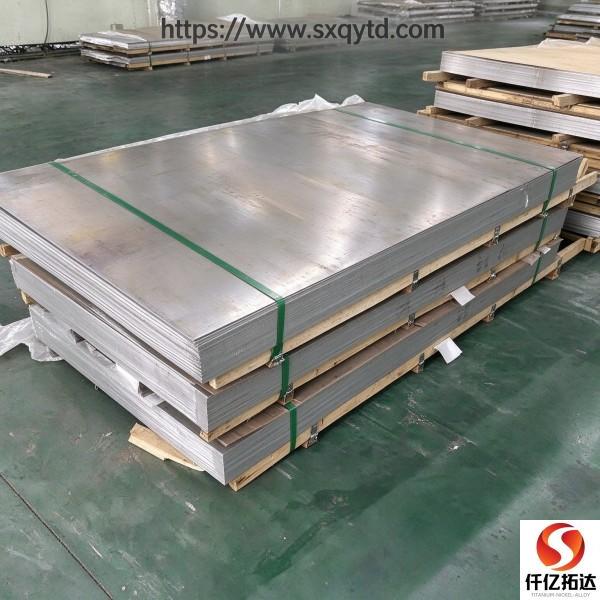
Yes, we cut plate, bar and tube to your dimensions, and no — a cut edge is not automatically weld-ready. Three things can go wrong. First, specify minimum thickness rather than nominal if the part is structural or pressure-containing: ASTM B265 permits a minus tolerance that can leave a nominal 6 mm sheet at 5.6 mm, which is compliant but may be below your design minimum. Second, hot-rolled plate carries an oxygen-enriched alpha case that must be removed by grinding or machining before welding; pickling removes scale but does not necessarily remove the alpha case. Third, thermal cutting leaves a heat-affected edge and possible iron contamination from carbon-steel tooling. Ask for cut edges ground back, free-iron-free handling, and the surface condition stated on the order. Our ASTM B265 plate guide and the B265 standard explainer set out the tolerances and surface conditions to put in a purchase order.
Do you accept drawings for custom parts and non-standard equipment?
Yes. We machine flanges, fittings, fasteners, agitator components and complete fabricated assemblies to customer drawings in STEP, IGES, PDF or DWG, and we also work from a sample or a sketch when a drawing does not exist. For non-standard equipment — reactors, heat exchangers, columns, storage tanks, coils, mixers — the useful first submission is not a fully dimensioned drawing but a process data sheet: medium and concentration, operating and design temperature, design pressure, volume or heat duty, required code, and the connection schedule. From that we can tell you whether all-titanium, titanium-clad steel or a PTFE-lined vessel is the economical answer before anyone spends time on detail design. See the process equipment buyer's guide, the seven custom-fabrication case studies and our reactor selection guide.
Which grades do you supply?
Titanium: commercially pure Gr1, Gr2, Gr3, Gr4; alloys Gr5 (Ti-6Al-4V / TC4), Gr7 (Ti-0.15Pd / TA9), Gr9 (Ti-3Al-2.5V), Gr11, Gr12 (Ti-0.3Mo-0.8Ni / TA10), Gr16/Gr17 and Gr23 (Ti-6Al-4V ELI). Nickel: Nickel 200 (N6), Nickel 201 (N4), Monel 400 and K500, Inconel 600/625/718, Incoloy 800/825, Hastelloy C276/C22 and Alloy 20. Zirconium: Zr702 and Zr705. We recommend ordering by UNS number plus the ASTM standard, not by a trade name or a Chinese grade symbol alone — see Q13. Useful references: our titanium grade selection guide, the Gr2 vs Gr5 comparison, the Zr702 vs Zr705 guide and the Monel / Inconel / Hastelloy guide.
Which standards do your products conform to?
By form: plate and sheet to ASTM B265 (or GB/T 3621); heat-exchanger and condenser tube to ASTM B338, seamless pipe to B861, welded pipe to B862; bar and billet to ASTM B348; wire to ASTM B863 and welding filler to AWS A5.16; butt-welding fittings to ASTM B363 with ASME B16.9 dimensions; forgings to ASTM B381 and flanges to ASME B16.5; fasteners to ASTM F467/F468 with ASME B18 dimensions. Medical grades to ASTM F67 (CP) and F136 (Ti-6Al-4V ELI). Nickel-side equivalents include B162, B161/B163, B160/B164, B127, B164, B165, B366 and B564. A standard number on a certificate is only meaningful if the test requirements are also met — see Q11 in our 100-question FAQ. Dual certification (ASTM + AMS 4911 for Gr5, ASTM + GB/T, ASTM + GOST) is available on request.
What payment terms do you accept, and how long is a quote valid?
New cooperation is normally T/T bank transfer with a deposit before production and the balance before shipment, or an irrevocable L/C at sight. Established accounts can be discussed against order history. Because titanium and nickel prices move with sponge titanium, palladium and nickel feedstock costs, a quotation is normally valid for a stated window — typically 7–15 days for stock items, shorter for grades tied to palladium — and we print the validity date on the quote rather than leaving it open-ended. If you are budgeting rather than ordering, use the titanium price index as an indicative FOB China reference, then request a firm quote when the specification is frozen.
How do you pack titanium for export, and why does it matter?
Plate is separated with non-metallic interleaving, edge-protected and strapped on fumigated wooden skids; tube is end-capped, bundled and braced against movement; machined flanges and fasteners are individually wrapped with vapour-phase corrosion inhibitor and boxed; all consignments are moisture-protected and crated for sea or air freight. Two titanium-specific points: never allow carbon-steel tools, wire brushes or steel straps to contact the surface, because embedded free iron creates local galvanic cells and pitting in chloride service; and long thin tubes need internal support, because vibration in transit frets the tube at each spacer. We can supply pre-shipment photographs and a packing list with heat numbers before the container is sealed. Our galvanic corrosion guide explains the iron-contamination mechanism.
Can I visit, or have an independent inspection before shipment?
Yes. We are at Floor 4, Building 4, No. 188 Gaoxin Avenue, High-tech Zone, Baoji, Shaanxi, China — the core of China's Titanium Valley cluster, about 1.5 hours from Xi'an by air or high-speed rail connections. Factory and warehouse visits are welcome by appointment, and we arrange pickup. If travel is not practical, we run live video inspection of the actual heat, marking and dimensions before packing. Third-party inspection by SGS, BV, TUV or your own nominated surveyor is supported, and for pressure equipment we can stage a witnessed hydrostatic test with the water quality and drying procedure agreed in advance. Our certifications page lists the quality-management documentation available for review.
How do I request a quotation, and what happens after I send it?
Use the quotation form, email [email protected], call +86-917-355-7966, or message WhatsApp +86 188 2967 9311. A technical question gets a substantive reply within 4 working hours and a written quotation within 24 hours, including grade and standard confirmation, stock or mill status, cutting and fabrication scope, inspection documents, packing, Incoterms, validity date and dispatch date. If your specification is incomplete we will tell you which field is missing rather than quote a guess. The inquiry response SOP shows the six steps between your message and the quote. For a first order, the eight fields in the checklist at the end of this page are enough to get an accurate price on the first pass.
2. Grades, Standards and Equivalents: 8 Questions That Prevent Wrong Material
Is TA2 the same as ASTM Grade 2?
Close, but not interchangeable on a purchase order. TA2 is a Chinese GB/T designation; Gr2 is an ASTM designation with UNS R50400. Both describe commercially pure titanium with broadly similar oxygen and iron limits, and in most chemical-service applications the corrosion behaviour is effectively the same. The problem is that the two standards do not impose identical maximums on every impurity, do not specify the same mechanical test regime, and do not use the same thickness tolerances, so "TA2" alone does not tell a supplier whether you expect GB/T 3621 or ASTM B265 compliance, nor which certificate you will accept. The same caution applies to TA9/Gr7, TA10/Gr12 and TC4/Gr5, and it is acute for N6 versus Nickel 200 where the carbon limit is the whole point of the grade. Write the UNS number, the ASTM or GB/T standard, the product form and the certificate type on the order. See our TA2/TA10 equivalence explainer, the GB/T 3621 plate standard breakdown and the N6 / Ni200 / Ni201 UNS selection guide.
What is the difference between Grade 2 and Grade 7, and when is the premium worth paying?
Gr7 is essentially Gr2 with 0.12–0.25% palladium added (UNS R52400, Chinese TA9). Palladium has a low hydrogen overpotential, so it shifts the cathodic reaction and holds the passive film stable inside a crevice where oxygen is depleted and pH falls. Gr2 is excellent on open, flowing surfaces; above roughly 60–70 °C in chloride-bearing crevices — tube-to-tubesheet expansions, gasket faces, under deposits, dead legs — it can suffer crevice corrosion, with the small anode inside the crevice driven by the large cathode outside. Gr7 resists that. It is also several times the price per kilogram because palladium tracks the open market. The economical answer is usually zoned selection: Gr2 for 90–95% of the tube length and Gr7 only for the 5–10% that sits in the tubesheet and crevice zones, giving a total premium in the range of 12–40% rather than 250–400%. Do not specify an all-Gr7 bundle unless the whole wetted surface is a crevice. Our Gr2 vs Gr7 seawater guide and the TA9 palladium alloy plate guide give the decision boundary.
When should I use Grade 12 instead of Grade 7?
Gr12 (Ti-0.3Mo-0.8Ni, UNS R53400, TA10) is a cheaper alternative to Gr7 for hot chloride and reducing-acid crevice service, and it has higher room-temperature strength. But it solves a different problem. In hot concentrated caustic soda, hydrogen absorption and hydride formation govern failure, and Gr12 contains no hydrogen-stabilising noble-metal addition — do not substitute Gr12 for Gr7 in caustic evaporator service. Gr7 remains the specified material there. The two grades are also visually identical to Gr2, so receiving inspection must include PMI or a certificate check per bundle. Compare them in our Gr7 vs Gr12 chlor-alkali comparison, and see the hydrogen embrittlement guide for the hydride mechanism.
Grade 5 or Grade 23 for medical implants?
Grade 23, without debate for implantable devices. Gr5 and Gr23 are the same nominal Ti-6Al-4V alloy; the difference is the oxygen limit — approximately 0.20% max for Gr5 versus 0.13% max for Gr23 ELI — and lower interstitial content gives Gr23 higher fracture toughness and better fatigue and crack-growth behaviour in the body. The governing specifications are ASTM F136 / ISO 5832-3 for Gr23 ELI and ASTM F67 for commercially pure implant grades, not the industrial bar standard B348 alone. A mill certificate that says "Gr5, ASTM B348" is not an implant certificate. For small-diameter wire and bar, surface defects matter disproportionately: a 20 µm flaw is 2% of a 1 mm wire's section, so centreless grinding plus 100% eddy-current inspection is worth specifying. See the Gr5 vs Gr23 selection guide and our ASTM B348 bar guide.
ASTM B338 or ASTM B861/B862 for titanium tube?
They are different standards for different duties, and confusing them is one of the most common causes of a non-compliant delivery. ASTM B338 covers seamless and welded titanium tube for condensers and heat exchangers and permits an average wall thickness basis, with eddy-current examination as the default NDT. B861 (seamless) and B862 (welded) cover titanium pipe for general pressure service and are written on a minimum wall basis with more demanding NDT. If a purchase order says only "B338 Gr2 25.4 × 0.7 mm" the supplier is entitled to deliver welded tube with an average wall of 0.7 mm whose thinnest point may be 0.56 mm. For a pressure header, specify B861; for an exchanger bundle, specify B338 and then upgrade the wall basis and NDT explicitly. See the ASTM B338 tube guide and the welded vs seamless tube decision guide.
Should I order seamless or welded titanium tube?
It is a service decision, not a quality ranking. ASTM B338 permits both, and welded tube with the internal bead properly removed and cold-worked is entirely suitable for steady, clean, low-pressure heat-exchange duty below about 60 °C — typically 25–60% cheaper than seamless. Choose seamless when there is pressure cycling, vibration, high velocity, a hazardous or penetrating fluid, or fatigue loading; an unremoved internal weld bead protruding 0.15 mm creates local turbulence and accelerates erosion-corrosion at exactly the thinnest section. Gr2 welded tube is often what fails in seawater surface condensers at eight to fourteen months. For any welded tube, state "internal bead removed and flush" and require a hydrostatic or enhanced eddy-current test. Our tube vibration and retubing guide covers the fatigue case.
What does EN 10204 3.1 versus 3.2 actually mean?
A 3.1 certificate is issued by the manufacturer's own authorised inspection representative, based on tests performed on the specific heat or lot, and confirms the chemical analysis and mechanical results against the ordered standard. A 3.2 certificate adds independent verification: the manufacturer's representative and either the purchaser's representative or an independent third party both sign, confirming the test results were witnessed or re-checked. For routine chemical equipment and stock material, 3.1 is normal and sufficient. Specify 3.2 when the material goes into a coded pressure vessel under ASME or PED, when the end client or EPC contract requires independent witnessing, or when a previous supplier's certificate has been questioned. Note that 3.2 raises cost and lead time, and it does not by itself prove the material in your crate matches the certificate — that is what heat-number traceability and PMI are for.
Can you supply dual-certified or multi-standard material, and an English MTR?
Yes, where the chemistry and test regime genuinely overlap. Common combinations are ASTM B265 + AMS 4911 for Gr5 plate, ASTM + GB/T for buyers using Chinese design drawings, and ASTM + GOST for CIS projects. Every overseas shipment includes a mill test report in English with heat number, chemical analysis, mechanical properties, dimensional results and the applicable standard. What we will not do is print a standard on a certificate that the material was not tested against; if you need a clause-by-clause compliance matrix, say so at the quotation stage so the mill can schedule the extra tests. For the paperwork chain on fabricated equipment, see the export products documentation guide.
3. Where Titanium Does NOT Work: 7 Questions About Failure Boundaries
Most supplier FAQ pages describe titanium as universally corrosion-resistant. It is not. Titanium's protection is a thin TiO₂ passive film, roughly 2–7 nm thick, and that film needs an oxidising environment and enough water to repair itself. Remove either condition and titanium corrodes fast. Knowing the boundary is worth more than any product catalogue.
In which media should I not use titanium at all?
Do not specify titanium in hydrofluoric acid at any practical concentration — fluoride complexes titanium and dissolves the film almost instantly. Do not use it in hot reducing acids (HCl, H₂SO₄ above roughly 5–10% and rising temperature), in dry chlorine gas (the reaction can ignite; wet chlorine is fine), in fuming nitric acid with low water content, or in anhydrous acetic anhydride where there is insufficient water to re-passivate the surface. In boiling acetic acid above about 200 °C, or at 150 °C when formic acid and chlorides contaminate the stream, the film breaks down and hydrogen uptake follows. The usual alternatives are Zirconium 702 for hot acetic and reducing-acid service, Hastelloy C276/C22 or a PTFE-lined vessel. Our zirconium vs titanium guide sets out the crossover.
| Medium / condition | What happens to titanium | Usual alternative |
| HF, any practical concentration | Passive film dissolved; rapid general attack | Monel 400, PTFE lining, Hastelloy |
| Hot HCl / reducing H₂SO₄ | Film breakdown, hydrogen absorption, hydride embrittlement | Zr702, Hastelloy C276, tantalum |
| Dry chlorine gas | Vigorous reaction / ignition risk; wet chlorine is safe | Keep chlorine wet; steel with dry-Cl controls |
| Hot chloride crevices above 60–70 °C | Crevice corrosion, pH drops to 2–3 inside the gap | Gr7 / Gr12 / Gr16 in the crevice zone only |
| Boiling acetic acid above ~200 °C, or acetic anhydride | Insufficient water to re-passivate TiO₂ | Zr702 (ZrO₂ film is stable without water) |
| Fuming nitric acid, low water | Oxide film instability, stress-corrosion risk | Aluminium alloys, stainless per concentration |
Can titanium handle hydrochloric acid?
Generally no, and this is the single most consequential "no" for chemical buyers. In dilute HCl at ambient temperature the corrosion rate may still be tolerable, but it rises steeply with both concentration and temperature; at a few percent HCl above roughly 60 °C, Gr2 can exceed 1 mm/year, and hydrogen uptake causes hydride precipitation even where general thinning looks acceptable. Gr7 or Gr12 improves the reducing-acid boundary somewhat but does not turn titanium into an HCl material. For real HCl duty the shortlist is Zirconium 702, Hastelloy C276/C22, tantalum or a lined vessel. See the zirconium in HCl service guide, the zirconium in sulfuric acid guide and the titanium vs 316L / 2205 / 254SMO comparison. If you send us concentration, temperature, oxidising contaminants and aeration, we will tell you whether titanium is viable before you spend on a quote.
Why do titanium tubes fail in seawater heat exchangers when titanium is "seawater-proof"?
Because open-surface seawater resistance and crevice resistance are different properties. On a clean, flowing surface Gr2 is effectively immune to seawater corrosion at ambient temperature. Inside a gap — the tube-to-tubesheet expansion joint, a gasket face, beneath a deposit, in a stagnant branch — oxygen is consumed and cannot be replenished, hydrolysis drives the local pH down to 2–3, and the passive film breaks. A 1 cm² crevice anode coupled to a 1 m² external cathode gives an area ratio near 1:10,000, so penetration is fast. The temperature threshold for Gr2 in chloride crevices is roughly 60–70 °C, which is exactly where MSF/MED desalination evaporators and hot seawater condensers operate. The fix is zoned grade selection, not a thicker tube: Gr2 for the open run, Gr7 or Gr16 for the tubesheet and crevice zones. See the Gr2 vs Gr7 seawater selection guide and the heat exchanger material selection guide.
Can titanium be welded directly to carbon steel or stainless steel?
Not by fusion welding. Titanium forms brittle intermetallic compounds with iron, and a direct TIG or MIG weld between titanium and steel cracks in the weld metal. The correct connections are a mechanical joint (a lap-joint flange with a titanium stub end and a carbon-steel backing ring, which also cuts flange cost by 60–80%), an explosion-bonded or roll-bonded titanium-steel transition joint that is welded titanium-to-titanium on one side and steel-to-steel on the other, or a gasketed bolted connection with electrical isolation. Galvanic corrosion is the second problem: titanium is noble, so a carbon-steel bolt or flange in a wet chloride environment becomes the anode and corrodes, while the titanium cathode can absorb hydrogen. Use B8/B8M stainless or Titanium Fasteners and isolate dissimilar metals. See the galvanic corrosion guide, the equipment layup guide and our ASME B16.5 flange guide.
Why do titanium bolts seize, and how do I stop it?
Galling. The TiO₂ film is thin and brittle; thread flank contact pressures of 200–400 MPa rupture it, and bare titanium sliding against bare titanium micro-welds under rotation, so the nut locks and the bolt shears on removal. Three controls work together: use dissimilar grades for the bolt and nut (Gr2 bolt with a Gr5 nut gives a hardness difference near 130 HV), apply a MoS₂ or nickel-free anti-seize compound, and never pair a titanium bolt with a carbon-steel nut in wet service. Also note the strength trap — Gr2 yields around 275 MPa while Gr5 yields about 828 MPa, roughly three times as much; a 1/2" Gr2 bolt has a proof load near 19.5 kN versus 58.5 kN for Gr5. TA2 is not a corrosion-resistant version of a steel bolt; it is a low-strength bolt. For Class 300 and above, or anything over 1/2", specify Gr5. See the Titanium Fasteners guide and the flange-bolt-gasket three-piece selection article.
At what temperature must I switch from Nickel 200 to Nickel 201?
315 °C (600 °F). The two grades differ in essentially one number: carbon, approximately 0.15% max in Nickel 200 (UNS N02200, Chinese N6) versus 0.02% max in Nickel 201 (UNS N02201, N4). Above roughly 315 °C, the dissolved carbon in Ni200 precipitates as graphite along grain boundaries, forming a continuous network that destroys ductility — an irreversible embrittlement called graphitisation. ASME Boiler and Pressure Vessel Code limits Ni200 to service below that temperature for pressure applications. Membrane-cell chlor-alkali caustic evaporators run at 300–350 °C, so they sit right on the boundary and must use Ni201. Ni201 costs only about 2–5% more; a graphitisation failure can idle a plant at USD 50,000–200,000 per day. Chinese designations N6 and N4 look identical and are indistinguishable by eye — require carbon analysis on the MTR. See our N6 / Ni200 / Ni201 selection guide and the ASTM B162 nickel plate guide.
For my vessel, should I choose titanium, a PTFE-lined vessel, or a high-alloy stainless?
Use the medium and temperature to decide, not the unit price. All-titanium or titanium-clad construction suits hot chloride, seawater, wet chlorine and oxidising acids where heat transfer matters — a lined vessel insulates the shell and limits temperature. PTFE lining is economical for moderate-temperature reducing acids and mixed acid streams, but it brings a lower temperature ceiling, permeation risk, vacuum limitations and mechanical vulnerability at nozzles. 316L fails in hot chlorides; 2205 and 254SMO extend the boundary but still pit in hot seawater crevices. A sensible rule: if you need heat transfer above 120 °C in chlorides, lean titanium; if the medium is hot HCl, none of these — go to zirconium or Hastelloy. Our titanium vs PTFE-lined vessel guide, titanium vs stainless comparison and reactor selection guide carry the decision tables.
4. Inspection, Documents and Claims: 3 Questions Before the Container Ships
What documents come with each shipment?
Every shipment carries the EN 10204 3.1 material test certificate with heat number, chemical analysis and mechanical test results; a dimensional inspection report; the commercial invoice and packing list; and the certificate of origin where required by the destination. Depending on the order we add heat-treatment records, NDT reports (eddy current, ultrasonic, radiographic, dye penetrant), a hydrostatic test record, PMI results, welding procedure and welder qualifications for fabricated equipment, and pre-shipment photographs. All documents are in English and the heat numbers on the certificate match the markings physically on the material. If you need a specific document set for customs or for an EPC dossier, state it at the quotation stage so it is priced and scheduled rather than requested after packing.
Do you perform PMI and third-party inspection, and when is PMI actually necessary?
Both are available. PMI (positive material identification) is worth requiring whenever a grade is visually indistinguishable from a cheaper one: Gr7 differs from Gr2 by about 0.15% palladium, Gr12 by 0.3% Mo plus 0.8% Ni, Gr16 by a lower palladium addition, and Nickel 201 from Nickel 200 by carbon content that an XRF analyser cannot reliably resolve. For those grades we recommend PMI or a verified certificate check on every bundle, not a sample, because a single mixed bundle in a tube sheet is an untraceable failure waiting to happen. For plain Gr2 plate or bar, sampling is normally sufficient. Third-party inspection by SGS, BV or TUV can cover chemistry verification, dimensional checks, NDT witnessing and pre-shipment loading supervision. Our quality documentation and the five supplier-verification questions cover how buyers audit us in practice.
What happens if material arrives wrong, damaged, or off-specification?
Send photographs of the marking and the defect, the packing list, the MTC and a short description of the nonconformity, and keep the material and packaging intact for inspection. We acknowledge within 24 hours, check the retained mill certificates and our own production and inspection records against the heat number, and give a written finding with a remediation proposal — replacement, rework, credit or refund according to the agreed contract terms. Where our documentation is at fault we cover the remedy; where the specification on the purchase order was ambiguous we say so plainly and fix the specification for the next order as well as the material for this one. That last point is why the eight-field checklist below exists: most disputes we see are specification disputes, not metallurgy disputes. For repair of installed equipment rather than returned material, see the titanium equipment leak repair guide.
Choose This, Not That: A Short Selection Checklist
| Choose this if… | Choose that if… |
| Gr2 — open, flowing surfaces below ~60 °C, no stagnant gaps, clean seawater or oxidising media | Gr7 / Gr16 — hot chloride crevices, tubesheet expansions, gasket faces above 60 °C |
| Gr12 — hot chloride or reducing-acid crevices where palladium cost is unacceptable | Gr7 — hot concentrated caustic where hydrogen absorption governs failure |
| ASTM B338 — condenser and heat-exchanger tubing | ASTM B861 / B862 — general pressure piping needing minimum-wall basis |
| Welded tube — steady clean fluid below 60 °C, bead removed and flush | Seamless tube — pressure cycling, vibration, high velocity, fatigue duty |
| Gr5 / B348 — industrial high-strength parts, aerospace hardware | Gr23 / F136 — implantable devices needing ELI toughness |
| Nickel 200 (N6) — caustic service below 315 °C | Nickel 201 (N4) — caustic service above 315 °C |
| Titanium — hot chlorides, seawater, wet chlorine, heat-transfer duty | Zr702 / Hastelloy / lined vessel — hot HCl, HF, hot reducing acids, dry chlorine |
| EN 10204 3.1 — routine stock and chemical equipment | EN 10204 3.2 — coded pressure vessels, PED/ASME dossiers, EPC witnessing |
Three things we will tell you not to buy: an all-Gr7 tube bundle when only the tubesheet zone needs it; socket-weld or threaded Titanium Flanges in corrosive service (the 0.8 mm stagnant gap is a crevice-corrosion cell); and Grade 5 bar sold against an ASTM F136 implant requirement. If a quotation arrives without these distinctions, ask who checked the service conditions.
8 Fields to Put in Every Inquiry (So the First Quote Is the Right Quote)
- Grade and UNS number — e.g. Gr2 / UNS R50400, not just "TA2" or "pure titanium".
- Applicable standard and certificate type — ASTM B265 with EN 10204 3.1, or 3.2 if the vessel is coded.
- Product form and full dimensions — plate 6.00 mm minimum × 1500 × 6000 mm; tube 25.4 × 0.7 mm minimum wall; bar Ø50 h9.
- Quantity and whether partial lengths are acceptable — one cut piece is fine, but tell us the exact count.
- Service conditions — medium, concentration, temperature range, pressure, aeration, crevices or stagnant zones. This is the field that decides whether titanium is the right answer at all.
- Surface, edge and NDT requirements — pickled or ground, alpha case removed, bead removed and flush, UT/ET/hydrostatic level, PMI per bundle.
- Destination port, Incoterm and required delivery date — plus whether air freight is an option if the plant is down.
- Document package — MTC, third-party inspection, pre-shipment photos, certificate of origin, any EPC dossier format.
Send those eight fields through the quotation form and you will have a written quotation within 24 hours, with grade and standard confirmation, stock or mill status, the certificate type, packing, Incoterms, a validity date and a dispatch date. If the service conditions in field 5 suggest titanium is the wrong material, we will say so in that reply rather than quote you something that fails in fourteen months. For an indicative budget before the specification is frozen, use the titanium price index.
Still Have a Question?
If your question is about a specific size, a cutting tolerance, a welding procedure or a shipping document, our 100-question export FAQ covers ten sections from company and inventory through to after-sales support. For a question about a live order or a material selection you are unsure about, contact us directly: [email protected], +86-917-355-7966, WhatsApp +86 188 2967 9311, or the inquiry form. Technical replies within 4 working hours, written quotations within 24 hours. We are at Floor 4, Building 4, No. 188 Gaoxin Avenue, High-tech Zone, Baoji, Shaanxi, China, and warehouse visits and live video inspection are welcome by appointment.
Technical notes: temperature and concentration boundaries in this page are approximate engineering guidance for material screening, not a corrosion guarantee. Final grade selection should be confirmed against your actual medium chemistry, aeration, velocity and crevice geometry, and against the current revision of the applicable ASTM/ASME standard. Cost multiples are indicative and move with palladium, nickel and sponge titanium prices — check the price index or request a dated quotation. Maintained by the engineering team at Shaanxi Qianyi Tuoda Technology Co., Ltd.
- Titanium Price Today (17 Nov 2026): Plate, Tube, Rod, Wire
- Titanium Prices 13 Nov 2026: Plate, Tube, Rod, Wire, Sponge
- Titanium Price Today (11 Nov 2026): Plate, Tube, Rod & Wire
- Titanium Price Today (9 Nov 2026): Plate, Tube, Rod & Wire
- What is Titanium Flange | ASME B16.5 ASTM B381 Gr2 Gr5 Titanium Flan
Contact Person: Wang Xiaoning
Tel: +86-917-355-7966
Email: [email protected]
WhatsApp: +86 188 2967 9311
Company: Shaanxi Qianyi Tuoda Technology Co., Ltd
Address: Floor 4, Building 4, No. 188 Gaoxin Avenue, High-tech Zone, Baoji City, Shaanxi Province, China