ASTM B265 Titanium Plate, Sheet & Strip
ASTM B265 Titanium Plate, Sheet & Strip: The Complete Engineering Guide

Table of Contents
- 1. What Is ASTM B265?
- 2. Products Covered Under B265
- 3. Common Titanium Grades Under B265
- 4. B265 vs. SB-265: What's the Difference?
- 5. How to Write a Correct Purchase Specification
- 6. Common Sourcing Mistakes (and How We Prevent Them)
- 7. Our Value-Add: Beyond Just Supplying Plate
- 8. Frequently Asked Questions
- 9. Related Standards
- 10. Get a Quote
1. What Is ASTM B265?
ASTM B265 is the standard specification for titanium and titanium alloy strip, sheet, and plate. It is the foundational material standard for flat-rolled titanium products in the U.S. and is widely adopted in ASME pressure vessel and piping systems (listed as SB-265).
This standard covers both commercially pure titanium and titanium alloys, delivered in annealed or as-rolled condition, with defined chemical composition, tensile properties, and surface finish requirements.
Key takeaway: B265 is not a product model—it is the acceptance baseline for all flat titanium materials used in engineering projects.
2. Products Covered Under B265
| Product Form | Thickness Range | Typical Use |
|---|---|---|
| Strip | 0.1 – 3 mm | Electrodes, deep-drawn parts, shielding |
| Sheet | 0.5 – 6 mm | Heat exchanger plates, linings, aerospace skins |
| Plate | 6 – 100+ mm | Tube sheets, flange blanks, pressure vessel walls, marine structures |
B265 covers both hot-rolled plate and cold-rolled sheet/strip, with different tolerance classes and surface conditions depending on final application.
3. Common Titanium Grades Under B265
| Grade | Composition | Key Properties | Typical Applications |
|---|---|---|---|
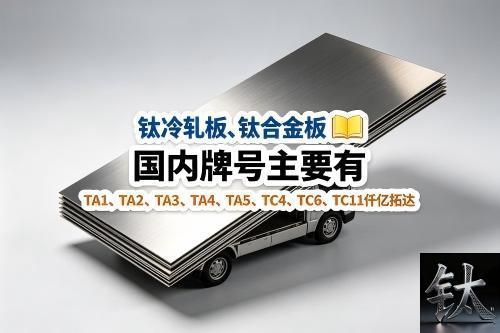
| Gr.1 | CP Ti (low O) | Highest ductility, excellent corrosion | Chemical tanks, cryogenic, medical |
| Gr.2 | CP Ti (medium O) | Best balance of strength & corrosion | Heat exchangers, seawater piping, plate heat exchangers |
| Gr.3 | CP Ti (higher O) | Higher strength than Gr.1/Gr.2 | Pressure vessels, heavier-wall applications |
| Gr.4 | CP Ti (highest O) | Highest strength among CP grades | Aerospace fittings, high-strength structural parts |
| Gr.5 (Ti-6Al-4V) | Ti-6Al-4V | High strength-to-weight, fatigue resistant | Aerospace frames, marine hardware, CNC-machined components |
| Gr.7 | Ti-Pd alloy | Superior resistance to reducing acids | Chloride environments, chemical processing |
| Gr.12 | Ti-0.3Mo-0.8Ni | Crevice corrosion resistance | Flue gas desulfurization, geothermal brine |
4. B265 vs. SB-265: What's the Difference?
| ASTM B265 | ASME SB-265 | |
|---|---|---|
| System | ASTM (general engineering) | ASME Boiler & Pressure Vessel Code |
| Use case | Procurement, general fabrication | Code-stamped vessels, heat exchangers |
| Interchangeability | Fully cross-referenced; direct substitution accepted | |
In practice, most export orders and ASME-code projects will specify SB-265 on drawings, while suppliers quote against ASTM B265. Both reference the same chemical and mechanical requirements.
5. How to Write a Correct Purchase Specification
Wrong: "Grade 2 titanium plate"
Correct: ASTM B265 / SB-265 Grade 2, annealed, 6.0 × 1500 × 3000 mm, pickled surface, EN 10204 3.1, heat number traceable
Must-include elements:
- Standard + Grade (e.g., ASTM B265 Gr.2)
- Condition (annealed, pickled, mill finish)
- Dimensions (thickness × width × length or coil)
- Tolerance class (if critical)
- Certification (EN 10204 3.1 or 3.2)
- Traceability (heat number, batch number)
6. Common Sourcing Mistakes (and How We Prevent Them)
| Mistake | Consequence | Our Solution |
|---|---|---|
| Buying "titanium plate" without grade | Wrong corrosion resistance | Grade confirmation by application review |
| No MTR / 3.1 certificate | Rejected at inspection | Every plate ships with EN 10204 3.1 |
| Mixed heat numbers in one order | Inconsistent welding results | Single-heat-number allocation on request |
| No surface specification | Oxidation, post-processing cost | Pickled / bright annealed finish options |
| Wrong thickness tolerance | CNC machining waste | Dimensional inspection report before shipment |
7. Our Value-Add: Beyond Just Supplying Plate
We don't just cut and ship. For B265 titanium plate, we provide:
- Precision CNC cutting to drawing (waterjet, laser, plasma)
- Tube sheet drilling for heat exchanger projects
- Flange blank pre-machining from thick plate
- MTR + chemical analysis + mechanical test bundled
- Export packaging: ISPM-15 wooden crates, VCI paper, desiccant
- Grade substitution advisory: help you select Gr.2 vs. Gr.7 vs. Gr.12 based on media analysis
One supplier for plate → cut → machine → certify → ship.
8. Frequently Asked Questions
Q: Can B265 Gr.2 be used for potable water?
A: Yes. Gr.2 is non-toxic, non-leaching, and widely approved for drinking water contact.
Q: What's the difference between B265 sheet and B265 strip?
A: Strip is narrower and thinner (typically <300 mm wide, <3 mm thick), usually supplied in coil. Sheet is wider, flat, and cut to length.
Q: Is B265 suitable for cryogenic service?
A: Yes. Gr.1 and Gr.2 retain excellent toughness at cryogenic temperatures (down to -250°C).
Q: Can I substitute B265 Gr.5 for Gr.2?
A: Not directly. Gr.5 has higher strength but reduced formability and different corrosion behavior. Substitution requires engineering review.
Get a Quote
Need ASTM B265 titanium plate, sheet, or strip for your project? Send us:
- Grade & quantity
- Dimensions (thickness × width × length)
- Surface & tolerance requirements
- Certification level (3.1 / 3.2)
- Delivery destination
We'll respond within 4 business hours with mill-direct pricing and lead time.
- Read titanium wire and titanium alloy wire: diameter classification
- Titanium wire: from brand selection to manufacturing process (2026 r
- Read titanium tube and titanium alloy tube: OD classification + comm
- Titanium pipe knowledge·tee + reducer selection 5 steps
- TA series vs TC series comparison: pure titanium vs titanium alloy s
Contact Person: Wang Xiaoning
Tel: +86-917-355-7966
Email: sales@sxqytd.com
WhatsApp: +86 188 2967 9311
Company: Shaanxi Qianyi Tuoda Technology Co., Ltd
Address: Floor 4, Building 4, No. 188 Gaoxin Avenue, High-tech Zone, Baoji City, Shaanxi Province, China