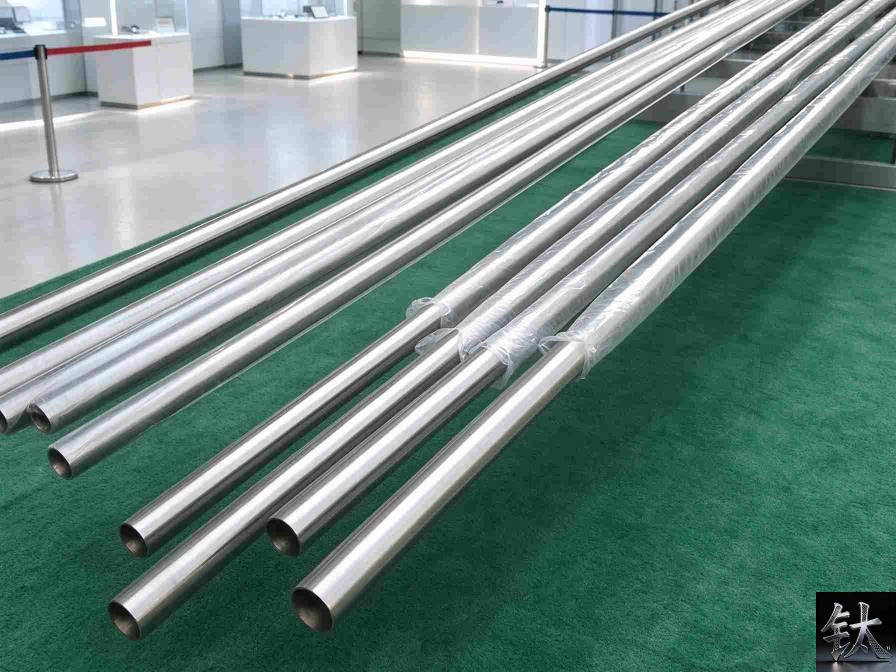
ASTM B338 Titanium Heat Exchanger Tubes
ASTM B338 Titanium Heat Exchanger Tubes: Engineering, Grades & Procurement Guide

Table of Contents
- 1. What Is ASTM B338?
- 2. Seamless vs. Welded Titanium Tubes
- 3. Common B338 Grades for Exchangers
- 4. OD, Wall Thickness & Length Tolerances
- 5. Mandatory Tests: ET, UT, Hydrostatic, Pneumatic
- 6. How to Write an ASTM B338 RFQ
- 7. Procurement Mistakes That Cause Retube Failures
- 8. Our Titanium Tube & Bundle Capability
- 9. FAQs
- 10. Related Standards
1. What Is ASTM B338?
ASTM B338 is the standard specification for seamless and welded titanium and titanium alloy tubes for surface condensers, evaporators, and heat exchangers. It is a tube standard—not a pipe standard. [1](@ref)
The ASME version is SB-338 and is used in ASME Section VIII pressure-equipment projects. Technically, B338 and SB-338 share the same chemistry, mechanical, and NDT requirements; the difference is only the code jurisdiction. [7,8](@ref)
If the drawing says “titanium heat exchanger tube”, the default reference should be ASTM B338 / ASME SB-338—not B861 or B862.
2. Seamless vs. Welded Titanium Tubes
| Item | Seamless (B338) | Welded (B338) |
|---|---|---|
| Manufacturing | Hollow billet → cold draw / pilger | Strip → automatic weld → cold work → anneal |
| Typical OD | 6–50 mm common | 12.7–38.1 mm very common |
| Cost | Baseline | Usually 15–25% lower |
| NDT | UT or ET + optional hydrostatic | ET + UT + hydrostatic/pneumatic |
| Best for | High-purity, U-tubes, critical service | Seawater-cooled condensers, large bundles |
Welded titanium tubes are no longer “second class” if the weld is cold-worked, fully annealed, and 100% eddy-current tested per ASTM E426. [8](@ref)
3. Common B338 Grades for Exchangers
| Grade | UNS | Why specify it | Typical service |
|---|---|---|---|
| Gr.1 | R50250 | Max ductility, best formability | U-bends, cryogenic, thin-wall forming |
| Gr.2 | R50400 | Best cost/corrosion balance, 345 MPa UTS | Seawater condensers, desalination, chemical coolers |
| Gr.7 | R52400 | Ti + Pd, resists reducing acids | HCl, dilute H₂SO₄, bleach, chlor-alkali |
| Gr.9 | R56320 | Ti-3Al-2.5V, high strength | Aerospace hydraulics, high-pressure exchangers |
| Gr.12 | R53400 | Ti-0.3Mo-0.8Ni, crevice corrosion resistance | Hot brine, geothermal, FGD, high-temp chloride |
ASTM B338 currently lists 28 grades, but most exchanger bundles are placed against Gr.1, Gr.2, Gr.7, Gr.9, and Gr.12. [1,7](@ref)
4. OD, Wall Thickness & Length Tolerances
- OD range: 6–114.3 mm common; smaller/larger on request
- Wall: 0.5–1.5 mm for condenser tubes; up to 6 mm for heavy-duty
- Length: straight lengths to 12 m; U-bends to customer radius
- OD tolerance: ±0.102 to ±0.254 mm depending on size
- Wall tolerance: typically ±10%
- Straightness: approx. 2.1 mm/m for long tubes
For tube-sheet rolling, OD consistency matters more than wall. Ask for go/no-go ring gauge inspection in the QA plan. [4](@ref)
5. Mandatory Tests: ET, UT, Hydrostatic, Pneumatic
ASTM B338 lets the purchaser select the examination route, so the RFQ must state it explicitly:
| Tube type | Required NDT | Pressure test |
|---|---|---|
| Seamless | UT or ET | Hydrostatic / pneumatic optional if NDT selected |
| Welded | ET and UT | Hydrostatic or pneumatic required |
Other acceptance checks:
- Tensile test (UTS / YS / elongation)
- Flattening test (seamless)
- Reverse flattening / flange test (welded)
- Flaring test for expandable tubes
- Chemical analysis with heat-number traceability
- EN 10204 3.1 MTR; 3.2 with third-party witness
Reference: ASTM B338 official scope ↗
6. How to Write an ASTM B338 RFQ
Weak: "Grade 2 titanium tubes 19x1 mm"
Strong: ASTM B338 / SB-338 Gr.2 seamless tube, 19.05 x 1.0 mm, 6096 mm long, annealed, pickled, 100% ET per ASTM E426, hydrostatic 10.3 MPa, EN 10204 3.1, heat no. on each bundle tag
Always state:
- Standard: ASTM B338 or ASME SB-338
- Construction: seamless or welded
- Grade: Gr.1 / Gr.2 / Gr.7 / Gr.9 / Gr.12
- Size: OD × WT × length
- Condition: annealed / bright annealed / pickled
- NDT route: ET / UT / hydrostatic / pneumatic
- U-bend radius and end condition if applicable
- Certificate: EN 10204 3.1 / 3.2
7. Procurement Mistakes That Cause Retube Failures
| Mistake | Result | Fix |
|---|---|---|
| No NDT route specified | Supplier picks cheapest option | Write ET+UT+hydrostatic explicitly |
| Mixed heat numbers in bundle | Uneven welding/rolling | Request single-heat or heat-map packing list |
| Iron contamination ignored | Localized corrosion | Pickled + passivated, no carbon-steel contact |
| Gr.2 used above ~80°C seawater | Crevice corrosion risk | Review Gr.12 / Gr.7 with corrosion engineer |
| U-bend radius omitted | Spring-back / wall thinning | Provide bend radius, mandrel requirement, post-bend anneal |
8. Our Titanium Tube & Bundle Capability
- ASTM B338 / SB-338 Gr.1, Gr.2, Gr.7, Gr.9, Gr.12
- Straight tubes, U-tubes, coiled titanium tubing
- Pickled, bright annealed, ID/OD polished (Ra < 0.4 µm)
- 100% eddy current + UT + hydrostatic as specified
- Tube-sheet drilling and bundle assembly support
- SGS / TÜV / BV inspection before shipment
- Export packing: VCI paper, end caps, sealed PE, ISPM-15 crate
We do not just sell “titanium tubes”—we supply inspectable, traceable, exchanger-ready tubing.
9. FAQs
Q: Is ASTM B338 the same as ASTM B861?
No. B338 = heat exchanger/condenser tube. B861 = seamless titanium pipe for process piping. [7](@ref)
Q: Can welded B338 tubes replace seamless in seawater condensers?
Yes, if the weld is cold-worked, annealed, and 100% tested. Many desalination and power-plant condensers now use welded Gr.2 tubes. [8](@ref)
Q: What wall thickness is typical for titanium condenser tubes?
0.4–1.0 mm for seawater service; 0.7 mm and 1.0 mm are very common because titanium’s corrosion allowance is minimal.
Q: Do I need Grade 7 or Grade 12 for seawater?
Not always. Gr.2 is standard below ~80°C. Choose Gr.7 for reducing acids, Gr.12 for hot chloride/crevice service.
10. Related Standards
Request ASTM B338 Titanium Tube Quote
Send us:
- Grade & construction (seamless / welded)
- OD × wall × total length or tube count
- Straight or U-bend (radius, leg length)
- NDT route: ET / UT / hydrostatic / pneumatic
- Certificate level: 3.1 / 3.2
We reply with mill-direct pricing, test plan, and lead time.
- Read titanium wire and titanium alloy wire: diameter classification
- Titanium wire: from brand selection to manufacturing process (2026 r
- Read titanium tube and titanium alloy tube: OD classification + comm
- Titanium pipe knowledge·tee + reducer selection 5 steps
- TA series vs TC series comparison: pure titanium vs titanium alloy s
Contact Person: Wang Xiaoning
Tel: +86-917-355-7966
Email: sales@sxqytd.com
WhatsApp: +86 188 2967 9311
Company: Shaanxi Qianyi Tuoda Technology Co., Ltd
Address: Floor 4, Building 4, No. 188 Gaoxin Avenue, High-tech Zone, Baoji City, Shaanxi Province, China