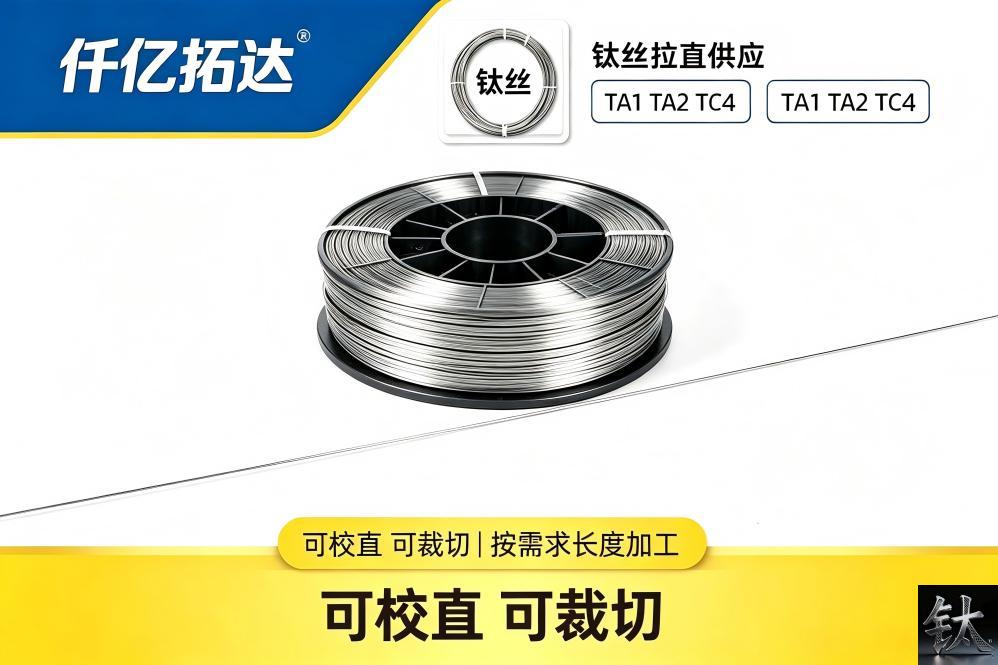
Titanium Wire — ASTM B863 Filler, Spring & Medical Guide
| Specification | ASTM B863 (wire), AWS A5.16 (filler classification), F136 (Ti-6Al-4V ELI implant), F67 (CP implant) |
|---|---|
| Applicable Standard | ERTi-1, ERTi-2, ERTi-5, ERTi-7, ERTi-9, ERTi-12, ERTi-23; non-weld Gr1, Gr2, Gr5, Gr23 |
| Material Condition | TIG/PAW welding filler, medical implant wire, spring wire, fastener heading wire |
| Inspection & Packaging | Match filler grade to base metal (ERTi-2 for Gr2, ERTi-5 for Gr5, ERTi-23 for Gr23); AWS A5.16 for weld wire; F136 for implant |
| Reference Price | $25.00 – $35.00 |
Product Description: ASTM B863 titanium wire guide: ERTi filler matching, AWS A5.16 classification, spring wire, F136 implant wire, surface conditions, 7 procurement traps, cost economics.
Product Overview
| Standards | ASTM B863 (wire); AWS A5.16 (filler classification); F136 (Ti-6Al-4V ELI implant); F67 (CP implant) |
| Grades | ERTi-1, ERTi-2, ERTi-5, ERTi-7, ERTi-9, ERTi-12, ERTi-23; non-weld Gr1, Gr2, Gr5, Gr23 |
| Service | TIG/PAW welding filler, medical implant wire, spring wire, fastener heading wire |
| Core distinction | B863 covers wire (≤6 mm); B348 covers bar (≥6 mm). Welding filler wire carries AWS ERTi-xx classification and must match the base metal; non-weld wire is for spring, fastener, or implant service where matching is by service, not by weld chemistry. |
The Case: A Weld Failure from Mismatched Filler Wire
In 2019, a chemical plant in Southeast Asia commissioned a titanium Gr2 (commercially pure) pressure vessel with a circumferential TIG weld. The fabricator used ERTi-5 (Ti-6Al-4V) filler wire, reasoning that a higher-strength filler would produce a stronger joint. Within fourteen months of service at 80 °C in chloride-bearing brine, the weld deposit developed transverse cracks at the fusion line, and the vessel leaked.
The failure investigation found a metallurgical mismatch. The ERTi-5 weld deposit was an alpha-beta alloy; the Gr2 parent metal was commercially pure. The fusion zone contained a composition gradient between the two, and the heat-affected zone (HAZ) on the Gr2 side was exposed to a thermal cycle that the parent metal was not designed for. The combination produced a microstructure with high residual stress and lower corrosion resistance than either the parent metal or the weld deposit alone. The cracks initiated at the fusion line — the highest stress, lowest corrosion resistance location in the joint.
This case is the wire equivalent of the 8-month condenser tube failure described in the B338 guide. The wire was genuine ERTi-5, correctly certified to AWS A5.16. The failure was a specification failure. The fabricator did not follow the cardinal rule of titanium welding: match the filler grade to the base metal grade. This guide exists so that your next B863 wire purchase order does not end the same way.
ASTM B863 Scope: Wire, Not Bar
ASTM B863 is titled "Standard Specification for Titanium and Titanium Alloy Wire." The word that does the work is wire. B863 covers titanium product up to roughly 6 mm in diameter, in straight lengths or on spools. Above 6 mm, the governing standard is ASTM B348 for bar. The two standards overlap at the 6 mm boundary, and a purchase order at that size must specify which standard governs — because the tolerance systems, surface condition defaults, and packaging options differ.
B863 covers welding filler wire, spring wire, medical implant wire, fastener heading wire, and general-purpose wire. The standard does not classify the wire by end use; it specifies the chemistry, mechanical, and dimensional requirements, and the buyer specifies the end use on the purchase order. The classification of welding filler wire by AWS designation (ERTi-xx) is governed by AWS A5.16, which cross-references B863 for the product form.
For most buyers, the relevant distinction is between welding filler wire (which carries AWS classification and must match the base metal) and non-weld wire (which is for spring, fastener, implant, or general use, and is matched to the service, not to a weld). The two are not interchangeable. A welding filler wire supplied in the wrong condition — too cold-worked, too oxidized, with the wrong surface preparation — will produce a defective weld regardless of the chemistry match. A non-weld wire used as welding filler will not have the chemistry control that produces a sound weld deposit.
Welding Filler Wire vs Non-Weld Wire: The AWS A5.16 System
Welding filler wire is classified under AWS A5.16, "Specification for Titanium and Titanium-Alloy Welding Electrodes and Rods." The classification system uses the prefix ERTi (Electrode Rod Titanium) followed by a number that corresponds to the base metal grade. ERTi-2 matches Gr2; ERTi-5 matches Gr5; ERTi-23 matches Gr23. The chemistry limits of the filler are tighter than the chemistry limits of the corresponding base metal, because the filler must produce a weld deposit that meets the mechanical and corrosion requirements of the joint.
The tighter chemistry is the first reason filler wire is not the same as a random piece of wire of the same grade. ERTi-2 has tighter limits on oxygen, nitrogen, carbon, and iron than the Gr2 base metal, because these interstitial elements control weld deposit toughness and cracking susceptibility. A piece of Gr2 wire picked off a coil and used as welding filler may meet Gr2 chemistry but fail the ERTi-2 limits, and the weld deposit will have lower toughness and higher cracking risk.
The second reason is surface preparation. Welding filler wire is supplied cleaned — pickled, solvent-degreased, and protected from atmospheric contamination during packaging. Any surface oxide, oil, or moisture on the wire ends up in the weld deposit and produces porosity and embrittlement. Non-weld wire is not supplied to the same surface preparation standard, and using it as welding filler is a common cause of porosity and hydrogen pickup in titanium welds.
| Property | Welding filler wire (ERTi) | Non-weld wire |
| Classification | AWS A5.16 ERTi-xx | ASTM B863 grade (e.g., Gr2, Gr5) |
| Chemistry control | Tighter than base metal | Same as base metal |
| Surface preparation | Pickled, degreased, sealed | As-drawn or as-rolled |
| Condition | Annealed (M) | Annealed, cold-drawn, or aged |
| Packaging | Spool or straight length, sealed | Coil or straight length |
Filler-to-Base-Metal Matching: The Cardinal Rule
The cardinal rule of titanium welding is: match the filler grade to the base metal grade. The AWS A5.16 classification system is designed around this rule — ERTi-2 for Gr2, ERTi-5 for Gr5, ERTi-23 for Gr23 — and the rule exists because mismatched filler produces a weld with properties that are not what the design assumed.
The 2019 chemical plant failure at the start of this guide is the textbook case. ERTi-5 (alpha-beta alloy) on Gr2 (commercially pure) produced a fusion zone with a composition gradient, a microstructure not present in either parent or filler, and a corrosion resistance lower than either. The weld was "stronger" in tensile but failed in corrosion and crack resistance — which was the actual service requirement.
The reverse mismatch — ERTi-2 filler on Gr5 base metal — is equally bad. The weld deposit is commercially pure titanium, lower in strength than the Gr5 parent metal, and the joint fails the design strength calculation. This is a common shortcut in shops that stock only ERTi-2 and use it for everything; the weld looks acceptable on visual inspection but does not meet the joint strength requirement.
The exceptions to the matching rule are narrow and require engineering justification. A lower-strength, higher-ductility filler may be specified when the joint is designed to yield in the weld deposit rather than the parent metal (a "yielding weld" design for seismic or overload service). A dissimilar-metal weld between two titanium grades may use a filler matching the lower-strength grade. Each of these exceptions must be documented in the weld procedure specification (WPS) and qualified by procedure qualification records (PQR).
Surface Conditions: Pickled, Ground, Polished
B863 wire is supplied in four principal surface conditions: black (as-drawn or as-rolled with oxide scale), pickled (oxide removed, alpha case may remain), ground (centerless-ground to final tolerance and surface finish), and polished (mirror finish for medical or appearance service). Each condition is suited to a different downstream use.
Black wire is the lowest-cost condition, supplied as-drawn or as-rolled with the oxide scale from the working temperature. The surface is dark, with the alpha case beneath the scale. Black wire is used for further drawing — the surface is cleaned during the next drawing reduction — and is not supplied for direct use. Do not specify black wire for a finished application; the alpha case will cause cracking.
Pickled wire has the oxide scale removed by acid pickling. The surface is gray, and the alpha case may or may not be fully removed depending on the pickling depth. Pickled wire is the baseline condition for general fabrication and for welding filler wire that will be cleaned before use. The buyer must verify alpha case removal for any cyclic or implant service; "pickled" does not mean "alpha case removed."
Ground wire is pickled wire that has been centerless-ground to a final diameter tolerance and surface finish. The surface is bright, with a finish typically better than 0.8 micrometers Ra. Ground wire is specified for precision applications — medical implant wire, spring wire, precision fastener heading wire — where the surface is the final surface and surface defects become crack initiation sites.
Polished wire is ground wire that has been further polished to a mirror finish, typically better than 0.2 micrometers Ra. Polished wire is specified for medical implant wire (F136, F67) where the surface finish is a regulatory requirement, and for appearance applications (jewelry, architectural). The premium over ground is 30 to 80 percent.
Diameter Tolerance and Spool vs Straight Length
B863 diameter tolerance follows the ISO system, with the class depending on the manufacturing route and the diameter range. For wire below 1 mm, the tolerance bands are tight in absolute terms — h7 on a 1 mm wire is plus 0 / minus 0.010 mm — but the relative tolerance is wider than for larger sizes. For wire above 1 mm, the tolerance bands loosen in absolute terms but tighten in relative terms.
The critical issue for precision applications is diameter variation along the length of the spool or coil. A spool of 1 mm wire with h7 tolerance may have a section at 1.000 mm and a section at 0.990 mm; if the application is precision coiling of a medical spring, the spring constant will vary by 2 percent between the two sections. For applications where the diameter variation translates directly into performance variation, specify a diameter traverse certificate per spool, showing the measured diameter at intervals along the length.
Packaging is the second variable. Welding filler wire is supplied on spools (typically 5 kg or 10 kg) for continuous-feed TIG welding, or in straight lengths (typically 914 mm or 1000 mm) for manual feeding. Non-weld wire is supplied in coils or on spools depending on the diameter and the downstream process. The packaging choice is driven by the welding process — automated TIG with wire feeder requires spool; manual TIG can use either. Specify the packaging on the purchase order; the default depends on the mill and may not match the welding process.
Condition: Annealed, Cold-Drawn, Stress-Relieved
B863 wire is supplied in three principal conditions, designated by Chinese standard symbols that have become common in international trade: M (annealed), Y (cold-drawn), and Y2 (cold-drawn plus stress-relieved). Each condition carries a different combination of strength, residual stress, and dimensional stability.
Annealed (M) wire is fully stress-relieved, isotropic, and dimensionally stable. The tensile strength is the baseline for the grade — for Gr2, roughly 345 MPa minimum. Annealed is the baseline condition for welding filler wire (where dimensional stability during welding matters more than as-supplied strength) and for most general fabrication. The trade-off is lower as-supplied strength.
Cold-drawn (Y) wire is work-hardened by the drawing reduction, with tensile strength 20 to 60 percent above the annealed baseline. The cold work introduces residual stress that can cause distortion during downstream forming or welding. Cold-drawn is specified for spring wire where the work-hardening contributes to the spring performance, and for applications where the higher as-supplied strength is required without heat treatment.
Cold-drawn plus stress-relieved (Y2) is a compromise: the cold-drawn strength is partially retained while the residual stress is reduced. Y2 is specified for fastener heading wire, where the wire must be formable enough to head (cold-drawn is too brittle, annealed is too soft) but strong enough to develop the final fastener strength after heading and aging. Y2 is the most common condition for fastener wire.
Medical Wire: F136 and the Implant Grade
For medical implant wire, the governing specifications are ASTM F136 (Ti-6Al-4V ELI, Gr23) and F67 (commercially pure titanium, Gr1-4). These specifications impose chemistry limits, mechanical requirements, and surface quality requirements beyond what B863 specifies. The implant specifications require the wire to be free of alpha case, free of surface defects that would become crack initiation sites, and supplied with a chemistry and mechanical certificate traceable to the heat.
For F136 wire, the oxygen limit is 0.13 percent maximum — the same ELI limit that distinguishes Gr23 from Gr5 in bar. A wire sold as "Ti-6Al-4V" or "Grade 5" without the F136 reference may have oxygen content up to 0.20 percent, which is compliant with Gr5 but not with Gr23. The implant buyer who accepts "Grade 5" language on a medical purchase order is exposed to the same risk described in the B348 guide: an implant with lower fracture toughness than the design assumed.
For wire below 1 mm diameter, the surface quality requirement becomes critical. A surface defect of 20 micrometers depth is 2 percent of the cross-section on a 1 mm wire; the same defect on a 25 mm bar is 0.08 percent. The stress concentration effect scales with the relative defect size, and a wire with a surface defect that would be acceptable on a bar may be a crack initiation site in cyclic body loading. For implant wire below 1 mm, specify centerless-ground, polished, with a zero surface defect acceptance criterion verified by 100 percent ET inspection.
Spring Wire and Fastener Heading Wire
Spring wire is a high-strength titanium wire supplied in the cold-drawn plus aged condition, designed to be coiled into a spring and heat-treated to develop the final yield strength. The grade is typically Gr5 (Ti-6Al-4V) or a beta titanium alloy (Beta C, Ti-15V-3Cr-3Al-3Sn). The cold-drawn condition provides the work-hardening that contributes to the spring performance; the aging treatment precipitates the alpha phase in the beta matrix and develops the final strength. Spring wire is not interchangeable with filler wire — the cold work makes it weld poorly, and the chemistry is not controlled for weld deposit properties.
Fastener heading wire is supplied in the Y2 condition, with strength and formability balanced for the heading operation. The wire must be formable enough to head (the head is formed by cold-forging the end of the wire) without cracking, and strong enough to develop the final fastener strength after heading and aging. For aerospace fasteners, the wire is typically Gr5 or a beta alloy, with the grain flow controlled by the drawing reduction ratio to follow the head-to-shank contour after heading. The grain flow requirement is the same as for forged bar — fastener heading is essentially a forging operation on wire.
For both spring and fastener wire, the buyer specifies the end use, and the supplier controls the chemistry, condition, and grain flow to match. A purchase order that writes "titanium wire Gr5, 3 mm" without specifying spring or fastener use will receive whatever the mill produces by default, which is rarely what the application needs.
Common Procurement Failures
Seven failures recur in B863 titanium wire procurement. All of them are avoidable by writing a complete purchase order.
1. Not specifying welding filler vs non-weld wire. "Titanium wire Gr2, 1.6 mm" is not a purchase order. The mill can furnish random Gr2 wire (not cleaned for welding) or ERTi-2 filler (cleaned and chemistry-controlled). Specify AWS A5.16 ERTi-2 for welding; specify B863 Gr2 for non-weld.
2. Mismatching filler to base metal. ERTi-5 on Gr2, ERTi-2 on Gr5, ERTi-23 on Gr5 — each is a specification failure that produces a weld with properties not assumed by the design. Match the filler grade number to the base metal grade number.
3. Not specifying surface condition. Black wire has the alpha case; pickled may retain it; ground and polished are clean. Specify the surface condition and the surface finish for the application; do not accept the default.
4. Not specifying diameter tolerance. The default B863 tolerance may be wider than the application can accept. For precision wire below 1 mm, specify h7 and require a diameter traverse certificate per spool.
5. Accepting "Grade 5" for F136 implant wire. The only chemistry difference is oxygen content (0.20 vs 0.13 percent), but the fracture toughness difference is the entire point of Gr23. Require the MTR to show UNS R56401 and F136 reference; require PMI on every lot.
6. Using spring wire as filler or filler as spring wire. Spring wire is too cold-worked to weld cleanly; filler wire does not have the strength to serve as a spring. Specify the wire by end use, not by diameter alone.
7. Not specifying packaging. Spool for automated TIG with wire feeder; straight length for manual TIG; coil for downstream drawing. The default depends on the mill and may not match the welding process.
Cost Economics: Filler Wire vs Spring Wire vs Medical Wire
The cost structure of B863 wire is driven by three variables: end use (welding filler vs spring vs medical vs fastener), surface condition (black vs pickled vs ground vs polished), and grade (Gr2 baseline vs Gr5/Gr23/Gr9/Gr12). Each variable carries a cost premium that is predictable and that the buyer should model before issuing the purchase order.
Filler wire is the baseline for welding applications. ERTi-2 (matching Gr2) is the lowest-cost filler; ERTi-5 is 1.5 to 2.5 times; ERTi-23 is 2 to 4 times. The premium is driven by the chemistry limits and the additional quality control required for implant-grade filler. For a typical manual TIG application using 1.6 mm ERTi-2 at $45 per kilogram, a 10 kg spool runs $450; the same spool in ERTi-5 runs $675 to $1,125.
Spring wire is supplied in the cold-drawn plus aged condition, with the cost premium driven by the additional drawing reductions and the aging treatment. Spring wire in Gr5 is typically 1.5 to 2.0 times the cost of annealed Gr5 wire of the same diameter; beta alloy spring wire is 2.5 to 4.0 times.
Medical implant wire is the highest-cost category, driven by the F136/F67 chemistry limits, the ground-and-polished surface condition, the 100 percent ET inspection, and the lot-traceable certificate. F136 Gr23 wire at 1 mm diameter may run $200 to $400 per kilogram, compared to $45 to $90 per kilogram for general-purpose Gr2 wire of the same size. The premium is the cost of the regulatory and quality assurance burden, and it is non-negotiable for implant service.
Supplier Verification Checklist
Before issuing a B863 purchase order, verify the supplier on eight points. A supplier that fails any of these is not a supplier for the corresponding end use.
1. For welding filler, does the MTR show AWS A5.16 classification (ERTi-xx), heat number, chemistry (tightened interstitial limits), and surface preparation certificate? Require a sample MTR before order.
2. Can the supplier furnish F136 certification for implant wire, with oxygen content reported as 0.13 percent maximum? If the supplier cannot furnish F136, the supplier is not qualified for implant wire.
3. What is the supplier's alpha case removal capability? Ask for a microhardness traverse on a sample cross-section. A supplier that cannot verify alpha case removal is a supplier that cannot furnish spring, fastener, or implant wire.
4. What is the supplier's surface finish capability? Can the supplier furnish ground (0.8 µm Ra) and polished (0.2 µm Ra) wire? A supplier that only furnishes pickled wire is not qualified for medical or precision applications.
5. What is the supplier's diameter tolerance capability? Can the supplier furnish h7 for wire below 1 mm? A supplier that only furnishes h11 is not qualified for precision coiling or Swiss machining.
6. What is the supplier's spring wire capability? Can the supplier furnish cold-drawn plus aged Gr5 or beta alloy wire, with the aging treatment documented? A supplier that only furnishes annealed wire is not qualified for spring applications.
7. What is the supplier's packaging capability? Can the supplier furnish spools for automated TIG, straight lengths for manual TIG, and coils for downstream drawing? A supplier that only furnishes one packaging is not qualified for all welding processes.
8. What is the supplier's PMI capability for Gr5/Gr23 lots? For implant service, the supplier must be able to PMI every received lot for oxygen content. The cost of PMI is trivial against the cost of a recall.
Summary: The 8-Field Purchase Order for Titanium Wire
A complete ASTM B863 titanium wire purchase order contains eight fields, and only eight. Writing these eight fields eliminates every failure mode described in this guide.
1. Standard
: ASTM B863 (wire). For welding filler, cross-reference AWS A5.16. For implant, cross-reference F136 or F67.
2. Grade
: UNS designation (R50400 for Gr2, R56400 for Gr5, R56401 for Gr23). For filler, AWS ERTi-xx classification matching the base metal. For implant, F136 reference.
3. End use
: Welding filler, spring wire, medical implant, fastener heading, or general. The end use drives the condition, surface, and inspection requirements.
4. Dimensions
: Diameter × length (or spool weight), with tolerance class (h7, h9, h11). Specify diameter traverse certificate for precision wire below 1 mm.
5. Surface condition
: Black, pickled, ground, or polished. Specify alpha case removal for spring, fastener, or implant service.
6. Condition
: Annealed (M), cold-drawn (Y), or cold-drawn plus stress-relieved (Y2). Specify the condition by end use — annealed for filler, Y for spring, Y2 for fastener heading.
7. Packaging
: Spool (5 kg or 10 kg) for automated TIG, straight length (914 mm or 1000 mm) for manual TIG, coil for downstream drawing.
8. Certification
: MTR with UNS, heat number, chemistry (including oxygen for Gr5/Gr23), mechanicals, surface preparation (for filler), F136 (for implant). PMI on every lot for Gr5/Gr23.Eight fields. The purchase order that opened this guide had three — "ERTi-5, 1.6 mm, 10 kg spool" — and produced a weld that failed in fourteen months. The difference between that purchase order and an eight-field purchase order is the difference between a sound weld and a vessel leak.
Frequently Asked Questions
Q1: What is the difference between ASTM B863 wire and B348 bar?
B863 covers titanium wire up to roughly 6 millimeters in diameter; B348 covers bar from 6 millimeters up. The two standards overlap at the 6 millimeter boundary, and a purchase order at that size must specify which standard governs. B863 typically has tighter diameter tolerance (h7-h9 versus h9-h13 for bar) and includes spool packaging for welding wire, which B348 does not address.
Q2: Can I use ERTi-2 filler wire to weld Gr5 (Ti-6Al-4V)?
No, not as a general practice. ERTi-2 is commercially pure titanium filler, and using it on a Ti-6Al-4V base metal produces a weld deposit that is lower in aluminum and vanadium than the parent metal. The weld metal has lower strength than the base metal and may not meet the design strength of the joint. The matching filler for Gr5 is ERTi-5; for Gr23 (medical ELI) it is ERTi-23. Cross-grade filler is used only when a lower-strength, higher-ductility weld is specifically engineered, and this must be documented in the weld procedure.
Q3: What is the matching filler wire for each base metal grade?
The AWS A5.16 matching rule is: ERTi-1 for Gr1; ERTi-2 for Gr2; ERTi-3 for Gr3; ERTi-4 for Gr4; ERTi-5 for Gr5; ERTi-7 for Gr7; ERTi-9 for Gr9; ERTi-12 for Gr12; ERTi-15 for Gr15; ERTi-16 for Gr16; ERTi-17 for Gr17; ERTi-23 for Gr23 (Ti-6Al-4V ELI). The filler grade number matches the base metal grade number. Exceptions: ERTi-0.5Pd and ERTi-0.05Pd are alternate designations for some Pd grades; consult AWS A5.16 for cross-references.
Q4: Is cold-drawn wire better than annealed?
Not universally. Cold-drawn (Y) wire has higher tensile strength from work-hardening, but the cold work introduces residual stress that can cause distortion during downstream forming or welding. Annealed (M) wire is stress-relieved, isotropic, and dimensionally stable, but lower in as-supplied strength. Cold-drawn is specified for spring wire where the work-hardening contributes to the spring performance; annealed is the baseline for welding and most general fabrication. Cold-drawn plus stress-relieved (Y2) is a compromise for fastener heading wire.
Q5: Which surface condition do I specify for medical implant wire?
For implant wire per ASTM F136 (Ti-6Al-4V ELI) or F67 (CP), specify ground and polished, with the surface finish verified to be below 0.4 micrometers Ra. The wire must be free of alpha case (verified by microhardness traverse per ASTM E384) and free of surface defects that would become crack initiation sites under cyclic body loading. For wire below 1 millimeter diameter, specify centerless-ground with a zero surface defect acceptance criterion; surface defects at that size are a significant fraction of the cross-section.
Q6: What is spring wire and how is it different from filler wire?
Spring wire is a high-strength, cold-drawn titanium wire (typically Gr5 or a beta alloy) supplied in the cold-worked plus aged condition, designed to be coiled into a spring and heat-treated to develop the final yield strength. Filler wire is supplied in the annealed condition for TIG or PAW welding, with chemistry tightly controlled to match the base metal. The two are not interchangeable: spring wire is too cold-worked to weld cleanly, and filler wire does not have the strength to serve as a spring. Specify the wire by end use, not by diameter alone.
Q7: How do I specify diameter tolerance for precision wire?
Use the ISO tolerance class explicitly. For precision wire (medical, spring, fastener heading), specify h7 (plus 0 / minus 0.010 millimeters on a 1 millimeter wire) for ground wire, or h9 (plus 0 / minus 0.025 millimeters) for cold-drawn. The default B863 tolerance depends on the diameter and the manufacturing route and may be wider than the application can accept. For wire below 1 millimeter diameter, even h9 is too loose for precision coiling or Swiss machining; specify h7 and require a diameter traverse certificate per spool.
Summary
ASTM B863 covers wire up to 6 mm; B348 covers bar from 6 mm up. Welding filler wire carries AWS A5.16 ERTi-xx classification and must match the base metal — the cardinal rule of titanium welding. Non-weld wire is matched to the service — spring, fastener, implant — not to a weld chemistry. Surface condition runs from black (with alpha case) through pickled (alpha case may remain) to ground and polished (clean and precision). Condition runs from annealed (M, stable, baseline for filler) through cold-drawn (Y, high strength, residual stress) to cold-drawn plus stress-relieved (Y2, the fastener wire compromise). For implant wire, F136 chemistry and ground-polished surface are non-negotiable. The eight-field purchase order eliminates every failure mode described in this guide. Write all eight.
Tell us your requirement — grade, size and quantity. We reply within 24 hours.
Prefer chat? WhatsApp +86 188 2967 9311 or email sales@sxqytd.com.
- Titanium Price Today (23 Oct 2026): Plate, Tube, Rod & Wire
- Read titanium wire and titanium alloy wire: diameter classification
- Titanium wire: from brand selection to manufacturing process (2026 r
- Read titanium tube and titanium alloy tube: OD classification + comm
- Titanium pipe knowledge·tee + reducer selection 5 steps
Contact Person: Wang Xiaoning
Tel: +86-917-355-7966
Email: sales@sxqytd.com
WhatsApp: +86 188 2967 9311
Company: Shaanxi Qianyi Tuoda Technology Co., Ltd
Address: Floor 4, Building 4, No. 188 Gaoxin Avenue, High-tech Zone, Baoji City, Shaanxi Province, China