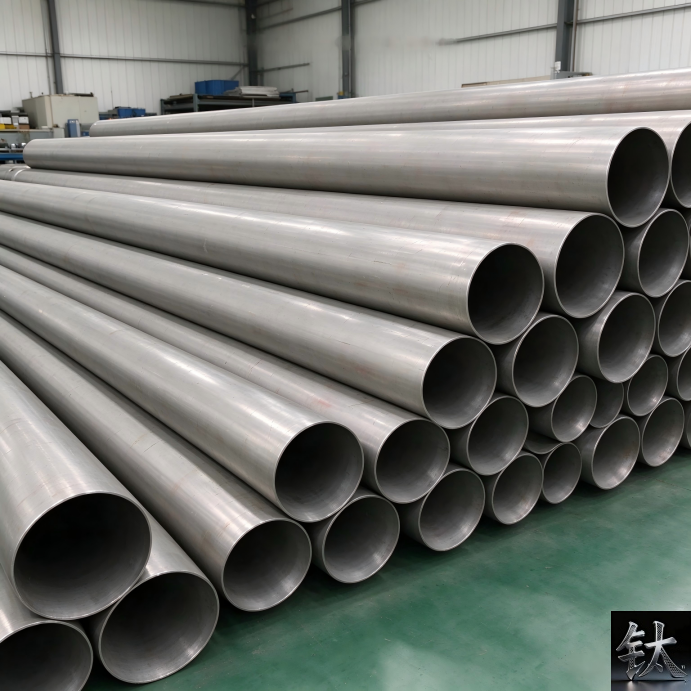
Gr2 vs Gr7 Titanium: Seawater Grade Selection Guide
| Specification | ASTM B338 tube, B265 plate, B348 bar, B381 forgings, B363 fittings |
|---|---|
| Applicable Standard | Gr2 (UNS R50400, TA2) vs Gr7 (UNS R52400, TA9, Ti-0.15Pd) |
| Material Condition | Seawater, desalination MSF/MED evaporator tubing, offshore condenser service |
| Inspection & Packaging | Gr2 for open flowing surfaces below 70°C; Gr7 for crevice zones above 60°C |
| Reference Price | $300.00 |
Product Description: Grade 2 titanium, Grade 7 titanium, Ti-0.15Pd, UNS R52400, seawater corrosion, desalination tubing, ASTM B338, crevice corrosion, titanium tube-sheet selection
Product Overview
| Item | Detail |
| Standards | ASTM B338 (tube), B265 (plate), B348 (bar), B381 (forgings), B363 (fittings) |
| Grades | Gr2 (UNS R50400, TA2) vs Gr7 (UNS R52400, TA9, Ti-0.15Pd) |
| Service | Seawater, desalination (MSF/MED), offshore condensers |
| Core distinction | Gr2 for open flowing surfaces; Gr7 for crevice zones above 60°C |
1. The Failure That Defines the Question
In 2019, a Middle East multi-stage flash (MSF) desalination plant reported tube-to-tube-sheet leakage in a titanium condenser after 14 months of service. The tubing was ASTM B338 Grade 2 — commercially pure titanium, the workhorse grade for seawater service. The failure location was not the tube body. It was the expanded tube-to-tube-sheet joints — the crevice zones where tube ends are mechanically expanded into the tube sheet holes.
The diagnosis: crevice corrosion initiated in the expansion gaps, where seawater was trapped in a narrow geometry, oxygen was depleted, the local pH dropped to 2–3, and chlorides concentrated. The passive TiO2 film that protects titanium in open flowing seawater broke down in the occluded environment. Once the film breached, the small anode (crevice interior, ~1 cm2) drove against the large cathode (open tube surface, ~1 m2) — the galvanic geometry accelerated pitting penetration.
The plant's response: replace the tube-sheet ligament zone with Grade 7 (Ti-0.15Pd) tubing, while retaining Grade 2 for the tube bodies. The incremental cost was small — the tube-sheet zone is 5–10% of total tubing weight — and the shutdown was avoided.
This case defines the central question: in seawater service, titanium grade selection is not uniform. It is zonal. The open surface and the crevice zone operate under different electrochemical conditions, and they require different grades.
2. The Two Grades at a Glance
| Property | Grade 2 | Grade 7 |
| UNS | R50400 | R52400 |
| Chinese grade | TA2 | TA9 |
| Composition | CP titanium | Ti-0.15Pd (Pd 0.12–0.19%) |
| UTS (min) | 345 MPa | 430 MPa |
| Yield (min) | 275 MPa | 345 MPa |
| Elongation (min) | 20% | 18% |
| Density | 4.51 g/cm3 | 4.51 g/cm3 |
| Primary use | General CP seawater service | Crevice corrosion resistance |
| Cost premium | Baseline | 2.5–4x over Gr2 |
Grade 2 is the most widely used commercially pure titanium grade — it accounts for the majority of titanium tubing and plate in seawater and chemical service. Grade 7 is chemically identical to Gr2 except for the palladium addition; the mechanical properties are slightly higher because Pd provides modest solid-solution strengthening.
3. Why Seawater Attacks the Crevice, Not the Surface
Titanium's corrosion resistance in seawater comes from a stable, adherent TiO2 passive film. In open, flowing seawater, this film is self-healing — any mechanical damage is repassivated by the dissolved oxygen in the water. A Grade 2 tube immersed in flowing seawater at 1.5–3 m/s, below 70°C, with no deposit accumulation, is essentially immune to corrosion. The surface stays bright for decades.
The failure mode is crevice corrosion, and it occurs in geometries where seawater is trapped:
- Tube-to-tube-sheet expanded joints: the expansion process creates a narrow annular gap (0.05–0.2 mm) between the tube OD and the tube sheet hole. Seawater trapped in this gap is stagnant.
- Gasketed flange faces: the gasket-to-flange contact zone traps a thin film of seawater, especially under intermittent service (thermal cycling, plant shutdowns).
- Under-deposit zones: biofouling (mussels, algae), silt, or scale creates a deposit that occludes a thin film of concentrated brine against the metal surface.
- Dead legs: piping branches with no flow trap stagnant seawater that degrades over time.
In all these geometries, the same electrochemical mechanism operates: oxygen in the trapped seawater is consumed by cathodic reduction faster than it can diffuse in from the bulk. The local environment becomes deoxygenated, acidic (pH 2–3), and chloride-concentrated. The TiO2 passive film, which is stable at neutral pH in oxygenated seawater, breaks down at low pH in the presence of concentrated chloride.
Once the film breaches at a single point, the small anode (the crevice interior, area ~1 cm2) drives against the large cathode (the open tube surface, area ~1 m2) — the area ratio of 1:10,000 accelerates pitting penetration dramatically. This is why the failure is always at the crevice, never at the open surface — the surface is the cathode that drives the crevice anode.
4. Where Grade 2 Is the Correct Choice
Grade 2 is the correct grade for:
- Open flowing seawater surfaces at velocity 1.5–3 m/s, temperature below 70°C
- MSF/MED evaporator tubes in the bulk brine flow path (the tube body, not the ends)
- Intake and discharge piping with continuous flow
- Shell-side surfaces of heat exchangers where flow is turbulent and deposits do not accumulate
- Any geometry without crevices or deposits in clean seawater below 60°C
In these conditions, Grade 2's passive film is stable and self-healing. The material has decades of successful service history in seawater — the problem is never the open surface. The problem is always the crevice.
5. Where Grade 2 Fails
Grade 2 is at risk in:
- Tube-to-tube-sheet expanded joints above 60°C — the classic crevice geometry
- Gasketed flange faces under intermittent service (shutdowns concentrate the trapped brine)
- Under-deposit zones where biofouling or silt creates an occluded environment
- Dead legs and stagnant branches where seawater degrades over time
- Any temperature above 70–80°C where crevice attack kinetics accelerate
Key point: The failure is insidious. The tube body looks pristine, the surface is bright, and the first sign of trouble is a leak at the tube-sheet joint. By the time the leak appears, the crevice wall may have perforated. Non-destructive detection of incipient crevice corrosion is difficult — eddy current (ASTM E426) can detect wall loss in the tube body, but the tube-sheet expansion zone is a blind spot for most tube inspection techniques.
6. Where Grade 7 Earns Its Premium
Palladium in Grade 7 acts as a cathodic depolarizer. The mechanism is electrochemical: Pd has a low hydrogen overvoltage, which means it facilitates the cathodic reduction reaction (oxygen reduction or hydrogen evolution) at a higher potential than the TiO2 surface. This shifts the mixed potential of the metal-solution interface in the positive direction, preventing the local pH from dropping below the passive film breakdown threshold.
In practical terms: in a crevice that would initiate attack on Grade 2, Grade 7 maintains passivity. The Pd content is small (0.12–0.19%), but during film formation, Pd enriches at the surface — a small amount of palladium protects the entire exposed surface. This surface-enrichment mechanism is why such a small alloying addition provides such disproportionate protection.
Grade 7 is specified for:
- Tube-to-tube-sheet joints in MSF/MED desalination above 60°C
- Gasketed flange faces in intermittent seawater service
- Tube sheet ligament zones (often as a clad or weld overlay on a Grade 2 base)
- Any crevice geometry in chloride service above 60°C where the consequences of failure justify the premium
Grade 7 does not make the entire system immune — it protects the zones where crevice corrosion initiates. The open surface does not need Gr7; the crevice does.
7. Temperature and Chloride Service Map
| Service temp | Chloride level | Open surface | Crevice zone |
| ≤60°C | Seawater (~19,000 ppm Cl) | Gr2 OK | Gr2 at risk → consider Gr7 |
| 60–80°C | Concentrated brine (MSF) | Gr2 OK | Gr7 required |
| >80°C | Any chloride crevice | Gr7 (or Gr12) | Gr7 required |
| >120°C | Acidic chloride | Gr7 / Gr12 / Gr16 | Gr7 / Gr12 |
Note: "Gr2 OK" for the open surface assumes clean, flowing seawater with no deposits. Deposits on the surface create a crevice — and a crevice on a Gr2 surface at 60°C can initiate attack.
8. Cost Economics
: Zonal Grade Selection
Palladium is a precious metal traded on open markets — its price has ranged from $1,500 to $3,000 per ounce over the past five years. Grade 7 plate carries a 2.5–4x premium over Grade 2 plate of the same dimensions, driven primarily by the Pd content.
But the premium is applied to a small fraction of the total material:
- A desalination plant condenser may use Grade 7 only at the tube-sheet zone (5–10% of total titanium weight) and Grade 2 for the tube bodies (90–95%)
- The incremental cost of zonal Grade 7 is: (2.5–4 x material cost) x 0.05–0.10 = 12.5–40% of the equivalent all-Gr2 material cost
- Compare this to the cost of a tube-sheet leak: unscheduled shutdown, brine contamination, tube-sheet repair or replacement, lost production
The economic case for zonal Gr7 is not "spend more on titanium" — it is "spend a small premium on 5–10% of the material to protect the 100% from the most common failure mode." A single tube-sheet leak in a desalination condenser can cost $50,000–$200,000 in lost production and repair. The zonal Gr7 premium on a typical condenser is a fraction of that.
Conversely, specifying Gr7 for the entire unit — including the 90–95% of tubing that is open flowing seawater surface — pays for Pd protection that is not needed. The open surface does not crevice-corrode; the Pd is wasted. Zonal specification is the correct economic and engineering answer.
9. Engineering the Grade Boundary
The practical question is not "Gr2 or Gr7 for the whole unit?" but "where exactly does the Gr2 stop and the Gr7 begin?" The boundary is an engineering decision:
- Tube-to-tube-sheet: Specify Gr7 for the tube ends (the expanded zone) or use a Gr7 tube sheet clad/weld-overlaid onto a Gr2 base. The tube bodies remain Gr2.
- Gasketed joints: Specify Gr7 gasket faces, or weld-overlay Gr7 onto the gasket contact zone of Gr2 flanges.
- Dead legs: Eliminate by design — if a stagnant branch cannot be eliminated, specify Gr7 for the dead leg section.
- Deposits: Design for velocity >1.5 m/s to prevent settling. If deposits are unavoidable (e.g., brine concentrators), specify Gr7 for the deposit-prone zones.
The grade boundary should be documented on the fabrication drawing — "Gr2 tube body, Gr7 tube ends" — and verified on the Material Test Reports (MTRs) for each component. A common error is to specify the grade on the material order but not on the fabrication drawing, leading to welders joining Gr2 to Gr7 without knowing the transition point.
10. Fabrication
: Dissimilar Grade Welding
Grade 2 and Grade 7 have nearly identical forming, machining, and welding characteristics. The Pd content does not significantly affect fabrication parameters. Dissimilar Gr2/Gr7 TIG welding is standard practice in desalination fabrication — the weld procedure is qualified under ASME Section IX, and the Pd from the Gr7 side diffuses into the weld metal during solidification, providing crevice protection at the joint.
This is why zonal grade selection is practical: you can weld Gr7 tube ends to Gr2 tube bodies, weld Gr7 overlay to Gr2 flange faces, and weld Gr7 tube sheets to Gr2 shells without metallurgical penalty. The weld metal inherits the Pd content from the Gr7 side and is protected.
Key fabrication notes:
- Use matching or slightly over-alloyed filler (ERTi-2 for Gr2, ERTi-7 for Gr7; ERTi-7 is acceptable for both)
- Standard TIG parameters: DCEN, argon shielding (torch + trailing + root purge)
- No preheat required; interpass temperature below 200°C
- Post-weld: no heat treatment required for Gr2/Gr7 joints
11. Procurement Checklist
- Specify grade by zone, not by unit: "Grade 2 tubes, Grade 7 tube-sheet zone" — not "Grade 7 for everything" or "Grade 2 for everything"
- Require UNS designation on MTR: R50400 for Gr2, R52400 for Gr7 — "Grade 2" without UNS is not traceable
- Require full chemistry including Pd for Gr7: 0.12–0.19% Pd must appear on the MTR
- For tube-sheet cladding: Specify overlay thickness (typically 3–5 mm), bond test method (ultrasonic per ASTM B898), and acceptance criteria
- Verify weld procedure for dissimilar Gr2/Gr7 joints: WPS/PQR per ASME Section IX, with Pd verification on the weld metal
- For B338 tubing: Require hydrotest records, eddy current (ASTM E426) records, and ultrasonic (ASTM A578) records — the tube body inspection records are separate from the crevice zone design
- Do not specify Gr7 for the entire unit unless the service temperature and chloride concentration require it everywhere — you pay for Pd you do not need
- Do not substitute Gr2 for Gr7 in crevice zones to save cost — the savings are 2.5–4x on 5–10% of material; the risk is unscheduled shutdown
12. FAQ
Q1: Can I use Grade 2 for the entire seawater system?
For open flowing seawater below 70°C, yes. For crevice zones (tube-sheet, gaskets, dead legs) above 60°C, no — specify Grade 7 for those zones. The failure is always at the crevice, never at the open surface.
Q2: What is the cost difference between Grade 2 and Grade 7 plate?
Grade 7 plate carries a 2.5–4x premium over Grade 2, driven by palladium content. Palladium is a precious metal traded on open markets; the premium fluctuates with the Pd spot price. Applied to a zonal specification (5–10% of material), the total cost impact is 12.5–40% of the equivalent all-Gr2 material cost.
Q3: Can Grade 2 and Grade 7 be welded together?
Yes. Dissimilar Gr2/Gr7 TIG welding is standard practice. The Pd from the Gr7 side diffuses into the weld metal and provides crevice protection at the joint. WPS/PQR per ASME Section IX. No preheat or post-weld heat treatment required.
Q4: At what temperature does Grade 2 start to fail in seawater crevices?
Crevice corrosion risk on Grade 2 accelerates above 60–70°C in chloride environments. Below this, with clean flowing seawater and no deposit accumulation, Grade 2 is generally safe. Above 60°C, any crevice geometry (tube-sheet, gasket, deposit) is at risk.
Q5: Is Grade 12 an alternative to Grade 7 for seawater?
Grade 12 (Ti-0.3Mo-0.8Ni) offers similar crevice protection to Grade 7 in many seawater services, at lower cost (no Pd). But Grade 12's protection is geometry-dependent and less universally effective in severe acid-chloride crevices. For most desalination crevice service, Grade 12 is a valid substitute; confirm with corrosion testing for the specific service.
Q6: What ASTM specifications apply to Grade 2 and Grade 7 for seawater service?
B338 (seamless and welded tube), B265 (plate, sheet, strip), B348 (bar), B381 (forgings), B363 (fittings). All list both Grade 2 (UNS R50400) and Grade 7 (UNS R52400). For desalination tubing, B338 is the primary specification.
Q7: How do I verify a supplier's Grade 7 is genuine?
Require a Material Test Report (MTR) listing UNS R52400 with full chemistry including Pd 0.12–0.19%. Cross-check with an independent spectrometry test (XRF or ICP) if the lot is large or the application is critical. "Grade 7" on a quote without UNS designation is not verification — "Grade 7" is a trade name, not a specification.
Summary: When to Use Which
- Open seawater surface, below 70°C, clean flowing: Grade 2
- Crevice zones above 60°C (tube-sheet, gaskets, deposits): Grade 7 (or Grade 12 as substitute)
- Tube-sheet ligament zone: Grade 7 (clad, overlay, or solid)
- Dissimilar Gr2/Gr7 welding: Standard, no metallurgical penalty
- Cost: Zonal Grade 7 adds 2.5–4x to 5–10% of material, not to 100%
Tell us your requirement — grade, size and quantity. We reply within 24 hours.
Prefer chat? WhatsApp +86 188 2967 9311 or email sales@sxqytd.com.


- Titanium Price Today (23 Oct 2026): Plate, Tube, Rod & Wire
- Read titanium wire and titanium alloy wire: diameter classification
- Titanium wire: from brand selection to manufacturing process (2026 r
- Read titanium tube and titanium alloy tube: OD classification + comm
- Titanium pipe knowledge·tee + reducer selection 5 steps
Contact Person: Wang Xiaoning
Tel: +86-917-355-7966
Email: sales@sxqytd.com
WhatsApp: +86 188 2967 9311
Company: Shaanxi Qianyi Tuoda Technology Co., Ltd
Address: Floor 4, Building 4, No. 188 Gaoxin Avenue, High-tech Zone, Baoji City, Shaanxi Province, China