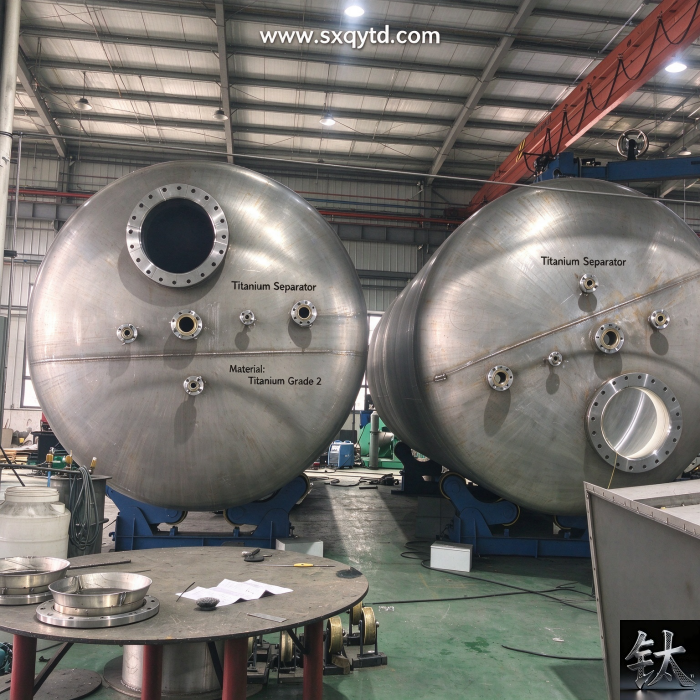
Titanium Process Equipment: A Buyer's Specification & Limits Guide
| Specification | Equipment Types: reactors, shell-and-tube heat exchangers, storage tanks, agitators/mixers, columns, explosive-clad vessels, process piping |
|---|---|
| Applicable Standard | Grades Covered: Gr1/Gr2 (CP Ti, R50250/R50400), Gr7/Gr11 (Pd, R52400/R52250), Gr12 (Ti-0.3Mo-0.8Ni, R53400), Gr5/Gr23 (Ti-6Al-4V, R56400/R56407); TA2/TA9/TA10 |
| Material Condition | Governing Standards: ASTM B265/B338/B861/B862 (materials), ASME VIII / GB 150 / PED 2014/68/EU (design), AWS D1.9 (weld), EN 10204 3.1 (cert) |
| Inspection & Packaging | Decision Boundaries: HF/free fluoride dissolves Ti; reducing acids need Pd grades; galvanic nobility needs isolation; weld color = quality (AWS D1.9); solid vs explosive-clad tradeoff; codes GB 150 / |
Product Description: Titanium process equipment isn't one metal. Specify by medium, grade (Gr2/Gr7/Gr12) and code; avoid HF, reducing acids, galvanic coupling and blue welds.
Product Overview
Titanium Process Equipment: Specify Right, Avoid 6 Failures
Titanium process equipment — reactors, heat exchangers, storage tanks, agitators, columns and explosive-clad vessels — is not one material and is not a drop-in replacement for stainless steel. Commercially pure titanium (Gr1/Gr2) resists seawater, wet chlorine and caustic; palladium-alloyed grades (Gr7, Gr11) and Gr12 resist reducing acids and hot brines; the alpha-beta alloy grades (Gr5, Gr23) add strength for shafts and impellers. But every one of them is dissolved by hydrofluoric acid and free fluoride, attacked in strong reducing acids unless the stream is dilute or the grade is palladium-bearing, and embrittled or ignited by red-fuming nitric, anhydrous methanol or dry chlorine. Specify by the service medium, the grade and the design code — and you avoid the six failures that account for most titanium-equipment recalls. Here is the checklist the catalog skips.
| Equipment | Typical grade | Best medium | Hard limit |
|---|---|---|---|
| Reactor (solid) | Gr2, Gr7, Gr12 | NaOH, seawater, reducing acid (Pd grades) | no HF; <~300 °C |
| Shell-and-tube HX | Gr2 tube, Gr12 hot brine | seawater, brines, dilute H₂SO₄ | crevice >~93 °C; no F⁻ |
| Storage tank | Gr1, Gr2 | caustic, chloride solutions | no HF; no dry Cl₂ |
| Agitator / mixer | Gr2 shaft, Gr5 impeller | neutral / chloride streams | isolate from steel |
| Column / tower | Gr2, Gr7 | chlorine, wet Cl₂ | no dry Cl₂ |
| Clad vessel (Ti-steel) | Gr1/Gr2 on steel | large low-pressure wetted surface | only wetted side protected |
| Piping / fittings | Gr2, Gr7 | process streams | argon weld; PTFE gasket |
| Tube sheet | Gr2, Gr12 | — | keep iron off |
What Counts as "Titanium Process Equipment" — and What the Order Must State
The term covers fabricated, engineered units built from Titanium Plate, tube, forgings and bar — not the mill shapes themselves. A titanium equipment program typically spans reactors and pressure vessels, shell-and-tube or U-tube heat exchangers, storage and surge tanks, agitators and mixers, distillation columns, and large vessels built from explosive-clad titanium-steel plate. These sit at the top of a three-tier product structure: raw titanium stock, deep-processed parts (e.g. agitators and coils), and non-standard equipment designed to a duty. "Non-standard" is the point — the unit is drawn for one service, so its survival depends on the service being named on the order, not on a generic "titanium" label. A custom reactor that is perfect in seawater can fail in months in a hydrochloric acid line, and the catalog will not warn you.
The Grade Trap: "Titanium" Is Four Different Metals
Commercially pure (CP) titanium comes as Gr1 and Gr2 (UNS R50250, R50400) — essentially the same corrosion resistance, with Gr2 carrying slightly more oxygen and strength. Palladium-bearing grades change the envelope: Gr7 is Gr2 plus about 0.15% palladium (R52400) and Gr11 is the Gr1 version; the palladium shifts the potential into the passive region in reducing acids, so they resist hydrochloric acid up to roughly 10% and sulfuric up to roughly 30% at ambient temperature, and they avoid crevice corrosion in chloride brines that would pit Gr2. Gr12 (R53400, titanium-0.3Mo-0.8Ni) is the hot-brine specialist — better crevice resistance in chlorides above about 70 °C than Gr2, at lower cost than the Pd grades. The alpha-beta alloys Gr5 (Ti-6Al-4V, R56400) and Gr23 (ELI) add strength for agitator shafts and impellers but do not improve corrosion in reducing acid. Chinese designations line up as TA2 ≈ Gr2, TA9 ≈ Gr1+Pd and TA10 ≈ Gr12. The trap is choosing on price or habit: picking Gr2 for a hot reducing-acid duty, or Gr7 where Gr2 would have been cheaper and adequate, both waste money or invite failure. Our Gr12 plate guide for reducing-acid equipment shows where the molybdenum-nickel grade earns its premium.
"Send us an inquiry" is not a specification, and it is the single most common reason a titanium unit arrives and then fails. The maker needs numbers, not adjectives. At minimum the datasheet should state: the medium by chemical name (never just "acid"); concentration; maximum and cyclic temperature; design pressure; pH; impurities that decide survival — fluoride (F⁻), chloride (Cl⁻), oxidizers, and metal ions such as ferric or cupric that can inhibit; solids and abrasion; flow velocity; the design code (GB 150, ASME VIII or PED); surface finish and any passivation requirement; quantities; and the inspection level (EN 10204 3.1). A usable first line reads: "Titanium reactor, Gr2 per ASTM B265, 30 m³, NaOH 30% at 90 °C, chloride <500 ppm, GB 150, EN 10204 3.1." That one sentence already rules out the fluoride and dry-chlorine failures below. For storage-tank and heat-exchanger scopes the same fields apply, with velocity added where erosion matters.
The Fluoride Trap: Hydrofluoric Acid Dissolves Titanium
This is the most common and most catastrophic titanium killer, and it is almost never on the radar. Titanium is attacked by hydrofluoric acid at even very dilute concentrations, and by free fluoride in acidic solution below about pH 7; fluoride ions form soluble TiF₆²⁻ complexes that dissolve the protective TiO₂ film, so the attack is linear and does not self-heal. The classic incident is a stainless-steel pickling bath (3–8% HF + 10–20% HNO₃, 40–60 °C) brought into contact with a titanium part — a 2 mm Titanium Plate can be perforated in months. Passivate titanium with nitric acid only; never use a bath containing HF. If the process stream itself contains fluoride, or the job is an HF pickle, line the vessel with PTFE or PP, or choose zirconium — do not specify titanium and hope. Our hydrometallurgy leaching-tank plate guide stresses the same fluoride rule for leach duties.
The Reducing-Acid Trap: Titanium Is Not "Acid-Proof"
Titanium's passive film loves oxidizing acid — it resists nitric acid well — but it is vulnerable in reducing acids such as hydrochloric, sulfuric and phosphoric unless the stream is dilute and near ambient, or the grade carries palladium or molybdenum. As a rule of thumb, CP titanium handles hydrochloric below about 7% and sulfuric below about 5% at room temperature with air present; above those thresholds, or deaerated, it corrodes at unacceptable rates and you need Gr7 or Gr12. The trap is the blanket assumption that "titanium handles all acid" — it does not, and a buyer who specifies Gr2 for a 20% HCl line will get a unit that dissolves. Match the grade to the redox character of the medium, exactly as the Gr7 seawater heat-exchanger logic does for chloride service.
Pick by Medium, Not by Catalog
The reliable selection tool is a medium-first matrix; everything else in this article is a footnote to it. "Pure titanium" here means Gr1/Gr2, with Gr7/Gr11 and Gr12 as the reducing-acid and hot-brine upgrades.
| Service medium | Titanium call | Grade |
|---|---|---|
| Caustic / alkali | excellent at all concentrations/temperatures | Gr2 |
| Seawater / brine | immune to pitting/crevice below ~70 °C | Gr2; Gr12 if hot |
| HCl / H₂SO₄ (reducing) | only dilute + ambient; else corrodes | Gr7 / Gr12 |
| Nitric (oxidizing) | excellent (red-fuming is the exception) | Gr2 |
| Wet chlorine | excellent; dry Cl₂ ignites | Gr2 |
| HF / free fluoride | dissolves — do not use | PTFE line / zirconium |
| Organic acids (acetic, citric) | good under oxidizing/aired conditions | Gr2 |
The Galvanic Trap: Titanium Next to Steel Without Isolation
In seawater titanium sits at roughly +0.2 V versus Ag/AgCl — close to platinum — which makes it the noble (cathodic) member of almost any couple. Bolt it directly to carbon steel or aluminum and you accelerate the corrosion of the steel, sometimes severely, while the titanium itself is unharmed. The correction is dielectric isolation: insulating sleeves, washers and gaskets at every titanium-to-steel interface, and isolating flanges where the pipe transitions. A second, harder rule: do not weld titanium directly to stainless steel. The molten interface forms brittle intermetallic compounds that crack immediately, so transitions need a bimetallic joint or a mechanical connection. This is why a titanium process-piping run is detailed for isolation, not just for the titanium alone.
The "Stainless Drop-In" Myth: Cost, TCO and Fit
Yes, commercially pure titanium costs roughly 4–6× 316L stainless per kilogram — but it is also about 57% as dense (4.51 versus 8.0 g/cm³), so on a per-volume basis the gap narrows, and over a 20-year life the near-zero maintenance and replacement often flips total cost of ownership in titanium's favor, especially where downtime is expensive. The mistake is treating it as a one-for-one swap. Titanium is softer, so flange faces need PTFE or Gylon gaskets, not serrated metal rings that would gall the face. Its thermal expansion differs from steel, so support and nozzle loads need re-checking. And post-weld heat treatment is generally not required for CP titanium (only a 480–595 °C stress-relief anneal in specific cracking environments), so do not assume the stainless weld procedure applies. The shell-and-tube exchanger pages make the same point: titanium wins on life, not on sticker price.
Limitations and Failure Conditions
These are the conditions that defeat titanium equipment. State them on the order so the maker designs around them.
Hydrofluoric acid and free fluoride (pH < 7)
Even trace fluoride in acidic service dissolves the passive film and attacks linearly. Treat any F⁻ in the stream as a hard exclusion for solid titanium; line or choose zirconium.
Reducing acids beyond dilute / ambient
Hydrochloric, sulfuric and phosphoric attack CP titanium above roughly 7% / 5% or when hot and deaerated. Move to Gr7 or Gr12, or accept a corrosion rate you have verified.
Red-fuming nitric, N₂O₄, anhydrous methanol (with halides), dry chlorine, cadmium, mercury
Commercially pure titanium is immune to stress-corrosion cracking almost everywhere except these specific environments — red-fuming (anhydrous) nitric, nitrogen tetroxide, anhydrous methanol containing halides, and liquid or dry chlorine, cadmium or mercury. Dry chlorine can ignite titanium. Keep these off titanium equipment entirely.
Crevice corrosion in hot chloride brines
CP titanium is safe in chloride brines below about 70 °C, but sharp crevices in near-neutral brine can pit from roughly 93 °C upward. For hot brine, specify Gr7 or Gr12 and tighten crevice geometry (weld instead of roll, eliminate stagnant pockets).
Galvanic coupling to carbon steel or copper
Titanium is the noble member of the couple and accelerates the other metal. Isolate every interface; never rely on the titanium to "protect" the joint.
Iron contamination and under-gasket crevices
Fabrication and assembly discipline matter. Steel tools, embedded iron, or a gasket that traps a tight crevice against titanium can seed local attack. Keep dedicated (iron-free) tooling and specify gasket materials that do not trap the metal.
High temperature above ~300 °C: hydrogen uptake and oxidation
Above about 300 °C titanium absorbs hydrogen and oxidizes, losing ductility; it must not be used in gaseous or liquid oxygen service where impact can ignite it. Keep continuous process temperature below roughly 300 °C and away from oxygen-rich duty.
Abrasion and erosion in coarse slurries
Titanium's oxide film gives outstanding erosion resistance in normal flow, but very coarse abrasive grit at high velocity can outrun film regrowth. For heavy slurry duties, verify velocity and consider hardened overlays or a different material.
Solid Titanium vs Explosive-Clad Steel: Where Each Pays
For a large, low-pressure vessel where only the wetted surface sees the corrosive medium, explosive-clad plate (ASTM B898) — a thin titanium layer metallurgically bonded to a steel backing — captures most of the corrosion benefit at a fraction of the solid-titanium mass. It is the standard answer for big tanks and columns where the shell carries mainly atmospheric or low pressure and the steel substrate is perfectly adequate structurally. Choose solid titanium when the wall is thin, the pressure is real, the medium is aggressive on both sides, or product purity forbids any steel contact. The decision rule: if the steel backing would ever be exposed to the process, you cannot use clad — use solid. Our explosive-clad plate guide works through the lining-vs-solid trade for pressure-vessel service.
Welding, QA and Codes: What "Good" Looks Like
Titanium welding needs complete exclusion of air from the molten pool, the solidifying weld and the heat-affected zone until it cools below roughly 300 °C. That means GTAW (TIG) with a trailing argon shield extending at least 50 mm behind the torch and an argon back-purge on the root side, using argon of at least 99.99% purity. The weld color is your honest inspector: silver or light straw is acceptable (minimal oxidation), deep blue or purple is borderline and needs engineering review, and a dull grey or powdery white surface is a rejected weld — it signals alpha-case contamination and lost ductility, and must be removed and re-welded. Post-weld heat treatment is generally not required for CP titanium; a stress-relief anneal (about 480–595 °C) is specified only for specific cracking environments. Never weld titanium to steel directly. Verify with NDT, a factory acceptance test (FAT) and an EN 10204 3.1 mill certificate, and keep a weld map for traceability. The U-bend condenser tube and tube-sheet articles show the same argon-and-color discipline in production.
The design code is set by the market, and it decides the allowable stresses and the stamp. In China the pressure-vessel code is GB 150; in the United States it is ASME Boiler and Pressure Vessel Code Section VIII Division 1 (with the U-stamp for the shop); in Europe it is the Pressure Equipment Directive 2014/68/EU (PED). Titanium design stresses are taken from the relevant code tables (for ASME, Section II Part D, referenced through SB-265 and the product specifications). Whatever the code, the mill certificate (EN 10204 3.1, or 3.2 with a witnessed inspection) must name the UNS number, the ASTM specification and edition, the heat number, the chemistry and the mechanical results — that certificate, not the word "titanium," is what proves the grade shipped. A stock heat-exchanger built to ASME and a custom unit built to GB 150 carry the same lesson: the paper has to be right before the metal matters.
Frequently Asked Questions
Can titanium equipment replace 316L stainless 1:1?
No. Titanium costs more per kilogram and behaves differently: it is softer (use PTFE/Gylon gaskets, not serrated rings), expands differently from steel (re-check supports), and resists chloride where 316L fails — but it is destroyed by hydrofluoric acid where 316L may survive with care. It wins on life and total cost in chloride and caustic service, not as a drop-in. Re-specify the joint, do not just swap the tag.
What must I send to get an accurate quote?
The medium by name, concentration, maximum and cyclic temperature, design pressure, pH, impurities (F⁻, Cl⁻, oxidizers, metal ions), solids/abrasion, flow velocity, design code (GB 150 / ASME VIII / PED), finish and inspection level (EN 10204 3.1), and quantity. A one-line example: "Gr2 reactor, ASTM B265, 30 m³, NaOH 30% at 90 °C, Cl⁻ <500 ppm, GB 150, 3.1 cert." Numbers, not adjectives.
My titanium weld is blue / grey — is that acceptable?
Silver or light straw is acceptable (minimal oxidation). Deep blue or purple is borderline and needs an engineering review. A dull grey or powdery white surface is a rejected weld — it means alpha-case contamination and lost ductility, and must be removed and re-welded. The color comes from air contact during cooling; fix the argon shielding, not the part.
Can I pickle titanium in the same HF bath as stainless?
No. Stainless pickling baths use 3–8% HF plus nitric, and hydrofluoric acid rapidly dissolves titanium — a 2 mm plate can be perforated in months. Passivate titanium with nitric acid only. If the job is an HF pickle, line with PTFE/PP or use a different material; never put titanium in an HF bath.
Does titanium handle nitric acid?
Yes, in normal (watered) nitric acid titanium is excellent — better than stainless at high temperature and concentration. The exception is red-fuming (anhydrous) nitric, which causes stress-corrosion cracking of all titanium alloys. Keep titanium away from anhydrous/fuming nitric and you keep the oxidizing-acid advantage.
Solid titanium or explosive-clad steel — which do I choose?
Use explosive-clad (ASTM B898) for large, low-pressure vessels where only the wetted surface is aggressive and the steel backing carries the load. Use solid titanium for thin walls, real pressure, aggressive duty on both sides, or where product purity forbids any steel contact. Rule of thumb: if the steel backing could ever see the process, you cannot use clad.
Which code applies — GB 150, ASME VIII or PED?
It follows the market: GB 150 in China, ASME Section VIII Div 1 (with U-stamp) in the United States, and the Pressure Equipment Directive 2014/68/EU in Europe. Each sets the allowable stresses and the stamp; the mill certificate (EN 10204 3.1/3.2) must still name the UNS, specification, heat and test results regardless of code.
Summary
One word — "titanium" — and six ways to get it wrong: assuming it is one material, that it survives all acid, that it drops into a stainless layout, that it welds like steel, that it ignores fluoride, and that the code takes care of itself. Specify by medium, grade and code, and the failures disappear. Choose solid titanium if the wall is thin, the pressure is real, the medium is aggressive on both sides, or product purity forbids any steel contact; for large low-pressure wetted-surface vessels, choose explosive-clad steel. Choose Gr2 if the duty is caustic, seawater or watered nitric; Choose Gr7 or Gr12 if the duty is a reducing acid (HCl, H₂SO₄) or a hot chloride brine where crevice corrosion threatens Gr2. Choose isolation and PTFE wherever titanium meets steel or copper. Six things the catalog leaves to your order: the medium and its impurities (especially F⁻), the grade call (Gr2 vs Gr7/Gr12), the galvanic isolation, the weld-color acceptance, the solid-vs-clad decision, and the design code with its certificate.
The order itself is eight fields, and they are the difference between a sound unit and a recalled one:
- Equipment and grade — reactor / HX / tank / agitator; Gr1/2, Gr7/11, Gr12, or Gr5/23; name the UNS (R50400, R52400, R53400).
- Standard and edition — ASTM B265/B338/B861/B862 (materials); cite the edition so the inspector reads your numbers.
- Medium and concentration — by chemical name, never "acid"; state impurities, especially fluoride and oxidizers.
- Temperature and pressure — maximum and cyclic values; state the ~300 °C upper bound explicitly.
- Design code — GB 150, ASME VIII Div 1, or PED 2014/68/EU; note the required stamp.
- Form and quantity — dimensions, wall, nozzle count, units, and batch size.
- Fabrication notes — GTAW with argon trailing shield + back-purge, no Ti-to-steel weld, nitric-only passivation (no HF), iron-free tooling.
- Inspection and certificate — NDT, FAT, and EN 10204 3.1 recording UNS, chemistry, mechanicals and heat number.
Send those eight fields — plus the drawing where one exists — to our inquiry desk; we return the grade, the UNS confirmation and what the EN 10204 3.1 certificate will record before any order is placed. For the broader equipment picture our custom-equipment manufacturer page maps scope to capability, and the same medium-first logic runs through our titanium equipment and agitator overviews.
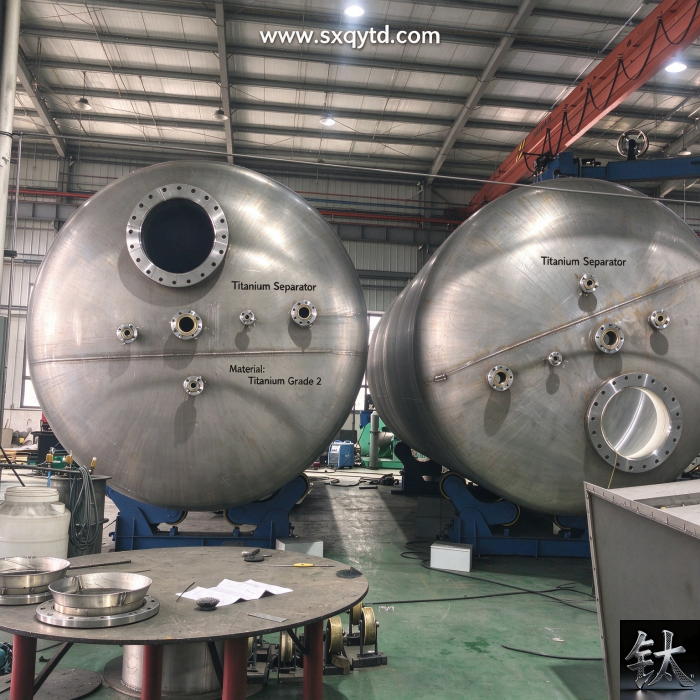
One line does most of the work: "Titanium reactor, Gr2 per ASTM B265, 30 m³, NaOH 30% at 90 °C, chloride <500 ppm, no fluoride, GB 150, EN 10204 3.1." Copy the right one into the PO and the "titanium that pitted / dissolved / cracked" conversation ends before it starts.
In stock & ready to ship — Titanium Process Equipment
We stock built to your drawing, ~100 units/year capacity and cut to your size. As a stockist-supplier we read drawings, work to ASTM / ASME / GB standards, export worldwide, and ship same day on stock items. Tell us your spec and get a quote fast.
Tell us your requirement — grade, size and quantity. We reply within 24 hours.
Prefer chat? WhatsApp +86 188 2967 9311 or email sales@sxqytd.com.


- What is Titanium Flange | ASME B16.5 ASTM B381 Gr2 Gr5 Titanium Flan
- ASME B16.5 Titanium Flange Grade2 DN100-DN600 Class150/300 FOB
- Gr2 Titanium Sheet Price FOB Shanghai | ASTM B265 In Stock
- Titanium Price Today (Oct 26, 2026): China Market Report
- Titanium Price Today (23 Oct 2026): Plate, Tube, Rod & Wire
Contact Person: Wang Xiaoning
Tel: +86-917-355-7966
Email: sales@sxqytd.com
WhatsApp: +86 188 2967 9311
Company: Shaanxi Qianyi Tuoda Technology Co., Ltd
Address: Floor 4, Building 4, No. 188 Gaoxin Avenue, High-tech Zone, Baoji City, Shaanxi Province, China