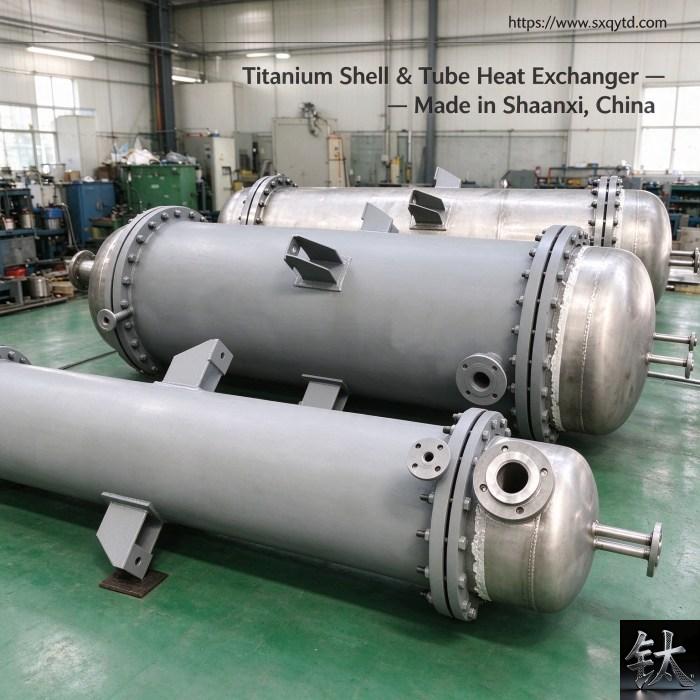
Gr7 Titanium Heat Exchanger for Seawater Desalination
| Specification | Ti-0.2Pd (R52400), ASTM B338, MSF/MED Brine Heater, ASME VIII + TEMA, MTC 3.1, Baoji |
|---|---|
| Applicable Standard | 1. Our Gr7 titanium heat exchanger is specially engineered for seawater desalination service. Gr7 titanium (titanium-palladium alloy) delivers superior crevice corrosion resistance against saltwater a |
| Material Condition | Strict non-destructive tests including helium leak test and hydrostatic pressure test are carried out after welding, to prevent leakage under continuous seawater circulation. |
| Inspection & Packaging | We provide MTC and inspection records for batch verification. Drawing adjustment, technical consultation and stable lead time are available for desalination EPC contractors. |
Product Description: Gr7 (Ti-0.2Pd, R52400) titanium heat exchanger for seawater desalination — MSF brine heaters, MED evaporators, condensers in hot deaerated brine. Palladium 0.12–0.25% raises crevice-corrosion threshol
Product Overview
Gr7 Titanium Heat Exchanger for Seawater Desalination | Ti-0.2Pd (R52400), ASTM B338, ASME VIII + TEMA
Meta Description: Gr7 (Ti-0.2Pd, R52400) titanium heat exchanger for seawater desalination — MSF brine heaters, MED evaporators, condensers in hot deaerated brine. Palladium 0.12–0.25% raises crevice-corrosion threshold; same strength as Gr2, no wall re-design. ASTM B338 tube / B265 tubesheet, ASME VIII + TEMA, roll+seal weld, PMI per heat, EN 10204 3.1, 3.2 TPI PO-fronted.
Gr2 Is Great — Until the Brine Gets Hot and Stagnant
Seawater desalination is not one duty. It is three:
- SWRO auxiliaries / ambient seawater coolers → Gr2 is usually correct
- MED evaporators / condensers (65–70°C) → Gr2 standard
- MSF brine heater (110–120°C, concentrated, deaerated brine) → Gr2 fails by crevice corrosion + hydrogen absorption regardless of wall thickness; Gr7 is the engineered answer
Thicker Gr2 does not raise the crevice threshold. At ~80°C+ in deaerated chloride, CP titanium can absorb hydrogen → hydride cracking in 6–12 months. That is not a wall-thickness problem; it is an alloy-potential problem.
What Palladium Actually Does (the Gr7 mechanism)
- Gr7 = commercially pure titanium + 0.12–0.25% Pd (UNS R52400, TA9)
- Pd ennobles the alloy, holds the TiO₂ passive film stable in hot deaerated chloride
- Crevice corrosion initiation temperature shifts substantially higher than Gr2 (~80°C CCT)
- Hydrogen evolution at the crevice is suppressed — no hydride embrittlement in MSF brine heater service
- Mechanicals unchanged: min tensile 345 MPa, yield 275 MPa, elongation ≥20% (annealed) — same allowable stress as Gr2, no re-rating
Translation: specify Gr7, keep the same wall, keep the same ASME calc — just close the corrosion gap.
Where Gr7 Is the Right Call in Desalination
| Duty | Temp | Call |
|---|---|---|
| SWRO seawater cooler | ambient–40°C | Gr2 (cost-optimal) |
| MED evaporator / condenser | 65–70°C, aerated | Gr2 |
| MSF brine heater | 110–120°C, concentrated, low DO | Gr7 (mandatory) |
| Concentrated blowdown / scaling brine with dead legs | >80°C crevice | Gr7 |
| Offshore platform seawater cooler with biofouling + low flow | warm, stagnant crevices | Gr7 upgrade justified |
| High-pressure U-bundle (weight-sensitive) | — | Gr9 (not a Gr7 substitute for crevice) |
How to Prove It Is Really Gr7 (not Gr2 with a Gr7 tag)
- MTC EN 10204 3.1 must declare Pd 0.12–0.25% — no Pd figure = not Gr7 proof
- Arrival PMI (OES/XRF): Pd detectable in matrix, not just surface
- Weld filler: matching Pd-bearing wire (ERTi-7) to keep HAZ corrosion upgrade
- Heat number cross-linked: tube tag = MTC = weld map
- 3.2 TPI (SGS/BV/TÜV) witness on Pd chemistry when PO-fronted
Design & Fabrication Baseline
- Tube: ASTM B338 Gr7, seamless or welded-annealed; typical 0.7–1.65mm wall
- Tubesheet: ASTM B265 Gr7 (solid) or Ti-clad CS; groove + roll+seal weld
- Joint: hydraulic roll → autogenous GTAW seal weld, dual-side argon ≥99.999%
- Clearance roll-to-weld ≥3.2mm; PT non-chlorinated; weld color silvery/straw only
- Code: ASME VIII Div.1 + TEMA Class R/C/B; MSF duty calc includes thermal shock + blowdown
- Surface: pickled/passivated, ferroxyl free-iron check, no carbon-steel contact in store
- Velocity: 1.5–2.5 m/s tube-side to limit scaling/biofouling (confirm with licensor)
MSF Brine Heater — Why Gr7 Pays Back
- Gr2 in 120°C deaerated brine: hydride risk in 6–14 months, perforation possible within a season
- Gr7 with 1.2–1.65mm wall: 10–15 yr service life typical, no hydrogen-damage driver
- Pd premium vs Gr2 is recovered by avoiding one unplanned retube in a critical-path unit
- Lifecycle cost, not kg-price, is the right comparison in MSF
QC Chain (per heat, per joint)
- B338 Gr7 MTC 3.1 — Pd chemistry explicit + tensile + ET/hydro election
- PMI on tube body + tubesheet — Pd verified
- Roll parameter log + seal-weld gas-shield record
- PT (non-chlorinated) on U-bends + tubesheet welds
- Helium leak option for critical MSF/MED duty
- Hydro per ASME VIII; as-built + weld map in MDR
- 3.2 TPI PO-fronted where project specifies
Hard Boundaries (no overclaim)
- Gr7 does not make HF/fluoride safe — titanium excluded on fluoride contact
- Dry Cl₂ (<0.5% H₂O) excluded — moisture required for passive film
- Gr7 ≠ strength upgrade — for high-pressure thin wall use Gr9; for hot-brine strength use Gr12
- Pd value must appear on MTC; "Grade 7" text without Pd = incomplete certification
- 3.2 cannot be back-issued; TPI named at PO
- Biofouling still happens on titanium — velocity + pretreatment still required
RFQ Template (copy-paste)
Process: MSF brine heater / MED evaporator / condenser / SWRO cooler ___
Seawater or blowdown Cl⁻ ___ppm, TDS ___, dissolved O₂ ___ppb
Max tube-wall temp: ___°C (upset ___°C)
Aerated / deaerated: ___
Scaling/biofouling: yes/no, treatment chem ___
Tube: ASTM B338 Gr7, OD×wall ___mm, straight / U-bend ___
Tubesheet: B265 Gr7 solid / clad (__mm Ti) ___
Joint: roll+seal weld, argon backing ___%
NDE: ET / hydro / PT(non-Cl) / helium (__ mbar·L/s)
Cert: 3.1 (Pd declared) / 3.2 TPI (SGS/BV/TÜV ___)
Code: ASME VIII Div.1 + TEMA Class ___
Incoterm: EXW / FOB / CIF / DAP ___
FAQ — Gr7 Titanium Desalination Exchanger
Q1: Can't I just use thicker Gr2 in MSF brine heater?
A: No. Wall thickness does not stop hydrogen absorption or crevice depassivation at 110–120°C deaerated brine. Gr7 changes the electrochemical potential; thickness cannot.
Q2: Is Gr7 stronger than Gr2?
A: Mechanically identical (345/275 MPa, ≥20% elong.). Gr7 is a corrosion upgrade, not a strength upgrade.
Q3: How do I confirm genuine Gr7 on arrival?
A: MTC must list Pd 0.12–0.25%; PMI verifies Pd in the matrix. No Pd on cert = not provable Gr7.
Q4: Gr7 or Gr12 for desalination?
A: Gr7 for maximum crevice/hydrogen resistance in hot deaerated brine (MSF). Gr12 where higher strength + lower cost is needed and duty permits.
Q5: Weld filler — can I use ERGr2 wire?
A: Only if you accept losing Pd in the weld/HAZ. For full Gr7 performance use matching Pd-bearing filler (ERTi-7).
Q6: Does Gr7 need cathodic protection?
A: Usually not in aerated seawater. In stagnant/deaerated hot brine, the alloy itself is the protection — that is the point of Pd.
Q7: SWRO plant — do I need Gr7?
A: Most SWRO aux coolers run Gr2. Gr7 is specified when temps/crevices or blowdown concentration push past Gr2 limits.
Q8: Lead time vs Gr2?
A: Pd-bearing melt slot confirmed per inquiry; not "always in stock", not "months". Firm slot after PO + heat allocation.
Q9: HS code?
A: Tube vs complete exchanger differ; Broker confirms by config/destination.
Q10: Biggest EPC mistake?
A: Writing "titanium, ASME" on an MSF brine heater PO with no grade call. Gr2 gets bought, hydride cracking arrives in under a year — and the cheapest tube becomes the most expensive retube.
Request a Grade-Fit Quote
Email: sales@[yourdomain].com
Send process step + dissolved O₂ + max wall temp + Cl⁻ + duty. We return Gr2-vs-Gr7 justification (not a default Gr2 quote) with Pd-verification scope.
About: Baoji Gr7 titanium desalination exchanger desk — ASTM B338 R52400 tube bundles and shell-and-tube units for MSF brine heaters, MED evaporators and seawater condensers. Pd 0.12–0.25% declared on every 3.1 MTC, PMI-verified per heat, roll+seal-weld joints, ASME VIII + TEMA, EN 10204 3.1 default, 3.2 TPI PO-fronted. Grade chosen by dissolved oxygen, crevice temp and brine concentration — not by catalog. Heat No. = tube tag = MTC = weld map.
Tell us your requirement — grade, size and quantity. We reply within 24 hours.
Prefer chat? WhatsApp +86 188 2967 9311 or email sales@sxqytd.com.


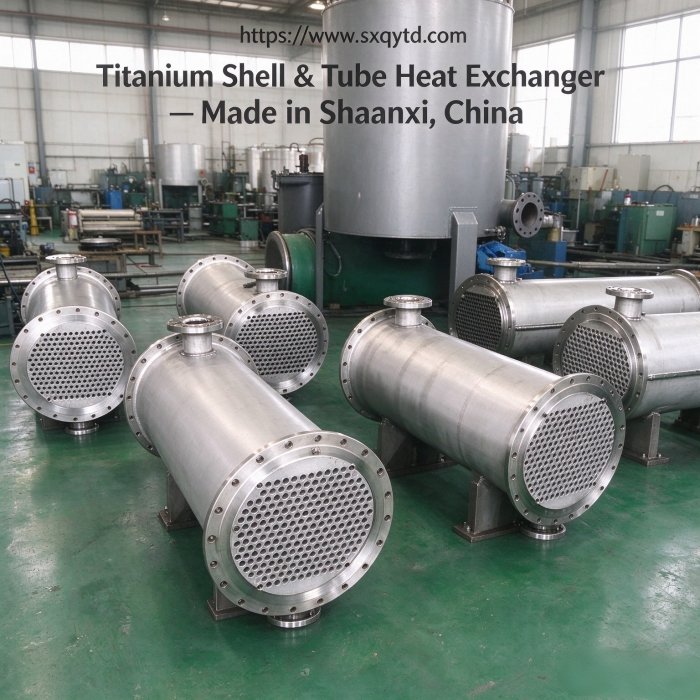
- Titanium Price Today (Oct 26, 2026): China Market Report
- Titanium Price Today (23 Oct 2026): Plate, Tube, Rod & Wire
- Read titanium wire and titanium alloy wire: diameter classification
- Titanium wire: from brand selection to manufacturing process (2026 r
- Read titanium tube and titanium alloy tube: OD classification + comm
Contact Person: Wang Xiaoning
Tel: +86-917-355-7966
Email: sales@sxqytd.com
WhatsApp: +86 188 2967 9311
Company: Shaanxi Qianyi Tuoda Technology Co., Ltd
Address: Floor 4, Building 4, No. 188 Gaoxin Avenue, High-tech Zone, Baoji City, Shaanxi Province, China