Titanium Storage Tank — Corrosion-Proof Tanks for Aggressive Liquids, Built to Drawing
Titanium storage tanks · drawing to delivery
A titanium storage tank holds corrosive liquids that would perforate a steel or FRP tank in months — dilute acid, wet chlorine, hypochlorite, brine and organic acids. SXQYTD builds vertical and horizontal titanium tanks to ASME Section VIII and GB/T 150, fully welded, passivated and inspected. Below is the procurement detail that decides the grade, structure and support before you issue a PO.
| Material | Gr1 / Gr2 / Gr7 / Gr12 (ASTM B265) | Principle | Static storage / buffer |
| Capacity | 1 m³ – 100 m³ (custom) | Industry | Chemical, chlor-alkali, pharma, seawater |
| Design code | ASME VIII / GB/T 150 / JB/T 4745 | Lead time | 3–8 weeks (stock plate shortens it) |
1. What a titanium tank is — by principle and by structure
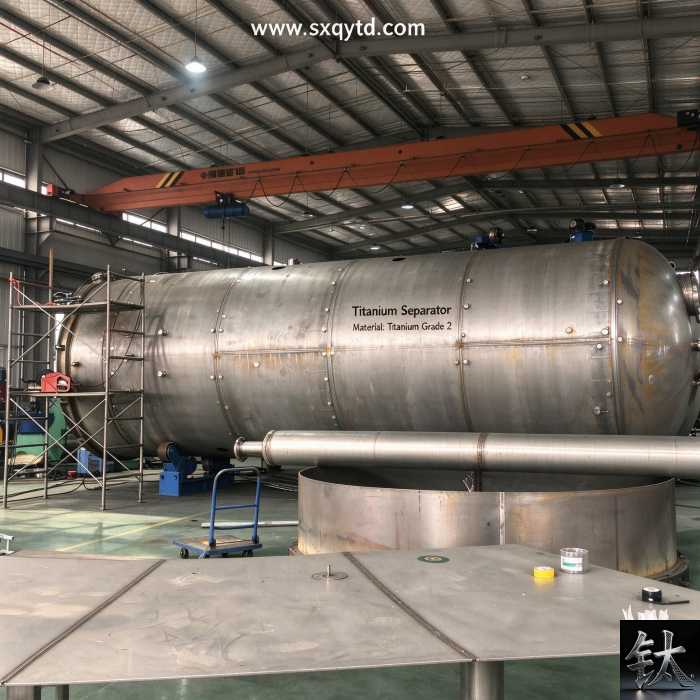
By principle, a storage tank is a static vessel for hold-up and buffer — no agitator, no reaction (when an agitator or heating jacket is added it becomes a process tank or reactor). By structure, the common builds are: vertical cylindrical with conical or flat roof for large stationary volumes; horizontal cylindrical for transport, skid or low-headroom sites; and jacketed tanks where the liquid must be kept at temperature. Small units ship fully welded; very large units are shop-built in sections and field-erected.
2. Why titanium — material vs. medium vs. corrosion
Titanium forms a self-healing TiO₂ film that resists chlorides and oxidizing acids. The selection logic:
| Medium | Recommended grade | Why |
| Dilute HCl, H₂SO₄ | Gr7 / Gr12 | Pd/Mo keeps film alive in reducing acid. |
| Wet chlorine, hypochlorite | Gr2 | Strongly oxidizing; Gr2 film stable. |
| Organic / acetic acid | Gr2 / Gr1 | Gr1 for highest purity service. |
| Seawater, brine | Gr2 | Avoid stagnant crevices above ~70°C. |
Two things that sink a titanium tank if ignored: (1) titanium is soft and low-modulus, so the tank needs a proper support ring and flat foundation with no point loads, and (2) titanium must never sit in direct metal contact with steel — use insulating gaskets and liners to stop galvanic attack. We design the support and isolation into the drawing, not as an afterthought.
3. Technical standards we build to
- Material: ASTM B265 / ASME SB-265 plate (MTC EN 10204 3.1), B338 tube if a coil is fitted.
- Tank code: ASME Section VIII Div.1 or GB/T 150 + JB/T 4745; API 650 referenced for geometry on large atmospheric tanks.
- Welding: ASME IX qualified GTAW with argon backing; weld colour acceptance silver to light straw, blue/grey rejected.
- Inspection: PT on seams, hydrostatic or pneumatic test, PMI of delivered plate, dimension and foundation-fit report.
4. Manufacturing flow — from drawing to delivery
1) Drawing & code review → 2) Material release with MTC & PMI → 3) Plate rolling and shell courses → 4) Fit-up and GTAW welding under argon → 5) Roof / bottom and nozzle welding → 6) PT inspection → 7) Hydrostatic test → 8) Pickling / passivation → 9) Support ring and insulation fitting → 10) Export packing or field-erection kit. We hold ~400 t of Gr2 plate in Baoji, so step 2 often starts within days of PO.
5. Key component performance
| Item | Control value | Note |
| Shell thickness | 3–12 mm | Zero corrosion allowance in design. |
| Weld colour | Silver – light straw | Contaminated weld is cut out and re-done. |
| Support | Ring + insulated isolation | No direct steel contact (galvanic). |
| Hydrostatic test | 1.3 × design pressure | Per ASME / GB code. |
6. Application industries
| Industry | Medium | Why titanium |
| Acid storage | HCl, H₂SO₄ | Steel/FRP fail; Gr7 lasts for years. |
| Chlor-alkali | Bleach, wet Cl₂ | Oxidizing duty, Gr2 standard. |
| Pharma / fine chem | Organic acids | Metal-ion-free product. |
| Seawater / brine | Salt solution | No crevice failure if designed right. |
7. Selection guide
By medium: oxidizing → Gr2; reducing acid → Gr7/Gr12; high-purity → Gr1. By structure: large fixed volume → vertical cylindrical; transport or low headroom → horizontal; temperature control needed → jacketed; if it also mixes or reacts, specify a process tank/reactor instead. Send medium, concentration, temperature, volume and whether heating/agitation is needed.
8. Customizable items & accessories
- Vertical / horizontal, capacity, diameter and height per footprint.
- Conical or flat roof, manway, level gauge nozzles, dip pipe and vent.
- Heating jacket or trace, insulation, titanium or lined support ring.
- Internal baffles, sight glass, thermowell, and export crate or field kit.
- Optional U-stamp, third-party inspection (SGS / TUV), extended traceability.
9. Lead time, test reports & warranty
| Item | Commitment |
| Lead time | 3–8 weeks typical; stock plate starts within days of PO. |
| Test reports | MTC 3.1, PT report, hydrotest record, PMI, dimension report. |
| Warranty | 12 months against material and workmanship defects from shipment. |
10. FAQ
Can a titanium tank sit on a steel support?
Only with insulation between them. Direct titanium-to-steel contact in an electrolyte causes galvanic corrosion that eats the titanium. We fit an isolating ring and liners so the two metals never touch.
Which grade for storing dilute acid?
For reducing acids like dilute HCl or H₂SO₄ without oxidizers, use Gr7 (Pd) or Gr12 (Mo/Ni); plain Gr2 would be attacked. Send the exact concentration and any oxidizer present.
Do you build large field-erected tanks?
Yes. Up to 100 m³ shop-built in courses and field-welded, or fully prefabricated for skid-mounted units. We supply the welding procedure and inspection plan for site work.
Request a quote
Send the medium, concentration, temperature, volume and whether heating/agitation is needed. We return grade, structure and a stock-backed price within 8 hours.
Phone / WeChat: +86 188 2967 9311
Email: sales@sxqytd.com
Or leave a message on the contact page with your drawing attached.
- What is Titanium Flange | ASME B16.5 ASTM B381 Gr2 Gr5 Titanium Flan
- ASME B16.5 Titanium Flange Grade2 DN100-DN600 Class150/300 FOB
- Gr2 Titanium Sheet Price FOB Shanghai | ASTM B265 In Stock
- Titanium Price Today (Oct 26, 2026): China Market Report
- Titanium Price Today (23 Oct 2026): Plate, Tube, Rod & Wire
Contact Person: Wang Xiaoning
Tel: +86-917-355-7966
Email: sales@sxqytd.com
WhatsApp: +86 188 2967 9311
Company: Shaanxi Qianyi Tuoda Technology Co., Ltd
Address: Floor 4, Building 4, No. 188 Gaoxin Avenue, High-tech Zone, Baoji City, Shaanxi Province, China