Titanium Agitator — Corrosion-Resistant Mixing Shafts & Impellers Built to Drawing
Titanium agitators · drawing to delivery
A titanium agitator keeps moving inside the liquids that destroy a steel or 316 mixer in months — acid baths, wet chlorine, brine and plating solutions. SXQYTD builds shafts, impellers, hubs and couplings to your drawing, with the rotating assembly dynamically balanced and the welds colour-checked. Below is the procurement detail that decides the grade, impeller type and balance grade before you issue a PO.
| Material | Gr2 / Gr7 / Gr12 / Gr5 (B265 / B348) | Principle | Mechanical mixing — impeller drives flow |
| Capacity | 0.5–200 m³ tank, 20–400 rpm, 0.37–75 kW | Industry | Plating, chlor-alkali, acid, seawater, pharma |
| Design code | Per drawing; ref. ISO 1940-1, ASME B73.1 | Lead time | 2–6 weeks (stock bar/plate shortens it) |
1. What a titanium agitator is — by principle and by structure
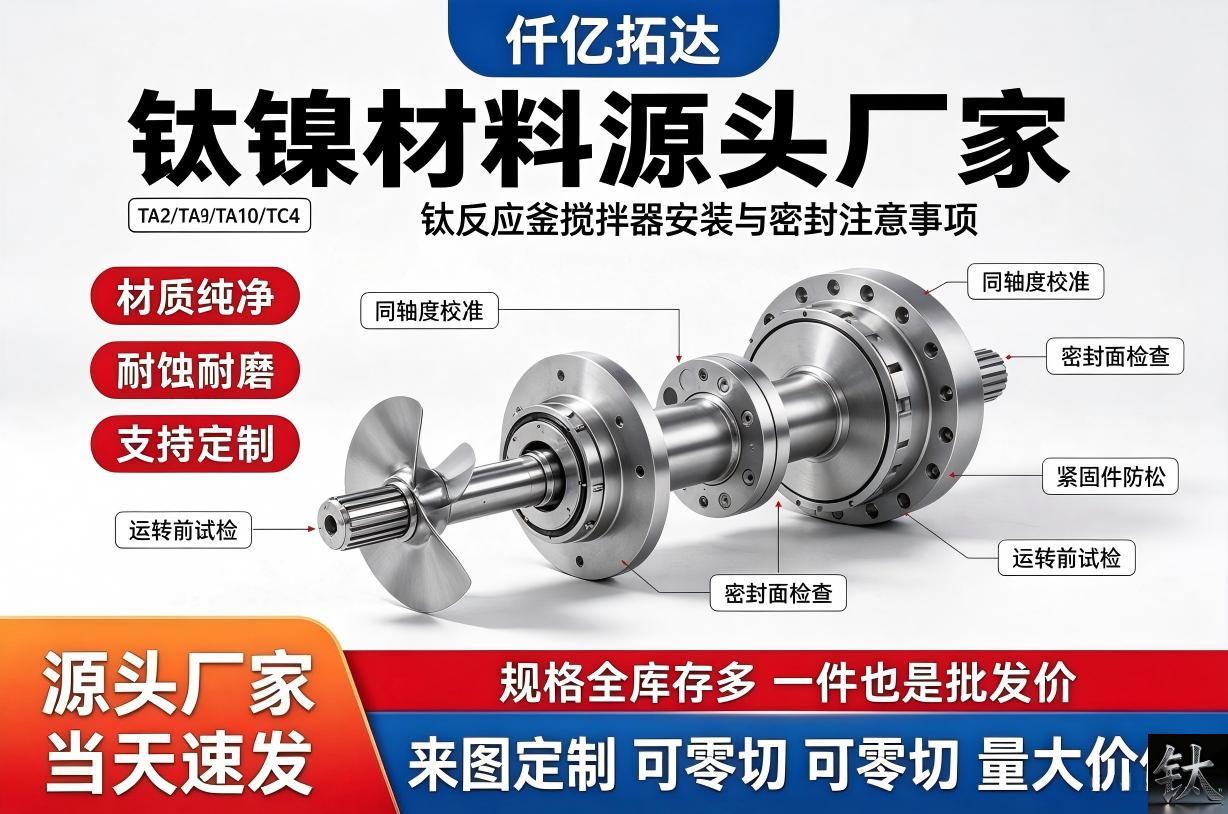
By principle, an agitator is a rotating machine that converts motor torque into fluid motion — blending, suspending solids, dispersing gas or driving a reaction inside a titanium vessel. Unlike a static tank, its value is in motion and in the shaft that survives it. By structure, the working parts are the shaft (the rotating member), the impeller (the blade that moves the fluid) and the hub that fixes the blade to the shaft, with optional steady bearing, mechanical seal and gearbox. Common impeller types: paddle (low-shear, high-viscosity), turbine (radial flow, gas dispersion), anchor / frame (wall-scraping, very viscous) and propeller (axial, low-viscosity bulk flow).
2. Why titanium — material vs. medium vs. corrosion
Titanium forms a self-healing TiO₂ film that resists chlorides and oxidizing acids, so the mixer survives where 316L pits. The selection logic:
| Medium | Recommended grade | Why |
| Dilute HCl, H₂SO₄ (no oxidizer) | Gr7 / Gr12 | Pd/Mo keeps film alive in reducing acid. |
| Wet chlorine, hypochlorite, bleach | Gr2 | Strongly oxidizing; Gr2 film stable. |
| Organic / acetic acid, plating bath | Gr2 / Gr1 | Gr1 for highest purity service. |
| Seawater, brine | Gr2 | Avoid stagnant crevices above ~70°C. |
| High-load rotating shaft | Gr5 (Ti-6Al-4V) | ~2× the strength of Gr2 for the shaft. |
Two things that sink a titanium agitator if ignored: (1) titanium's low elastic modulus (~110 GPa, roughly half of steel) makes long shafts deflect and whip at speed — the shaft must be sized for its critical speed and dynamically balanced, not just "made thicker"; and (2) titanium must never be coupled directly to steel — use an insulated coupling and isolation bushing, otherwise galvanic corrosion attacks the titanium in electrolyte. We design the balancing and isolation into the drawing, not as an afterthought.
3. Technical standards we build to
- Material: ASTM B265 / SB-265 plate (impeller), B348 rod (shaft), B863 wire if weld-built; MTC EN 10204 3.1 with PMI.
- Machining: per drawing; shaft straightness, runout and surface finish specified, not "as turned".
- Balancing: ISO 1940-1 balance grade G6.3 as standard, G2.5 for high-speed assemblies.
- Welding: ASME IX qualified GTAW with argon backing; weld colour acceptance silver to light straw, blue/grey rejected.
- Inspection: PT on seams, dimensional report, PMI, and a dynamic-balance certificate per rotor.
4. Manufacturing flow — from drawing to delivery
1) Drawing & duty review (medium, viscosity, rpm) → 2) Material release with MTC & PMI → 3) Shaft turning and straightening → 4) Impeller blanking, forming and machining → 5) Hub and blade welding (GTAW, argon backing) → 6) Pickling / passivation → 7) Finish machining, runout check → 8) Dynamic balancing to grade → 9) Assembly: coupling, seal, steady bearing → 10) Test spin / export packing. We hold Gr2 plate and Gr5 bar in Baoji, so step 2 often starts within days of PO.
5. Key component performance
| Item | Control value | Note |
| Shaft straightness | ≤ 0.1 mm/m, total ≤ 0.5 mm | Low modulus needs tight control. |
| Dynamic balance | ISO 1940-1 G6.3 (G2.5 on request) | Certificate supplied per rotor. |
| Weld colour | Silver – light straw | Contaminated weld is cut out and re-done. |
| Impeller runout | ≤ 1 mm at blade tip | Prevents eccentric vibration. |
| Surface finish | Pickled & passivated, Ra ≤ 1.6 µm | Ra ≤ 0.8 µm on request. |
6. Application industries
| Industry | Medium | Why titanium |
| Electroplating / surface | Acid bath, electroless Ni | 316L pits; Gr2 resists the bath. |
| Chlor-alkali | Bleach, wet Cl₂ | Oxidizing duty, Gr2 standard. |
| Acid mixing / pickling | HCl, H₂SO₄ | Gr7/Gr12 for reducing acid. |
| Seawater / desalination | Salt, brine | No crevice failure if designed right. |
| Pharma / food | Organic acids, sterile | Metal-ion-free product. |
7. Selection guide
By medium: oxidizing → Gr2; reducing acid → Gr7/Gr12; high-strength rotating shaft → Gr5; high-purity → Gr1. By impeller: low-viscosity bulk flow → propeller; gas dispersion / radial flow → turbine; high-viscosity or wall-scraping → anchor/frame; gentle blending → paddle. Send medium, viscosity, tank size, rpm and whether gas or solids are involved — that decides the impeller and shaft grade together.
8. Customizable items & accessories
- Shaft length, diameter, single or multi-stage; impeller type, diameter, blade count.
- Anchor / frame / turbine / propeller built to the process duty.
- Steady bearing, mechanical seal, gearbox, insulated coupling.
- Surface finish and passivation level; spare blades and hub kits.
- Optional third-party inspection (SGS / TUV), extended traceability, spare-shaft option.
9. Lead time, test reports & warranty
| Item | Commitment |
| Lead time | 2–6 weeks typical; stock bar/plate starts within days of PO. |
| Test reports | MTC 3.1, PT report, dynamic-balance cert, dimensional, PMI. |
| Warranty | 12 months against material and workmanship defects from shipment. |
10. FAQ
Can you make the shaft from Gr5 for high speed?
Yes. Gr5 (Ti-6Al-4V) gives about twice the strength of Gr2, so we recommend it for the rotating shaft above ~300 rpm or for long overhung lengths where a Gr2 shaft would deflect. The impeller can stay Gr2 to keep cost down.
How do you stop galvanic corrosion at the coupling?
We fit an insulated coupling and an isolation bushing so the titanium shaft never touches steel in the electrolyte. Without that isolation, a steel motor or support will galvanically attack the titanium even in a mild acid bath.
Do you balance the rotating assembly?
Every rotor is dynamically balanced to ISO 1940-1 G6.3 as standard (G2.5 on request) and shipped with a balance certificate. On long shafts we also check the first critical speed so it never runs through resonance in service.
Request a quote
Send the medium, concentration, viscosity, tank size, rpm and whether gas or solids are involved. We return grade, impeller type, balance grade and a stock-backed price within 8 hours.
Phone / WeChat: +86 188 2967 9311
Email: sales@sxqytd.com
Or leave a message on the contact page with your drawing attached.
- What is Titanium Flange | ASME B16.5 ASTM B381 Gr2 Gr5 Titanium Flan
- ASME B16.5 Titanium Flange Grade2 DN100-DN600 Class150/300 FOB
- Gr2 Titanium Sheet Price FOB Shanghai | ASTM B265 In Stock
- Titanium Price Today (Oct 26, 2026): China Market Report
- Titanium Price Today (23 Oct 2026): Plate, Tube, Rod & Wire
Contact Person: Wang Xiaoning
Tel: +86-917-355-7966
Email: sales@sxqytd.com
WhatsApp: +86 188 2967 9311
Company: Shaanxi Qianyi Tuoda Technology Co., Ltd
Address: Floor 4, Building 4, No. 188 Gaoxin Avenue, High-tech Zone, Baoji City, Shaanxi Province, China