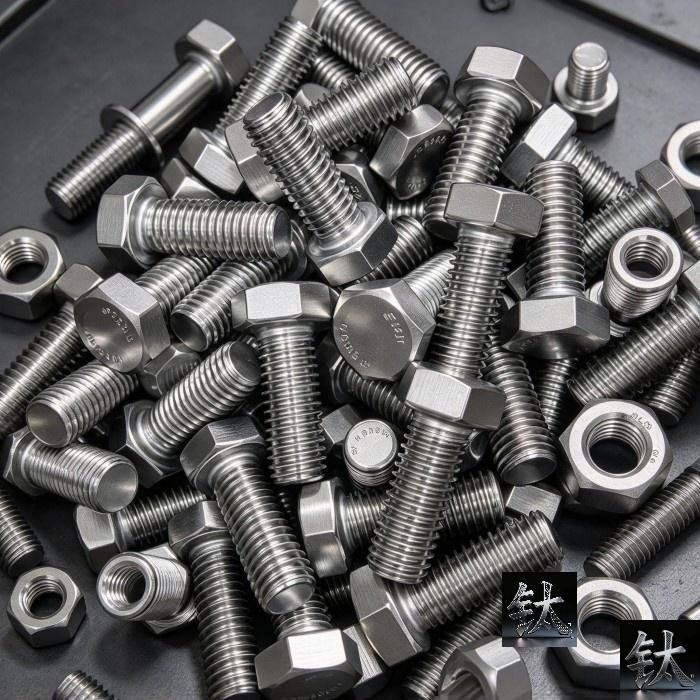
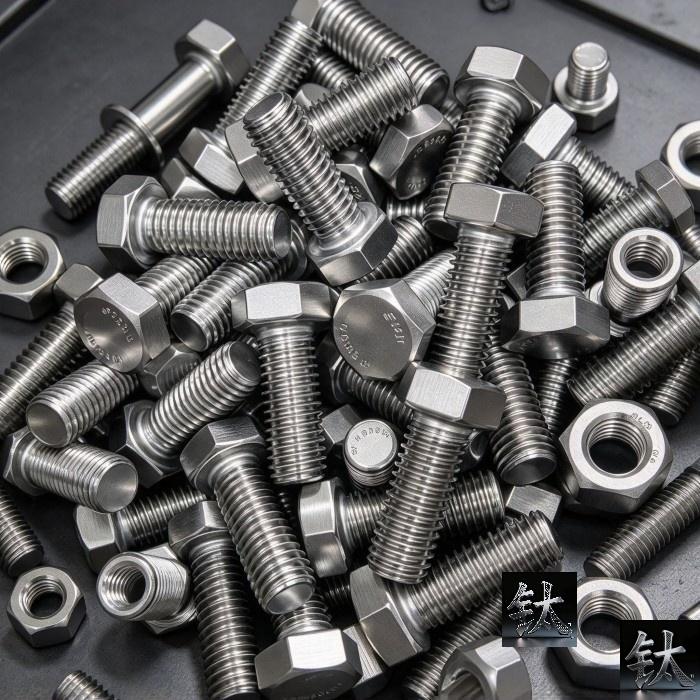
Titanium Fasteners: Bolt, Nut, Washer Selection Guide
| Specification | ASTM B348 (bar for bolts), ASME B18.2.1 (bolts), B18.2.2 (nuts), B18.21.1 (washers), B18.3 (screws) |
|---|---|
| Applicable Standard | Gr2 (UNS R50400, general), Gr5 (UNS R56400, high-strength), Gr7 (corrosion-resistant), Gr23 (ELI medical) |
| Material Condition | Flange bolting, pressure vessel closure, heat exchanger tube sheet, marine hardware, aerospace structural |
| Inspection & Packaging | Use dissimilar grades for bolt-nut pair to prevent galling (Gr2 bolt + Gr5 nut); apply anti-seize; reject carbon steel contact |
| Reference Price | $1.00 – $10.00 |
Product Description: Titanium fasteners: thread galling prevention, bolt-nut grade dissimilarity, hydrogen embrittlement, B348 bar vs forged head, galvanic isolation, anti-seize selection. Buyer guide with 8-field PO chec
Product Overview
| Standards | ASTM B348 (bar for bolts), ASME B18.2.1 (bolts), B18.2.2 (nuts), B18.21.1 (washers), B18.3 (screws), F467/F468 (mechanical properties) |
|---|---|
| Grades | Gr2 (UNS R50400, general), Gr5 (UNS R56400, high-strength), Gr7 (corrosion-resistant), Gr23 (ELI medical) |
| Service | Flange bolting, pressure vessel closure, heat exchanger tube sheet, marine hardware, aerospace structural |
| Core distinction | Galling is the #1 failure mode; bolt-nut must be dissimilar grades; bar is for ≤1/2" cold-headed bolts, forged heads above; hydrogen embrittlement limits service above 80°C in acid. |
The Failure: A Bolt That Would Not Come Off
In 2020, a chemical plant in Shandong commissioned a Gr2 titanium pipeline with Gr2 titanium bolt and nut flange joints. The service was ambient-temperature dilute hydrochloric acid at 0.5 MPa. The flanges operated without leakage for 18 months. During a scheduled turnaround, the maintenance crew attempted to disassemble the flange joints for inspection — and found that approximately 40% of the bolts could not be loosened with standard hand tools. When force was applied with an impact wrench, the bolts fractured at the first engaged thread, leaving the nut and the broken stud in the flange hole. Removing the broken studs required drilling and retapping the titanium flange holes, a 3-day job on a line that should have taken 4 hours.
The failure was thread galling — the microscopic welding of titanium thread flanks to titanium nut thread flanks under contact pressure and rotation. Titanium's passive TiO2 film is thin and brittle; under the contact stress of a threaded fastener (typically 200-400 MPa at the thread flank), the oxide film fractures, exposing bare titanium. Bare titanium-to-titanium contact, under rotation, creates microscopic friction welds at the thread flanks. The welds grow with continued rotation until the threads are locked solid. The fracture at the first engaged thread — the thread closest to the bearing surface of the nut — is the point of highest torque and highest stress concentration.
The lesson is that "titanium bolt and nut" is not a complete fastener specification. A titanium fastener purchase order has eight fields, and the bolt-nut grade combination, anti-seize requirement, and washer material are three of the missing fields the failure will find.
Titanium Fastener Standards: B348, B18, F467, F468
Titanium Fasteners are governed by a stack of standards that buyers must cite together. ASTM B348 specifies the bar stock from which bolts are manufactured — the chemistry, mechanical properties, and surface requirements for the raw material. ASME B18.2.1 specifies the dimensional geometry of hex head bolts (head size, shank diameter, thread length, head fillet radius); B18.2.2 specifies hex nuts; B18.21.1 specifies flat and lock washers; B18.3 specifies socket head cap screws. ASTM F467 (inch-series) and F468 (metric) specify the mechanical properties of non-ferrous bolts including titanium — proof strength, tensile strength, hardness, and marking requirements.
A complete fastener purchase order cites B348 for the material, B18 for the geometry, and F467/F468 for the mechanical properties. Specifying only "titanium bolt Gr2" leaves the geometry and mechanical properties open; a supplier can deliver a bolt of unspecified head size, thread tolerance, and proof load, and the buyer has no contractual basis to reject it. The minimum citation is "ASTM B348 Gr2, ASME B18.2.1, ASTM F467 Grade 2."
Galling: Why Titanium Threads Weld Themselves Shut
Thread galling is the single most common failure mode for Titanium Fasteners, and it is unique to titanium and titanium alloys among common engineering metals. The mechanism is well understood. Titanium's passive oxide film (TiO2, approximately 2-7 nm thick) provides corrosion resistance but is thin and brittle compared to the passive films on stainless steel (Cr2O3) or aluminum (Al2O3). When two titanium threaded components are mated under load and rotated, the contact pressure at the thread flanks (200-400 MPa for a standard preload) exceeds the yield strength of the oxide film, which fractures and exposes bare titanium metal.
Bare titanium is highly reactive. When two bare titanium surfaces contact under pressure and slide, the atomic-level friction creates microscopic weld junctions at the thread flanks. As rotation continues, the junctions grow, and the threads lock. The phenomenon is not corrosion and not mechanical wear — it is solid-phase welding at room temperature. The result is a bolt that cannot be removed without fracture.
Three prevention strategies exist, in order of effectiveness. First, use dissimilar grades for the bolt-nut pair: Gr2 bolt with Gr5 nut, or Gr5 bolt with Gr2 nut. The hardness difference between the two grades (Gr5 is approximately 330 HV vs Gr2 at 200 HV) reduces the microwelding tendency because the harder thread flanks do not conform as closely to the softer flanks. Second, apply an anti-seize compound to the thread flanks before assembly — MoS2-based for general service, copper-based for high temperature, never nickel-based. Third, use a stainless steel nut (B8M 316) with a titanium bolt, eliminating the titanium-to-titanium contact entirely. This last option introduces a galvanic couple, but the 316-to-titanium couple is weak enough to be acceptable in most atmospheric and mildly corrosive service.
Gr2 vs Gr5: The 3x Strength Gap
The choice between Gr2 and Gr5 titanium bolts is governed by the required preload and the bolt size. Gr2 (commercially pure titanium, UNS R50400) has a minimum yield strength of 275 MPa and ultimate tensile of 345 MPa. Gr5 (Ti-6Al-4V, UNS R56400) has a minimum yield of 828 MPa and ultimate tensile of 895 MPa — approximately 3x the strength of Gr2. The proof load (the maximum tensile load the bolt can carry without permanent deformation) scales with the yield strength and the bolt shank cross-section.
| Bolt Size | Gr2 Proof Load (kN) | Gr5 Proof Load (kN) | Ratio |
|---|---|---|---|
| 1/4" (M6) | 4.5 | 13.5 | 3.0x |
| 3/8" (M10) | 11.5 | 34.5 | 3.0x |
| 1/2" (M12) | 19.5 | 58.5 | 3.0x |
| 3/4" (M20) | 48.0 | 144.0 | 3.0x |
| 1" (M24) | 88.0 | 264.0 | 3.0x |
For flange bolting, the bolt preload must exceed the internal pressure force plus the gasket residual stress. On a 6-inch Class 150 flange at 150 psi, the total bolt load is approximately 180 kN distributed across 8 bolts — 22.5 kN per bolt. A Gr2 1/2-inch bolt (proof 19.5 kN) is marginal; a Gr5 1/2-inch bolt (proof 58.5 kN) has 3x margin. For flange sizes above 1/2 inch or pressure classes above Class 300, Gr5 is required. Gr2 is acceptable for small sizes (1/4 to 3/8 inch) in low-pressure ambient service where the preload requirement is modest.
Bolt-Nut Grade Dissimilarity: The Anti-Galling Rule
The single most important design rule for Titanium Fasteners is that the bolt and nut must be of dissimilar grades. The identical-grade pair (Gr2 bolt + Gr2 nut, or Gr5 bolt + Gr5 nut) is the galling-prone configuration because the identical hardness of the thread flanks creates maximum conformal contact and maximum microwelding area. The dissimilar-grade pair (Gr2 bolt + Gr5 nut, or Gr5 bolt + Gr2 nut) reduces conformal contact because the harder thread flanks (Gr5, 330 HV) ride on the softer flanks (Gr2, 200 HV) with less intimate contact area.
The preferred dissimilar pairs are: Gr5 bolt with Gr2 nut (the bolt carries the higher load, the nut is the consumable wearing part), or Gr2 bolt with Gr5 nut (less common but used where the nut is the higher-stress component, e.g., a tapped-hole application). The hardness difference is the key parameter — at least 100 HV difference between bolt and nut thread flank material. Gr2 (200 HV) and Gr5 (330 HV) have a 130 HV difference, which is sufficient. Gr2 and Gr7 (both approximately 200 HV) have insufficient difference and will gall as a pair.
For all-titanium systems where the bolt and nut must be the same grade (e.g., nuclear or medical service where traceability requires identical chemistry), anti-seize is mandatory and the assembly torque must be limited to 60-70% of the standard torque value to reduce contact pressure at the thread flanks. Even with these precautions, identical-grade titanium pairs have a measurably higher galling incidence than dissimilar-grade pairs and should be avoided where possible.
Hydrogen Embrittlement: The Temperature Boundary
Titanium absorbs hydrogen aggressively in hydrogen-bearing environments above 80°C. The absorbed hydrogen forms brittle titanium hydride (TiH2) precipitates at grain boundaries, reducing ductility and causing delayed fracture under sustained tensile load. The mechanism is electrochemical: in acid service (HCl, H2SO4), the cathodic reaction generates atomic hydrogen at the titanium surface; in galvanic coupling with carbon steel, the titanium cathode generates hydrogen; in cathodic protection systems, the impressed current generates hydrogen directly.
The threshold for hydrogen embrittlement in titanium is approximately 150 ppm hydrogen content by weight. Below 150 ppm, the hydride precipitates are isolated and ductility is preserved. Above 150 ppm, the hydride precipitates form a continuous network along grain boundaries, and the bolt can fail under static load (delayed fracture) without any warning signs. ASME B31.3 and the titanium industry recommend a maximum hydrogen content of 150 ppm on the MTR for pressure-fastener service.
Three prevention strategies apply. First, do not use titanium bolts in hydrogen-bearing acid service above 80°C — switch to Gr7 (Ti-0.15Pd), which has higher hydrogen tolerance, or switch to nickel alloy bolts (Monel 400, Inconel 625). Second, isolate titanium bolts from carbon steel to prevent cathodic hydrogen generation at the titanium surface. Third, specify a maximum hydrogen content of 150 ppm on the MTR and reject lots exceeding this; if the supplier cannot guarantee hydrogen content, require a hydrogen analysis on every lot. Avoid pickling processes that use hydrofluoric acid (HF), which can charge hydrogen into the surface to depths of 0.1-0.5 mm and create a hydrogen-enriched layer that initiates delayed fracture.
Bar Stock vs Forged Heads: The Size Boundary
Titanium bolts are manufactured by two processes: cold-heading from bar stock for small sizes, and hot forging of the head for larger sizes. The process boundary is approximately 1/2 inch (M12). Below 1/2 inch, cold-heading is standard and produces a forged grain flow in the head because the upsetting process aligns the grain with the head geometry. Above 1/2 inch, cold-heading becomes impractical — the force required to upset the head exceeds the bar's yield strength, and the resulting head fillet develops cracking or transverse grain weakness.
For bolts above 1/2 inch, hot forging of the head is required. The head is forged at 800-950°C (below the beta transus for Gr5, approximately 980°C) with a reduction ratio of at least 3:1, producing a grain flow that follows the head-to-shank fillet. ASME F468 (non-ferrous bolt mechanical properties) requires forged heads for bolts above 1/2 inch. A bolt machined from bar stock without head forging has grain running along the bolt axis, intersecting the head fillet at the wrong orientation and leaving a fatigue weakness at the fillet — the highest-stress concentration in the bolt.
Buyers should require on the PO: "For bolts above 1/2 inch, heads shall be hot-forged per ASTM F468 with forging reduction ratio minimum 3:1; MTR shall show forging process and reduction." Reject bolts above 1/2 inch that do not show a forged-head grain flow on the MTR — these are machined-from-bar parts with no grain flow, non-code-compliant, and prone to head fillet fatigue.
Anti-Seize Selection: MoS2, Copper, PTFE
Anti-seize is mandatory for titanium threads, even with dissimilar bolt-nut grades. The choice of anti-seize depends on the service temperature and the chemical environment. Three families are used.
MoS2-based anti-seize (molybdenum disulfide in a grease or paste carrier) is the standard for general titanium thread service up to 400°C. MoS2 is a solid lubricant that maintains a low-friction film on the thread flanks even under high contact pressure, and it is chemically inert to titanium. The film thickness should be 0.02-0.05 mm — a thin wipe, not a thick blob, because excess anti-seize attracts particulate contamination and reduces the effective thread friction coefficient (which the torque calculation assumes at 0.14 for lubricated threads).
Copper-based anti-seize (copper flakes in a grease carrier) is used for higher-temperature service (up to 800°C) where MoS2 oxidizes. The weakness is that copper is cathodic to titanium, and if the anti-seize washes out or dries, residual copper particles on the thread create local galvanic cells that initiate pitting. Copper anti-seize should not be used in acid service or in service where the threads are exposed to process fluid.
PTFE-coated threads (dry PTFE film applied by spray or dip) are an alternative for clean-service applications where anti-seize paste contamination is unacceptable (e.g., semiconductor, pharmaceutical). PTFE is chemically inert and provides low friction. The weakness is that the PTFE film wears after 3-5 assembly cycles, and the galling risk returns for the 6th and subsequent assemblies. For one-time assembly, PTFE is acceptable; for repeated assembly, use MoS2.
Never use nickel-based anti-seize with titanium. Nickel is strongly cathodic to titanium, and the residual nickel on the thread initiates pitting within weeks in chloride or acid service. Nickel anti-seize is formulated for stainless steel service and is explicitly contraindicated for titanium.
Washer Selection: Flat, Spring, Material
Washers under titanium bolt heads and nuts serve two functions: they distribute the contact pressure over a larger area, preventing surface brinelling on the titanium flange (which has lower hardness than steel), and they provide a bearing surface for the rotating bolt head or nut. The washer material must be compatible with the bolt and flange materials — no carbon steel.
Flat washers (ASME B18.21.1 Type A, plain flat) are the standard for general service. Material: titanium Gr2 for general service, Gr5 for high-strength service, or 316 stainless steel for cost-driven applications where the galvanic couple is acceptable. The washer OD should be 1.5-2x the bolt diameter, and the washer thickness should be at least 10% of the bolt diameter. A 1/2-inch bolt should use a washer with approximately 25 mm OD and 3 mm thickness.
Belleville (conical spring) washers are used for thermal cycling service where bolt preload relaxation is a concern. The Belleville washer is a conical disc that deflects under load like a spring; as the bolt relaxes under thermal cycling, the spring washer maintains the load. The deflection of a single Belleville washer is small (0.1-0.5 mm), so they are often stacked in pairs (nested) for larger deflection. Material: Gr5 titanium or 17-7 PH stainless for the spring temper.
Never use carbon steel washers. The carbon steel washer in contact with the titanium bolt head and the titanium flange creates a galvanic cell: the carbon steel washer corrodes, and the contact area on the titanium flange develops pitting. The cost savings of a carbon steel washer (5 cents vs 50 cents for a titanium washer) are not worth the pitting failure risk.
Eight Common Procurement Failures
These are the eight failures observed in titanium fastener purchase orders over the past decade, in approximate frequency order:
1. Using identical bolt-nut grades (Gr2 bolt + Gr2 nut). Maximum galling risk. Always specify dissimilar grades: Gr2 bolt + Gr5 nut, or Gr5 bolt + Gr2 nut. The 130 HV hardness difference reduces microwelding.
2. Not applying anti-seize to titanium threads. Even with dissimilar grades, anti-seize is mandatory. Specify "MoS2 anti-seize applied to thread flanks before assembly, film thickness 0.02-0.05 mm."
3. Using carbon steel nuts on titanium bolts. Galvanic corrosion + thread strip strength mismatch. Use B8M 316 stainless nuts or titanium nuts of dissimilar grade.
4. Using Gr2 bolts above 1/2 inch for Class 300+ service. Gr2 proof load is insufficient. Use Gr5 (Ti-6Al-4V) for bolts above 1/2 inch or pressures above Class 300.
5. Accepting machined-from-bar bolts above 1/2 inch without forged heads. Non-code-compliant, no grain flow, head fillet fatigue failure. Require hot-forged heads per F468 for bolts above 1/2 inch.
6. Using titanium bolts in hydrogen-bearing acid service above 80°C. Hydrogen absorption → TiH2 precipitation → delayed fracture. Use Gr7 or switch to nickel alloy bolts. Specify max hydrogen 150 ppm on MTR.
7. Using carbon steel washers under titanium bolt heads. Galvanic pitting on the flange. Use titanium or 316 stainless washers.
8. Using nickel-based anti-seize on titanium threads. Nickel is strongly cathodic to titanium; residual nickel initiates pitting. Use MoS2-based anti-seize; never nickel-based.
Cost Economics: Gr2 vs Gr5 vs Stainless
A 1/2-inch hex head bolt with nut and two flat washers priced per set breaks down approximately as follows (illustrative, based on 2024-2026 producer and trader quotations for finished mill products):
| Component Set | Gr2 Set (USD) | Gr5 Set (USD) | B8M Stainless Set (USD) |
|---|---|---|---|
| Bolt 1/2" hex head | $4-7 | $10-15 | $2-4 |
| Nut (hex, full thread) | $2-3 | $5-8 | $1-2 |
| Flat washers (2 pcs) | $1-2 | $2-3 | $0.50-1 |
| Anti-seize (MoS2, per assembly) | $0.50 | $0.50 | $0.50 |
| Total per set | $7.50-12.50 | $17.50-26.50 | $4-7.50 |
The Gr2 set is 1.5-2x the cost of the B8M stainless set; the Gr5 set is 2.5-3.5x. For a 100-bolt flange manifold, the all-titanium Gr5 option costs $1,750-$2,650; the all-stainless option costs $400-$750. The titanium premium buys corrosion resistance in the process fluid and galvanic compatibility with the titanium flange — but only if the bolt-nut grade dissimilarity and anti-seize rules are followed. A Gr5 bolt + Gr2 nut + MoS2 anti-seize + titanium washers is the cost-optimized all-titanium configuration; a B8M stainless bolt + B8M stainless nut + stainless washers is the cost-optimized mixed configuration where the galvanic couple is acceptable.
Supplier Verification: Six Documents to Request
Before placing a titanium fastener order, request these six documents. A supplier who cannot produce all six is not qualified for titanium fastener service.
1. Material Test Report (MTR) per EN 10204 3.1, showing heat chemistry, mechanical properties (yield, tensile, elongation, hardness), UNS designation, and hydrogen content (maximum 150 ppm for pressure service).
2. ASTM F467 (inch) or F468 (metric) mechanical properties certificate showing proof load, tensile strength, and hardness for each bolt size and grade in the order.
3. Forging certificate for bolts above 1/2 inch, showing hot-forging process, reduction ratio (minimum 3:1), and heat treatment. Reject bolts above 1/2 inch without forged heads.
4. ASME B18 dimensional compliance certificate, including thread tolerance (Class 2A external, Class 2B internal), head size, and thread length.
5. PMI (XRF) certificate for every lot of Gr7 or Gr12 bolts, verifying the palladium content. Gr7 differs from Gr2 by 0.15% Pd — invisible to the eye.
6. Pickling certificate showing that no hydrofluoric acid (HF) was used in the final surface treatment, or if HF was used, that a subsequent vacuum anneal was performed to remove charged hydrogen from the surface layer.
Summary: The 8-Field Purchase Order for Titanium Fasteners
A complete titanium fastener purchase order has these eight fields. Anything less leaves a gap the failure will find.
1. Standard + grade: ASTM B348 bar, ASME B18.2.1 geometry, ASTM F467 mechanical; Grade 2 (UNS R50400) or Grade 5 (UNS R56400) as required by load.
2. Bolt-nut grade combination: Dissimilar grades (Gr2 bolt + Gr5 nut, or Gr5 bolt + Gr2 nut) to prevent galling. Never identical grades without anti-seize.
3. Size + thread: Hex head, 1/2"-13 UNC (or M12x1.75 metric), thread Class 2A/2B, thread length per B18.2.1.
4. Head forging: Cold-headed ≤1/2"; hot-forged >1/2" per F468, reduction ratio minimum 3:1. Reject machined-from-bar above 1/2".
5. Anti-seize: MoS2-based for general service up to 400°C; copper-based for high temperature (non-acid); never nickel-based. Film thickness 0.02-0.05 mm.
6. Washers: Titanium Gr2 flat (or Gr5 for high-strength) or 316 stainless. Never carbon steel. OD 1.5-2x bolt diameter, thickness 10% bolt diameter.
7. Documentation: MTR EN 10204 3.1 with hydrogen content ≤150 ppm, F467/F468 mechanical certificate, forging certificate (above 1/2"), B18 dimensional certificate, PMI certificate (Gr7/Gr12), pickling certificate (no HF or vacuum anneal).
8. Service limit confirmation: Confirm the bolt is not specified for hydrogen-bearing acid service above 80°C; if it is, switch to Gr7 or nickel alloy bolts.
Frequently Asked Questions
Q1: Why do titanium bolts and nuts gall, and how do I prevent it?
Titanium forms a thin TiO2 passive film on its surface. When two titanium threads are mated under load and rotated, the oxide film breaks under contact pressure, exposing bare metal. Bare titanium-to-titanium contact creates microscopic friction welds at the thread flanks — the threads seize and tear on disassembly. Prevention: (1) use dissimilar grades for the bolt-nut pair (Gr2 bolt with Gr5 nut, or vice versa) so the hardness difference reduces microwelding; (2) apply an anti-seize compound (MoS2-based or copper-based, never nickel-based for titanium) to the thread flanks before assembly; (3) use stainless steel nuts (B8M) with titanium bolts where the galvanic couple is acceptable, eliminating the titanium-to-titanium contact entirely.
Q2: What is the strength difference between Gr2 and Gr5 titanium bolts?
Gr2 (commercially pure titanium, UNS R50400) has a minimum yield strength of 275 MPa and ultimate tensile of 345 MPa. Gr5 (Ti-6Al-4V, UNS R56400) has a minimum yield of 828 MPa and ultimate tensile of 895 MPa — approximately 3x the strength of Gr2. A Gr2 bolt in 1/2 inch (M12) diameter carries about 30 kN proof load; a Gr5 bolt of the same diameter carries about 90 kN. For flange bolting where the bolt is in tension and the preload governs sealing, Gr5 is required for sizes above 1/2 inch or pressures above Class 300. Gr2 is acceptable for small sizes (1/4 to 3/8 inch) in low-pressure ambient service.
Q3: Can I use carbon steel nuts on titanium bolts?
No, for two reasons. First, galvanic corrosion: carbon steel is anodic to titanium, so the carbon steel nut corrodes in any humid or chloride environment, and the contact area on the titanium bolt develops hydrogen pickup that can embrittle the thread root. Second, strength mismatch: the bolt preload is limited by the weaker of the bolt or nut thread, and a carbon steel nut (Grade 2 or Grade 5) may have lower thread strip strength than a titanium bolt of equivalent grade. Use stainless steel (B8M 316) nuts for general corrosive service, or titanium nuts of a dissimilar grade (Gr5 nut with Gr2 bolt) for all-titanium systems.
Q4: What is hydrogen embrittlement in titanium bolts and how do I prevent it?
Titanium absorbs hydrogen at temperatures above 80C in hydrogen-bearing environments (acid service, cathodic protection, galvanic coupling with carbon steel). Absorbed hydrogen forms brittle titanium hydride (TiH2) precipitates at grain boundaries, reducing ductility and causing delayed fracture under sustained tensile load. Prevention: (1) do not use titanium bolts in hydrogen-bearing acid service above 80C; use Gr7 (Ti-0.15Pd) which has higher hydrogen tolerance, or switch to nickel alloy bolts; (2) isolate titanium bolts from carbon steel to prevent cathodic hydrogen generation; (3) specify a maximum hydrogen content of 150 ppm on the MTR and reject lots exceeding this; (4) avoid pickling processes that use HF, which can charge hydrogen into the surface.
Q5: Should titanium bolts be made from bar stock or forged heads?
For bolts 1/2 inch and below, cold-heading from B348 bar is standard and acceptable — the grain flow follows the head geometry in the upsetting process. For bolts above 1/2 inch, forged heads are required because cold-heading at larger sizes causes head fillet cracking and transverse grain weakness. ASME F468 (non-ferrous bolt mechanical properties) requires forged heads for bolts above 1/2 inch. A bolt machined from bar without head upsetting has grain running along the bolt axis, intersecting the head fillet at the wrong orientation and leaving a fatigue weakness at the highest-stress concentration. Reject bolts above 1/2 inch that do not show a forged-head grain flow on the MTR.
Q6: What anti-seize compound should I use on titanium threads?
Use MoS2-based (molybdenum disulfide) anti-seize for general titanium thread service up to 400C. Use copper-based anti-seize for higher temperature (up to 800C) but only in non-acid service — copper is cathodic to titanium and can accelerate corrosion if the anti-seize washes out and leaves copper particles on the thread. Never use nickel-based anti-seize with titanium — nickel is strongly cathodic and the residue initiates pitting. PTFE-coated threads (dry film) are an alternative for clean-service applications where anti-seize contamination is unacceptable, but the PTFE film wears after 3-5 assembly cycles and the galling risk returns.
Q7: What washers should I use under titanium bolt heads and nuts?
Use titanium washers (Gr2 for general service, Gr5 for high-strength) or stainless steel (316) washers. The washer distributes the bolt head or nut contact pressure over a larger flange area, preventing surface brinelling on Titanium Flanges (which have lower hardness than steel). Never use carbon steel washers — the carbon steel washer in contact with the titanium bolt head and the titanium flange creates a galvanic cell that initiates pitting on the flange surface. Use flat washers for general service; use Belleville (conical spring) washers for thermal cycling service where bolt preload relaxation is a concern, because the spring washer maintains load as the bolt relaxes.
 PREVIOUS:itanium Flanges: ASME B16.5 Weld Neck, Slip-On, Lap Joint, Blind Guide
NEXT:Nickel Products: N6, Ni201, Monel 400 Selection Guide
Tell us your requirement — grade, size and quantity. We reply within 24 hours.
Prefer chat? WhatsApp +86 188 2967 9311 or email sales@sxqytd.com.
Related Products


- Titanium Price Today (23 Oct 2026): Plate, Tube, Rod & Wire
- Read titanium wire and titanium alloy wire: diameter classification
- Titanium wire: from brand selection to manufacturing process (2026 r
- Read titanium tube and titanium alloy tube: OD classification + comm
- Titanium pipe knowledge·tee + reducer selection 5 steps
Contact Person: Wang Xiaoning
Tel: +86-917-355-7966
Email: sales@sxqytd.com
WhatsApp: +86 188 2967 9311
Company: Shaanxi Qianyi Tuoda Technology Co., Ltd
Address: Floor 4, Building 4, No. 188 Gaoxin Avenue, High-tech Zone, Baoji City, Shaanxi Province, China