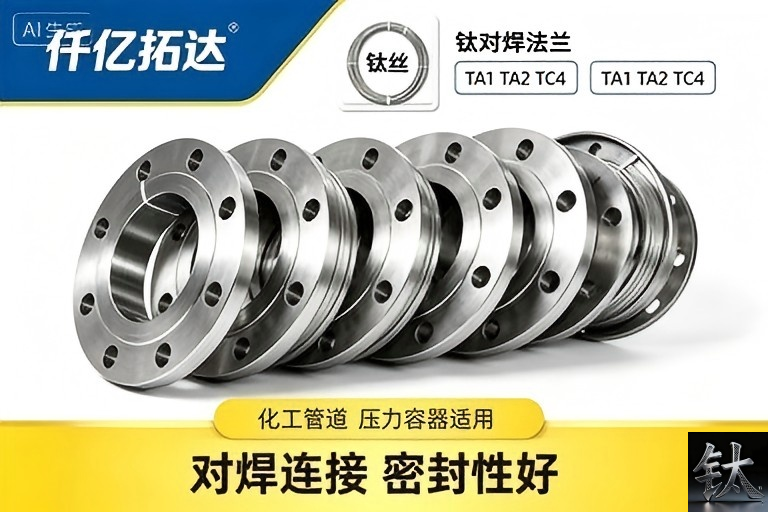
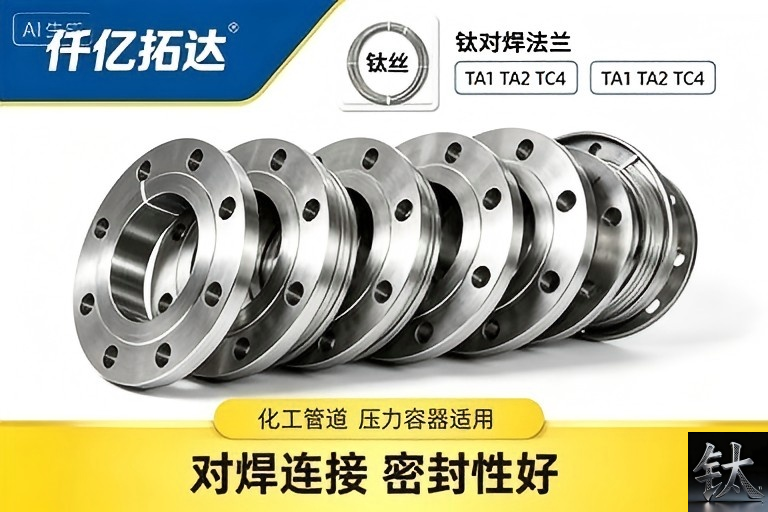
itanium Flanges: ASME B16.5 Weld Neck, Slip-On, Lap Joint, Blind Guide
| Specification | ASME B16.5 (NPS 1/2-24, Class 150-2500), B16.47 (large diameter 26-60), B381 (forgings) |
|---|---|
| Applicable Standard | Gr2 (UNS R50400, baseline), Gr3, Gr5, Gr7, Gr12 — forged per B381, not machined from bar |
| Material Condition | Process piping flanges, swivel joints, blind ends, orifice connections in corrosive service |
| Inspection & Packaging | WNRF for primary corrosive service, lap joint + stub end for cost; reject socket weld (crevice); use B8/B8M stainless or Ti bolts — never carbon steel |
| Reference Price | $25.00 – $40.00 |
Product Description: ASME B16.5 titanium flanges: bolt load relaxation, gasket creep, galvanic bolt corrosion, weld neck vs lap joint, reject socket weld, B381 forging, Class 150-2500 pressure ratings. Buyer guide with 8-
Product Overview
| Standards | ASME B16.5 (NPS 1/2-24, Class 150-2500), B16.47 (large diameter 26-60), B381 (forgings), B16.20 (gaskets), B16.21 (non-metallic gaskets) |
|---|---|
| Grades | Gr2 (UNS R50400, baseline), Gr3, Gr5, Gr7, Gr12 — forged per B381, not machined from bar or plate |
| Service | Process piping flanges, swivel joints, blind ends, orifice connections in corrosive service |
| Core distinction | B16.5 is dimensional; B381 is material + forging. Pressure class is temperature-dependent. Bolt material governs galvanic risk. Socket weld is rejected for titanium. |
The Failure: 50 Thermal Cycles to Weep at a Raised Face
In 2023, a Middle East refinery commissioned a 6-inch Class 150 Gr2 titanium flange joint in a condensate line operating between ambient and 130°C with weekly startup-shutdown cycles. The flange was a weld neck raised face (WNRF), paired with a PTFE gasket and carbon steel ASTM A193 B7 bolts. After approximately 50 thermal cycles, the joint developed a slow weep at the raised face gasket surface. Visual inspection showed no corrosion, no flange deformation, and no bolt failure — the joint simply lost its sealing stress.
Three compounding effects caused the failure. First, titanium has a Young's modulus of approximately 105 GPa, about half that of carbon steel (200 GPa). The lower modulus means the flange body stores less elastic strain energy under bolt preload, and that energy relaxes faster during thermal cycling as the flange flexes. Second, PTFE gaskets cold-flow under sustained compressive load — the gasket material creeps away from the high-stress zone, reducing the gasket factor (m) and the minimum design seating stress (y). Third, the carbon steel bolts in contact with the titanium flange hub created a galvanic cell; even before the weep appeared, hydrogen pickup on the titanium cathode side of the contact area was slowly embrittling the hub fillet, the highest-stress concentration in the assembly.
The lesson is that "Class 150 Gr2 flange" is not a complete specification. A titanium flange purchase order has eight fields, and the bolt material, gasket material, and pressure-temperature rating at design temperature are three of the missing fields the failure will find.
ASME B16.5 Scope: Dimensions, Classes, and What It Does Not Cover
ASME B16.5 covers pipe flanges and flanged fittings from NPS 1/2 through NPS 24, in pressure classes 150, 300, 400, 600, 900, 1500, and 2500. The standard specifies flange dimensions (OD, bolt circle, bolt hole size and count, flange thickness, hub dimensions, raised face or flat face dimensions), tolerances, facing finish, marking, and pressure-temperature ratings for a list of material groups. Titanium is Material Group I (Gr1, Gr2, Gr3, Gr7, Gr9, Gr12, Gr16) per B16.5 Table 1-2.1.
B16.5 does not specify the material — it specifies dimensions and pressure-temperature ratings by material group. The material specification for Titanium Flanges is ASTM B381 (forgings). A complete flange specification cites both: "Flange, ASME B16.5, Class 150, NPS 6, weld neck raised face, ASTM B381 Grade 2." Specifying only B16.5 leaves the material open; a supplier can deliver a carbon steel flange "to B16.5 dimensions" and the buyer has no contractual recourse.
For diameters above NPS 24 (above 24 inch), use ASME B16.47 in Series A (MSS SP-44, heavier) or Series B (API 605, lighter). B16.47 covers NPS 26 through NPS 60 in pressure classes 150, 300, 400, 600, and 900. Above NPS 60, flanges are designed per ASME Section VIII Appendix 2 or per the TEMA standard, not per B16.5 or B16.47.
Pressure Class vs Working Pressure: The Temperature Trap
The single most misunderstood concept in B16.5 is that the pressure class is not the working pressure. "Class 150" does not mean the flange is rated for 150 psi at all temperatures — it means the flange is rated for a working pressure that depends on the design temperature, per the B16.5 pressure-temperature rating table for the material group.
For titanium Material Group I (Table 1-2.1), the Class 150 working pressure is approximately 235 psi at -29 to 38°C, drops to 180 psi at 100°C, 150 psi at 150°C (the nominal class), 125 psi at 200°C, and falls to 60 psi at 315°C (the upper limit for sustained Gr2 service). A buyer who specifies "Class 150" for a 200 psi service at 200°C is buying a flange that cannot carry the design pressure at the design temperature. The correct selection at 200 psi and 200°C is Class 300.
| Temperature | Class 150 (psi) | Class 300 (psi) | Class 600 (psi) |
|---|---|---|---|
| 38°C | 235 | 620 | 1240 |
| 100°C | 180 | 500 | 1000 |
| 200°C | 125 | 360 | 720 |
| 300°C | 65 | 190 | 380 |
| 315°C | 60 | 170 | 340 |
The pressure class is selected by the B16.5 Table 1-2.1 rating at the design temperature, not by the nominal line pressure. The penalty for undersizing is not theoretical — the ASME code case history is full of Class 150 flanges on 200 psi, 200°C service that weeped within months of startup.
Flange Types: WN, SO, LJ, BL, SW — and Why SW Is Rejected
B16.5 recognizes seven flange types; for titanium corrosive service, four are commonly specified, one is conditionally accepted, and two are rejected.
Weld neck raised face (WNRF) is the primary flange type for titanium corrosive service. The butt-weld neck joins to the pipe with a full-penetration bevel weld per B16.25 — no crevice, no fillet weld, no internal geometry change. The hub taper distributes stress from the flange face to the pipe, and the forged grain flow follows that taper. WNRF is mandatory for high-pressure cyclic service and severe corrosion service.
Lap joint (LJ) with stub end is the cost-architecture flange covered in detail in the B363 fittings article. The stub end is a B363 fitting butt-welded to the pipe; the backing ring is loose and can be carbon steel or stainless. LJ is preferred for sizes above 2 inch where cost matters and for systems requiring bolt-hole rotation during assembly. The flange face is the back of the stub end, which carries the gasket.
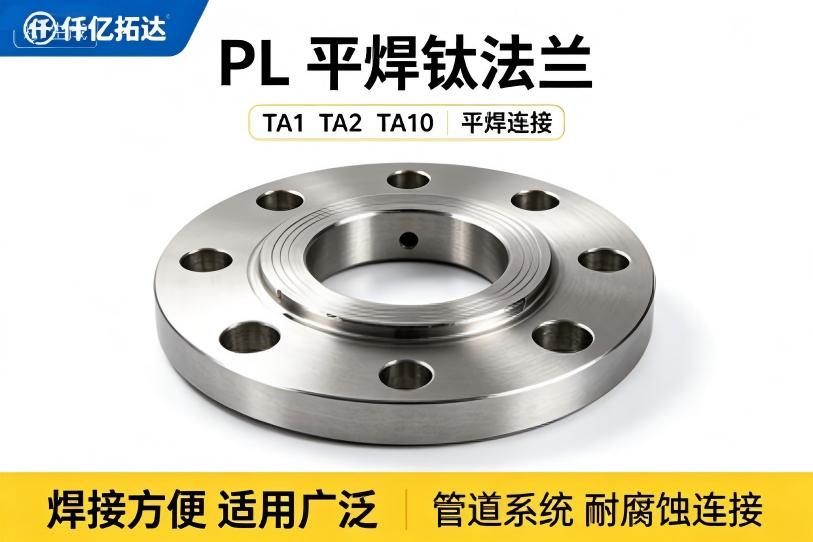
Slip-on raised face (SORF) is acceptable for low-pressure ambient service. The pipe slips into the flange bore and is joined by two fillet welds — one at the front, one at the back. The slip-on has lower fatigue life than weld neck because the double fillet weld has higher stress concentration than a butt weld, and the bore-to-pipe gap (typically 1.5-3 mm) is a partial crevice. For corrosive service above 60°C or chloride service, SORF is not recommended; use WNRF.
Blind raised face (BLRF) is used to close the end of a line or a vessel nozzle. The blind flange carries the full pressure load without a hub; the bolt load is transferred directly to the flange body. Blind flanges are forged per B381 and face the same pressure-temperature rating requirements as the matching WNRF.
Socket weld (SW) is rejected for titanium corrosive service. The socket weld has an internal fillet weld at the front, with the pipe inserted into a socket bore that leaves a 0.8 mm gap (per B31.3 recommendation for thermal expansion) between the pipe end and the socket shoulder. That 0.8 mm gap is a dead-water crevice — fluid enters, stagnates, oxygen is consumed, and crevice corrosion initiates within months in chloride or organic acid service. The B16.5 socket weld flange is dimensionally valid for titanium, but B31.3 Appendix F effectively excludes SW from titanium corrosive service by requiring the user to evaluate crevice corrosion for socket welds in materials susceptible to it.
Threaded flange is rejected for titanium because the NPT thread is a long, multi-start helical crevice. Threaded flanges are used only for low-pressure non-corrosive service (e.g., instrument air) and are not used in process corrosive service with titanium.
Bolt Material: The Galvanic Trap
Carbon steel bolts on a titanium flange are the second most common cause of premature flange failure, after gasket cold-flow relaxation. The mechanism is electrochemical: titanium is more noble than carbon steel, so in the presence of any conductive medium (humidity, condensation, chloride-bearing atmosphere, or process leaks), the carbon steel bolt is anodic and corrodes, while the titanium flange at the contact area becomes a cathode. At the cathode, hydrogen ions are reduced to atomic hydrogen, which can be absorbed by the titanium and lead to hydrogen embrittlement over time.
Three bolt material options exist for Titanium Flanges. First, ASTM A193 B8 (Type 304 stainless) or B8M (Type 316 stainless) bolts with A194 Grade 8 or 8M nuts are the industry default for general corrosive service. The stainless-to-titanium galvanic couple is much weaker than carbon-steel-to-titanium because stainless is closer to titanium in the galvanic series, and the contact area is small relative to the cathode area. Second, ASTM A193 B7 or B16 carbon steel bolts with hot-dip galvanized or PTFE coating can be used in dry indoor environments where condensation is controlled — but this is not recommended for outdoor, humid, or chloride environments. Third, titanium bolts (B348 Gr2 for general service, B348 Gr5 for high-strength) eliminate the galvanic couple entirely, but titanium bolts have lower allowable stress than steel bolts (Gr2 bolt allowable stress is approximately 140 MPa vs B7 at 175 MPa), which requires either a larger bolt diameter or more bolts to achieve the same preload.
For most titanium flange applications, the answer is B8M stainless bolts with 8M nuts. The cost premium over B7 carbon steel is approximately 3-4x, but the elimination of galvanic corrosion and hydrogen pickup risk is the single largest reliability improvement available to a titanium flange system.
B381 Forging: Why Machined-from-Bar Flanges Fail
ASME B16.5 specifies flange dimensions; ASTM B381 specifies the forging material and process. The two standards work together — a complete titanium flange purchase order cites both. B381 covers titanium and titanium-alloy forgings for general industrial application, including flanges, fittings, and other pressure-bearing parts. Forgings under B381 are produced by open-die, closed-die, or ring-rolling processes, with the forging reduction ratio controlled to consolidate ingot center porosity and break up segregation.
Forging aligns the grain flow with the flange geometry. In a weld neck flange, the grain flows from the hub, around the fillet, and into the flange body — continuous through the highest-stress transition. A flange machined from bar stock has grain running along the bar axis, which intersects the hub fillet at the wrong orientation, leaving a transverse grain weakness at the fillet where stress is highest. A flange machined from plate has a similar misalignment at one or more transitions.
ASME B31.3 (Process Piping) and ASME Section VIII (Pressure Vessels) require forged flanges for pressure service. Machined-from-bar flanges are not code-compliant and cannot carry a code stamp. Suppliers who offer "equivalent" machined flanges at a 20-30% discount are selling a non-code part that the buyer's inspector and insurance underwriter will reject on review. Always require B381 forged flanges with EN 10204 3.1 MTR showing the heat chemistry, mechanical properties, forging reduction ratio, and heat treatment.
Gasket Selection: PTFE, Graphite, Spiral-Wound
Gasket selection for Titanium Flanges is governed by ASME B16.20 (spiral-wound and filled gaskets) and B16.21 (non-metallic flat gaskets). Three gasket families are used with titanium raised face flanges; the choice depends on the service conditions, particularly the thermal cycle count.
PTFE (Teflon) gaskets are widely used for ambient-temperature, steady-state corrosive service. PTFE is chemically inert to almost all process fluids, has good compressibility, and is low-cost. The fatal weakness is cold flow — under sustained compressive load, PTFE creeps away from the high-stress zone, reducing the gasket sealing stress. In thermal cycling service, the PTFE gasket loses sealing stress within 50-100 cycles and the joint weeps. PTFE is acceptable for constant-temperature corrosive service below 100 cycles between startups; it is not acceptable for thermal cycling service.
Flexible graphite gaskets (with or without stainless steel tang reinforcement) are the standard gasket for thermal cycling titanium flange service. Graphite does not cold-flow, retains sealing stress across thermal cycles, and is chemically inert in reducing and oxidizing environments up to approximately 540°C. The stainless tang (a perforated foil insert) provides mechanical strength and blow-out resistance. Graphite gaskets are 2-3x the cost of PTFE but eliminate the relaxation failure mode.
Spiral-wound gaskets per B16.20 (CG type with centering ring, CGI type with inner ring) combine a stainless steel winding with a graphite or PTFE filler. The spiral winding provides mechanical resilience — the gasket springs back under thermal cycling — while the filler provides the seal. Spiral-wound graphite (CG) is the standard for high-pressure thermal cycling titanium flange service. The inner ring (CGI) protects the winding from process-fluid intrusion and is required for services above Class 300.
The buyer who specifies "gasket" on the purchase order leaves the choice to the supplier, who will deliver the cheapest option — PTFE — and the joint will weep under thermal cycling. Always specify the gasket material, type, and thickness on the flange purchase order.
Raised Face, Flat Face, and RTJ: Facing Selection
B16.5 specifies four facing types for flanges: raised face (RF), flat face (FF), ring-type joint (RTJ), and tongue-and-groove (TG) or small male-female (SM). For titanium corrosive service, raised face is the standard; the other three have specific applications.
Raised face (RF) is the default facing for Class 150 through Class 2500. The raised face is 1.6 mm high for Class 150 and 300, and 6.4 mm high for Class 400 and above. The gasket sits on the raised face, and the bolt load compresses the gasket into the serrated finish (typical 3.2 µm Ra, 40-50 serrations per inch, concentric or spiral). RF is the most cost-effective and most interchangeable facing — it is the default unless the service requires otherwise.
Flat face (FF) is used for Class 150 service with non-metallic (PTFE, graphite) full-face gaskets, particularly for cast iron or fragile materials that would crack under the concentrated load of a raised face. Titanium FF flanges are rare — titanium is ductile enough to accept RF — but FF is used in some low-pressure instrumentation service where a large gasket area is desired for soft gasket materials.
Ring-type joint (RTJ) is used for high-pressure (Class 600 and above) or toxic/flammable service where a metal-to-metal seal is required. The RTJ groove holds a metal ring gasket (octagonal or oval) that deforms under bolt load to form a pressure-tight seal. For titanium RTJ flanges, the ring gasket material is typically Monel 400 or soft titanium — using a carbon steel ring gasket creates the same galvanic problem as carbon steel bolts. RTJ flanges are rare in titanium service because most titanium corrosive service is below Class 600 and below the temperature where RTJ becomes necessary.
Eight Common Procurement Failures
These are the eight failures observed in titanium flange purchase orders over the past decade, in approximate frequency order:
1. Specifying only B16.5 without B381. The supplier can deliver a flange machined from bar or plate to B16.5 dimensions, without forging. Non-code, no grain flow, fails at the hub fillet. Always cite "B16.5 dimensions, B381 Grade 2 forging."
2. Selecting pressure class by nominal line pressure, not by B16.5 Table 1-2.1 at design temperature. Class 150 at 200 psi and 200°C is under-rated; the flange weeps within months. Always check the pressure-temperature rating table at the design temperature.
3. Using PTFE gaskets in thermal cycling service. PTFE cold-flows and loses sealing stress within 50-100 cycles. Use graphite or spiral-wound graphite for any service with more than 50 thermal cycles.
4. Using carbon steel bolts on Titanium Flanges. Galvanic cell, bolt corrosion, hydrogen pickup on the titanium hub. Use B8M stainless or titanium bolts.
5. Specifying socket weld flanges for titanium corrosive service. The 0.8 mm internal crevice initiates crevice corrosion within months. Use WNRF; reject SW for any chloride or organic acid service.
6. Accepting machined-from-bar flanges as "B381 equivalent." Not code-compliant, no grain flow, fails at the hub fillet. Always require forged B381 with MTR showing forging reduction.
7. Not specifying gasket material and type. Supplier defaults to cheapest PTFE; thermal cycling service weeps. Specify material (graphite, spiral-wound CG), thickness, and B16.20/B16.21 reference.
8. Using titanium weld neck flanges where lap joint + stub end would do. 4-6x the flange cost without service benefit. Reserve WNRF for primary corrosive service; use LJ + stub end for cost-driven spools.
Cost Economics: Flange vs Stub End + Ring
A 6-inch Class 150 Gr2 flanged joint priced by component breaks down approximately as follows (illustrative, based on 2024-2026 producer and trader quotations for finished mill products):
| Component | WNRF Option (USD) | LJ + Stub End Option (USD) |
|---|---|---|
| Flange body (titanium WNRF) | $280-380 | $60-90 (CS backing ring) |
| Stub end (titanium B363) | — | $90-130 |
| Gasket (graphite, RF) | $15-25 | $15-25 |
| Bolts B8M + 8M nuts (8 set) | $60-90 | $60-90 |
| Welding + NDT (one butt weld) | $30-50 | $30-50 (stub-to-pipe weld) |
| Total per joint | $385-545 | $195-285 |
The lap joint + stub end option delivers approximately 50% flange cost savings on 6-inch Class 150 service, with the same pressure-temperature rating and the same gasket and bolt options. On a 100-joint pipeline, the savings are $19,000-$26,000 — sufficient to fund the gasket upgrade from PTFE to graphite on every joint and the bolt upgrade from B7 carbon steel to B8M stainless on every joint, with residual savings. The buyer who specifies WNRF across a cost-driven pipeline "for uniformity" forfeits both the savings and the upgrade.
Supplier Verification: Six Documents to Request
Before placing a B16.5 titanium flange order, request these six documents. A supplier who cannot produce all six is not qualified for titanium flange service.
1. Material Test Report (MTR) per EN 10204 3.1, showing heat chemistry, mechanical properties (yield, tensile, elongation), and UNS designation matching the ordered grade (Gr2 = R50400, Gr7 = R52400, Gr12 = R53400).
2. B381 forging certificate showing the forging process (open-die, closed-die, ring-rolled), reduction ratio (minimum 3:1 typical), and heat treatment. Reject machined-from-bar flanges — the certificate must show "forged."
3. B16.5 compliance certificate stating the flange is manufactured to B16.5 dimensions with pressure class, facing type, and material group verified.
4. Pressure-temperature rating confirmation at the design temperature, signed by the supplier's engineer — not just the B16.5 table reference, but an explicit confirmation that the supplied class carries the design pressure at the design temperature.
5. Hydrotest or proof test report at 1.5× rated pressure at ambient temperature per B16.5 (for Class 150 and 300, hydrotest is standard; for Class 600 and above, verify proof test was performed).
6. PMI (XRF) certificate for every lot of Gr7, Gr12, or Gr16 flanges, verifying the palladium, molybdenum, or nickel content matches the grade specification. Gr7 differs from Gr2 by 0.15% Pd — invisible to the eye and easily confused in inventory.
Summary: The 8-Field Purchase Order for Titanium Flanges
A complete B16.5 titanium flange purchase order has these eight fields. Anything less leaves a gap the failure will find.
1. Standard + grade: ASME B16.5 dimensions, ASTM B381 forging, Grade 2 (UNS R50400) or Gr7/Gr12 as specified.
2. Type + facing: WNRF / SORF / LJ / BLRF / SW (rejected). RF / FF / RTJ.
3. Size + class: NPS 6, Class 150 (or 300, 600, 900, 1500, 2500 as required by pressure-temperature rating).
4. Pressure-temperature confirmation: Design pressure at design temperature per B16.5 Table 1-2.1 (Material Group I for titanium). Confirm class is sufficient.
5. Gasket: Material (graphite / spiral-wound CG / PTFE for steady-state), thickness (1.5 or 3.0 mm), standard (B16.20 or B16.21).
6. Bolting: ASTM A193 B8M bolts with A194 8M nuts (or titanium B348 Gr2 bolts for high galvanic risk service).
7. Documentation: MTR EN 10204 3.1, B381 forging certificate with reduction ratio, B16.5 compliance certificate, pressure-temperature rating confirmation, hydrotest report, PMI certificate (for Gr7/Gr12/Gr16).
8. Surface + pickling: Pickled after forging; free-iron test per ASTM A380 on 10% of lot. Raised face finish 3.2 µm Ra, 40-50 serrations per inch, concentric or spiral.
Frequently Asked Questions
Q1: Why do titanium flanges leak under thermal cycling when carbon steel flanges of the same class do not?
Titanium has a Young's modulus of approximately 105 GPa, about half that of carbon steel (200 GPa). Lower modulus means the flange body deflects more under bolt preload, and more critically, the bolt preload relaxes faster under thermal cycling because the elastic strain energy stored in the flange-bolt system is lower. With a PTFE gasket that also cold-flows (creeps) under load, the combined effect drops the gasket sealing stress below the minimum required within 50-100 thermal cycles. Use graphite or spiral-wound gaskets and re-torque after the first heat cycle.
Q2: What flange types are acceptable for titanium corrosive service?
Weld neck raised face (WNRF), slip-on raised face (SORF), lap joint (LJ) with stub end, and blind raised face (BLRF) are all acceptable under B16.5 for titanium. Weld neck is preferred for primary corrosive service because the butt weld has no crevice and full penetration. Lap joint + stub end is preferred for cost above 2 inch because only the stub end is titanium, the backing ring can be carbon steel or stainless. Socket weld (SW) is rejected for titanium — the internal fillet weld creates a 0.8 mm crevice between the pipe OD and the socket bore, which initiates crevice corrosion within months in chloride service.
Q3: Can I use carbon steel bolts on a titanium flange?
No. Carbon steel bolts in contact with a titanium flange hub create a galvanic cell in any humid or chloride environment. The carbon steel bolt is anodic and corrodes, while the contact area on the titanium becomes a cathode and develops local hydrogen pickup that can embrittle the hub over time. Use ASTM A193 B8 (304 stainless) or B8M (316 stainless) bolts with A194 Grade 8 or 8M nuts for general corrosive service. For high-temperature or hydrogen-bearing service, use titanium bolts (B348 Gr2 or Gr5) — but titanium bolts have lower allowable stress than steel, requiring larger bolt diameter or more bolts.
Q4: Why must titanium flanges be forged per B381 rather than machined from bar?
Forging aligns the grain flow with the flange geometry — the hub-to-flange transition is the highest stress concentration and a forged flange has continuous grain across that transition. Bar stock machined to a flange has grain running along the bar axis, which intersects the hub at the wrong orientation and leaves a transverse grain weakness at the fillet. B381 forging also consolidates any center porosity or segregation from the original ingot, which bar stock retains. ASME B16.5 and B31.3 require forged flanges for pressure service; machined-from-bar flanges are not code-compliant and have caused hub fillet failures.
Q5: What pressure class do I need for a 150 psi titanium line?
Pressure class in ASME B16.5 is not the working pressure — it is a rating that depends on temperature. A Class 150 flange has a working pressure of 150 psi at the rated temperature of the material class, but at 200°C the Gr2 Class 150 rating drops to about 90 psi (per ASME B16.5 Table 1-2.1 for Group I titanium alloys). For a 150 psi service at ambient temperature, Class 150 is acceptable. For 150 psi at 200°C, you need Class 300. Always select class by the B16.5 pressure-temperature rating table for the specific material group at the design temperature, not by nominal line pressure.
Q6: What gasket should I use with a titanium flange raised face?
For raised face titanium flanges, use flexible graphite gaskets (with or without stainless tang) or spiral-wound gaskets with graphite filler (CG or CGI type) per ASME B16.20. Avoid PTFE (Teflon) gaskets for any thermal cycling service — PTFE cold-flows under load and loses sealing stress within 50-100 cycles. For flat face (FF) titanium flanges, use full-face gaskets in 1/8 inch thickness. For ring-type joint (RTJ) flanges, use soft iron or low-carbon steel ring gaskets for non-corrosive service; for corrosive service, use monel or titanium ring gaskets, recognizing that RTJ flanges are rare in titanium service.
Q7: How do I prevent galvanic corrosion between a titanium lap joint flange ring and the carbon steel backing ring?
In a lap joint system, the titanium stub end contacts the process fluid; the carbon steel backing ring contacts only the titanium stub end hub on the back side and atmosphere on the outer surfaces. The galvanic couple is titanium-to-carbon-steel at the back-of-stub-end contact area. Prevention: (1) apply a dielectric gasket or tape between the stub end back face and the ring; (2) paint the carbon steel ring with a zinc-rich or epoxy coating to break the cathode area; (3) where the environment is wet or chloride-bearing, use stainless (304 or 316) backing rings instead of carbon steel. The cost premium for stainless rings is 2-3x but eliminates the galvanic risk entirely.
Tell us your requirement — grade, size and quantity. We reply within 24 hours.
Prefer chat? WhatsApp +86 188 2967 9311 or email sales@sxqytd.com.



- Titanium Price Today (23 Oct 2026): Plate, Tube, Rod & Wire
- Read titanium wire and titanium alloy wire: diameter classification
- Titanium wire: from brand selection to manufacturing process (2026 r
- Read titanium tube and titanium alloy tube: OD classification + comm
- Titanium pipe knowledge·tee + reducer selection 5 steps
Contact Person: Wang Xiaoning
Tel: +86-917-355-7966
Email: sales@sxqytd.com
WhatsApp: +86 188 2967 9311
Company: Shaanxi Qianyi Tuoda Technology Co., Ltd
Address: Floor 4, Building 4, No. 188 Gaoxin Avenue, High-tech Zone, Baoji City, Shaanxi Province, China