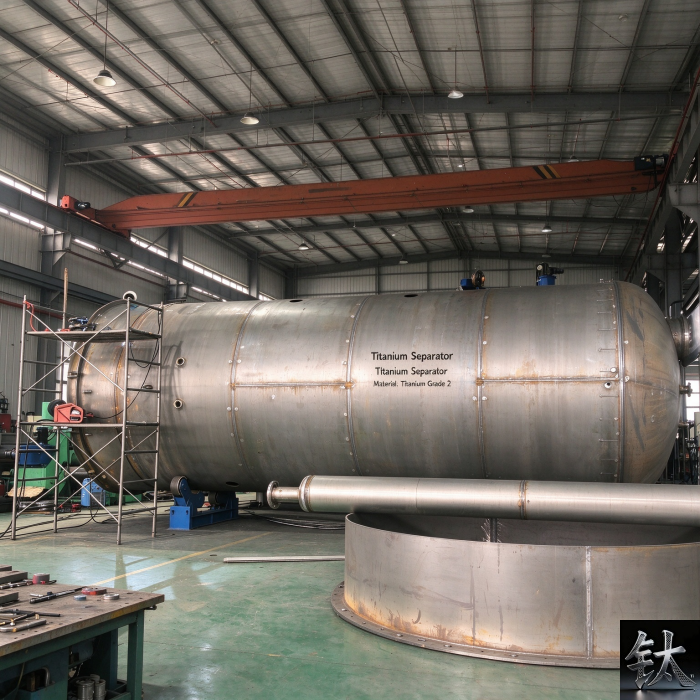
Titanium vs PTFE-Lined Equipment: Barrier or Inherent Corrosion Resistance
| Спецификация | Material selection / corrosion barrier |
|---|---|
| Применимый стандарт | Gr2 / Gr7 / Gr12 titanium vs PTFE / PFA / glass / graphite / FRP lining |
| Состояние материала | Permeation / vacuum rating / holiday test / thermal cycling |
| Контроль и упаковка | AMPP SP0188 / ASTM D5162 / ASME RTP-1 / ASTM B265 / B338 |
| Справочная цена | $1000.00 – $10000.00 |
Описание продукции: PTFE is rated 260 C; a lined vessel can derate to 150-180 C under vacuum. When a liner wins, when titanium wins, and the two acceptance systems.
Обзор продукции
Titanium vs PTFE-Lined Equipment: Barrier or Inherent Corrosion Resistance
A PTFE-lined carbon steel reactor is advertised at 260 °C and is frequently derated to 150–180 °C once full vacuum, nozzle geometry and steam-out cycles are on the data sheet. A Grade 2 titanium reactor has no liner to collapse, no bond to lose and no vent path to design: the entire wall thickness resists the medium. That single structural difference decides more purchases than any corrosion table. Lined equipment usually wins the initial quote on cold, ambient-pressure acid storage with no heat transfer; solid or clad titanium usually wins once a coil, a vacuum step, a quench, a slurry or a twenty-year inspection interval enters the specification. This guide is about the branch that our earlier material selection articles did not take. Our hydrochloric acid grade-limit guide names PTFE-lined equipment and our reactor selection working table names PTFE or Hastelloy as the fallback where titanium fails, but both stop at the recommendation and say nothing about how that liner is rated, tested or damaged. Our 316L to 2205 to 254SMO upgrade ladder covers the branch that climbs through metallic alloys; our explosive welded titanium clad plate guide covers a metallurgically bonded metallic liner with ultrasonic and shear-strength acceptance. This article covers the other branch: non-metallic barriers, and the four questions that settle the choice. What temperature is really being quoted, what happens at the barrier interface, which acceptance documents prove anything, and where the barrier stops being cheaper.
At a Glance: Barrier or Metal, Eight Decisions That Settle It
| Item | What the buyer must know |
|---|---|
| The short answer | A lined vessel is carbon steel protected by a thin non-metallic barrier; a titanium vessel is corrosion resistant through its whole wall. The barrier wins on cold, ambient-pressure, non-heat-transfer acid duty. The metal wins on heat transfer, vacuum, thermal cycling, abrasion and inspectability |
| The 260 °C number | That is the continuous service limit of unstressed PTFE resin. A real lined assembly is derated by the steel shell, differential expansion and anchoring, often to 150–230 °C; published guides put full-vacuum service as low as 150–180 °C |
| Four different limits | Melting point near 327 °C (sintering only), bare resin continuous limit near 260 °C, mechanically derated assembly limit, and a thermal-shock or ramp-rate limit. Published fabricator ramp rates sit roughly between 30 and 80 °C per hour with single-step shock limits near 60–120 °C |
| Permeation | Small molecules including HCl and HF diffuse slowly through solid PTFE. It is a guaranteed design condition, not a defect. Correct designs vent the liner-to-shell annulus through shell ports and manage where the permeated species goes |
| Three mechanical limits | Vacuum pulls a flexible liner inward and can collapse it; PTFE expands roughly ten times more than carbon steel, so thermal cycling pumps it against its restraints; cold flow relaxes flange bolt load and starts leaks at gasketed joints |
| Heat transfer | Fluoropolymer thermal conductivity is of the order of 0.25 W/(m·K), roughly one to two orders of magnitude below Grade 2 titanium. Coils, jackets, reboilers and tube bundles are where a lined concept normally stops being viable |
| The acceptance mismatch | Lined equipment is accepted by holiday (spark) testing, dry film thickness, vacuum rating and thermal cycling records under AMPP SP0188 or ASTM D5162. Titanium is accepted by MTC, PMI, NDT and surface cleanliness. Neither set of documents substitutes for the other |
| Voltage numbers disagree | Old rules of thumb used about 100 V per mil; a widely quoted formula gives V = 1250 x square root of thickness in mm; the 2023–2024 revisions of D4787, D5162, G62 and SP0188 adopted a Paschen-based expression. Name the edition, the measured DFT and the instrument type |
| The PO line that causes trouble | “PTFE lined or Grade 2 titanium, whichever is cheaper”. They are not comparable products. Compare cost per square metre of wetted surface over design life, including heat transfer area, inspection intervals and planned liner replacement |
| Cheapest verification | One fabricator derated temperature curve with ramp rate, one vacuum rating for the minimum process pressure, one holiday test record with voltage and edition, one vent-path drawing, and one liner thickness map at nozzles and flares |
Read rows two, four, six and seven first. The recurring procurement error is not choosing the wrong chemistry; PTFE really is chemically inert to almost everything a plant will put in it, and Grade 2 titanium really is excellent in oxidising and chloride media. The error is treating a headline resin property as a vessel rating, and treating two different products as interchangeable line items on one enquiry. Every numerical value in this table is orientational and carries a governing document behind it. Derated temperature curves belong to a specific fabricator and geometry; holiday test voltages belong to a specific standard edition and a measured dry film thickness; vacuum ratings belong to a specific liner thickness and anchoring method. Treat the table as a list of documents to demand, not as a substitute for the fabricator data package. Where published sources disagree, we say so and give the verification action rather than averaging the numbers into a false precision.
The “260 °C” Trap: Four Temperatures, Only One Is on the Data Sheet
Ask a lined-equipment supplier what 260 °C means and a good one will tell you there are at least four different numbers hiding behind the single figure. The first is the melting point: PTFE melts near 327 °C and PFA near 305–310 °C. That number matters for sintering and welding the sheet, and for nothing in service. The second is the maximum continuous service temperature of unstressed resin, the number that headlines almost every data sheet: about 260 °C for PTFE, with PFA commonly quoted at 260 °C short term and 200–250 °C continuous in lined hardware. It is a creep and degradation limit measured on a free resin specimen. The third is the mechanically derated limit of the lined assembly, and it is the one that usually governs. A liner is captured by a steel shell whose thermal expansion coefficient is roughly one tenth that of PTFE. Heating puts the liner into compression, cooling puts it into tension, and cycling pumps it against its mechanical restraints. Published fabricator derated curves for lined pipe and lined vessels commonly fall in the 150–230 °C band depending on geometry, anchoring and whether vacuum is present. The fourth is the thermal-shock and ramp-rate limit. Fabricator guidance frequently caps heating and cooling at roughly 30–80 °C per hour and single-step shocks near 60–120 °C. Steam-out, a cold feed into a hot vessel and an emergency quench create transient stresses well above steady thermal stress, and it is the rate, not the absolute temperature, that cracks most liners.
A vessel data sheet reading “PTFE lined, max 260 °C” and a process running a 230 °C reaction with a 150 °C steam-out between batches looks comfortable against the resin figure. The derated continuous limit for that geometry may be 220 °C, and an 80 °C step executed in minutes can exceed the shock limit and craze the liner over a few dozen cycles. Two governing numbers were never printed on the sheet.
The published values do not agree with each other, and we are not going to pretend they do. One supplier table gives 260 °C continuous and 290 °C short term at atmospheric pressure, 150–180 °C under full vacuum, 200–230 °C under repeated steam-out and 230 °C under hot nitrogen purge. Another gives −200 °C to +260 °C for the resin, then warns that mechanical strength falls from 100 °C and that sustained operation above 200 °C needs reinforced attachment. A third quotes an isostatic PTFE liner at −200 to 260 °C but caps negative-pressure service near 200 °C. These are different constructions, different vacuum levels and different definitions of continuous, so there is no honest single number. What there is, is a single procurement action: require the fabricator derated curve for the exact geometry, the maximum ramp rate in °C per hour, the maximum single-step shock, and the thermal cycling test record for that liner thickness and anchoring method. If the supplier answers with the resin data sheet, the answer is missing.
Grade 2 titanium does not have an equivalent derating conversation. It has a code allowable stress that falls with temperature and a published maximum allowable temperature in the pressure vessel code of roughly 315 °C, which our cross-family upgrade ladder discusses in the context of stainless and duplex alternatives. That ceiling is a design-code matter with a calculation sheet, not a bonded-interface matter with a ramp rate. This does not make titanium universally better: titanium fails outright in hydrofluoric acid, dry chlorine, red fuming nitric acid and hot reducing acids beyond the grade envelope, all catalogued in the HCl and grade-limit guide. It means the two materials have entirely different failure clocks, and a purchase order that records only a maximum temperature captures neither of them.
Why a Liner Is a Barrier and Titanium Is a Bulk Material
The most useful mental model is not a corrosion table but a section through the wall. A lined vessel is a pressure-bearing carbon steel shell, typically Q245R or Q345R in Chinese fabrication, with a 2–6 mm fluoropolymer sheet mechanically captured, isostatically formed or adhesively bonded to the inside. The steel carries pressure and load; the liner carries almost no structural duty; the interface between them carries every thermal, vacuum and permeation problem. A solid titanium vessel, of the type covered in our titanium reactor guide, is a single homogeneous wall in which the entire thickness is the corrosion barrier and the pressure boundary at the same time. A titanium clad steel plate is the hybrid: a metallurgically bonded titanium layer on a carbon steel base, accepted by 100 percent ultrasonic scanning of the bond interface and by shear-strength testing. That hybrid is closer to the lined concept in cost structure, but it is still a metallic, electrically conductive, diffusion-bonded layer with no polymer creep and no permeation path, which is why our explosive clad plate guide treats it under a completely different acceptance regime.
The consequence for failure mode is sharp. In a lined vessel, a single discontinuity in the barrier exposes a tiny area of bare carbon steel to a large volume of aggressive medium. Corrosion current concentrates at that point and perforation can be faster than on an unprotected steel surface, because the surrounding liner prevents the current from spreading. Inspection literature describes exactly this small-anode effect for holiday defects in coatings. In a titanium vessel there is no interface and no coating discontinuity to find: degradation is uniform thinning, localised crevice attack under a gasket, or one of the hard exclusions already named. The wall can be measured with an ultrasonic thickness survey at any planned shutdown, and the remaining life can be calculated.
What this changes in a purchase order
First, the inspection plan. A lined vessel needs a defect-detection programme with a defined scan coverage, a defined test voltage and a defined repair-and-retest loop. A titanium vessel needs a material identity and weld-quality programme: an EN 10204 3.1 certificate with heat number traceability, positive material identification on the wetted parts, weld NDT and qualified procedures, and surface acceptance for free iron contamination after the final wet operation. Second, the spare-parts logic. A lined vessel is normally repaired by patching or relining and the shell remains at risk until the breach is found. Titanium repairs are weld repairs governed by the qualified procedure and shielding discipline, with the hydrogen pickup risk that follows any thermal or chemical operation. Third, the lifetime arithmetic. A lining is a consumable with a replacement interval; a titanium wall with zero corrosion allowance in the right medium is generally not. Comparing the two on purchase price alone is an accounting error, not an engineering choice.
There is one more difference buyers rarely put on the enquiry: what happens to the outside of the wetted surface during maintenance. A lined vessel cannot be welded, ground, heated with a torch or struck without destroying the barrier locally; hot work on the steel shell conducts straight through to the polymer interface. A titanium vessel can be repaired, modified and nozzle-added, provided the shop has the shielding, cleanliness and procedure discipline. Plants that expect to move nozzles, add instrument ports or reconfigure internals over a twenty-year life should price that flexibility at the enquiry stage, not discover it during the first turnaround.
Permeation Is a Design Condition, Not a Defect
PTFE is chemically inert and still not impermeable. Small molecules, notably hydrogen chloride, hydrogen fluoride and water vapour, diffuse slowly through solid fluoropolymer. Published lining references treat this as unavoidable and describe the engineering response: the equipment does not try to stop permeation, it manages where the permeated species goes. Lined pipe is commonly supplied with a pattern of small vent holes through the steel wall, sometimes fitted with porous PTFE plugs or sintered metal frits that let gas escape while excluding rain. Lined vessels use grooves, woven glass spacer cloth or a perforated backing to channel permeated gas to one or more shell nozzles. Those ports have two jobs: preventing pressure build-up behind the liner that would blister or disbond it, and giving the operator a place to detect what has crossed the barrier.
The failure nobody sees: a permeated acid gas reaches the liner-to-shell annulus, condenses, and attacks the carbon steel from behind. There is no visible stain on the process side, no cathodic protection reaching the annulus and no thickness reading taken there. By the time a blister appears at a nozzle, the shell underneath has been thinning for months.
Three specification lines follow directly. Ask for a vent-path drawing showing every port, its elevation, its plug type and its inspection access; ask whether the shell material or any internal coating in the annulus is compatible with the permeated species; and add the vent ports to the routine inspection checklist with a requirement that they remain open and unobstructed after painting, insulation and shipping. A blocked vent hole converts a designed permeation path into a closed pressure vessel behind the liner. The literature also notes that cold service combined with absorbed permeant raises blistering risk, so the minimum metal temperature during shutdown and steam-out belongs on the same data sheet as the maximum.
This is where the two product families stop being comparable at all. Titanium has no liner, no annulus and no permeation path; hydrogen can diffuse into the metal lattice under certain conditions, but that is an entirely different mechanism with its own test method, covered in our hydrogen embrittlement and MTC limits guide. A specification that says corrosion barrier with zero permeation is unenforceable for a polymer and meaningless for a metal. Write the requirement in the language of the family you are buying: vent design, annulus compatibility and port inspection for a liner; grade chemistry, oxide-film stability and hydrogen limits for titanium. Our grade-limit guide makes the same point from the other direction when it lists the nine process fields an enquiry needs before any grade recommendation can be trusted.
Vacuum, Thermal Cycling and Cold Flow: The Three Mechanical Limits
Vacuum collapse
The pressure rating of a lined system is that of the steel shell, with one important exception: negative pressure reverses the load. Instead of pressing the flexible liner against the shell, the differential pushes it inward, and a thin PTFE sleeve is not stiff enough to resist buckling without support. Published supplier tables give full-vacuum service a continuous limit as low as 150–180 °C where the resin has softened, and isostatic-lining references quote an upper bound near 200 °C for negative pressure with steel-mesh reinforcement and a peel-strength requirement. Vacuum-rated construction therefore needs either a thicker, mechanically anchored liner with a stated collapse rating or a design in which the liner is attached to the shell at intervals. Check the minimum process pressure including steam-out condensation, relief scenarios, pump suction and blocked-in cooling, not just the normal operating pressure. A vessel rated for atmospheric reaction duty can see full vacuum once during a cleaning cycle, and that single cycle is enough.
Thermal cycling and differential expansion
PTFE expands roughly ten times more than carbon steel. Heating puts a captured liner into compression; cooling pulls it into tension against its anchors; repeated cycling works the flares at nozzles, the welded seams and the dished ends. Published failure lists name blistering after rapid steam-out, cracking near nozzles, weld-seam failure from expansion mismatch and detachment from poor surface preparation. The practical controls are a stated ramp rate, a stated single-step shock limit, a documented thermal cycling validation for the construction, and a nozzle and flare design that allows movement. Ask the fabricator how many cycles their qualification covered and to what amplitude, and put the plant steam-out procedure on the enquiry so the supplier can check it rather than assume it.
Cold flow at flanged joints
Cold flow is the slow plastic deformation of PTFE under sustained compressive load at temperatures well below its softening point. At a flanged joint the liner face creeps inward, contact stress falls, and the joint leaks unless the initial bolt load is set for the polymer rather than for a metallic gasket and unless spring-energised elements or Belleville washers maintain residual load. Lining references describe reduced bolt loads for PTFE-lined flanges and re-torquing after a thermal cycle as standard practice, with liner thicknesses from about 3 mm in small bore to 6 mm or more in larger bore chosen partly for dimensional stability. Our flange, bolt and gasket three-piece guide covers the pressure-class, sealing-face and bolt-grade synchronisation for Titanium Flanges, and our passivated titanium fastener guide covers the surface treatment of the bolts themselves; for lined equipment there is an additional fourth item, which is the creep behaviour of the flare itself. Do not copy a metallic gasket torque table onto a lined flange, and do not schedule the first re-torque after the first leak.
None of these three limits has a titanium equivalent, and that is the cleanest way to frame the choice for a process engineer. Titanium has a yield strength, a fatigue curve and a code allowable stress; it does not have a liner-to-shell bond, a creep relaxation at a gasket face or a collapse mode under vacuum. That is why vacuum crystallisers, batch reactors with quench steps and jacketed vessels with frequent steam-out so often migrate to titanium coils and solid or clad titanium shells, even when the resin data sheet looks like the cheaper answer. Conversely, an ambient-pressure HCl storage tank with no jacket and no agitation is exactly where a liner earns its keep and titanium may be an unnecessary expense. Comparisons of this kind are also made at equipment level: our titanium versus stainless steel agitator comparison weighs the service life, price and weight of a whole machine, while this article weighs the corrosion barrier itself. Both answers can be correct at once because they are answering different questions.
When Heat Transfer Decides the Material for You
Fluoropolymer thermal conductivity is of the order of 0.25 W/(m·K). Grade 2 titanium is commonly quoted around 16–22 W/(m·K), and carbon steel near 45–50 W/(m·K). That is a one to two order of magnitude gap between the barrier and the metal, and it is not a detail that a larger pump or a higher jacket temperature can fix. Every millimetre of liner is an insulating layer in series with the heat path. For a reactor that merely holds acid at ambient temperature the number is irrelevant. For a reboiler, a crystalliser, a jacketed reactor with an exotherm, or a condenser tube bundle it determines whether the required area is physically achievable inside the available shell. This is the single most common technical reason a lined concept is abandoned after the first thermal design pass, and it should be evaluated before the corrosion comparison is even opened.
| Heat transfer configuration | What the liner does to the design | Usual outcome |
|---|---|---|
| Internal heating or cooling coil | A lined coil is difficult to fabricate, difficult to holiday test at bends and highly exposed to mechanical damage during cleaning | Titanium coil or tube bundle |
| Jacketed vessel wall | Liner adds a low-conductivity layer between process and jacket; overall U falls and area or jacket temperature must rise | Upsized titanium or clad wall |
| Shell and tube exchanger | Tube-side lining and tube-to-tubesheet joints are the highest-risk geometry; any tube-side defect is hard to locate | ASTM B338 titanium or impervious graphite block |
| Ambient storage, no duty | No heat path to penalise; chemistry dominates | Lined carbon steel is often the economic winner |
For titanium the relevant documents are dimensional and metallurgical rather than thermal-insulation documents. Our ASTM B338 tube ordering guide sets out how tube is specified by failure mode, our coiled tube selection guide covers bend radius and post-forming heat treatment, and our heat exchanger material selection guide compares titanium grades by medium. Where a tubesheet is involved, the tube-to-tubesheet joint guide explains the expansion and welding sequence; where the medium is a hot chloride stream, Grade 2 versus Grade 7 in seawater and Grade 7 versus Grade 12 set the crevice-corrosion boundary. A lined tube bundle has no equivalent body of standards to lean on, which is itself a procurement risk on an export project where a third-party inspector needs a named acceptance code. On the storage side, our titanium storage tank guide sets out the fabrication flow for a vessel with no thermal duty, which is precisely the case where a liner quotation deserves the closest look.
There is a second thermal effect beyond steady-state heat transfer: local hot spots. Lining references warn against flame impingement, uneven jacket heating and high-temperature gas purging because a polymer that is chemically stable at 230 °C in bulk can still discolor, creep or disbond at a locally overheated nozzle. Ask for the heating method, the maximum wall temperature at every jacket inlet, and the steam or hot-oil control range on the enquiry. Titanium does not care about a local hot spot in the same way, though it does care about the code temperature limit and about the oxidising or reducing nature of the medium at that elevated wall temperature.
The Other Four Barriers: PFA, Glass, Graphite and FRP
PTFE is not the only non-metallic option, and the four alternatives fail in different places. None of them is a drop-in substitute with an equivalent specification, so the enquiry should name the family and its acceptance documents rather than saying plastic lined or equivalent.
| Barrier | Where it is strong | Where it breaks |
|---|---|---|
| PFA and modified PTFE | Better creep resistance at elevated temperature, melt-processible for welded seams and complex nozzle geometry, low extractables for high-purity duty | Still a polymer: vacuum, permeation, thermal shock and cold flow remain. Higher material cost and a different welding qualification |
| Glass lined (enamel) | Fused borosilicate glass on steel, inert across most of the pH range, smooth and easy to clean, long history in pharma and fine chemicals | HF and fluoride attack silica even at trace levels; hot caustic above roughly pH 9 and 60 °C hydrolyses the network; brittle under impact and thermal shock |
| Impervious graphite | Excellent in HCl and many reducing acids, high thermal conductivity for a non-metal, established block and shell-and-tube exchanger designs | Brittle, vulnerable to mechanical and hydraulic shock, attacked by strong oxidisers; electrically conductive, so it is a galvanic participant |
| FRP / GRP | Low weight, low installed cost on large atmospheric tanks and ducting, no metallic corrosion path | Service temperature set by the resin, not the fibre; permeation, fire performance, UV and mechanical damage all need their own clauses and code basis |
The glass-lined chemistry limits are unusually crisp and worth putting into a requisition verbatim. Hydrofluoric acid dissolves the silica network, and published lining references state that even trace fluoride below bulk detection limits can etch and weaken a glass surface over time. Strong alkali at elevated temperature hydrolyses the same network, with guidance commonly placing the boundary above about pH 9 and 60 °C. Manufacturers quote different thermal-shock limits, commonly in the 100–120 °C step range, so we do not print a single value as if it were a code requirement: ask for the manufacturer data sheet, the edition and the permitted temperature step for the specific enamel thickness. If the process stream contains fluorides or hot caustic, glass is a hard no regardless of how attractive the price looks, and the enquiry should go to the fluoride and acid exclusion list before anything else.
Graphite deserves a specific warning that links back to an earlier article. It is electrically conductive and more noble than passive titanium in many practical couples, so a graphite block or a carbon-filled gasket joined to titanium can make the titanium the anodic member. Our galvanic corrosion guide covers the area-ratio and insulation logic in detail, including the counter-intuitive rule that when only one side can be coated it is usually the cathode that should be coated. A lined-equipment comparison that lists graphite as chemically inert without also listing it as an electrical participant is incomplete. For the same reason, do not mix graphite internals into a titanium vessel without an electrochemical review.
For high-alloy metallic fallbacks the logic is different again. Where the medium is a hot reducing acid that excludes every titanium grade, Hastelloy C276 versus C22 sets out the chromium-molybdenum trade-off, titanium versus zirconium 702 in acetic acid explains when zirconium beats titanium, and the metallic upgrade ladder explains why 316L is not the last stop before titanium. The point of the table above is not that one of these materials wins. It is that our reactor selection table and our HCl guide only name these options as fallbacks; the derated temperature, the permeation path, the holiday test and the galvanic review are the four things that turn a named fallback into a defensible purchase.
The “Or Equivalent” Trap: Two Acceptance Systems That Do Not Translate
Here is the specification error that costs the most on mixed projects. Holiday testing, also called spark or continuity testing, detects pinholes, voids and thin spots in a non-conductive coating on a conductive metallic substrate. AMPP (formerly NACE) SP0188 and ASTM D5162 describe low-voltage wet-sponge testing for thin films and high-voltage spark testing for thicker linings; ASTM D4787 addresses concrete substrates and ASTM G62 pipeline coatings. Every one of those documents presupposes a non-conductive layer over steel. A solid titanium vessel has no non-conductive layer. Running a holiday detector over it produces no meaningful acceptance result, just as running a mill certificate and a PMI programme over a PTFE liner says nothing about whether the barrier has a pinhole in a nozzle flare.
Two acceptance packages, one purchase order:
Lined item: resin grade and sheet thickness with a thickness map at flares and nozzles, holiday test method and voltage with the standard edition, dry film thickness measurement, repair and retest records, vent-path drawing, vacuum rating, thermal cycling record, flare inspection, and adhesion or peel evidence where a bonded system is used.
Titanium item: ASTM B265 or B338 material standard and grade, EN 10204 3.1 MTC with heat traceability, PMI on wetted parts, qualified WPS and PQR with NDT records, surface cleanliness and free-iron smear test after the last wet operation, and the code pressure test records.
The holiday test voltage is where buyers get a false sense of precision, and the published numbers genuinely conflict. A long-standing rule of thumb used roughly 100 volts per mil of coating thickness. A widely quoted formula under NACE SP0274 and related practice gives V = 1250 times the square root of thickness in millimetres, so a 3 mm lining computes near 2165 V. Instrument and inspection references also quote 100–125 V per 25 µm of dry film thickness, note that manufacturers often specify their own voltage for a given product, and report that the 2023–2024 revisions of ASTM D4787, D5162, G62 and SP0188 adopted a common Paschen-based expression of roughly 1.5 times the dielectric strength of air at the measured thickness plus 1500 V. Under that revised formula a 34 mil coating is tested near 7500 V, more than double the old rule of thumb. Low-voltage wet-sponge testing at 9–90 V DC, frequently 67.5 V, is generally limited to films up to about 500 µm, which rules it out for most thick chemical linings.
We are not going to select one of these as the correct number, because they belong to different editions, different thickness ranges and different substrate rules. Two things are consistent across all of them and are what the purchase order should demand. First, voltage too low misses real holidays and voltage too high punctures sound lining, creating false defects and actual damage; the setting must be derived from a measured dry film thickness and a named standard edition, not guessed. Second, pulsed DC and continuous DC are not interchangeable, and inspection literature notes pulsed DC can break down a lining at a lower voltage than continuous DC, so the instrument type belongs in the record. Add the scan speed, the grounding check, the operator qualification, the marking and repair procedure, and the mandatory retest of every repaired spot. Also note that these standards cover new coatings; they are not an in-service inspection method for a liner that has been through fifty steam-out cycles.
The mirror-image error is equally common. A third-party inspector assigned to a lined vessel sometimes asks for a material certificate and a positive material identification report and signs off the package, because those are the documents they know from metal equipment. The shell certificate is real, but it proves the steel grade, not the continuity of the barrier. Our certificate and traceability guide explains what an EN 10204 3.1 certificate does and does not cover on the titanium side; our three-step arrival acceptance checklist sets out the receiving checks for metal equipment; and our process equipment specification guide shows how to structure a requisition. When one plant order contains a titanium coil and a lined storage tank, the inspection and test plan needs two separate witness columns. A single column headed inspection to code will be signed by everyone and prove almost nothing.
The 12-Line RFQ and Purchase Order Template Buyers Can Copy
The lines below are written as clauses rather than advice. They force the two product families to answer in their own language and stop the whichever-is-cheaper comparison from reaching a purchase order. Delete the lines that do not apply, but never delete the governing-document column: every numerical value below must name the standard, edition or fabricator data sheet that produced it.
1. Duty definition
: full medium description including upset, cleaning and start-up chemistry; concentration in wt%; impurities including fluorides, oxidisers and dissolved gases; solids content and particle size.
2. Temperature envelope
: normal, maximum, minimum, cleaning and shutdown wall temperatures; heating and cooling ramp rate in °C per hour; maximum single-step temperature shock; number of cycles per year.
3. Pressure envelope
: normal, maximum and minimum absolute pressure including full vacuum, steam-out condensation, relief and blocked-in cooling; state who calculated the vacuum rating.
4. Heat transfer duty
: required duty in kW, available area, heating or cooling medium and maximum wall temperature. If duty exceeds zero, require a calculated U value for the lined construction before the quote is compared.
5. For a lined item
: resin family and grade, nominal and minimum liner thickness, thickness map at nozzles and flares, forming or bonding method, and the fabricator derated temperature curve for this geometry.
6. For a lined item
: holiday test method, governing standard and edition, measured dry film thickness, derived test voltage, instrument type (pulsed or continuous DC), scan coverage, repair and mandatory retest procedure.
7. For a lined item
: vent-path drawing with every port location and plug type, annulus material compatibility with the permeated species, and the inspection interval that confirms ports remain clear.
8. For a lined item
: vacuum rating and liner anchoring method, thermal cycling qualification record, flange bolt load and re-torque schedule for the polymer flare, and the planned relining interval used in the lifecycle cost.
9. For a titanium item
: grade and product standard (ASTM B265 plate, B338 tube, B348 bar, B363 fittings), EN 10204 3.1 MTC, PMI on wetted parts, qualified WPS and PQR, and the NDT acceptance criteria.
10. For a titanium item
: surface acceptance after the last wet operation, including free-iron smear test and the prohibition on fluoride-bearing and chloride-bearing consumables.
11. Mixed orders
: split the inspection and test plan by material line with two witness columns; name which acceptance package applies to each component and which inspector signs each hold point.
12. Commercial comparison
: quote cost per square metre of wetted surface over the stated design life, including heat transfer area penalty, planned inspection and relining downtime, and the required ship date. State the governing code of construction and its edition.
Lines 2, 6, 7 and 12 do nearly all the work. Line 2 stops the 260 °C conversation from being settled by a resin data sheet. Line 6 turns spark testing into a reproducible record instead of a technician with a wand. Line 7 makes permeation a managed design path. Line 12 forces the two quotes into the same unit of comparison. If a bidder refuses any one of these lines, that refusal is more informative than the price.
A practical note on supply and schedule. Lined vessels and titanium vessels have very different lead times and very different repair windows, and a shutdown rarely waits for a derated curve to be reissued. We hold roughly 800 tonnes of titanium stock in Baoji, China Titanium Valley, including about 400 tonnes of plate, 80 tonnes of tube and 200 tonnes of bar and ingot; we cut to non-standard and small-batch sizes, work from customer drawings rather than only a size list, certify to ASTM, ASME and GB standards, export-pack in house and dispatch confirmed in-stock orders the same day. That does not make a liner unnecessary on ambient HCl storage; it does mean that when a lined vessel fails during a turnaround, a replacement B338 tube bundle, B265 plate cut to the drawing, or a custom reactor and exchanger package can be on its way while the failure report is still being written. Put the required ship date on the requisition with the duty, not after the first delay.
Limitations and Failure Conditions: Eight Services Where the Liner Loses
Read this section as a list of enquiry defects, not as a list of bad materials. In every case below the chemistry table probably said PTFE is resistant, the quote was probably lower than titanium, and the resin was probably genuine. What was missing was a derated temperature curve, a vacuum case, a vent path, a ramp rate or the right acceptance document. Several of the entries are also places where titanium itself loses and we would rather say so here than in a failure investigation.
Full vacuum above roughly 150 °C with steam-out between batches
The liner is softest exactly when the pressure differential is most dangerous. Published supplier tables put continuous full-vacuum service as low as 150–180 °C for some constructions, while the resin data sheet still reads 260 °C. Steam-out adds a downward temperature step and a condensation event that can pull vacuum even on a vessel never designed for it. Require a stated vacuum rating at the maximum metal temperature, confirm the liner anchoring or thickening method, check the minimum absolute pressure across every operating, cleaning and relief case, and insist that the steam-out ramp rate appears on the plant operating procedure rather than being left to the shift team.
Hydrofluoric acid, fluoride contamination or hot concentrated caustic on glass lining
Glass lining is attacked by fluoride through direct dissolution of the silica network, and published references note that even trace HF below bulk detection limits can etch and weaken the surface over time. Hot strong alkali above roughly pH 9 and 60 °C hydrolyses the same network. These are chemistry exclusions, not accelerated-wear warnings. PTFE is largely immune to both, which is why the same process stream can be a hard no for glass and a routine duty for a fluoropolymer. Put the full impurity spectrum, including cleaning chemicals and any fluoride-bearing upstream contamination, on the enquiry; a medium description reading dilute acid is not enough to rule either family in or out.
Slurries, crystallising solids, aggressive agitation and mechanical cleaning
A liner is a relatively soft, thin surface. Settling crystals, abrasive slurry, high-tip-speed agitation, scraping during manual cleaning and impact from dropped tools all act on the barrier rather than on a structural wall. Lining references recommend filled or reinforced PTFE grades and increased liner thickness for solids duty, but that is a mitigation, not an elimination. Titanium is not immune to erosion-corrosion either, yet it can be specified with a corrosion allowance, a harder grade and a measurable remaining wall thickness. Ask for solids concentration, particle size and hardness, agitator tip speed, and the exact cleaning method including whether metal scrapers or high-pressure jets are used, and treat an unstated cleaning procedure as a missing specification.
Any duty requiring heat transfer through the wetted wall
Fluoropolymer conductivity is of the order of 0.25 W/(m·K), one to two orders of magnitude below Grade 2 titanium. A lined coil is difficult to fabricate and to holiday test at bends; a lined jacketed wall adds an insulating layer in series with the whole heat path; a lined tube bundle puts its highest-risk joints at the tube-to-tubesheet interface. If the thermal design requires a calculated overall U value, require that calculation before comparing quotes. The usual outcome is a titanium coil, a B338 tube bundle or an impervious graphite block exchanger, with the grade chosen from the medium rather than from the price list.
Rapid quench, cold feed into a hot vessel and uncontrolled ramp rates
Fabricator ramp rates in published guidance commonly sit near 30–80 °C per hour and single-step shock limits near 60–120 °C, with the exact numbers varying by construction and thickness. An emergency quench, a cold batch charged into a hot vessel or an aggressive steam-out can exceed those limits in minutes while the absolute temperature stays well inside the headline rating. Thermal cycling then works the nozzle flares, welds and dished ends until cracking or disbonding appears. Require the fabricator ramp rate and shock limit in writing, the thermal cycling qualification record for the construction, and a check of the plant start-up, shutdown and cleaning procedures against those numbers before the order is released.
Small-molecule permeation into an unvented liner-to-shell annulus
PTFE is chemically inert and still permeable to small molecules such as HCl and HF. Without a designed vent path, permeated species accumulate in the annulus, condense, and corrode the carbon steel shell from behind where no visual inspection and no cathodic protection can reach. Blistering at a nozzle is often a late sign rather than the start of the problem. Require a vent-path drawing, annulus compatibility with the permeated species, porous plugs or frits where specified, and a routine check that the ports remain open after painting, insulation and shipment. A painted-over vent hole is a closed pressure vessel behind the liner.
A single purchase order mixing titanium and lined components with one inspection plan
This is the paperwork version of a real corrosion problem. A titanium coil with a lined storage tank on one order needs two incompatible acceptance packages: MTC, PMI, NDT and free-iron smear for the metal; holiday test, thickness map, vacuum rating and thermal cycling record for the liner. A single inspection-to-code clause will be signed against whichever document the inspector knows, and the other family goes unchecked. Split the inspection and test plan by material line, name the governing standard and edition for each hold point, and assign the witness by component. Our process equipment specification guide shows how to structure the requisition before it reaches this stage.
Field hot work, weld spatter and unqualified liner patch repairs
Lined equipment cannot tolerate hot work near the barrier. Welding a bracket onto the steel shell, grinding near a nozzle, spatter from an adjacent bay or an unqualified patch applied by a site crew can destroy the bond locally while the process side still looks intact. Repairs need the fabricator procedure, compatible patch material, surface preparation, a defined cure, and a full holiday retest of the repaired area plus the surrounding zone. Add a hot-work permit rule specific to lined equipment, require the repair method statement before start-up, and record every repair location with its retest result so the next turnaround inspector knows where to look first.
Summary: Choose a Lined Vessel if, Choose Titanium if, Escalate if
Choose a PTFE, PFA or glass-lined vessel if:
- The duty is cold or moderately warm, at or near atmospheric pressure, with no full-vacuum case in operation, cleaning or relief.
- The medium is one where titanium is excluded outright, in particular HF, fluoride-bearing mixed acids or hot reducing acid beyond the grade envelope.
- There is no heat transfer through the wetted wall: ambient storage, transfer lines, static hold tanks and ducting.
- The plant can control heating and cooling ramp rates, avoid mechanical cleaning damage and inspect vent ports routinely.
- The fabricator supplies a derated temperature curve, a vacuum rating, a holiday test record with edition and voltage, and a planned relining interval that is priced into the comparison.
Choose Grade 2, Grade 7, Grade 12 or clad titanium if:
- The vessel has a coil, jacket, reboiler or tube bundle and the thermal design needs a real overall heat transfer coefficient.
- The cycle includes vacuum, quench, rapid steam-out or frequent thermal cycling between batches.
- The stream carries abrasive solids, sees high agitation, or is cleaned mechanically.
- The plant needs to weld, modify, add nozzles or ultrasonically survey remaining wall thickness over a long service life.
- The medium is seawater, wet chlorine, hypochlorite, nitric acid or neutral chlorides, where titanium is in its home territory and the grade choice is settled by crevice risk rather than by price.
Escalate to a corrosion or materials review if:
- The enquiry says lined or titanium, whichever is cheaper, with no duty envelope attached.
- Graphite or carbon-filled components are proposed inside a titanium circuit without a galvanic review.
- The order mixes lined and titanium components but carries one inspection and test plan with one witness column.
- Any fluoride-bearing, hot caustic or strong oxidising cleaning chemical appears in the start-up or maintenance inventory.
- The quoted maximum temperature is the resin data sheet number with no derated assembly curve and no ramp rate.
The whole subject reduces to one sentence: a liner is a consumable barrier on a structural steel shell, and titanium is a structural material that is itself the barrier. When you send an enquiry, the six most useful inputs are the full medium with impurities and cleaning chemistry, the complete temperature envelope with ramp rates, the minimum absolute pressure including vacuum cases, the heat transfer duty, the solids and agitation conditions, and the required ship date with the design life. Those six lines settle the branch before any price is compared and remove most of the round trips that delay shutdown orders. We hold roughly 800 tonnes of titanium stock in Baoji (China Titanium Valley), including about 400 tonnes of plate, cut to non-standard and small-batch sizes, work from customer drawings, certify to ASTM / ASME / GB standards, export-pack in house and dispatch confirmed in-stock orders the same day. Send us the duty envelope and the drawing and we will tell you honestly whether a liner is the better answer for that vessel. Request a quote →
Frequently Asked Questions
Is PTFE really rated for 260 °C service?
The resin is, in the sense of a continuous service limit on an unstressed specimen. A lined vessel is a different product. Published fabricator guidance derates the mechanically captured assembly to roughly 150–230 °C depending on geometry, anchoring and vacuum, and some supplier tables put continuous full-vacuum service at 150–180 °C. There is also a ramp-rate limit, commonly quoted near 30–80 °C per hour, and a single-step thermal shock limit near 60–120 °C, both of which vary by construction. Ask for the fabricator derated curve for the exact geometry, the ramp rate, the shock limit and the thermal cycling qualification record. A resin data sheet is not a vessel rating.
Why does a PTFE-lined vessel lose its rating under vacuum?
Positive pressure pushes the flexible liner against the steel shell, which supports it. Negative pressure reverses the load and pulls the liner inward, and a thin polymer sleeve has little buckling resistance on its own. Elevated temperature softens the resin and accelerates creep, so the two effects compound. Vacuum-rated construction uses thicker liners, steel-mesh or mechanical anchoring at intervals, and a stated collapse rating from the fabricator. Check the minimum absolute pressure across normal operation, steam-out condensation, relief scenarios, pump suction and blocked-in cooling, because a single unplanned vacuum cycle is enough to disbond a liner.
What is a holiday test, and which voltage should be specified?
Holiday or spark testing detects pinholes, voids and thin spots in a non-conductive lining on a conductive steel substrate. AMPP SP0188 and ASTM D5162 describe low-voltage wet-sponge testing for films up to about 500 µm at 9–90 V DC, and high-voltage spark testing for thicker linings. Published voltage rules conflict: an old rule of thumb near 100 V per mil, a formula V = 1250 x square root of thickness in mm, values of 100–125 V per 25 µm, and the 2023–2024 Paschen-based revision adopted across D4787, D5162, G62 and SP0188. We do not print one correct number. Specify the standard and edition, measure dry film thickness first, derive the voltage from that edition, record whether the instrument is pulsed or continuous DC, and require retest of every repaired spot. Voltage too low misses holidays; too high punctures sound lining.
Can holiday testing be used to inspect a titanium vessel?
No. Those standards are written for a non-conductive coating over a conductive metallic substrate. A solid titanium vessel has no non-conductive layer, so a spark test produces no meaningful acceptance information. Titanium equipment is accepted through a different package: ASTM B265 or B338 material standard and grade, EN 10204 3.1 mill certificate with heat traceability, positive material identification on wetted parts, qualified welding procedures and NDT records, and surface cleanliness including a free-iron smear test after the last wet operation. If one order contains both a lined tank and a titanium coil, write two witness columns in the inspection and test plan.
When is a PTFE-lined vessel genuinely cheaper than Grade 2 titanium?
On a cold, ambient-pressure, non-heat-transfer acid storage or transfer duty with no abrasive solids, no vacuum case and controlled temperature changes, a lined carbon steel vessel often wins on installed cost and should be bought without apology. The arithmetic changes once a jacket, coil or tube bundle needs a real U value, once the cycle includes quench or vacuum, once mechanical cleaning is routine, or once a twenty-year life with planned relining is priced. Compare cost per square metre of wetted surface over the design life, including heat transfer area, inspection intervals, planned relining downtime and the required ship date. Never compare a liner quote and a titanium quote on purchase price alone.
Does a PTFE liner protect the carbon steel shell from a pinhole?
Only where the barrier is continuous. A single holiday exposes a tiny area of bare steel to a large aggressive volume, and inspection literature notes that corrosion current concentrates at that point, so perforation can be faster than on unprotected steel because the surrounding liner prevents the current from spreading. Permeation is a second, slower path: small molecules such as HCl and HF diffuse through solid PTFE and can attack the shell from behind if the annulus is not vented. This is why holiday testing, a vent-path drawing and a routine vent-port check are acceptance items rather than optional quality extras.
Can zirconium, Hastelloy or a clad plate replace both titanium and PTFE lining?
Sometimes, but they solve different problems. Zirconium 702 is highly resistant to non-oxidising HCl across a wide concentration and temperature range, yet oxidising species such as ferric or cupric ions can push it into pitting, which is the inverse of the titanium case. Hastelloy C276 and C22 split on the chromium-molybdenum balance between oxidising and reducing media. An explosively welded titanium clad steel plate reduces cost on a large shell by using carbon steel for load and a thin titanium layer for corrosion, accepted by ultrasonic bond scanning and shear testing rather than by holiday testing. None of these removes the need to state the medium, temperature, vacuum and heat transfer duty before choosing.
Опишите ваши требования — марка, размер и количество. Ответим в течение 24 часов.
Предпочитаете чат? WhatsApp +86 188 2967 9311 или напишите на sales@sxqytd.com.


- Что такое титан фланец| ASME B16.5 ASTM B381 Gr2 Gr5 титановые флажк
- ASME B16.5 титановая флажка класса 2 DN100-DN600 Класс 150/300 FOB
- Gr2 Titanium Sheet Price FOB Shanghai | ASTM B265 In Stock
- Titanium Price Today (26 октября 2026 г.): отчет о рынке Китая
- Цена на титан сегодня (23 октября 2026 г.): пластина, трубка, стерже
Контактное лицо: Wang Xiaoning
Телефон: +86-917-355-7966
Эл. почта: sales@sxqytd.com
WhatsApp: +86 188 2967 9311
Компания: Shaanxi Qianyi Tuoda Technology Co., Ltd
Адрес: Floor 4, Building 4, No. 188 Gaoxin Avenue, High-tech Zone, Baoji City, Shaanxi Province, China