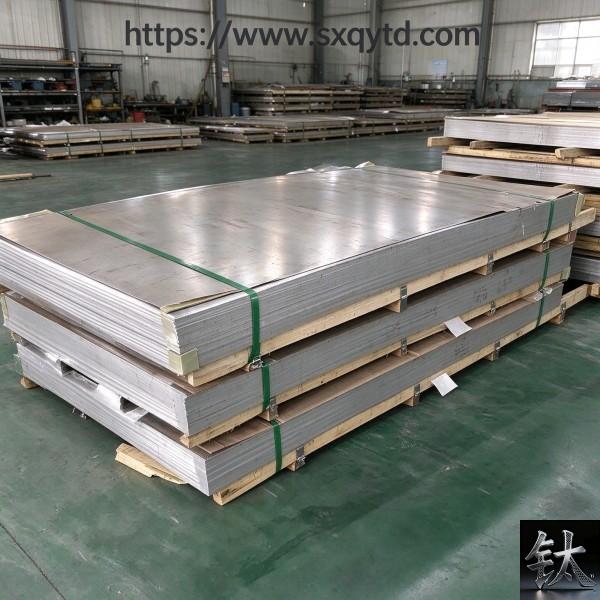
Titanium Pickling and Passivation: How Free Iron Contamination Causes Pitting, and How to Prove the Surface Is Clean
| Specification | ASTM B600 / GB/T 23602 |
|---|---|
| Applicable Standard | free iron contamination / ferroxyl test |
| Material Condition | nitric-HF pickling 10:1 |
| Inspection & Packaging | titanium surface passivation |
Product Description: Free iron on titanium starts pitting that outlives the iron itself. ASTM B600 10:1 nitric-HF pickle, hydrogen limits, ferroxyl testing, 8 failure modes.
Product Overview
Titanium Pickling and Passivation: How Free Iron Contamination Causes Pitting, and How to Prove the Surface Is Clean
Titanium parts almost never fail because the grade was wrong. They fail because somebody cleaned them with a carbon-steel wire brush. An iron particle smeared into a titanium surface sets up a galvanic cell with a potential difference of nearly 0.5 V in hot saturated brine, and the iron dissolves first — but by the time the rust spot disappears, a self-propagating pit is already growing in the titanium underneath. The fix is not a thicker oxide coating; it is a controlled pickle that holds a 10:1 nitric-to-hydrofluoric acid ratio, a neutral rinse, and a documented free-iron test. This article explains the mechanism, the standard that actually governs titanium surface cleaning (ASTM B600, not the stainless-steel passivation specs most purchase orders quote), the eight ways the process goes wrong, and the acceptance tests that prove the surface is clean. If you are buying finished hardware rather than writing a process spec, our pickled and passivated Titanium Fasteners page covers the commercial route; this guide covers the metallurgy and the verification behind it.
At a Glance: Contaminated Surface vs a Properly Cleaned One
| Item | Contaminated / as-machined | Correctly cleaned & passivated |
|---|---|---|
| Protective film | Native TiO2 approx 2-10 nm, interrupted by embedded iron | Continuous, self-healing TiO2 film reformed in air |
| Free iron | Smeared into the surface by steel tools, grit, slings | Removed; ferroxyl / copper sulfate test shows none |
| Local chemistry | Fe/Ti potential gap near 0.5 V in hot brine; acidic micro-zone | No micro-galvanic cell; passivity holds |
| Controlling spec | None (shop soil, heat tint, alpha case remain) | ASTM B600 / GB/T 23602; ASTM F86 for implants |
| Pickle chemistry | Uncontrolled HF-rich bath | 10:1 HNO3:HF volume ratio at approx 49 °C, neutral rinse |
| Hydrogen | Unmonitored pickup, hydride blisters | Increment held to 0.002% (20 ppm) per GB/T 23602 clamping |
| Typical outcome | Rust spots vanish, hidden pits keep growing to perforation | Decades of service in seawater and chloride duty |
| Proof on delivery | Visual check only | Free-iron test + rinse pH + hydrogen + MTR / PMI record |
What Actually Protects Titanium: A 2-10 nm Film That Rebuilds Itself
Titanium is a thermodynamically reactive metal that behaves as if it were noble, because exposure to oxygen or water produces a dense, adherent titanium dioxide film within nanoseconds. That film starts at roughly 1-2 nm and thickens to about 5-10 nm over time; it is chemically stable across approximately pH 2 to 12 and re-forms instantly when scratched, provided oxygen or moisture is available. This is why commercially pure Grades 1 and 2 are effectively immune to pitting in aerated seawater, why chloride stress-corrosion cracking is not a design concern for titanium the way it is for 316L, and why published seawater exposure trials report negligible general corrosion even at very high flow velocities. The important consequence for this article: the corrosion barrier already exists and needs no chemical help to be created. Surface treatment on titanium is therefore a cleaning and verification operation, not a coating operation.
Two useful boundaries follow. First, the film is not infinitely robust: fluoride ions dissolve it, and strongly reducing acids at elevated temperature prevent it from re-forming. Second, the film can be deliberately thickened. Thermal oxidation in air at roughly 593-649 °C for 30-60 minutes grows a rutile TiO2 layer on the order of 1-2 µm — hundreds of times thicker than the ambient film — which is used where hydrogen permeation must be reduced. Colour anodising is different again: it is a thin interference film used for identification coding, not a corrosion upgrade. Confusing these three (native film, thermal oxide, anodised colour) is a common source of over-specified purchase orders.
Grade selection and surface condition are separate decisions. Choosing Grade 2 versus Grade 7 for seawater or Grade 7 versus Grade 12 decides how the alloy behaves in a hot chloride crevice or a reducing acid; pickling decides whether the surface you actually install can deliver that behaviour. A perfectly chosen Grade 7 plate with embedded tool steel in the gasket face will pit before a well-cleaned Grade 2 plate in the same line. Our product-form guides cover the first decision for plate to ASTM B265, tube to ASTM B338, bar to ASTM B348 and wire to ASTM B863.
The “Passivation Adds a Protective Layer” Myth
On stainless steel, passivation is a real chemical step: a nitric or citric bath preferentially dissolves free iron from the surface and enriches the chromium oxide film, and standards such as ASTM A967 define baths, temperatures and acceptance tests around a chromium-to-iron ratio. Buyers carry that mental model to titanium and assume a passivation bath deposits or grows a protective layer that was not there before. It does not. A clean titanium surface grows its own TiO2 film in air; the acid step exists to remove contaminants that prevent that film from being continuous — free iron, heat tint, scale, cutting-fluid residue, graphite and molybdenum-disulphide lubricant, and the oxygen-rich alpha case left by hot working or welding.
Practical definition: on titanium, "passivated" means "chemically cleaned to a verified state, then allowed to re-passivate naturally in air". If a supplier cannot tell you what was removed, what bath ratio was used, what the rinse-water pH was, and which free-iron test was passed, the word on the certificate is marketing, not process control.
Two corollaries matter commercially. Nitrogen-bearing or citric "passivation" baths designed for stainless have no defined role in ASTM B600 and should not be substituted for the nitric-HF route on titanium without qualification. And passivation does not solve galling: titanium-on-titanium threaded joints still need clean threads, matched grades and a dry-film MoS2 or PTFE anti-seize, as set out in our ASTM F468 / F467 fastener torque guide. Anodising for colour coding is also not a substitute — it is identification, not protection. Treating these as interchangeable is how a clean-looking shipment ends up seized on assembly or pitted six months into service.
The ASTM A967 Trap: Why Most Passivation Standards Do Not Apply to Titanium
The single most common error we see on titanium purchase orders is the line "passivate per ASTM A967". A967, ASTM A380, SAE AMS 2700 and the ASME BPE surface requirements are all written for stainless steel. Their chemistry is nitric or citric acid without hydrofluoric acid; their acceptance logic is a chromium-to-iron ratio (ASME BPE calls for Cr:Fe ≥1.3) measured by XPS/AES; their test menu centres on rust staining of free iron on a ferrous substrate. None of those concepts exists on titanium: there is no chromium in the alloy, iron is a contaminant rather than a matrix element, and the oxide is TiO2, not Cr2O3. Specifying A967 on titanium therefore produces a certificate that looks compliant while omitting the three controls that actually matter: fluoride-containing descaling, the nitric-to-HF ratio, and hydrogen pickup monitoring.
The correct documents are narrow and specific. ASTM B600 ("Standard Guide for Descaling and Cleaning Titanium and Titanium Alloy Surfaces") is the governing guide; B600-11 was reapproved in 2017 and B600-22 is the current revision. China’s GB/T 23602-2009 is a modified adoption of the 1991 B600 and was drafted by Baoji Titanium Industry, which is why it is the reference most domestic mills actually work to. ASTM E1447 is the vacuum hot-extraction method for quantitative hydrogen. ASTM F86 covers surface preparation and marking of metallic surgical implants, and is the right callout for F136 implant hardware rather than an industrial nitric passivation. NASA PRC-5010 is a useful aerospace cross-check: it explicitly requires a 10:1 or greater nitric-to-HF ratio per B600 and mandates hydrogen analysis of process coupons whenever that ratio is not maintained.
Write this on the PO instead: "Descale, pickle and clean titanium surfaces per ASTM B600 (or GB/T 23602); nitric:HF volume ratio 10:1; final rinse to neutral pH with DI water; free-iron verification by agreed test; hydrogen increment ≤0.002% verified per ASTM E1447 on lot coupons; supply bath-ratio and rinse-pH records with the EN 10204 3.1 MTR." Name the alloy, product form and whether weld heat tint / alpha case must be removed.
This is not pedantry. When a dispute follows an unexplained leak, the first question an investigator asks is which cleaning standard was invoked. An A967 certificate on a titanium vessel answers a question nobody asked. Our non-standard titanium equipment buyers guide lists the documentation package we ship with fabricated equipment, including the EN 10204 3.1 MTR that ties chemistry and tensile results to a heat number.
How Free Iron Turns a Sound Titanium Part into a Leak
A degradation-mode survey of titanium alloys compiled for the US Department of Energy records the core number: the difference in corrosion potential between low-carbon steel and unalloyed titanium is nearly 0.5 V in saturated brine near its boiling point. That is ample driving force for a local electrochemical cell. The embedded iron becomes the anode and dissolves; the surrounding titanium is the cathode. As iron ions hydrolyse, they release hydrogen ions and create a strongly acidic micro-zone directly against the titanium surface — crevice-corrosion studies on titanium report local pH values as low as 0 to 1 inside active attack sites. The TiO2 film cannot sustain itself at that pH, so it breaks down locally. Once the pit is established, chloride migrates in to maintain charge balance, titanium chlorides hydrolyse to TiO2 plus more acid, and the process becomes autocatalytic.
The genuinely dangerous part is what happens next. The iron is consumed and the visible rust spot disappears. Field reports on titanium immersion heaters describe exactly this deceptive sequence: a temporary rust stain, then a clean-looking surface, with no foreign residue left to find and no change in bulk solution chemistry that liquid sampling could detect. The pit, however, keeps propagating under chloride attack until the wall is penetrated. By the time a leak appears there is no contamination evidence left at the origin, which is why these failures are so often misdiagnosed as "the wrong grade" or "an unexpectedly aggressive batch". Our five real heat-exchanger tube-bundle failure cases shows how this pattern presents in service.
There is a second, slower path that matters even when pitting is not obvious. Each embedded iron smear forms an autonomous micro-cell in which atomic hydrogen is generated on the adjacent titanium cathode and driven into the metal lattice. API 571-style hydriding reviews describe localised hydride blisters or pit-like hydrided craters at these sites, which then initiate through-wall fatigue or vibration cracks — particularly at tube-to-tubesheet roller expansions and at support contact points. Grades with the lowest interstitial content are not immune; the driving force is the galvanic couple, not the alloy chemistry. This is also why tube-sheet material and joint design and ASTM B338 heat-exchanger tube specification belong in the same conversation as surface cleanliness: a poor joint geometry amplifies the consequences of a contaminated surface.
Where Embedded Iron Comes From: A Shop-Floor Contamination Map
Free iron is almost never a mill defect. It is introduced during fabrication, and it is pressed in rather than lying loosely on the surface — which is exactly why wiping or a simple solvent degrease does not remove it. The usual sources, in the order they appear in real fabrication shops: carbon-steel turning and milling tools; steel wire brushes and rotary flap wheels used for deburring or weld cleaning; steel shot or grit blasting media; abrasive cut-off wheels and grinding debris from adjacent carbon-steel work; carbon-steel lifting slings, chains, jigs, fixtures and work tables; machining smear on threads and gasket faces; mixed storage racks where titanium and steel parts touch; and drag marks from handling or transport. On a tube bundle, roller expansion tools and steel support plates are additional culprits; on site, so are steel scaffolds and tools used during installation.
ASTM B600 addresses this directly: where blast cleaning is used, the abrasive must be iron-free (Chinese guidance derived from B600 calls for non-ferrous silica sand with Fe below 0.1%), and blasting must be followed by acid pickling specifically to remove any steel particles the blast may have embedded. The current revision also recommends physically separating blasting and pickling areas so that iron-bearing dust cannot migrate into the clean zone. For precision threads and blind holes, ultrasonic cleaning in deionised water after the acid step is what actually clears trapped residue; a simple hose rinse leaves fluoride and fine particles in the root of the thread.
Prevention is cheaper than verification. Dedicated titanium-only tooling (carbide or non-ferrous brushes), non-metallic or titanium lifting gear, segregated storage, clean gloves after the final rinse, and a written rule that no carbon steel contacts the part after pickling will remove most of the risk. The same discipline applies after welding: the heat-affected zone is the most contamination-sensitive region on the part, and our GTAW shielding and back-purge guide explains why a coloured oxide there is not a protective film and must be removed before service. Note that re-contamination after cleaning is entirely possible — a part that passed a ferroxyl test on Tuesday can fail it on Friday if it was stacked on a steel rack.
Pickling Chemistry: The 10:1 Ratio and Why It Decides Hydrogen Pickup
ASTM B600 section 4.3.2 gives the workhorse final pickle: 10-30 volume percent nitric acid (70%) plus 1-3 volume percent hydrofluoric acid (60%), held at about 49 °C (120 °F), with the bath maintained at ten parts nitric acid to one part HF. The standard’s Note 7 is unusually blunt: the ratio of nitric to hydrofluoric acid is more important than the concentration of either acid, because at 10:1 hydrogen absorption is minimised. Note 10 adds that if 48% HF is used instead of 60%, the ratio should be 8:1. Nitric acid is the oxidising component that keeps the titanium passive while HF does the dissolving; let HF drift upward and the same bath that cleans the part starts charging it with hydrogen.
Other B600 routes handle heavier contamination. After molten-salt conditioning, a 10-40 vol% sulphuric acid bath at roughly 66 °C removes converted scale (B600 4.3.1); sulphuric acid is not appreciably corrosive to titanium and can be inhibited with 0.25-1.0% cupric or ferrous sulphate. Mixed contamination of graphite or MoS2 lubricant with oxide scale is conditioned in a molten salt bath around 204 °C (400 °F) before the nitric-HF brightening dip. For the final removal of metallic iron, B600 4.3.3.1 offers a nitric-only route: 20-25 vol% HNO3 for at least 20 minutes at 49-60 °C, or at least 30 minutes at 21-32 °C. B600-22 additionally introduces a citric-acid option (4.3.3.2). For alpha-case removal, NASA PRC-5010 documents a 30% nitric / 3% HF / 67% water solution and requires visual confirmation that the oxygen-rich layer is gone.
Three shop-floor controls cause most of the failures we are called in to diagnose. First, bath ratio drift: HF is consumed and topped up by eye, so a bath that started at 10:1 quietly becomes 5:1; automatic ratio monitoring with an alarm at a few percent deviation is cheap insurance. Second, residual fluoride: the rinse must be verified to neutral pH with deionised water, because fluoride is precisely the ion that destroys TiO2 passivity — a part can leave the pickle clean and start corroding in storage from its own rinse residue. Third, over-etching: workshops commonly control metal removal to around 0.05-0.1 mm, but thin-wall tube, fine threads and precision bores cannot absorb that; B600’s process-verification clause uses thin flat coupons of the same alloy to measure the day’s etch rate and set the immersion time before production parts enter the bath.
Hydrogen Pickup and Hydriding: The Failure You Cannot See Until It Cracks
Hydrogen enters titanium from four routes that are easy to overlook: an HF-rich or overheated pickle; cathodic over-protection of seawater-cooled equipment; high-temperature alkaline service (published limits cluster above roughly 77 °C at pH >12); and reducing conditions above about 80 °C where the passive film cannot be maintained. Once absorbed, atomic hydrogen precipitates as brittle titanium hydride. Crevice-corrosion research reports substantial hydride layers forming at 70-130 °C, while above about 130 °C hydrogen diffuses deeper into the metal and leaves thinner surface layers — which makes surface inspection a poor detector.
The quantitative control is straightforward. GB/T 23602-2009 clause 6.2 requires the cleaning system to be monitored by chemical analysis of hydrogen on coupons through the process, and states that if hydrogen exceeds the pre-cleaning result by 0.002% (20 ppm) the acid must be changed or its composition adjusted. Chinese commentary on B600-22 describes the permitted increment as having been tightened from 50 ppm to 20 ppm; treat that figure as a summary of the revision and confirm the exact clause in the standard text you are contractually working to. ASTM B600 Note 9 and GB/T 23602 clause 5.9 both allow excess hydrogen to be removed by vacuum annealing of the cleaned workpiece. Quantitative measurement is by vacuum hot extraction per ASTM E1447, using calibrated ppm standards in a competent laboratory — not by a workshop hardness check.
The in-service version of the same problem is cathodic protection. In seawater condensers with carbon-steel water boxes, sacrificial anodes or impressed-current systems installed to protect the steel can polarise titanium tube ends past the hydrogen-evolution boundary — published figures place it around −0.90 to −1.00 V vs a copper/copper-sulphate electrode (approx −0.85 V vs SCE), with the exact value depending on the reference electrode. Over-protection drives through-wall hydriding of tube ends even in cool water. This is a design issue, not a cleaning issue, and it belongs in the same review as tube-sheet and joint selection and tube-bundle failure analysis: electrically isolate the titanium from steel, cap the CP potential, and never assume that "more cathodic protection" is safer for a titanium bundle.
Verification and Acceptance: How to Prove the Surface Is Clean
Verification should be layered, and the purchase order must name the test and the acceptance criterion in advance — otherwise the supplier’s default (usually a visual check) becomes the standard by omission.
Layer 1 — visual and process records
ASTM B600 clause 6.1 and its GB/T equivalent require the cleaned material to show no paint, oil, grease, glass, graphite, lubricant, dirt, abrasive, iron or other contamination on visual inspection. Alongside it, file the bath ratio log, immersion time and temperature, rinse-water pH and conductivity record, and the coupon etch-rate result. These records are what make an investigation possible six months later; without them, every failure becomes an argument about opinion.
Layer 2 — free-iron spot tests
The ferroxyl test (potassium ferricyanide in nitric acid) turns Turnbull’s blue where Fe2+ is present and is the most sensitive free-iron indicator available. Its drawbacks are real: the reagent is toxic, must be completely removed afterwards, and is unsuitable as a routine release test on product-contact or food-contact surfaces. The copper sulfate test (roughly 8% CuSO4, six minutes of contact) plates a visible pink copper deposit where free iron remains, and is fast for in-line checking. A water-break check — a clean surface holds an unbroken water film — is the simplest degreasing indicator. Be precise about provenance: ferroxyl, copper sulfate, water immersion, high humidity and ASTM B117 salt spray are the acceptance tests defined in ASTM A967 / A380 for stainless steel. Industry commonly borrows the free-iron spot tests for titanium because the chemistry detects Fe regardless of substrate, but the formal cleanliness criteria for titanium come from B600 / GB/T 23602, not A967. State this explicitly in the PO so nobody certifies a Cr:Fe ratio on a titanium part.
Layer 3 — exposure and coupons
A high-humidity cabinet at 98 ±2% relative humidity and 49 ±3 °C for 24 hours, water immersion, or an agreed ASTM B117 salt-spray duration will reveal rust staining from contamination that a spot test missed. B600 / GB/T 23602 also describe a chemical-milling coupon: remove about 0.025-0.05 mm from each surface of a same-alloy test piece and confirm the result is uniformly smooth and bright with no raised scale or contamination. For implants and high-purity systems, ISO 16232 / VDA 19 particle-count cleanliness verification and ASTM E1447 hydrogen analysis are the quantitative layer, with handheld XRF PMI confirming that the grade on the tag matches the part. Allow at least 24 hours after passivation before acceptance testing: the passive film continues to stabilise in air, and testing straight off the rinse can fail a lot that would pass comfortably a day later.
Finally, distinguish the two documents a buyer actually receives. An EN 10204 3.1 mill test certificate proves the chemistry and tensile properties of the heat the material came from; it says nothing about the condition of this particular surface after machining. The surface release package — free-iron result, rinse pH, hydrogen analysis if specified, bath record, and PMI report — is a separate deliverable and should be requested explicitly.
Limitations and Failure Conditions: Where This Process Breaks
Pickling and passivation fix contamination; they do not change alloy chemistry, design geometry or the service environment. The eight conditions below are organised by medium and shop-floor situation, in the order they appear in real RFQs and failure reports. Each one has produced leaks in equipment whose material certificate was entirely correct.
Residual fluoride from an incomplete rinse
The most self-inflicted failure on this list. HF is the cleaning agent that makes the pickle work, and fluoride is also the ion that most aggressively destroys TiO2 passivity — published corrosion data report attack at concentrations as low as roughly 0.1%. Blast-cleaning residue, blind holes, threaded roots and tube-bundle crevices trap acid that a hose rinse will not clear. Require a measured neutral rinse-water pH, an ultrasonic or high-flow DI-water final rinse for complex geometry, and drying before stacking. A part that leaves the bath clean but wet with dilute HF can pit in storage, before it is ever installed.
HF-rich bath, lost 10:1 ratio and hydrogen pickup
When the nitric-to-HF ratio is allowed to drift, hydrogen absorption climbs sharply and the part can leave the shop with hydride embrittlement that no visual inspection detects. Chinese guidance derived from B600 reports hydrogen permeation increasing several-fold when the ratio deviates beyond roughly 15%; NASA PRC-5010 handles the same risk by requiring hydrogen analysis on same-lot coupons whenever 10:1 is not maintained. Monitor the ratio automatically, sample hydrogen per ASTM E1447, and use vacuum annealing where an increment above 0.002% is measured. Do not "fix" an over-etched part by pickling it again.
Embedded iron in hot chloride crevices and under deposits
This is the classic delayed perforation. Gasket faces, lap joints, tube-to-tubesheet expansions, support contacts and under-deposit zones concentrate chloride and become acidic; titanium Grade 2 crevice-corrosion thresholds in seawater are commonly quoted near 82 °C, above which Grade 7 or Grade 12 is the correct alloy choice. Embedded iron lowers the local threshold still further. The rust stain vanishes, the bulk water analysis stays normal, and the pit grows until it leaks. Design the crevice out, choose the grade on the crevice condition, and verify surface iron before commissioning — see the tube-bundle failure cases.
Hydrofluoric acid and fluoride-bearing process streams
A hard material boundary, not a surface-preparation problem. Titanium has no useful resistance to HF or acidic fluoride solutions; the reaction forms soluble titanium fluorides and there is no effective inhibitor. Note the awkward irony: the correct pickle contains HF at low concentration under strict oxidising control, while the service environment must contain essentially none. Fluoride complexed as cryolite or bound in a stable fluorocarbon such as PTFE is far less aggressive, which is why PTFE-lined and PTFE-jacketed components appear in fluoride duty. If the process stream carries free fluoride, change material family — zirconium or a lined system — rather than specifying a better pickle.
Dry chlorine, red fuming nitric acid and hot concentrated sulphuric acid
These are the red lines on every titanium data sheet. Wet chlorine is a normal titanium service; dry chlorine reacts exothermically to TiCl4 and can ignite, with the minimum moisture needed for passivity rising from roughly 0.3-0.4% at room temperature to above 1.5% at 200 °C. Red fuming nitric acid with insufficient water can cause spontaneous combustion. Hot concentrated H2SO4 (broadly above 80 °C at >50%) and strongly reducing HCl at temperature are outside the useful range for unalloyed grades. No amount of passivation changes any of these boundaries; they are grade-and-environment limits covered in our Grade 7 vs Grade 12 comparison.
Cathodic over-protection and galvanic coupling to carbon steel
In seawater-cooled condensers, protecting a carbon-steel water box with sacrificial anodes or impressed current can drive titanium tube ends into the hydrogen-evolution regime (approx −0.90 to −1.00 V vs CSE, depending on reference electrode) and produce through-wall hydriding at moderate temperatures. The same physics applies when titanium is expanded directly into a carbon-steel tube sheet without electrical isolation. Use solid or clad titanium tube sheets, non-conductive dielectric sleeves and insulated flange kits, and put a hard ceiling on CP potential in the operating procedure. This failure is designed in, not cleaned off.
Alpha case and weld heat tint left in place
Hot working, heat treatment and welding in air produce an oxygen-rich brittle surface layer (alpha case) and a coloured oxide scale. Neither is the protective passive film: the coloured layer is thicker, defective and corrodes preferentially, and alpha case cracks under forming or fatigue. B600 Note 8 requires complete removal of residual oxide and scale before final pickling to avoid preferential etching; NASA PRC-5010 requires visual confirmation that alpha case is gone. Remove heat tint mechanically or by a controlled nitric-HF pickle, then re-verify the surface. Our GTAW shielding and back-purge guide covers preventing the tint in the first place, which is always cheaper than removing it.
Re-contamination after cleaning: tools, handling, stacking and packaging
Cleanliness is a state with a shelf life. A part that passes ferroxyl on the bench can pick up free iron from a steel rack, a carbon-steel sling, a shared deburring wheel, bare-hand handling, or contact with steel fittings during assembly and packing. B600-22 guidance recommends physically separating blasting and pickling zones for this reason. Specify dedicated non-ferrous tooling downstream of the pickle, clean gloves, segregated packaging and a documented final free-iron check as close to dispatch as practical. Where site installation involves steel scaffolding or supports, repeat the check after erection and before commissioning.
Application Map and How to Specify
Match the level of surface control to the consequence of failure. Chemical process equipment and chlor-alkali: full B600 pickle, documented free-iron test, neutral-rinse record and coupon hydrogen check on welded assemblies; weld heat tint and alpha case removed before service. Seawater, desalination and heat-exchanger bundles: same surface route plus a hard CP potential limit and electrical isolation from carbon-steel tube sheets; verify ASTM B338 exchanger tubes on arrival rather than assuming mill finish is clean. Marine and subsea hardware: consider thermal oxidation where hydrogen permeation is a design concern, and re-check free iron after installation.
Pharmaceutical, food-contact and high-purity systems: avoid ferroxyl and copper-sulfate reagents on product-contact surfaces — use water-break, high-humidity exposure, rinse-water conductivity/TOC trending and documented borescope comparison instead; polished plus passivated surfaces with a stated Ra. Surgical implants (F136 / Grade 23 ELI): invoke ASTM F86-type surface preparation explicitly on the order, with ISO 16232 / VDA 19 particulate cleanliness and traceable lot records; industrial nitric passivation is not an implant protocol. Fasteners and small precision parts: control etch depth tightly, use ultrasonic DI rinse for threads and blind holes, and pair the clean surface with dry-film anti-seize per our fastener torque guide; our pickled and passivated fastener line ships this route as a finished product.
Give the fabricator a one-page brief and you will get a real process rather than a guess: alloy and UNS number; product form and minimum wall; what contamination is present (scale, heat tint, alpha case, lubricant, free iron); whether the part is welded; maximum allowable metal removal; the required cleaning standard and revision; the agreed acceptance test and its pass criterion; hydrogen limit and analysis method; rinse-water requirement; and the documentation package. For plate, tube, fittings and flanges bought as stock rather than as a service, the corresponding specification guides — B265 plate, B338 tube, B363 fittings, ASME B16.5 flanges — set the base condition that the surface route must preserve.
| Situation | Required route | Proof to request |
|---|---|---|
| As-rolled / as-drawn mill stock, no fabrication | Visual inspection; clean only if shop soil or iron is found | EN 10204 3.1 MTR, PMI |
| Machined with shared carbon-steel tooling | Degrease → 10:1 nitric-HF pickle → neutral DI rinse → passivate in air | Ferroxyl or CuSO4, rinse pH record |
| Welded assembly with heat tint | Remove tint / alpha case, then full B600 pickle | Visual alpha-case check, coupon H per E1447 |
| Hot-worked part with scale + graphite / MoS2 | 204 °C salt-bath conditioning → H2SO4 → nitric-HF brighten | Etch-rate coupon 0.025-0.05 mm, visual |
| Thin-wall tube, fine thread, precision bore | Nitric-only final clean (B600 4.3.3.1) or citric option; ultrasonic DI rinse | Dimensional check, neutral pH, water-break |
| F136 surgical implant | ASTM F86-type protocol named on the PO | Particulate cleanliness, full lot traceability |
| Product-contact / food surface | Avoid ferroxyl & CuSO4 reagents on contact faces | Water-break, humidity exposure, conductivity/TOC |
Summary: Choose a Full Pickle if, Choose a Light Clean if
Choose a full B600 pickle + documented passivation + verification if:
- The part has been machined, ground, blasted or handled with carbon-steel tools or slings.
- There is weld heat tint, alpha case, hot-work scale or graphite / MoS2 lubricant on the surface.
- Service is hot chloride, seawater, brine, reducing acid or any environment where a single pit becomes a leak.
- The specification, customer audit or regulated industry requires a free-iron test and a surface release record.
- The consequence of a pinhole leak (shutdown, contamination, safety) dwarfs the cost of the cleaning step.
Choose degreasing / a light nitric-only clean (or no acid at all) if:
- The material is clean mill stock that has never contacted ferrous tooling and shows no iron on a spot test.
- The part is thin-wall, fine-threaded or dimension-critical and cannot tolerate measurable metal removal.
- No welding or hot work has occurred, so there is no heat tint or alpha case to strip.
- The duty is mild and dry, and the part will be cleaned again as part of a validated downstream process.
- You cannot guarantee a neutral DI rinse and thorough drying — a badly rinsed pickle is worse than no pickle.
The one-line rule: specify what must be removed, how it will be removed, and how you will prove it is gone — and never write "passivate per ASTM A967" on a titanium order. We hold roughly 800 tonnes of titanium, nickel and zirconium stock in Baoji, cut to non-standard sizes, work from customer drawings, certify to ASTM / ASME / GB with traceable MTR and PMI, and ship export orders the same day. If you need a surface condition rather than just a size, tell us the alloy, product form, what the part has been through in the shop, and the acceptance test your customer will apply; we will quote the cleaning route and the documentation together. Request a quote →
Frequently Asked Questions
Does titanium actually need passivation?
Not in the stainless-steel sense. Titanium forms a self-healing TiO2 film in air within nanoseconds, so no chemical bath is needed to create protection. What is needed on fabricated parts is cleaning: remove free iron, heat tint, scale, alpha case and lubricant residue so that the native film can be continuous. Many chemical, marine and pharmaceutical specifications require a documented pickle and passivation step for exactly that reason, not for cosmetic or coating purposes.
Can I write "passivate per ASTM A967" on a titanium purchase order?
No. ASTM A967, ASTM A380, SAE AMS 2700 and ASME BPE are stainless-steel documents built around chromium-to-iron surface ratios; titanium has neither a chromium oxide film nor a chromium-rich matrix. The correct callout is ASTM B600 (or GB/T 23602-2009 in China) for descaling and cleaning, ASTM E1447 if hydrogen must be measured, and ASTM F86-type surface preparation for F136 surgical implants. A967-based tests may be borrowed as free-iron spot checks, but that should be stated explicitly rather than assumed.
What nitric-to-HF ratio and temperature should the pickle use?
ASTM B600 section 4.3.2 specifies 10-30 vol% nitric acid (70%) with 1-3 vol% hydrofluoric acid (60%) at about 49 °C (120 °F), maintained at a 10:1 nitric-to-HF volume ratio. Note 7 states that the ratio matters more than either concentration because it minimises hydrogen absorption; Note 10 gives 8:1 if 48% HF is used. For final removal of metallic iron, B600 4.3.3.1 offers 20-25 vol% nitric acid for at least 20 minutes at 49-60 °C or 30 minutes at 21-32 °C.
How do I test whether free iron has actually been removed?
Use a layered approach. Visual inspection per B600 clause 6.1 comes first. The ferroxyl (potassium ferricyanide) test is the most sensitive free-iron indicator and turns blue where Fe2+ is present, but the reagent is toxic, must be fully removed, and is unsuitable as a routine release test on product-contact surfaces. The 8% copper sulfate test shows a pink copper deposit within six minutes where free iron remains. A water-break check confirms degreasing. Follow with a high-humidity exposure (98 ±2% RH at 49 ±3 °C for 24 h) and wait at least 24 hours after passivation before acceptance testing.
How much hydrogen pickup is acceptable, and what if it is exceeded?
GB/T 23602-2009 clause 6.2 requires hydrogen to be monitored by chemical analysis through the cleaning process and states that if hydrogen exceeds the pre-cleaning value by 0.002% (20 ppm), the acid should be changed or its composition adjusted. Chinese commentary on B600-22 describes the permitted increment as tightened from 50 ppm to 20 ppm; confirm the exact clause in the standard revision named in your contract. Measure by vacuum hot extraction per ASTM E1447. ASTM B600 Note 9 and GB/T 23602 clause 5.9 both allow excess hydrogen to be removed by vacuum annealing of the cleaned workpiece.
Will pickling remove weld heat tint and alpha case?
Yes, if the bath and time are specified for it, but it must be verified visually. Heat tint is a coloured, defective oxide — not the protective passive film — and alpha case is a brittle oxygen-rich layer left by hot working or welding in air. B600 Note 8 requires all residual oxide and scale to be removed before final pickling to prevent preferential etching, and NASA PRC-5010 documents a 30% nitric / 3% HF / 67% water solution with a visual alpha-case check. Prevention by proper inert shielding is cheaper; see our GTAW shielding and back-purge guide.
Can pickling repair pitting that has already started?
No. Acid cleaning removes contamination from the surface; it cannot restore metal lost to an active pit, and putting a pitted part into an HF-containing bath can accelerate attack at the pit root. Once iron-driven pitting or hydriding is established, the affected area must be assessed by NDT, excavated and weld-repaired under qualified procedures, or the component replaced. This is why the free-iron test belongs before commissioning rather than after the first leak, and why a documented rinse pH and hydrogen record matter when a failure is investigated.
Tell us your requirement — grade, size and quantity. We reply within 24 hours.
Prefer chat? WhatsApp +86 188 2967 9311 or email sales@sxqytd.com.
- What is Titanium Flange | ASME B16.5 ASTM B381 Gr2 Gr5 Titanium Flan
- ASME B16.5 Titanium Flange Grade2 DN100-DN600 Class150/300 FOB
- Gr2 Titanium Sheet Price FOB Shanghai | ASTM B265 In Stock
- Titanium Price Today (Oct 26, 2026): China Market Report
- Titanium Price Today (23 Oct 2026): Plate, Tube, Rod & Wire
Contact Person: Wang Xiaoning
Tel: +86-917-355-7966
Email: sales@sxqytd.com
WhatsApp: +86 188 2967 9311
Company: Shaanxi Qianyi Tuoda Technology Co., Ltd
Address: Floor 4, Building 4, No. 188 Gaoxin Avenue, High-tech Zone, Baoji City, Shaanxi Province, China