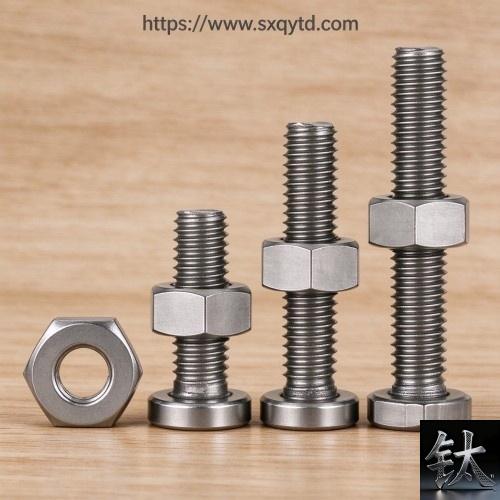
Titanium Fasteners: ASTM F468 / F467 Guide to What the Torque Spec Does Not Tell You
| Specification | Product Forms: Hex bolt, socket head cap screw, stud bolt, fully/partially threaded screw, hex nut, flange nut (DIN 6926), washer |
|---|---|
| Applicable Standard | Grades Covered: Gr2 (R50400), Gr5 (R56400), Gr7 (R52400), Gr9 (R56320), Gr12 (R53400), Gr23 ELI (R56401) |
| Material Condition | Governing Standards: ASTM F468 / F467, F468M / F467M (metric), ASME B18.2.1, B18.2.3.x, B18.3, EN 10204 3.1 |
| Inspection & Packaging | Decision Boundaries: F468/F467 = material + mechanical only, torque from nut-factor K, modulus ~110 GPa, galling = bolt+nut+lube, UNR thread, one-time reuse |
| Reference Price | $100.00 – $300.00 |
Product Description: F468/F467 set titanium fastener strength, not clamp force. See what they hide: K-factor torque, lower modulus, galling pairing, UNR thread, reuse; 8-field RFQ.
Product Overview
Titanium Fasteners: What ASTM F468 and F467 Do Not Tell You
ASTM F468 and F467 define what a titanium fastener is - its grade, tensile and yield strength, proof load, UNR thread form and dimensions through ASME B18.2.1 - but not what the joint needs: the torque that becomes clamp. F468 covers bolts, screws and studs; F467 covers nuts; grades run Gr2, Gr5, Gr7, Gr9, Gr12 and Gr23. The number buyers reach for, torque, is set by a nut factor K the standards never name: dry titanium runs K ≈ 0.20-0.25, lubricated ≈ 0.12-0.18, and titanium's modulus (~110 GPa) is barely half steel's (~200 GPa), so it loses more preload to embedding. Here is what the spec leaves to your purchase order.
| Item | What F468 / F467 State (and Do Not) |
|---|---|
| Scope | F468 = bolts, screws, studs (external thread); F467 = nuts (internal thread). Both titanium, both material/mechanical specs. |
| Grades | Gr2 (R50400), Gr5 (R56400), Gr7 (R52400), Gr9 (R56320), Gr12 (R53400), Gr23 ELI (R56401). |
| Tensile, min | Gr2 345 MPa / 50 ksi; Gr5 895 MPa / 130 ksi; Gr7 345 MPa; Gr9 620 MPa; Gr12 483 MPa; Gr23 860 MPa (approx, per grade). |
| Yield, min | Gr2 275 MPa / 40 ksi; Gr5 828 MPa / 120 ksi; Gr7 275 MPa; Gr9 438 MPa; Gr12 345 MPa (approx). |
| Thread form | UNR (controlled root radius) per F468; UNC/UNF pitch; metric F468M / F467M. |
| Dimensions | ASME B18.2.1 (hex), B18.2.3.x, B18.3 (socket); DIN / ISO metric forms. |
| Torque relation | T = K × D × F. K dry ≈ 0.20-0.25, K lubricated ≈ 0.12-0.18. F468 sets neither K nor T. |
| Modulus | Ti ≈ 103-113 GPa vs steel ≈ 200 GPa (≈ 1.8× more elastic stretch). F468 is silent on this. |
| Proof load | ≈ 0.90 × yield (typical; confirm per grade and diameter). Not a working clamp target. |
| Reuse | Generally one-time use in critical joints - breakaway galling on removal is common. |
The "Torque" Myth: F468 Sets Strength, Not Clamp
The torque you apply and the clamp you get are linked by a single awkward fact: most of the torque is eaten by friction, not turned into stretch. The relation is T = K × D × F, where T is torque, D is nominal diameter, F is the target clamp (preload) and K is the nut factor - a stand-in for thread-flank and under-head friction. F468 tells you the bolt will not break below its tensile strength; it does not tell you K, because K depends on lubrication, surface finish and the mating nut, none of which the bolt spec controls.
That matters because titanium sits at the high end of K. A dry titanium fastener typically runs K ≈ 0.20-0.25; the same fastener with molybdenum-disulfide (MoS2) anti-seize drops to K ≈ 0.12-0.18. A steel torque table assumes K ≈ 0.15-0.20. Use a steel table on a dry titanium bolt and you under-preload it (the joint walks loose); use a steel "dry" value on a lubricated titanium bolt and you over-stretch it past yield. Neither failure shows up as a broken head - it shows up as a joint that will not hold, which our flange bolt-and-gasket selection guide covers from the mating-flange side.
Two rules follow. First, size torque from K and the target clamp, not from a generic table; target roughly 70% of yield for the preload and treat the proof load as a ceiling, not a working value. Second, when you change lubrication, re-derive the torque - the ~20% dial-down from dry to lubricated is the difference between a sound joint and a yielded shank. The ASME B16.5 flange guide uses the same T = K×D×F logic for flange bolting, so the physics transfers directly.
What ASTM F468 and F467 Actually Specify
F468 is the specification for externally threaded Titanium Fasteners - bolts, screws and studs. F467 is the companion for internally threaded nuts. Both are material and mechanical-property specifications; they are not dimensional standards. The actual sizes, head dimensions and across-flats come from ASME B18.2.1 for inch hex products, ASME B18.2.3.x for specific geometries, ASME B18.3 for socket products, and DIN / ISO equivalents for metric forms. Metric editions exist as F468M and F467M.
The grades and their minimum properties are the part buyers quote most often. The values below are minimums reproduced from publicly available F468/F467 summaries and should be confirmed against the edition cited in your contract:
| Grade | Tensile min | Yield min (0.2%) | Elong. min | Typical use |
|---|---|---|---|---|
| Gr2 (R50400) | 345 MPa / 50 ksi | 275 MPa / 40 ksi | 20% | Low-load, formability, low cost |
| Gr5 (R56400) | 895 MPa / 130 ksi | 828 MPa / 120 ksi | 10% | Max strength-to-weight, aerospace |
| Gr7 (R52400) | 345 MPa / 50 ksi | 275 MPa / 40 ksi | 20% | Reducing acids, chlorides (Pd added) |
| Gr9 (R56320) | 620 MPa / 90 ksi | 438 MPa / 70 ksi | 15% | Higher temp, good cold work |
| Gr12 (R53400) | 483 MPa / 70 ksi | 345 MPa / 50 ksi | 18% | Gr7 alternative, lower cost |
| Gr23 ELI (R56401) | 860 MPa / 125 ksi | 795 MPa / 115 ksi | 10% | Medical, fracture toughness |
The base Titanium Fasteners guide and the F467 nut guide already walk through these grades and the dimensional forms in depth, so this article does not repeat them; it picks up at the point where the certificate stops being useful - the joint. The bolts-and-screws guide adds head styles and thread series if you need them. Metric editions exist as F468M and F467M and carry the same grade and property intent under SI units; if your project is metric, cite the M edition explicitly so the inspector reads the same numbers you quoted.
Proof Load Is a Ceiling, Not a Clamp Target
F468 lists tensile, yield and proof load as minimums - and stops there. Proof load is the axial load at which the fastener must not take permanent set; it is a quality ceiling used in proof testing, not the clamp you should run in service. A common error is to treat "proof load" and "working clamp" as the same number and torque straight to the proof value. That leaves no margin for the friction scatter inherent in titanium assembly, and it pushes the joint to the edge of yield on every tighten.
The working target sits well below proof: roughly 70% of yield for the installed preload, with proof load held in reserve as the failure ceiling. Because K scatters more on titanium than on steel, the same nominal torque can land anywhere across a band of actual clamps - another reason to specify the target clamp and the K you used, rather than a single torque figure. None of this appears in the F468 table; it is assembly engineering the standard expects you to add. Our chemical-flange stud bolts are quoted against a stated clamp target for exactly this reason.
When "Grade 5" Is Not Enough - Choose by Joint, Not Catalog
Grade 5 (Ti-6Al-4V) is the strongest and most quoted titanium fastener grade, but "strongest" is not the same as "right". Three cases pull you off Gr5. First, cold-formed fasteners and parts needing high ductility are easier in commercially pure Gr2. Second, reducing-acid or chloride services call for Gr7 (palladium-added) or Gr12 as a lower-cost stand-in, because corrosion - not strength - is the life limit. Third, medical and some aerospace parts specify Gr23 ELI for fracture toughness and interstitial control. The Gr2 bolt-nut-washer sets, marine-environment screws pages cover those duty splits in detail.
The trap is specifying Gr5 everywhere "because it is the good one" and then fighting galling and cost on a joint that only needed Gr2. Strength rarely fails a titanium fastener; the joint around it does. Pick the grade by the failure mode you are actually defending against - corrosion, fatigue, or load - and let the torque and lubrication do the rest.
The Modulus Gap: Why a Titanium Bolt Loses Preload Differently
Titanium's modulus of elasticity is roughly 103-113 GPa; steel's is about 200 GPa. For the same clamp force F, a titanium bolt elongates about 1.8 times more than a steel one. That single number changes assembly behavior in a way F468 never mentions. More of your tightening rotation goes into stretching the bolt and less into seating the joint, so the small amount of embedment and relaxation at the threads and bearing faces - which happens on every first tighten - consumes a larger share of the preload you just installed.
The stiffness ratio matters as much as the stretch. A bolt and a joint share an external load in proportion to their spring rates; titanium's lower modulus makes the bolt the softer spring, so a given load sheds more of it into the bolt and less stays as clamp. On a joint that sees vibration or thermal cycling, that shift is what lets the fastener loosen. Design for it with longer engaged thread and a hardened washer to spread bearing load - small geometry choices the material spec never mentions.
The practical consequence is a re-torque step. After the first load or thermal cycle, check the torque; titanium's extra stretch means it relaxes more than steel would, and a one-time check catches the loss before the joint goes slack. This is not in the fastener specification and is rarely on a generic installation card, yet it is the difference between a titanium joint that stays put and one that weeps. Our chemical-flange stud bolts are quoted with this relaxation in mind for cyclic petrochemical duty.
Galling Is a Pairing Problem, Not a Bolt Problem
Galling - the cold-welding of mating threads under load - is the failure mode Titanium Fasteners are famous for, and it is the clearest example of something F468 does not cover. The standard specifies the bolt. It does not specify the nut grade, the surface finish, or the lubrication, and those three are what decide whether the threads seize. Dry titanium-on-titanium is the worst case; titanium against aluminium or stainless also galls. The fix is never "a better bolt" - it is the combination.
Two actions close it. Always run an anti-seize (MoS2, wax, or graphite-based) on the threads and under the head, unless the design explicitly forbids it; and pair the nut deliberately - a Gr5 bolt wants a nut of comparable galling resistance, not a soft or mismatched one. Passivation helps corrosion resistance but does not, by itself, stop galling, which is why our assembly-accident write-up and the passivation-treatment page treat the two as separate controls.
Verify it before shipment, not after. A galling-risk review should sit in incoming inspection: confirm the nut grade matches the bolt, confirm anti-seize is specified, and confirm the thread form is UNR. Those three lines in the PO turn a famous titanium failure mode into a controlled one - and they are exactly the lines F468 leaves blank.
The UNR Root-Radius Rule Most Buyers Skip
F468 specifies a UNR thread form for external threads - a controlled root radius rather than the flat-bottom root of a plain UNC thread. That radius is not decorative. It raises fatigue strength at the thread root and reduces the chance of thread stripping and galling during make-up. If your purchase order simply says "UNC" or omits the thread form, you can receive a fastener that meets the letter of F468 only loosely and loses the fatigue margin the standard intended.
Write the thread form explicitly: UNR, with the series (UNC/UNF) and class. The point is small on paper and large in service, especially for high-strength flange nuts and any fastener seeing vibration. It is one line in the PO and one fewer field failure.
Where a Titanium Fastener DOES Fail
F468 tells you the bolt will not break in tension below its rated strength. It does not tell you the ways it actually fails in the field. The six below are the ones to design the purchase order against - none of them is a "bad bolt", all of them are a missing specification.
Dry installation galling
Threads run without anti-seize; the flanks cold-weld before the clamp builds. Write "MoS2 or approved anti-seize on all threads and under head" into the PO.
Over-torque past yield
A steel "dry" torque value applied to a lubricated titanium bolt over-stretches the shank past its 0.2% offset. Write the target clamp and the K you used, not just a torque number.
Breakaway galling on removal
The fastener seizes when loosened, so it cannot be re-used. Write "single-use in critical joints; do not re-torque without inspection" for safety-related assemblies.
Wrong or mismatched nut
A Gr5 bolt with a soft or non-titanium nut strips or galls at the nut. Write the nut grade and standard (F467) explicitly, matched to the bolt.
Marine crevice and chloride seizing
Threads in seawater trap chloride; crevice corrosion plus mechanical seizing locks the joint. Write the service envelope (medium, concentration, temperature) so grade and coating are chosen against it - see our marine screws guidance.
Hydrogen embrittlement from pickling or plating
Acid pickling or electroplating without a proper bake can introduce hydrogen. Write "no unchecked pickling/plating; bake per accepted practice if plated" when any coating is specified.
Choose Grade 2 if / Choose Grade 5 if / Choose Grade 7 if
The grade decision is the one place a one-line rule helps. Tick the block that matches your duty:
Choose Gr2 if the load is low to moderate, you need easy forming or cold heading, budget matters more than strength, or the fastener is non-structural. It is the default commercially pure choice and the basis of our Gr2 sets.
Choose Gr5 if strength-to-weight is the constraint - aerospace, racing, or any joint where you must hold high clamp in a light package. Pair it with deliberate lubrication and nut matching, or its galling tendency outweighs the strength gain.
Choose Gr7 if the service is reducing acid, chloride, or mixed chemical duty where Gr2 would pit or crevice. Gr12 is the lower-cost substitute when the full Gr7 margin is not required. For medical or high-toughness needs, specify Gr23 ELI. Feedstock for these comes from our aerospace fastener rod and B348 bar lines, which is where the grade is first locked in.
The 8-Field RFQ: What F468 Does Not Say You Must Add
A conforming F468/F467 fastener is necessary and not sufficient. The standard hands you a bolt that meets a material and strength floor; it does not hand you a joint. The eight fields below are the ones the spec leaves blank, and they are the ones that decide whether the assembly holds. Put them into the inquiry and the quote stops being a catalog guess:
- Standard and grade - F468 (or F468M) Gr5 (R56400), with UNS and any H-condition; paired nut to F467.
- Form and head - hex bolt, socket cap screw, stud, fully/partially threaded; head style and drive.
- Size and thread - diameter, length, thread series (UNC/UNF), class, and UNR root form stated.
- Quantity and lot - batch size, whether full inspection or lot acceptance, and traceability needs.
- Finish and lubrication - passivation, anodize, or coating for corrosion; anti-seize (MoS2) for assembly; state both, they are different controls.
- Nut and mating pairing - the nut grade and the mating material, so galling is designed out, not discovered.
- Service envelope - medium, concentration, pH, temperature, cyclic or sour duty, so grade and coating match the real job.
- Inspection and certificate - EN 10204 3.1, chemistry, dimensions, and any NDT (F468 itself does not require NDT on the fastener).
The same "spec leaves it to the PO" logic applies one level up, at the fitting: our B363 fittings guide makes the parallel point that a material standard does not state geometry or pairing. Send those eight fields - plus the drawing and the mating-part bolt pattern - to our inquiry desk; we return a torque basis (K and target clamp), the nut pairing, and what the EN 10204 3.1 certificate will actually record before any order is placed. Non-standard fasteners by drawing and M6-M10 hex bolts are quoted on the same eight fields.
Frequently Asked Questions
Does ASTM F468 specify the torque for a titanium bolt?
No. F468 and F467 set material, mechanical properties, thread form and (via referenced standards) dimensions. Torque depends on the nut factor K - friction at the threads and under the head - which the bolt specification does not control. Derive torque from T = K × D × F using the lubrication you will actually use, not from a generic steel table.
Can I reuse a titanium fastener after removing it?
Generally no, not in critical joints. Titanium tends to gall on breakaway, so removal can damage the threads and the mating nut. Treat Titanium Fasteners as single-use where safety or sealing matters, and inspect before any re-torque.
Why does my titanium bolt gall even when torqued to spec?
Because galling is a pairing problem, not a torque problem. Dry titanium-on-titanium (or titanium-on-aluminium/stainless) cold-welds under load regardless of torque. The control is anti-seize lubrication and a deliberately matched nut, neither of which F468 specifies.
Is Grade 5 always the right choice for titanium fasteners?
No. Gr5 is the strongest but not always right: Gr2 for low load and formability, Gr7 (or Gr12) for reducing-acid and chloride service, Gr23 ELI for medical and toughness. Choose the grade by the failure mode - corrosion, fatigue or load - not by "strongest".
What does UNR mean and do I need it?
UNR is a thread form with a controlled root radius, specified by F468 for external threads. The radius raises fatigue strength and reduces thread stripping and galling versus a flat-bottom UNC root. State UNR explicitly in the PO for vibration or high-cycle joints.
How much clamp force do I actually get from a given torque?
It depends almost entirely on K. The same torque gives less clamp on a dry titanium fastener (high K) than on a lubricated one (low K), and a steel torque table will mis-size a titanium joint. Compute clamp from T = K × D × F with your actual K, and target roughly 70% of yield.
Do titanium fasteners need a coating or passivation?
Two different controls. Passivation or anodize improve corrosion resistance; they do not stop assembly galling. Anti-seize (MoS2, wax or graphite) is the assembly control that prevents thread seizure. Specify both when relevant - one is for the environment, the other for the joint.
Summary
ASTM F468 and F467 tell you what a titanium fastener is; they do not tell you what the joint needs. Five things the spec leaves to your purchase order: the torque-to-clamp relation (set by nut factor K, not the standard), the modulus gap that drives re-torque after first cycle, galling as a bolt-plus-nut-plus-lube combination, the UNR root-radius thread form, and the one-time reuse limit. None of these is a "bad bolt" - each is a missing line in the PO. Pick the grade by duty (Gr2 low-load, Gr5 strength, Gr7 chloride/acid), lubricate deliberately, pair the nut on purpose, and send the eight-field RFQ - standard, grade, form, size/thread, quantity, finish/lube, nut pairing, service envelope, certificate - to our inquiry desk so the quote states a torque basis and a certificate before you order.
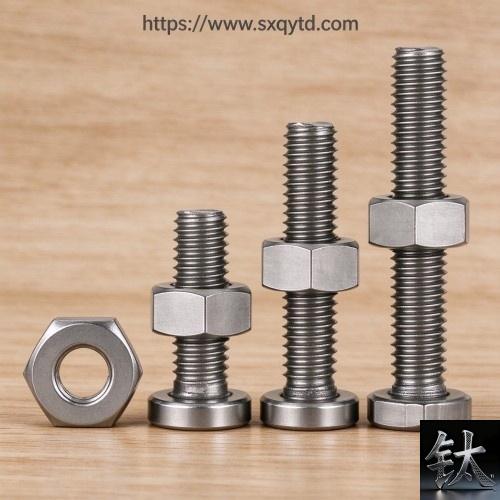
One line does most of the work: "Fastener to ASTM F468 Gr___ (R___); nut to F467 Gr___; UNR thread; anti-seize on all threads and under head; K = ___ used for torque; single-use in critical joints; EN 10204 3.1." Copy it into the PO and the "titanium bolt that galled or walked loose" conversation ends before it starts.
In stock & ready to ship — Titanium Fasteners
We stock ~30,000 pcs in stock (Gr2/Gr5/Gr7/Gr23) and cut to your size. As a stockist-supplier we read drawings, work to ASTM / ASME / GB standards, export worldwide, and ship same day on stock items. Tell us your spec and get a quote fast.
Tell us your requirement — grade, size and quantity. We reply within 24 hours.
Prefer chat? WhatsApp +86 188 2967 9311 or email sales@sxqytd.com.


- What is Titanium Flange | ASME B16.5 ASTM B381 Gr2 Gr5 Titanium Flan
- ASME B16.5 Titanium Flange Grade2 DN100-DN600 Class150/300 FOB
- Gr2 Titanium Sheet Price FOB Shanghai | ASTM B265 In Stock
- Titanium Price Today (Oct 26, 2026): China Market Report
- Titanium Price Today (23 Oct 2026): Plate, Tube, Rod & Wire
Contact Person: Wang Xiaoning
Tel: +86-917-355-7966
Email: sales@sxqytd.com
WhatsApp: +86 188 2967 9311
Company: Shaanxi Qianyi Tuoda Technology Co., Ltd
Address: Floor 4, Building 4, No. 188 Gaoxin Avenue, High-tech Zone, Baoji City, Shaanxi Province, China