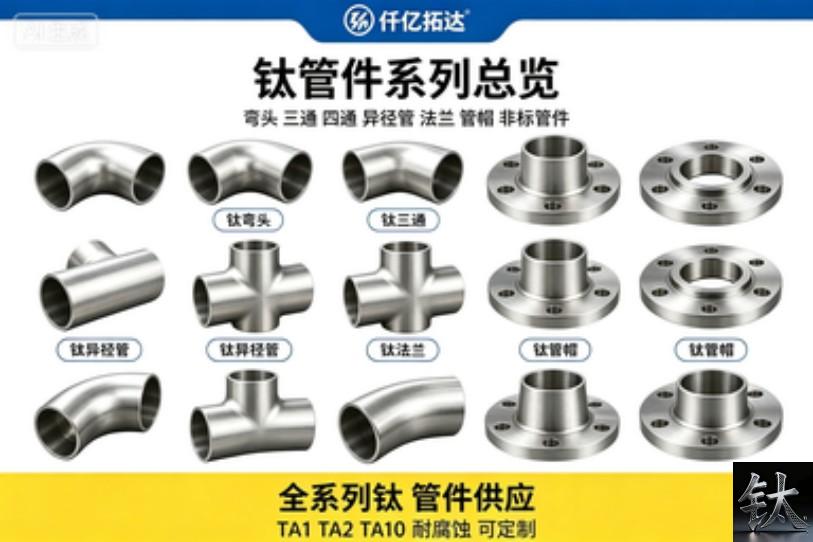
Titanium Fittings: ASTM B363 Guide to What the Grade Does Not Tell You
| Specification | Product Forms: 45 deg / 90 deg / 180 deg return elbows, tees, reducers, caps, lap-joint stub ends, crosses |
|---|---|
| Applicable Standard | Grades Covered (WPT): WPT1, WPT2, WPT2H, WPT3, WPT7, WPT7H, WPT9, WPT11, WPT12, WPT16, WPT26H |
| Material Condition | Governing Standards: ASTM B363 / ASME SB363, ASME B16.9, MSS SP-43, ASME B16.11, ASME B36.19M, ASTM B381, EN 10204 3.1 |
| Inspection & Packaging | Decision Boundaries: material-only scope, seamless vs welded (W suffix), feedstock route, Schedule wall basis, intrados thinning tolerance |
| Reference Price | $30.00 – $80.00 |
Product Description: ASTM B363 sets material only. Learn what WPT2 hides: feedstock, seamless vs welded, wall basis, intrados thinning, F-vs-WPT naming - closed by a 9-field RFQ.
Product Overview
Titanium Fittings: ASTM B363 Guide to What the Grade Does Not Tell You
ASTM B363 sets material only. It fixes the chemistry and the minimum tensile of the feedstock a titanium fitting is made from - WPT2, WPT7, WPT12 and the rest - but it does not set the shape. The outside diameter of an elbow, the center-to-face of a tee, the wall thickness of a reducer and whether the part is seamless or welded are governed by ASME B16.9, MSS SP-43 and your purchase order, not by B363. A 2 in (60.3 mm) Schedule 40S Grade 2 elbow can be seamless or welded, formed from tube or from plate, and still carry the identical WPT2 certificate. That single fact - the grade proves chemistry, not geometry - is the reason most mismatched Titanium Fittings reach the site.
| At a Glance | |
| B363 governs | Chemistry, feedstock tensile, heat treatment and testing - not shape or dimensions |
| Shape and dimensions | ASME B16.9 (butt-weld fittings), MSS SP-43 (stub ends and light-wall), ASME B16.11 (small socket-weld / threaded fittings) |
| Grades covered | WPT1, WPT2, WPT2H, WPT3, WPT7, WPT7H, WPT9, WPT11, WPT12, WPT16, WPT26H and others |
| Seamless vs welded | Both permitted; a welded fitting carries a "W" suffix, e.g. WPT2W |
| Wall thickness basis | Schedule 5S / 10S / 40S / 80S per ASME B36.19M - B363 sets no wall thickness |
| Size range | NPS 1/2 to 24 (DN15 to DN600); larger by agreement |
| Feedstock route | Pipe B861/B862, tube B338, plate B265, bar/billet B348, casting B367, forging B381 |
| Intrados thinning | Cold-formed bends thin a few percent at the inside; the minimum retained wall is set by ASME B16.9 |
| WPT vs F- naming | WPT = wrought fitting per B363; F- = forging per B381 (feedstock grade, seen on the same cert) |
| RFQ fields | 9 - listed in the Summary below |
1. The "B363 Grade" Myth
: Why the Grade Alone Will Not Ship You the Right Fitting
The most expensive titanium fitting mistake is also the most common one. A buyer writes "Grade 2 titanium 90-degree elbow, ASTM B363" on the purchase order, receives a conforming WPT2 part, and finds on site that it will not mate with the pipe. The reason is that the order named a chemistry and said nothing about geometry. B363 is silent on outside diameter, center-to-face, wall thickness, radius and seam type. Those are owned by the dimensional standard - ASME B16.9 for butt-weld fittings - and by the purchase order. The grade on the certificate is the one field that tells you the least about whether the part fits.
This is not a titanium peculiarity; it is how every alloy piping specification is built. ASTM B363 points its material requirements at the feedstock and the finished fitting's chemistry and tensile, then delegates shape to the dimensional standards. The practical consequence is that two fittings with identical markings can be different purchased products. Our ASTM B363 fittings guide covers what the grade does define - the types, the grades and the certification. This article covers what it does not, and how to write the missing lines.
The four omissions that cause the most field rejects are, in order: (1) seamless versus welded, because a welded fitting is a different manufacturing route with different inspection; (2) the dimensional standard and wall basis, because B363 sets no wall thickness and Schedule 5S, 10S and 40S are not the same wall; (3) the feedstock route, because a tube-formed elbow and a plate-pressed elbow have different grain flow; and (4) intrados thinning, because the inside of a bend is thinner than the nominal wall and the drawing rarely shows it. Each is closed with one or two words on the PO.
2. What ASTM B363 Actually Covers (and What It Hands to B16.9 and MSS SP-43)
Read narrowly, B363 is a short document. It lists permissible raw materials and their grades, the chemical composition requirements, the tensile property requirements, the heat-treatment condition, workmanship and the tests. It covers factory-made 45-degree and 90-degree elbows, 180-degree returns, caps, tees, reducers, lap-joint stub ends and crosses, in both seamless and welded construction. What it does not do is state a single outside diameter or center-to-center dimension. Those live in the dimensional standards, and the purchaser is expected to name them.
| Document | What it governs for a titanium fitting |
|---|---|
| ASTM B363 / ASME SB-363 | Chemistry, feedstock tensile, condition, workmanship, testing - the material only |
| ASME B16.9 | Dimensions, tolerances and wall basis for butt-weld fittings: elbows, tees, reducers, caps, crosses |
| MSS SP-43 | Dimensions for stub ends and for light-wall (corrosion-resistant) fittings |
| ASME B16.11 | Small socket-weld and threaded fittings (couplings, half couplings, elbolets) |
| ASME B36.19M / B36.10M | Nominal pipe size, outside diameter and Schedule wall thickness basis |
The inch-pound values in the referenced standards are the standard; the SI equivalents are for information. Write the governing unit on the purchase order, or state both with the inch-pound value marked controlling - and name the exact edition, because tolerances shift between revisions.
The clean way to think about it: B363 answers "what is this made of", ASME B16.9 answers "what shape is it", and the purchase order answers "which of the allowed options do I actually want". A complete order names all three. The existing ASTM B363 Titanium Fittings article walks the material side; pair it with this one and the dimensional standards and the PO is no longer guesswork.
3. Seamless vs Welded
: The "W" Suffix That Changes Acceptance, Not Chemistry
B363 permits both seamless and welded fittings, and the welded version is marked with a "W" suffix - WPT2 becomes WPT2W. The chemistry is identical; the difference is a longitudinal weld seam and the inspection that goes with it. A welded fitting is made by forming from welded pipe or plate and joining the seam, then usually annealing. For most corrosion and pressure services a properly qualified, fully radiographed or penetrant-inspected weld is entirely acceptable and is often the only economical route for large diameters, where a seamless elbow would require an impractically large forging or hot-formed blank.
The trap is that many orders say "B363 Grade 2" and never state seamless or welded, so the supplier ships whichever is cheaper or in stock. If your system is cyclic, sour, or subject to vibration, the seam is a known fatigue and crevice site and you should specify seamless, or specify the weld acceptance method (RT, UT or PT) explicitly. For low-risk, static, non-sour service, a welded fitting with documented NDT is usually the right commercial choice. The seamless 90-degree elbow page and the general elbow-tee-reducer stock page show the two constructions side by side.
One more point that surprises buyers: welded does not mean weaker. The seam is qualified to ASME Section IX, the fitting is annealed, and the base metal around it meets the same WPT tensile. What changes is not strength but the number of places where a defect can hide, which is why the inspection clause - not the W suffix itself - is the line that protects you. Write "seamless" or "welded, 100% RT" on the PO and the ambiguity disappears.
4. Wall Basis
: Why Schedule 5S/10S/40S Comes From the Dimensional Standard, Not B363
B363 contains no wall-thickness table. The wall of a titanium butt-weld fitting is taken from ASME B36.19M (for stainless and titanium-like corrosion-resistant piping) as a Schedule: 5S, 10S, 40S, 80S and so on, matched to the pipe it connects to. A 2 in Schedule 40S fitting has a nominal wall of 0.154 in (3.91 mm) only because B36.19M says so, not because B363 says so. Ordering "Grade 2 elbow" without a Schedule is an open invitation to receive a light-wall 5S part that will not match a 40S run.
| NPS (DN) | OD (mm) | Sch 5S wall (mm) | Sch 10S wall (mm) | Sch 40S wall (mm) |
|---|---|---|---|---|
| 1/2 (DN15) | 21.3 | 1.65 | 2.11 | 2.77 |
| 1 (DN25) | 33.4 | 1.65 | 2.77 | 3.38 |
| 2 (DN50) | 60.3 | 1.65 | 2.77 | 3.91 |
| 4 (DN100) | 114.3 | 2.11 | 3.05 | 6.02 |
| 6 (DN150) | 168.3 | 2.77 | 3.40 | 7.11 |
Wall thicknesses are ASME B36.19M nominal values for indication only; confirm the exact wall and tolerance in the edition named on your drawing. Titanium corrosion-resistant piping normally uses the "S" Schedules, not the standard-weight Series.
Two consequences follow. First, always state the Schedule and confirm the mating pipe uses the same one; a 5S fitting on a 40S line is a wall step that becomes a crevice and a turbulence point. Second, heavy-wall or custom-thickness fittings are made to order - the connecting run and the fitting must be quoted together. Our butt-weld fittings cut to spec page covers that made-to-order route. For offshore and topside cooling lines our Grade 2 welded tube to B338 is the usual mating pipe, and the fitting Schedule is matched to it at the quoting stage.
5. The Feedstock Trap
: A B363 Fitting Can Be Made From Pipe, Tube, Plate, Bar or Forging
B363 Table 1 lists the permissible raw materials for each grade, and the list is long: pipe made to B861 or B862, tube to B338, plate to B265, bar or billet to B348, castings to B367, and forgings to B381. A WPT2 elbow might have started life as a length of welded B862 pipe, a section of B338 tube, a piece of B265 plate, or a B381 forging. The grade is the same; the grain flow, the residual stress and the cost are not. A fitting formed by cold drawing tube has fine, oriented grain and tight tolerances; one pressed from plate has a different flow line and is the normal route for large or odd shapes; a forged fitting carries the highest integrity and the highest price.
Why this matters to a buyer: the feedstock decides formability, thickness uniformity and price, none of which the WPT grade reveals. For a thin-wall, tight-tolerance, high-purity service, ask for tube-formed (B338) or forged (B381) stock. For a large, low-pressure, cost-driven header, plate-formed is fine. The plate ordered by end use, the bar ordered above 76 mm and the tube ordered by failure mode articles explain how each feedstock standard behaves; a B363 fitting simply inherits one of them. The wire ordered below 3.2 mm applies the same "grade proves chemistry, not geometry" logic at the other end of the mill.
The naming confusion sits here. On a mill certificate you may see both a "WPT2" fitting designation and an "F-2" forging reference. WPT is the B363 wrought-fitting grade; F- is the B381 forging grade of the feedstock. They are not in conflict - the fitting is WPT2, and if it was forged the forging that fed it is F-2. Buyers sometimes reject a perfectly good cert for "the wrong grade" when they are simply reading the feedstock line. Specify the feedstock route only when it matters to your service; otherwise leave it to the supplier and pay for the route you accept.
6. Intrados Wall Thinning
: The Few Percent You Do Not See on the Drawing
A bent elbow is not a constant-wall part. Forming stretches the outside of the bend and compresses the inside, and in cold-formed elbows the wall at the intrados (the inside of the curve) is thinner than the nominal wall, while the extrados is thicker. ASME B16.9 controls this through tolerances and requires that the finished fitting not fall below the applicable minimum wall. A commonly cited allowance is that the intrados may thin by up to about 12.5 percent for a cold-formed long-radius elbow under B16.9 - but the exact figure depends on the edition, the radius and the forming method, so confirm it in the standard named on your drawing rather than quoting a single number.
The risk is practical, not theoretical. A 2 in Schedule 5S elbow has a nominal wall of only 1.65 mm; a 12.5 percent intrados thinning leaves roughly 1.44 mm of actual metal on the inside of the bend. In a high-velocity, erosive or corrosive stream that is the first place to lose section. For thin-wall and high-velocity services, specify the minimum retained wall at the intrados as an acceptance criterion, or move to a heavier Schedule, rather than assuming the nominal wall is present everywhere.
This is also why radius matters for wall. A long-radius (1.5D) elbow spreads the forming stretch over a longer arc and thins less than a short-radius (1.0D) elbow of the same nominal wall. When the service is borderline on wall, choose long radius and a heavier Schedule together; do not trade one for the other without checking the intrados. The point is not to fear the thinning - it is expected and permitted - but to make sure the drawing's minimum wall is the wall you actually get at the most stressed point.
7. Stub Ends and Lap Joints
: The MSS SP-43 Exception Buyers Miss
Most titanium butt-weld fittings follow ASME B16.9, but lap-joint stub ends - the short, flared piece that backs a lap-joint flange - are dimensioned to MSS SP-43, not B16.9. SP-43 also covers light-wall corrosion-resistant fittings. Buyers who order "B16.9 stub end" either get a part made to the wrong standard or a supplier who quietly substitutes, and the lap then does not seat against the flange face. State MSS SP-43 explicitly for stub ends, and match the stub-end type (A, B or C) to the flange you are buying.
The lap-joint combination is common in titanium because it lets you rotate the flange to align bolt holes without spinning a corrosion-sensitive, often expensive, titanium spool. The flange itself is normally titanium too - our titanium flange article (B381 / ASME B16.5) covers the flange side; the stub end is the B363 / SP-43 piece that meets it. Get the two standards aligned and the joint is straightforward; leave one unspecified and the field crew is reaming metal to make it fit.
One more SP-43 point: because it is the light-wall standard, an SP-43 fitting can look identical to a B16.9 fitting of the same diameter but carry a thinner wall. If you are mating a stub end to a B16.9 run, confirm the wall basis of each piece, or the lap joint becomes a wall step at the most rotated, hardest-to-inspect point in the line.
8. When ://www.sxqytd.com/Titanium-Fittings.html target='_blank'>Titanium Fittings DO Fail
Chloride crevice corrosion at laps, gaskets and stub-end faces
Commercially pure titanium resists bulk chlorides well, but it is vulnerable in tight crevices where oxygen is depleted and the passive film cannot repassivate. Lap-joint faces, gasket contact rings, stub-end seats and the root of a threaded joint are exactly those crevices. In hot chloride service - brine, seawater at temperature, cooling-water concentrators - crevice attack starts at these points even when the straight pipe survives. Published thresholds for CP titanium crevice corrosion in chlorides are commonly cited in the approximate 70 to 80 deg C region, but the real boundary depends on pH, chloride level and crevice geometry; treat any single number as indicative only. Upgrade to Pd- or Ru-bearing grades (Grade 7, Grade 16, Grade 26H) or change the crevice geometry before escalating the alloy. Our Grade 7 fittings for corrosive media are the usual upgrade path.
Galvanic corrosion where titanium meets steel flanges and bolts
Titanium is noble relative to carbon steel and most stainless grades. When a titanium fitting is bolted into a carbon-steel flange with steel bolts in an electrolyte, the steel corrodes preferentially - sometimes aggressively - and the crevice it leaves accelerates the attack. Use titanium or compatible alloy flanges and fasteners, or insulate the joint with non-metallic sleeves and washers. This is a system-design issue, not a fitting defect, and it is the most common "titanium failed" report that was never a titanium problem.
Weld-line crevice and HAZ attack on welded fittings
A welded (WPT2W) fitting carries a longitudinal seam. If the weld is not fully purged during fabrication, if it is not properly annealed, or if the heat-affected zone is left in a sensitized condition, the seam and its HAZ become preferred sites for crevice and pitting attack. Specify the weld acceptance method (RT, UT or PT), post-weld heat treatment and a purge statement, and confirm them on the certificate. A "B363 Grade 2 welded" order with no inspection clause is the classic route to a seam that fails in service while the base metal is perfect.
Erosion-corrosion at the intrados of small-radius elbows in high-velocity service
Combined with the wall thinning in H2 6, a short-radius elbow in a high-velocity, abrasive or two-phase stream loses section fastest at the intrados. The fix is geometric: long-radius elbows, a heavier Schedule, and lower line velocity. For slurry, cooling-water with entrained solids, or any service where the velocity is high, design the bend for the wall you will actually have at the inside of the curve, not the nominal wall of the straight run.
Hydrogen pickup during fabrication causing delayed cracking at the seam
Titanium absorbs hydrogen from pickling, from air annealing, and from welding with inadequate argon purity, no trailing shield or no back purge. On a welded fitting the seam is the stressed, heat-affected location where hydride precipitation drives delayed cracking under sustained load. Ask for the hydrogen value on the finished fitting, not only on the ingot or starting stock, and require a controlled atmosphere for annealing and welding. The EN 10204 3.1 certificate page lists what the mill should report.
Under-thickness at the intrados of a thin-wall elbow
The last failure mode is the simplest: the part conforms to B363 and B16.9, but the combination of a light Schedule and a permitted intrados thinning leaves too little metal for the service. It is not a non-conformance; it is a specification gap. Close it by stating the minimum retained wall at the intrados as an acceptance limit, choosing long radius and the right Schedule, and verifying with a UT scan at the most stressed point before the line is pressurized.
9. Grades in Practice
: WPT2, WPT7, WPT12, WPT9 and When Each Earns Its Premium
B363 covers a long list of grades - WPT1 through to the higher alloy numbers, including the palladium-bearing WPT7 and WPT26H, the molybdenum-nickel WPT12, the Ti-3Al-2.5V WPT9 and the ruthenium-bearing WPT16 and WPT16H. In trading, perhaps eight appear regularly. The grade decides corrosion resistance and strength; it does not decide shape, seam or wall, which is the whole point of this article.
| B363 grade | Equivalent mill grade | Min UTS (approx) | Typical use for fittings |
|---|---|---|---|
| WPT2 | Grade 2 (R50400) | 345 MPa / 50 ksi | General chemical, chlor-alkali, seawater piping - the volume grade |
| WPT7 | Grade 7 (R52400, Pd) | 345 MPa / 50 ksi | Reducing acids (HCl, dilute H2SO4), chlor-alkali membrane cells |
| WPT12 | Grade 12 (R53400, Mo-Ni) | 483 MPa / 70 ksi | Hot brine, seawater, MSF / MED desalination at lower cost than Grade 7 |
| WPT9 | Grade 9 (R56320, Ti-3Al-2.5V) | 620 MPa / 90 ksi | Higher strength at lower weight; aerospace and subsea headers |
| WPT16 / WPT26H | Grade 16 / 26 (Ru-bearing) | 345 MPa / 50 ksi | Crevice-prone chlorides, similar service to Grade 7 at different alloying |
Tensile minima are approximate values drawn from the referenced feedstock specifications (B265, B338, B348, B381); B363 itself references those tables rather than restating them. Confirm the exact values in the edition on your drawing. The H-suffix grades (2H, 7H, 16H, 26H) carry a higher minimum UTS for pressure-vessel intent.
Grade choice is where the existing Grade 12 fitting article and the Grade 2 chemical-piping article do the detailed work. The takeaway for this article is narrower: pick the grade for the medium, then write the four non-grade lines - seam, wall, feedstock, intrados - so the part you receive matches the service you designed. A Grade 7 fitting in the wrong Schedule, or a welded Grade 2 in a sour line with no NDT, fails for reasons the grade never addressed.
10. Choose Seamless If / Choose Welded If / Choose Forged or Plate-Fed If
Do not split the difference between constructions; pick the one your service actually requires.
Choose seamless if
- The service is cyclic, sour, or subject to vibration, where a longitudinal weld is an avoidable fatigue and crevice site.
- The diameter is small and a seamless route is readily available, so the cost premium is minor.
- The specification or the end-user requires "seamless" explicitly for code or insurance reasons.
- You want the fewest possible defect-hiding locations and are willing to pay for it.
Choose welded (W suffix) if
- The diameter is large, where a seamless forging or hot-formed blank would be impractical or very costly.
- The service is static, non-sour and low risk, and a qualified, NDT-inspected seam is acceptable.
- You specify the weld acceptance method (RT, UT or PT) and post-weld heat treatment on the PO.
- Lead time and price matter more than the marginal integrity gain of seamless.
Choose forged or plate-fed if
- The service is high-purity, thin-wall or tight-tolerance, where tube-formed or forged stock gives the most uniform wall and best surface.
- The shape is large or non-standard, where plate pressing is the only economical route.
- You need maximum integrity for a coded pressure vessel or reactor, where forged feedstock is the conservative choice.
- Cost is secondary to traceability and formability, and you state the feedstock route on the order.
11. Frequently Asked Questions
Does ASTM B363 cover the dimensions of a titanium elbow?
No. B363 sets chemistry, feedstock tensile, heat treatment and testing - the material only. The outside diameter, center-to-face, wall thickness and radius of an elbow are governed by ASME B16.9 (for butt-weld fittings), with wall basis taken from ASME B36.19M Schedules. A complete order names B363 for material and B16.9 plus the Schedule for shape.
What does the "W" in WPT2W mean, and when is a welded fitting acceptable?
The "W" marks a welded fitting. The chemistry is identical to seamless WPT2; the difference is a longitudinal seam qualified to ASME Section IX and inspected by RT, UT or PT. A welded fitting is acceptable for static, non-sour, low-risk service when the weld acceptance method and any post-weld heat treatment are specified on the purchase order. For cyclic, sour or vibrating service, specify seamless instead.
Is a B363 Grade 2 fitting the same as a Grade 2 pipe or bar?
Same chemistry family, different product. B363 fitting grades are written WPT2 and reference the same underlying Grade 2 composition, but the fitting can be made from pipe, tube, plate, bar, casting or forging feedstock (B861/B862, B338, B265, B348, B367, B381). A forging-fed fitting may also show an F-2 reference on the certificate; that is the B381 forging grade of the feedstock, not a conflicting grade.
Why does my titanium elbow wall look thinner on the inside of the bend?
Because forming thins the intrados. Cold-formed elbows lose a few percent of wall at the inside of the curve - commonly cited as up to about 12.5 percent under ASME B16.9, but confirm the exact allowance in the edition named on your drawing. Specify the minimum retained wall at the intrados as an acceptance limit for thin-wall or high-velocity service rather than assuming the nominal wall is present everywhere.
What wall thickness should I specify for a B363 fitting?
B363 sets no wall thickness. Take it from ASME B36.19M as a Schedule - 5S, 10S, 40S, 80S - and match it to the mating pipe. A 2 in Schedule 40S fitting has a nominal wall of 3.91 mm only because B36.19M says so. Always state the Schedule and confirm the connecting pipe uses the same one to avoid a wall step that becomes a crevice.
Which grade should I choose for chloride or reducing-acid service?
For general chloride service, Grade 2 is the baseline but upgrades to Pd- or Ru-bearing grades (WPT7, WPT16, WPT26H) reduce crevice risk; for hot brine and desalination, WPT12 is a lower-cost option. For reducing acids such as hydrochloric or dilute sulphuric, WPT7 is the usual choice. State the medium, concentration, pH, temperature and crevice geometry in the RFQ; a grade name alone is not a corrosion specification.
What should an EN 10204 3.1 certificate show for a titanium fitting?
At minimum: standard and edition, WPT grade and UNS, heat and lot number, full chemistry, tensile results (where required), dimensions and tolerances, heat-treatment condition, and the results of any weld inspection for a welded fitting. Note that B363 does not require a tensile test on the finished fitting unless the order specifies it, so if you need one, write it into the PO. Wall-thinning, seam NDT and feedstock route are reportable only if you request them.
12. Summary
: The 9 RFQ Fields That Close Every Gap B363 Leaves Open
ASTM B363 is an excellent material specification and an incomplete purchase order. It proves chemistry and feedstock tensile; it says nothing about shape, seam, wall basis, feedstock route or intrados thinning. None of that is the supplier's fault - it is the specification's design. Nine fields on the purchase order close the gap, and they are the same nine whether you buy one elbow or a thousand.
- Standard and edition - ASTM B363 or ASME SB-363, plus the dimensional standard (ASME B16.9, MSS SP-43 for stub ends, ASME B16.11 for small fittings) and the wall-basis standard (ASME B36.19M), each with its exact year.
- Grade and H suffix if required - WPT2, WPT7, WPT12, WPT9, WPT16H with the UNS, and the H suffix where a coded vessel demands higher minimum tensile.
- Type and ends - elbow (45 / 90 / 180), tee (equal / reducing), reducer (concentric / eccentric), cap, stub end (Type A / B / C), cross; butt-weld, socket-weld or threaded.
- Size, Schedule and wall basis - NPS or DN, the Schedule (5S / 10S / 40S / 80S) and a statement that the mating pipe uses the same wall, plus any minimum retained wall at the intrados.
- Seamless or welded - "seamless" or "welded (WPT2W)" with the weld acceptance method (RT / UT / PT) and post-weld heat treatment named.
- Feedstock route if it matters - tube-formed (B338), forged (B381), plate-formed (B265), pipe-formed (B861/B862) or casting (B367), stated only where service or integrity requires it.
- Radius - long radius (1.5D) or short radius (1.0D), because radius changes the intrados thinning and the pressure drop.
- Certificate content - EN 10204 3.1, heat and lot traceability, full chemistry, dimensions, weld inspection results, and any finished-fitting tensile or UT scan you require.
- End use and service envelope - medium, concentration, pH, temperature, velocity, and whether the service is sour, cyclic or high-purity, so the grade and construction can be chosen against the real duty.
One line does most of the work: "Fitting material to ASTM B363; dimensions and tolerances to ASME B16.9 (stub ends to MSS SP-43); wall to ASME B36.19M Schedule ___; seamless / welded with ___ NDT; minimum retained wall at intrados not less than ___ mm." Copy it into the PO and the "Grade 2 elbow that does not fit" conversation ends before it starts.
Send the drawing, the governing specifications and those nine fields to our inquiry desk. We will confirm which dimensional standard and Schedule your size falls into, whether seamless or welded suits the duty, and what the EN 10204 3.1 certificate will actually state before any order is placed.
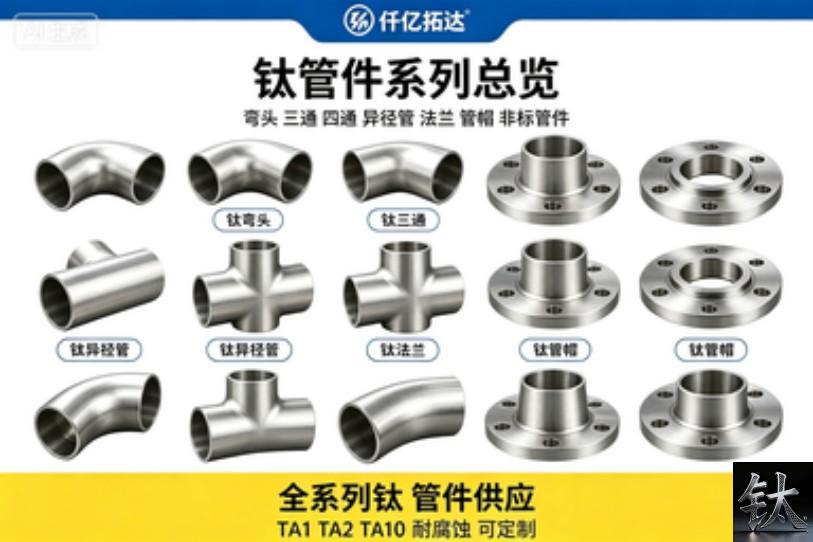
In stock & ready to ship — Titanium Fittings
We stock ~3,000 pcs in stock (Gr1/Gr2/Gr5/Gr7/Gr12) and cut to your size. As a stockist-supplier we read drawings, work to ASTM / ASME / GB standards, export worldwide, and ship same day on stock items. Tell us your spec and get a quote fast.
Tell us your requirement — grade, size and quantity. We reply within 24 hours.
Prefer chat? WhatsApp +86 188 2967 9311 or email sales@sxqytd.com.


- What is Titanium Flange | ASME B16.5 ASTM B381 Gr2 Gr5 Titanium Flan
- ASME B16.5 Titanium Flange Grade2 DN100-DN600 Class150/300 FOB
- Gr2 Titanium Sheet Price FOB Shanghai | ASTM B265 In Stock
- Titanium Price Today (Oct 26, 2026): China Market Report
- Titanium Price Today (23 Oct 2026): Plate, Tube, Rod & Wire
Contact Person: Wang Xiaoning
Tel: +86-917-355-7966
Email: sales@sxqytd.com
WhatsApp: +86 188 2967 9311
Company: Shaanxi Qianyi Tuoda Technology Co., Ltd
Address: Floor 4, Building 4, No. 188 Gaoxin Avenue, High-tech Zone, Baoji City, Shaanxi Province, China