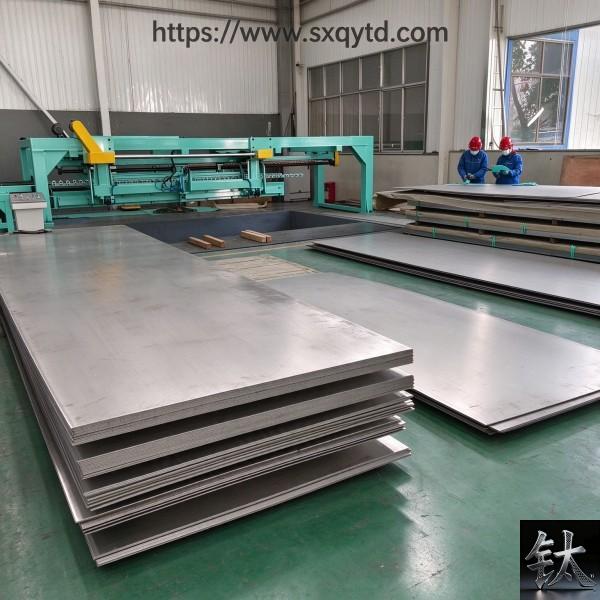
Titanium Plate: ASTM B265 Guide to Ordering by End Use
| Specification | Product Forms: Plate / Sheet / Strip / Clad plate |
|---|---|
| Applicable Standard | Grades Covered: Gr1, Gr2, Gr5, Gr7, Gr12, Gr23 |
| Material Condition | Governing Standards: ASTM B265-25, ASME SB-265, ASTM B898, ASTM A578, EN 10204 3.1 |
| Inspection & Packaging | Typical End Uses: Tube sheets, vessel shells, heads, linings, baffles URL 优化 titanium-plate-b265-ordering-by-end-use |
| Reference Price | $10.00 – $12.00 |
Product Description: A 6 mm B265 plate can legally arrive 7.14 mm thick. Order by finished part: tolerance math, grades, clad vs solid costs, UT and 9 RFQ fields
Product Overview
Titanium Plate: ASTM B265 Guide to Ordering by End Use
Order a 6 mm Grade 2 plate to ASTM B265 and it can legally arrive 7.14 mm thick — or 5.75 mm. Published B265 tolerance tables for hot-rolled plate in the 800–2134 mm width band allow roughly +1.14 mm above nominal but only −0.25 mm below it, and width and length tolerances are one-sided too (about +1.60 / −0 mm and +6.35 / −0 mm at common sizes). B265 certifies the plate as it leaves the mill. It says nothing about the tube sheet, vessel head or lining you intend to machine from it. Specify by nominal thickness and the machining allowance you budgeted may already be gone. This guide works backwards from the finished part to the purchase order, because that is the direction in which these errors are caught.
| At a Glance | |
| Governing spec | ASTM B265 / ASME SB-265 — identical chemistry and mechanicals; SB-265 is the endorsed form for ASME Code work |
| Form boundary | Plate ≥4.76 mm and >254 mm wide; sheet <4.76 mm and ≥610 mm; strip <4.76 mm and <610 mm; narrow flat bar → ASTM B348 |
| Common grades | Gr1, Gr2, Gr5, Gr7, Gr12, Gr23 |
| Gr2 minimums (annealed) | ≈345 MPa tensile / 275 MPa yield / 20% elongation |
| Plate thickness tolerance | Asymmetric: approx +1.14 / −0.25 mm at 4.76–9.53 mm, 800–2134 mm wide — verify against the edition cited on your PO |
| Surface | Hot-rolled descaled, pickled, bright annealed, ground or polished — must be named on the order |
| Certification | EN 10204 3.1 MTR minimum; 3.2 where third-party witnessing is required |
| Extra testing | UT for heavy plate (ASTM A578 commonly cited), PMI on every plate, flatness verification |
| RFQ fields | 9 — listed in the Summary below |
1. The "6 mm" Trap
: B265 Is a Floor, Not a Finish Line
A purchase order reading "ASTM B265 Grade 2 plate, 6 mm" is a complete order as far as the standard is concerned. It is not a complete specification for a machined component. Plate thickness tolerances in B265 are asymmetric: published mill tables reproducing the standard give, for 4.76–9.53 mm plate in the 800–2134 mm width band, about +1.14 mm on the plus side against a fixed −0.25 mm on the minus side, with the plus allowance growing as width and thickness increase (up to several millimetres on very wide, heavy plate). Width and length tolerances are one-sided positive only. None of this is a defect — it is how flat-rolled products are made — but it changes what you can machine.
Work the numbers on a tube sheet. You need a 5 mm finished face after machining both sides of a nominal 6 mm plate. The thinnest compliant delivery is 5.75 mm. After removing oxide scale and the shallow oxygen-enriched surface layer on each face, and after correcting flatness (B265 permits several millimetres per metre on thinner plate), 0.75 mm of total stock is tight. A plate arriving at 7.14 mm is not a bonus either: it adds machining time, and if the drawing was nested against a fixed blank thickness it can push a drilled hole pattern out of the tolerance you quoted. The fix is not to reject the standard. It is to state a tighter, measurable incoming thickness range on the purchase order — a nominal plus an explicit minimum — and to define what happens at incoming inspection when a plate falls outside it.
A mill certificate is a statement about the plate, not about your part. Read the tolerance table before you set the machining allowance.
For the clause-by-clause reading of B265 — chemistry limits, mechanical properties, surface finishes and the full tolerance tables — see our ASTM B265 Titanium Plate, sheet and strip specification guide. This article deliberately does not repeat it. What follows is the decision work that happens before that standard is cited on an order.
2. The 4.76 mm Line — and the Quotation That Used 6.35 mm
B265-25 draws the form boundaries at 0.1875 in (4.76 mm): plate is 4.76 mm or thicker and more than 10 in (254 mm) wide; sheet is thinner than 4.76 mm and at least 24 in (610 mm) wide; strip is thinner than 4.76 mm and narrower than 610 mm. A flat product at least 4.76 mm thick but no wider than 254 mm is flat bar and belongs to ASTM B348 instead. These definitions are not pedantry. They decide which tolerance table applies, whether a bend test is required, how the material is certified, and what the mill calls the line it rolled the product on.
In practice quotations arrive with a second boundary — 6.35 mm (0.25 in) — used by many distributors and product catalogues to separate sheet from plate. A 5 mm item can therefore be described as "sheet" in one bid and "thin plate" in another, with different thickness tolerances, different surface options and different prices. Neither convention is necessarily wrong, but mixing them on one RFQ makes the bids non-comparable and the winning bid is often the one that quietly used the looser table.
Write both the form and the standard edition on the enquiry: "ASTM B265-25, Grade 2, hot-rolled plate, 8 × 1500 × 3000 mm, pickled". Ask each supplier to state which tolerance table the offer follows. If the part is a long narrow machined component, check whether a bar route is the better-specified purchase instead. Our titanium materials overview lists the forms we supply, the Titanium Plate category shows the standard stock range, and the Titanium Plate product page gives the grade and finish options to reference on the PO.
3. Start From the Finished Part, Not the Mill Certificate
Three end uses account for most industrial titanium flat products, and each one reverses a different assumption in the purchase order.
Tube sheets, baffles and machined blanks
Here thickness, flatness and internal soundness dominate. A tube sheet is drilled with hundreds of holes and then expanded or seal-welded to ASME SB338 U-bent condenser tubes; a lamination or a hard alpha-case streak in the plate shows up as a leaking joint, not as a surface blemish. Specify ultrasonic examination for heavy plate, a ground or pickled sealing face, and a thickness range that leaves stock after both faces are cleaned. Match the plate grade to the tube grade so a Grade 7 seamless tube for chlor-alkali service does not sit in a Grade 2 sheet under conditions where the sheet becomes the weak point. Titanium Flanges for the same vessel are usually quoted against one project specification — send it with the plate enquiry so the whole package is priced on one basis.
Vessel shells, heads and formed parts
Formability and weldability dominate. Annealed Grade 1 or Grade 2 is rolled and pressed; the order must name the condition, because cold-worked sheet will not take the same bend radius. For ASME Code construction specify ASME SB-265 rather than plain B265 — the chemistry and mechanicals are identical, but SB-265 is the form endorsed for code work. Welding needs high-purity argon on the torch, a trailing shield and a back purge: above roughly 400 °C titanium picks up oxygen and nitrogen, and the bead turns straw, then blue, then grey as toughness falls. Titanium process equipment fabrication should be quoted together with the plate, so the shielding procedure belongs to one accountable supplier rather than being assumed by two.
Linings, trays and light-gauge fabrications
Surface and flatness dominate, thickness less so. Cold-rolled sheet under 4.76 mm carries much tighter tolerances (published tables give about ±0.05 mm near 0.2 mm and ±0.35 mm near 3.7 mm) and a bright-annealed finish that cleans easily and welds predictably. For loose linings, ask whether in-stock sheet can be cut to your developed blank dimensions, and check the Grade 2 sheet price page before assuming a thinner gauge is always cheaper — handling, distortion during welding and extra support often cost more than the metal saved.
4. Grade Selection by What the Plate Will See
Strength is rarely the deciding variable for a plate in chemical service; the medium is. Use the table as a shortlist, then check the corrosion data for the actual concentration and temperature.
| Grade | Minimum tensile / yield (annealed, approx) | Right choice for | Where to stop |
|---|---|---|---|
| Gr1 | ≈240 / 170 MPa, 24% El | Deep-drawn heads, cladding layer, maximum ductility | Stiffness-governed structural parts |
| Gr2 | 345 / 275 MPa, 20% El | General chemical service, vessel shells, seawater, tube sheets | Hot reducing acids; hot chloride crevices |
| Gr5 | ≈895 / 828 MPa, 10% El | High-strength structural and aerospace plate | Cold forming; severe reducing-acid service |
| Gr7 | 345 / 275 MPa, 20% El | Reducing acids, wet chlorine, hot chloride crevices | Oxidising media — no gain over Gr2 |
| Gr12 | ≈483 / 345 MPa, 18% El | Hot brines, crevice resistance at lower alloy cost | Not a drop-in substitute for Gr7 in strong HCl |
| Gr23 | ELI variant of Gr5, low interstitials | Medical and cryogenic plate | General chemical plant — cost is not justified |
Grade 2 remains the default for a reason: it covers most oxidising and neutral media, it is the most widely available, and at 4.51 g/cm³ (against 4.43 for Ti-6Al-4V) it is roughly 57% of the density of steel. Move off it only when a named failure mode justifies the change, not because a higher grade number looks safer on a drawing.
5. Where Grade 7 Earns Its Premium — and Where It Wastes Money
Grade 7 is Grade 2 with 0.12–0.25% palladium. The palladium does not change strength — both grades carry the same 345 MPa tensile and 275 MPa yield minimums — it speeds repassivation when the protective oxide film breaks down in a reducing acid or a hot chloride crevice. That is the entire mechanism, and it defines exactly where the premium is earned.
Earned: hydrochloric or sulfuric acid service inside the grade's corrosion envelope, wet chlorine, hot seawater crevices at tube-to-tube-sheet joints, and any design where a gasket, deposit or lap joint creates a stagnant gap. Wasted: nitric acid, ferric chloride solutions, oxidising bleach service, and ambient seawater with no crevices. In oxidising media the film repassivates on its own, so a Grade 2 component and a Grade 7 component behave the same and the palladium buys nothing. Palladium is a traded metal, so the size of the premium moves; treat any cost multiple as an indicative industry estimate, not a quotation. Where the budget is tight and the medium is a hot chloride rather than a strong reducing acid, Grade 12 (Ti-0.3Mo-0.8Ni) is often the intermediate step worth testing.
6. The Tolerance Math to Do Before You Sign the PO
| Item | Published B265 value (approx) | What it does to your part |
|---|---|---|
| Plate thickness, 4.76–9.53 mm, 800–2134 mm wide | +1.14 / −0.25 mm | Design machining stock from 5.75 mm on a 6 mm nominal, not from 6.00 mm |
| Sheet thickness, ≈0.2 mm / ≈3.7 mm | ±0.05 / ±0.35 mm | Fine for formed linings; still state the range for welded assemblies |
| Width, 610–1220 mm | +1.60 / −0 mm | Nesting layouts must allow the plus, not just the nominal |
| Length, up to 3 m | +6.35 / −0 mm | Affects crate size, freight and cut-to-length yield |
| Flatness | Several mm per metre, by agreement | Put a number on the PO for tube sheets and sealing faces |
Then define incoming inspection, because B265 is a minimum requirement rather than a machining guarantee. Ask for: an EN 10204 3.1 MTR carrying heat number, chemistry, tensile results, condition and heat treatment, with 3.2 where third-party witnessing is required; positive material identification on every plate so a Grade 2 sheet cannot enter a Grade 7 job; thickness mapped at defined points rather than one edge reading (the standard measures near the edge, which is the least representative place on a rolled plate); ultrasonic examination for heavy plate; and a written surface condition. Our certifications page shows the documents we issue — request the actual MTR format before the order, not after the plates land.
7. Surface Condition
: The Cheapest Pitting Initiator
| Finish | Description | Typical use |
|---|---|---|
| Hot-rolled, descaled / pickled | Matt, oxide removed by acid pickling | Vessel shells, structural members |
| Cold-rolled, bright annealed | Smooth, reflective, oxide-free | Heat exchanger plates, linings, medical |
| Ground | Controlled thickness and flatness | Tube sheets, precision machined parts |
| Polished | Satin or mirror | Food, pharmaceutical, architectural |
A rough, scale-retaining surface holds chlorides against the metal and gives pitting a place to start; it also hides contamination. Embedded free iron from shared rollers, carbon-steel cutting tools or storage racks is a common and entirely avoidable cause of rust spots on Titanium Plate in a chloride plant. Require dedicated tooling or a documented cleaning and passivation step on the PO for any surface that will contact process fluid. Iron smears are cheap to find with a ferroxyl test and cheap to remove; a pit discovered after hydrotest is neither.
8. When Solid Titanium Plate Is the Wrong Buy
| Option | Construction | Where it wins | Where it fails |
|---|---|---|---|
| Solid B265 plate | Full-thickness titanium | Machined tube sheets, small parts, vacuum, severe thermal cycling | Material cost scales directly with wall thickness |
| Explosion-bonded clad (ASTM B898) | 1.5–6 mm Ti on 10–100 mm steel backing | Large vessels (≈2 m+ diameter), thick tube sheets | Ti cannot be welded directly to steel; PWHT limited to about ≤480 °C to avoid brittle FeTi intermetallics |
| Loose lining | Thin sheet mechanically attached | Lowest material cost, simple atmospheric tanks | Vacuum and thermal cycling make it bulge and tear; the air gap insulates |
Published industry estimates put explosion-bonded clad plate at roughly 30–50% of the material cost of an equivalent solid titanium wall, and lower still on very large thick-walled vessels — indicative multiples, not quotations, and they exclude the extra fabrication work. Bond integrity is checked by ultrasonic testing (ASTM A578 or A264 are commonly cited) from the steel side, with unbonded zones rejectable. The economic break-even is usually a large diameter or a wall thickness above about 25 mm; below that, edge preparation, cover-strip welding and inspection overhead consume the saving. Titanium process equipment and machined parts and forgings enquiries often start at exactly this fork: send vessel diameter, design pressure and whether vacuum is present, and the form choice can be settled before any plate is quoted.
9. When Titanium Plate DOES Fail
Hydrofluoric acid and fluoride-bearing cleaners
HF dissolves the protective oxide film as fast as it forms. Even trace fluoride in a cleaning formulation, a pickling residue or an upstream process stream can produce rapid general metal loss. No B265 grade solves this. Specify a different material, or prove the fluoride level is effectively zero and put the cleaning chemistry under written control.
Dry chlorine and anhydrous methanol
Titanium depends on a trace of moisture to maintain its passive film. In dry chlorine the reaction can be vigorous enough to ignite; in anhydrous methanol, stress corrosion cracking is a documented risk. Wet chlorine is a routine titanium service — the single word "dry" reverses the conclusion. Always state water content on the data sheet.
Hot reducing acids and fuming nitric acid
In HCl and H₂SO₄, Grade 2 has a narrow concentration–temperature envelope — published iso-corrosion curves put the ambient limit at roughly 7% HCl at room temperature — and raising either concentration or temperature shrinks it quickly. At the opposite extreme, fuming nitric acid with low water content can support a rapid exothermic reaction. Neither is a grade-selection problem: both are media-specification problems. Check the medium against published corrosion data before committing to any titanium product form.
Hot chloride crevices on tube sheets
Above roughly 70–80 °C in chloride-bearing media, a stagnant gap under a gasket, beneath a deposit or inside an expanded tube joint can acidify locally and break down the passive film on Grade 2. This is the classic tube-sheet failure and the reason to specify Grade 7 or Grade 12 for the plate even when the bulk medium looks harmless. Design the crevice out first — seal weld rather than plain expansion, drainable geometry, no horizontal ledges — then upgrade the grade.
Weld contamination above 400 °C
Oxygen, nitrogen and hydrogen dissolve into titanium at welding temperature and embrittle the bead. Colour is the field check: silver is clean, light straw is borderline, blue or purple is rejectable for pressure work, and a grey or chalky white bead must be ground out entirely. High-purity argon (99.999%), a trailing shield and a back purge are not optional extras. Contaminated welds tend to fail later, in service, not in the shop.
10. Choose Solid Plate If / Choose Clad Plate If / Choose Sheet If
Choose solid B265 plate if:
- The finished part is machined all over — tube sheets, flanges, baffles — and needs uniform through-thickness properties.
- The vessel sees vacuum or severe thermal cycling, where a loose lining can collapse, bulge or tear.
- Diameter is small enough that titanium mass is not the cost driver.
- You need a single-material MTR and one straightforward welding procedure.
Choose explosion-bonded clad plate if:
- Shell diameter is roughly 2 m or more, or design wall thickness is above about 25 mm.
- The structural load is carried by steel and only the inner surface contacts the corrosive medium.
- The fabricator has a qualified procedure for stripping the titanium at edges, steel welding and titanium cover strips.
- You can verify bond integrity with UT and accept the restricted PWHT temperature window.
Choose B265 sheet or strip if:
- Thickness is below 4.76 mm and the part is formed, rolled or welded rather than machined.
- Surface finish and cleanability matter more than machining stock.
- You are making linings, trays, covers or heat exchanger plates.
11. Frequently Asked Questions
Is ASTM B265 the same as ASME SB-265?
The chemical and mechanical requirements are identical. SB-265 is the ASME Boiler and Pressure Vessel Code endorsement of B265, used when the plate enters ASME Code construction; plain B265 is normal for general industrial use. If the part is a pressure vessel tube sheet or shell, write SB-265 on the purchase order so the MTR matches the code file and the inspector has the right document in hand.
What thickness separates plate from sheet under ASTM B265?
0.1875 in, or 4.76 mm. At or above that thickness and wider than 254 mm the product is plate; below it, sheet is 610 mm wide or more and strip is narrower. A flat product at least 4.76 mm thick but no wider than 254 mm is flat bar under ASTM B348. Some suppliers quote 6.35 mm as the sheet-to-plate boundary, so always name the form explicitly rather than relying on the word "plate" in a quotation.
Why is plate thickness tolerance asymmetric, and why does it matter?
Published B265 plate tables allow a fixed −0.25 mm below nominal with a much larger plus allowance — about +1.14 mm at 4.76–9.53 mm in the 800–2134 mm width band. A nominal 6 mm plate can therefore be delivered between roughly 5.75 and 7.14 mm and still comply. For a machined tube sheet, design the allowance from 5.75 mm rather than 6 mm, or state a tighter incoming thickness range on the order and agree the acceptance rule in advance.
Can ASTM B265 plate be used for a pressure vessel tube sheet?
Yes, but specify ASME SB-265 and add what B265 does not automatically include: an EN 10204 3.1 (or 3.2) MTR, ultrasonic examination for heavy plate, a defined surface finish on the sealing face, a flatness value, and a thickness range that leaves machining stock. Confirm the design conditions with your vessel engineer — the material standard is a purchase specification, not a design code.
When should I choose Grade 7 plate instead of Grade 2?
When the plate will see a reducing acid, wet chlorine, or a hot chloride crevice — typical at gasket faces and expanded tube joints above roughly 70 °C. Grade 7 adds 0.12–0.25% palladium, which speeds repassivation; it does not raise strength. In oxidising media such as nitric acid or ferric chloride solutions, Grade 2 and Grade 7 behave the same, so the premium buys nothing and the money is better spent on surface finish or inspection.
Is titanium clad plate cheaper than solid titanium plate?
Usually on large, thick-walled equipment. Published industry estimates put explosion-bonded clad at roughly 30–50% of the material cost of an equivalent solid titanium wall, because only 1.5–6 mm of titanium is bonded to a steel backing that carries the structural load. These are indicative multiples, not quotations: edge preparation, cover-strip welding, UT and a restricted PWHT window all add fabrication cost. Below roughly 25 mm wall or 2 m diameter the saving often disappears.
What should incoming inspection check on titanium plate?
Six things: the MTR against heat number and grade; PMI on every plate; thickness mapped at defined points rather than a single edge reading; width, length and flatness against the PO; surface condition and freedom from embedded iron; and UT results where specified. Photograph the marking and keep the MTR with the job file — traceability is the first thing an auditor or a customer asks for after a failure.
12. Summary
: Send These 9 Fields With Your RFQ
B265 is the starting point, not the specification. The 4.76 mm form boundary decides which tolerance table applies; the asymmetric plate tolerance decides your machining stock; the finished part decides the grade, surface, testing and whether solid plate is the right buy at all. Plate that fails in service usually fails because one of those links was left off the enquiry, not because the chemistry was wrong.
Send these nine fields and a supplier can quote a comparable, buildable offer on the first pass:
- Standard and grade — e.g. ASTM B265-25 / ASME SB-265, Grade 2 (UNS R50400), or Grade 7 if the medium requires it.
- Product form and dimensions — plate, sheet or strip; exact thickness × width × length and piece count.
- Finished part and drawing — tube sheet, shell, head, lining or machined blank, with final machined thickness and hole pattern.
- Incoming thickness range and flatness — tighter than the standard table wherever machining follows.
- Condition and surface finish — annealed; descaled, pickled, bright annealed or ground.
- Certification — EN 10204 3.1 minimum, 3.2 if third-party witnessing is required.
- Additional testing — UT acceptance level, PMI on every plate, bend test if applicable.
- Service medium — full composition including trace oxidising or fluoride impurities, concentration, temperature, and presence of crevices or vacuum.
- Packaging and delivery — export crate, moisture protection, marking, required documents, destination and required date.
One action: send those nine fields through our enquiry form. We will confirm which form and grade fits, state the thickness tolerance we can hold for the part you are making, and return the MTR format together with the quotation.
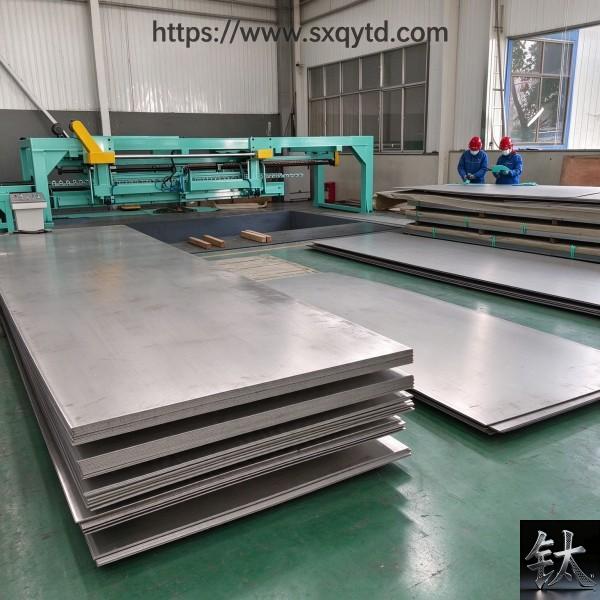
Tell us your requirement — grade, size and quantity. We reply within 24 hours.
Prefer chat? WhatsApp +86 188 2967 9311 or email sales@sxqytd.com.


- What is Titanium Flange | ASME B16.5 ASTM B381 Gr2 Gr5 Titanium Flan
- ASME B16.5 Titanium Flange Grade2 DN100-DN600 Class150/300 FOB
- Gr2 Titanium Sheet Price FOB Shanghai | ASTM B265 In Stock
- Titanium Price Today (Oct 26, 2026): China Market Report
- Titanium Price Today (23 Oct 2026): Plate, Tube, Rod & Wire
Contact Person: Wang Xiaoning
Tel: +86-917-355-7966
Email: sales@sxqytd.com
WhatsApp: +86 188 2967 9311
Company: Shaanxi Qianyi Tuoda Technology Co., Ltd
Address: Floor 4, Building 4, No. 188 Gaoxin Avenue, High-tech Zone, Baoji City, Shaanxi Province, China