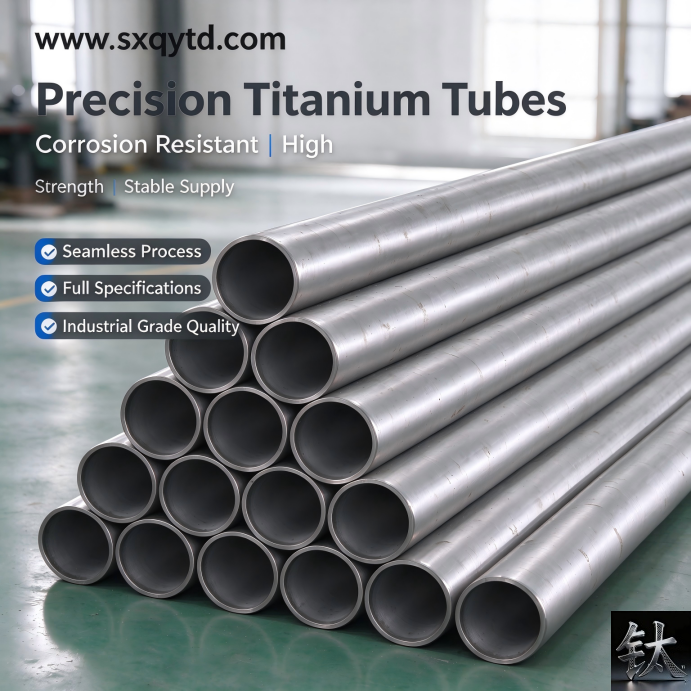
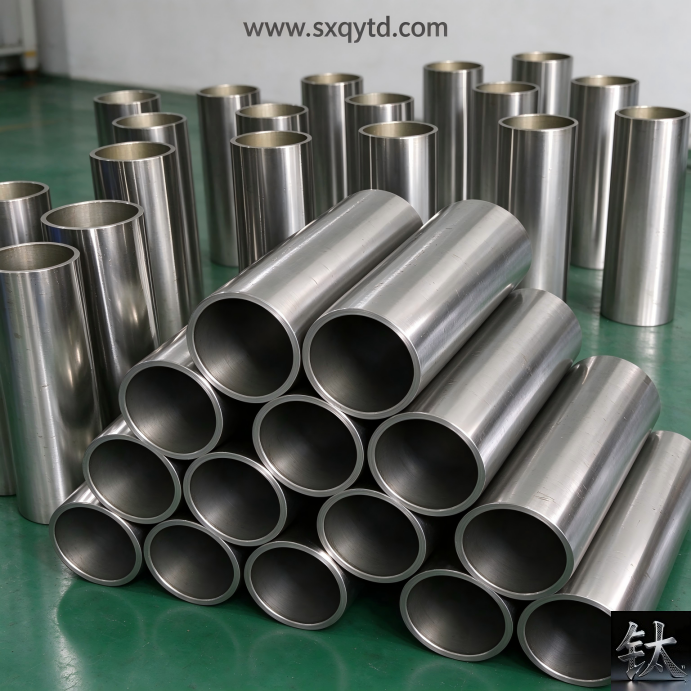
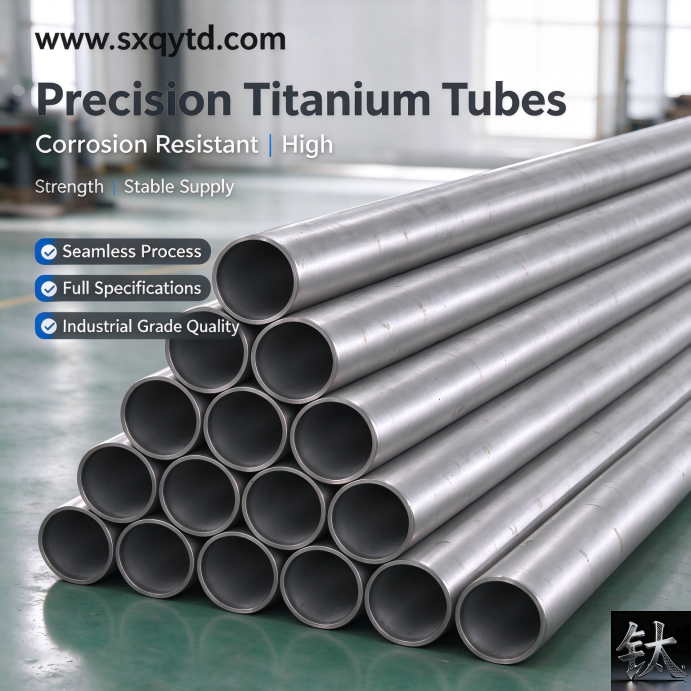
Titanium Tube: ASTM B338 Guide to Ordering by Failure Mode
| Specification | Product Forms: Seamless tube / Welded tube / U-bend tube / Coiled tube |
|---|---|
| Applicable Standard | Grades Covered: Gr1, Gr2, Gr7, Gr9, Gr12, Gr16 |
| Material Condition | Governing Standards: ASTM B338, ASME SB-338, ASTM E426, ASTM B861, ASTM B862, EN 10204 3.1 |
| Inspection & Packaging | Service Limits Covered: Hot chloride crevice, cathodic protection potential, dry chlorine, HF, reducing acids |
Product Description: B338 caps hydrogen at 0.015%, yet over-protected tubes reached 650 ppm in service. Specify the tube sheet, CP potential, grade and 9 RFQ fields.
Product Overview
Titanium Tube: ASTM B338 Guide to Ordering by Failure Mode
ASTM B338 caps hydrogen at 0.015% (about 150 ppm) when a tube leaves the mill. In a published power-station condenser case, titanium tubes coupled to a copper-alloy tube sheet and protected below approximately −0.75 V versus a saturated calomel electrode reached roughly 650 ppm hydrogen within one year — fully compliant tube, prematurely retired bundle. The wall was never the problem: in flowing seawater, Grade 2 titanium corrodes at approximately 0.3 mpy even at 36.6 m/s, and stays intact above 20 m/s where copper-nickel begins to erode above about 3 m/s. B338 certifies a tube. It does not certify the tube-to-tubesheet joint, the water box metal, the protection potential or the deposit under a baffle. Order by failure mode: fix the interface first, then the grade, then the wall, then the test package.
| At a Glance | |
| Governing spec | ASTM B338 / ASME SB-338 for condenser and heat exchanger tube — not B861 or B862, which are pipe standards |
| The number that matters | 0.015% (≈150 ppm) hydrogen mill cap versus ≈650 ppm reported after one year of over-protection in service |
| Wall corrosion in seawater | ≈0.3 mpy at 36.6 m/s for Grade 2 — no meaningful corrosion allowance; wall is a mechanical specification |
| Gr2 crevice threshold | ≈70 °C at low-to-moderate pH, 80–85 °C in near-neutral brine, ≈82 °C quoted for seawater (approx, published reviews) |
| Cathodic protection window | ≈−0.45 to −0.75 V (SCE) used for Ti/Cu coolers; below ≈−0.75 V, hydriding becomes a practical concern |
| Critical crevice pH below 100 °C | ≈9.5–10 for CP titanium, ≈2.5 for Grade 12, below 1 for Ti-Pd grades (screening values, not design allowables) |
| Wall tolerance | ±10% on average wall; minimum-wall orders carry an all-plus tolerance at roughly twice that variation |
| Test package | ET (E426, 3 × ≈0.787 mm holes), UT (notch ≤10% of wall or ≈0.102 mm), hydro at 50% of minimum yield strength for ≥5 s, pneumatic ≈100 kPa |
| RFQ fields | 9 — listed in the Summary below |
1. The "0.015% Hydrogen" Trap
: What B338 Certifies — and What It Cannot
ASTM B338 is a delivery specification. It defines chemistry, tensile properties, flattening and flaring behaviour, dimensions, and the nondestructive examination each tube must pass before it is marked. One of its least discussed lines is the hydrogen limit: 0.015% by weight, or about 150 ppm, on the finished product. That number is a mill-gate check. It is not a prediction of what the hydrogen content will be after ten years in a condenser water box.
A published power-station case makes the gap concrete. Titanium tubes were retrofitted into a condenser with a copper-alloy tube sheet. Because titanium is the noble member of that couple, cathodic protection was added to keep the copper alloy from corroding. With the protection potential held below approximately −0.75 V versus SCE, the tube ends absorbed hydrogen: about 650 ppm after one year in the reported case. Compare that with the 0.015% mill cap. Nothing about the delivered tube was out of specification; the damage was created by a design decision made after the mill certificate was signed. All figures here are approximate values from published industry case literature, not measurements from our own production.
This is not an argument against titanium tube. It is an argument about where to put the engineering attention. If the RFQ carries only grade, OD, wall and length, every supplier will quote a compliant tube and none of them will price the joint, the water box or the protection system. The failure modes that retire bundles early live in those three places, and none of them can be caught by a stricter reading of the standard.
A mill certificate is a statement about a tube on the day it shipped. It says nothing about the galvanic couple you bolt it to.
For clause-by-clause coverage of the standard, see our ASTM B338 heat exchanger tube engineering and procurement guide and the B338 specification, chemistry and tolerance reference. This article deliberately does not repeat their tables. Our titanium tube and pipe buyers guide sets out the tube-versus-pipe boundary; if the drawing actually calls for process piping, the governing documents are ASTM B861 seamless pipe and ASTM B862 welded pipe, not B338.
2. Why the Tube Wall Is Almost Never the Failure Point
In natural seawater, Grade 2 titanium sits at the noble end of the galvanic series behind a stable oxide film. Published corrosion data place the general corrosion rate at approximately 0.3 mpy (about 0.008 mm per year) even at a flow velocity of 36.6 m/s. Copper-nickel condenser alloys, by contrast, begin to suffer erosion-corrosion above roughly 3 m/s in sulphide-polluted water. Titanium is routinely operated above 20 m/s and is not attacked by the sulphide pulses that destroy Cu-Ni bundles. These are published industry screening values, not design allowables for a specific plant.
That changes what wall thickness means. On a steel or copper-alloy tube, wall is partly a corrosion allowance consumed over the design life. On a titanium tube in seawater, the wall is almost entirely a mechanical specification: it must survive roller expansion into the tube sheet, hold a seal weld, resist flow-induced vibration between baffles, and tolerate occasional sponge-ball or brush cleaning. Adding 0.2 mm "for corrosion" buys almost nothing. Reducing 0.2 mm to hit a price can cost the joint.
It also explains why the ±10% wall tolerance in B338 matters less than engineers expect, while the OD tolerance matters more. A tube ordered to average wall can legally contain local thin spots; a tube ordered to minimum wall carries an all-plus tolerance and is heavier and more expensive. Neither choice repairs a poorly expanded joint. If the tube sheet holes were drilled against a nominal OD and the delivered tubes sit at the low end of the OD band, the expansion ratio changes and the leak path is mechanical rather than metallurgical. Our titanium tube weight calculator converts the wall choice into a tonnage difference before bids arrive, and the seamless B338 tube size and weight table lists the common OD and wall combinations.
3. Start From the Tube Sheet, Not the Tube
Three decisions made before the tube order determine most of a bundle's service life. None of them appears on a standard tube enquiry form.
Joint type
Roller-expanded only is cheapest, relies on residual contact pressure and leaves a crevice at the outer end of the expansion. Seal-welded plus expanded closes that crevice and is common in seawater condensers. Strength-welded puts the load into the weld and suits high-pressure and thermal-cycling duty. Each makes a different demand on the tube: expandability (Grade 1 or annealed Grade 2), weldability (oxygen and iron control, shielding on both faces), and end condition (square, deburred, chemically clean). Ask for the joint symbol on the drawing, not just the tube size.
Tube sheet and water box metal
Titanium is cathodic to carbon steel, copper alloys and most stainless steels in seawater. A large titanium tube bundle coupled to a smaller-area steel or Cu-Ni tube sheet is a favourable area ratio for the titanium and an unfavourable one for the sheet: the sheet becomes the anode and can waste around the holes. Standard answers are a titanium-clad or solid titanium tube sheet, coating the cathode, electrically isolating the couple, or cathodic protection — the last of which introduces the trap described in the next section. The ASTM B265 plate and sheet guide covers the flat product used for tube sheet blanks, and our tube bundle failure case review shows what happens at the joint in practice.
Crevice geometry
Every expansion, gasket, baffle contact and deposit is a crevice. Bulk water chemistry — the chloride number on the process datasheet — is not the chemistry inside a stagnant crevice, where oxygen is depleted, pH falls and chloride concentrates. Specify the joint detail, the lay-up procedure and the cleaning regime on the enquiry, not just the water analysis.
4. The Cathodic Protection Trap
Here is the loop that catches retrofit projects. Titanium tube plus a copper-alloy or carbon-steel tube sheet produces galvanic attack on the sheet. Cathodic protection is added to stop it. The protection potential is set too negative. The titanium then absorbs hydrogen, hydrides precipitate, and ductility is lost at the tube ends — the exact location that was expanded or seal-welded. The system installed to save one metal damages the other.
The numbers are unusually well documented. A general cathodic potential limit of about −0.75 V (SCE) is widely cited as the point below which hydriding becomes a practical concern; one published corrosion handbook states that impressed potentials should not fall below −0.75 V (SCE) to prevent hydrogen embrittlement, and that above roughly 80 °C, detrimental galvanic couples should be eliminated rather than protected. A Chinese nuclear-condenser study concluded that the safe potential in seawater should not be more negative than about −0.7 V, with hydrogen embrittlement coefficients rising sharply beyond it. Published utility practice for mixed titanium and copper-alloy coolers sits in a narrow band: approximately −0.45 to −0.75 V (SCE), with several operators specifying −0.45 to −0.65 V. Industry literature quotes the solid-solubility limit of hydrogen in alpha titanium at only about 20 ppm, above which hydrides precipitate — which is why a reported 650 ppm after one year is not a marginal result. All potentials are reference-electrode dependent and approximate; confirm against the project corrosion engineer.
| Indicative cathodic protection bands for titanium / copper-alloy coolers (vs SCE, approx) | ||
| Potential band | Effect | Action |
| Less negative than −0.45 V | Copper alloy may be under-protected at the tube sheet | Review anode sizing and area ratio |
| −0.45 to −0.65 V | Common published operating window | Monitor with a calibrated reference electrode |
| −0.65 to −0.75 V | Upper guard band; risk rises with temperature and stress | Tighten control, especially above 80 °C |
| More negative than −0.75 V | Hydrogen uptake and hydride formation at tube ends | Hard exclusion; reconsider the tube sheet material instead |
Two practical consequences follow. First, the RFQ must ask whether cathodic protection is fitted, what potential is targeted, and against which reference electrode — otherwise the tube supplier cannot flag the risk. Second, if the project is a retrofit into an existing Cu-Ni tube sheet, the right answer may be a titanium-clad tube sheet or electrical isolation rather than a more aggressive protection system. U-bent ASME SB338 condenser tube orders in particular should carry the water box material and the protection design on the same sheet as the tube dimensions.
5. Where Grade 7 Earns Its Premium — Grade Selection by the Crevice, Not the Bulk Water
Grade selection is where most B338 enquiries go wrong, because the datasheet reports bulk water temperature and pH while the failure happens in a crevice at a higher metal temperature and a lower local pH. Published reviews of crevice corrosion in hot NaCl brines put the critical pH at which attack occurs at about 9.5–10 for unalloyed CP titanium, about 2.5 for Grade 12, and below 1 for Ti-Pd grades at 90 °C and above. Those are laboratory screening values, not design allowables. Salts of Mg²⁺, Ca²⁺, Zn²⁺ or Al³⁺ hydrolyse to form acidic pockets and pull the threshold down; dissolved Fe³⁺ and Cu²⁺ tend to passivate titanium in acid service.
| Grade selection by crevice conditions (approx, indicative) | ||||
| Grade / UNS | Crevice behaviour | Typical duty | Relative cost | Where it earns the premium |
| Gr1 / R50250 | Same crevice limits as Gr2; highest ductility | Heavy expansion, thin-wall tight U-bends | Baseline | Formability, not corrosion |
| Gr2 / R50400 | Immune below ≈70 °C in near-neutral chloride; risk above 80–85 °C; ≈82 °C quoted for seawater | Ambient seawater condensers, desalination | 1.0× | Default; do not over-specify |
| Gr12 / R53400 | Below 100 °C, attack generally needs pH below ≈2.5 | Hot brine, geothermal, petrochemical coolers | Indicative +20–30% | Near-neutral hot chloride at rolled joints |
| Gr7 / Gr16 (Ti-Pd) | Below 100 °C, attack generally needs pH below ≈1 | Hot acidic chlorides, chlor-alkali, reducing acid traces | Indicative ≈+50% | Low-pH crevices and reducing media |
| Gr9 / R56320 | Higher strength, lower corrosion resistance than CP grades | Aerospace hydraulics, high-pressure exchangers | Higher | Pressure, not corrosion |
So the question on the RFQ is not "Grade 2 or Grade 7?" but "what is the highest metal temperature at a crevice, and what is the lowest local pH?" Ambient seawater with a titanium tube sheet does not need palladium. Hot brine at a rolled joint does. Our titanium grade overview compares the full family; see the Grade 12 heat exchanger tube and Grade 12 petrochemical seamless tube pages for the Mo-Ni option, and the Grade 7 seamless tube for chlor-alkali service for the Pd option. Cost multiples are published industry estimates for finished mill products, not quotations.
6. Seamless vs Welded
: Where the Seam Actually Matters
B338 permits both routes. Welded tube is formed from strip, autogenously welded, then cold-worked and annealed so the weld microstructure becomes equiaxed. The standard adds a reverse flattening test on the weld and requires eddy-current plus ultrasonic examination. Properly made welded tube is not a second-class product: seawater condensers have used it for decades, and published price indications put it roughly 15–25% below seamless. That figure is an industry estimate, not a quotation.
Where the seam matters is geometric as much as metallurgical. On a U-bend it should sit on the neutral axis of the bend; a seam on the outer radius is worked in tension through the full bend, and on a thin-wall tight-radius bend that is where a leak starts. Under roller expansion the seam passes through the expanded length, so any local hardness variation shows up as inconsistent expansion. In cyclic pressure or vibration duty the seam is a metallurgical boundary, and seamless removes the variable. In silt-laden water a slightly proud internal bead can trap solids, so the bead condition belongs on the order.
Our B338 guide covers NDT route selection in detail and the seamless tube size table lists common dimensions. If the item is process piping rather than exchanger tubing, use ASTM B862 welded pipe with schedule-based dimensions. Mixing tube and pipe conventions on one order is a recurring quoting error covered in the tube and pipe buyers guide.
7. The Tolerance and Test Package That Protects the Joint
B338 lets the purchaser select parts of the examination route, so the PO has to name them. The table below is a summary of publicly reproduced B338-17 requirements; verify every figure against the edition cited on your own contract.
| B338 tolerance and test items (approx, verify the edition on the PO) | ||
| Item | Requirement | Why the joint cares |
| Average wall | ±10% of nominal; minimum-wall orders carry an all-plus tolerance at roughly twice that variation | Expansion ratio, mass per metre, price |
| Outside diameter | ≈±0.102 to ±0.254 mm by size bracket | Tube sheet hole fit; a tighter OD band is often agreed for roller expansion |
| Cut length | May not be short; ≈+3.2 / −0 mm up to about 7.3 m | Tube-end projection at the sheet |
| Straightness | ≈3.2 mm on short lengths; ≈2.1 mm per metre on long tubes | Insertion and baffle alignment |
| Eddy current (ASTM E426) | Calibration tube with at least three ≈0.787 mm through-holes | Short axial defects and through-wall pinholes |
| Ultrasonic | Longitudinal or transverse notch ≤10% of wall or ≈0.102 mm | Weld-seam and wall flaws ET can miss |
| Hydrostatic | Stress of 50% of specified minimum yield strength, held ≥5 s, no leak or bulge | Proof of tightness before expansion |
| Pneumatic | ≈100 kPa held 5 s, no leakage | Alternative where water is unacceptable |
| Flaring / flattening | 60° flaring tool for tubes up to ≈88.9 mm OD and ≈3.4 mm wall; reverse flattening on welded seams | Proves the tube survives expansion and the weld is sound |
Two lines deserve to be written on the PO in words rather than by reference to the standard. State "average wall" or "minimum wall" explicitly: they are priced differently and produce different mass. And if the tube will be roller-expanded, ask for a tighter OD band plus go/no-go ring gauge inspection, because OD consistency drives the expansion ratio more than wall thickness does. The B338 clause reference gives the numbering to cite; the tube weight calculator converts the wall decision into kilograms per metre.
8. When Titanium Tube DOES Fail
Titanium is not a universal answer. These are the conditions under which a B338 tube will be damaged, and each one is a reason to change the design rather than to buy a thicker tube.
Hot chlorides and the tube-sheet crevice (above ≈70–82 °C)
Grade 2 is essentially immune to general seawater attack, but the passive film is not stable inside a tight, oxygen-depleted crevice at elevated temperature. Published reviews put the onset for unalloyed titanium above roughly 70 °C at low-to-moderate pH, above 80–85 °C in near-neutral solutions, and around 82 °C for seawater. The rolled joint, baffle contact or deposit that creates the crevice usually runs at a higher metal temperature than the bulk water reading on the datasheet. Move to Grade 12 or a Ti-Pd grade, or remove the crevice by seal welding.
Hydrogen pickup from over-protection (below ≈−0.75 V SCE)
When cathodic protection is applied to a mixed-metal water box and driven too negative, atomic hydrogen enters the titanium and precipitates as hydride. Hydrogen solubility in alpha titanium is quoted at only about 20 ppm, and a published condenser case reports ≈650 ppm at tube ends after one year below −0.75 V (SCE). Uptake accelerates above roughly 80 °C and under high residual stress — exactly the condition at an expanded joint. This is a protection-setting failure, not a material defect.
Dry chlorine, HF and hot reducing acids
Wet chlorine is well handled — published data show negligible attack from about 10 to 88 °C — but dry chlorine gas can cause rapid attack and ignition at around 30 °C. Hydrofluoric acid dissolves the oxide film at any practical concentration, so fluoride-containing cleaning chemicals are a hard exclusion too. On the 5 mpy iso-corrosion line, room-temperature HCl is usable to roughly 7% for Grade 2, about 9% for Grade 12 and about 27% for Grade 7; boiling sulphuric acid attacks from as little as about 0.5%. Oxidising Fe³⁺ and Cu²⁺ ions shift those limits upward. Confirm the cleaning-in-place chemistry as well as the process stream.
Red fuming nitric acid and anhydrous methanol
Both are documented stress-corrosion-cracking hazards for titanium and belong on a hard exclusion list. Neither is fixed by palladium or molybdenum-nickel additions, and neither is a reason to increase wall thickness. If either appears anywhere in the circuit, including during commissioning or chemical cleaning, the material choice has to be revisited.
Stagnant zones, deposits and biofouling
Because titanium does not release copper ions, marine organisms settle on it more readily than on Cu-Ni. A fouled tube loses heat transfer and creates a deposit crevice; silt or shell fragments trapped under a baffle do the same. Titanium tolerates high velocity, so the usual answer is to design for continuous flow above the settling velocity, provide sponge-ball or brush cleaning, and use a lay-up procedure that does not leave stagnant seawater in the bundle. Coiled B338 tube for seawater desalination enquiries should include the fouling and cleaning regime.
Vibration, baffle spacing and iron contamination
Titanium's modulus is about half that of steel and the walls are thin, so the tubes are more sensitive to flow-induced vibration. Retrofits that reuse the original Cu-Ni baffle spacing are a documented source of tube failure; spacing must be recalculated. Separately, carbon-steel tools, wire brushes and grinding dust embed iron particles in the surface, which then rust and produce brown staining often misread as titanium corrosion. Dedicated clean tools, no carbon-steel contact, and weld colour inspection — silver or pale straw acceptable, blue, purple or grey not acceptable — belong in the installation procedure.
9. What the Mill Certificate Cannot Tell You
An EN 10204 3.1 MTR records heat chemistry, tensile results, dimensional checks, NDT and the hydrogen result for the lot as shipped. A 3.2 certificate adds third-party witnessing. Neither covers the tube sheet metal, the protection potential, the crevice temperature or the hydrogen the tube will pick up in service. Where a leak is expensive, specify 3.2 with defined witness points, PMI by heat, heat-number traceability through to the packing list, a documented finished-tube hydrogen result, and a receiving inspection that checks OD with a ring gauge, examines the ends and internal surface, and records weld colour on any pre-welded joints. Our B338 guide lists the mandatory test set and the specification reference gives the clause numbers to cite. Ask for these before production — witness points cannot be added afterwards.
10. Choose Seamless If / Choose Welded If / Choose a Pd or Mo-Ni Grade If
Choose seamless B338 tube if:
- The bundle is U-bent to a tight radius and the seam position cannot be guaranteed on the neutral axis.
- Service involves cyclic pressure, thermal cycling or known flow-induced vibration.
- The design code or the end user explicitly excludes welded tube.
- One tube leak means an unplanned shutdown with high consequential cost.
Choose welded B338 tube if:
- Duty is ambient-temperature seawater or clean cooling water with steady, non-cyclic flow.
- OD and wall consistency for roller expansion are the priority and the mill can document cold work plus annealing.
- Budget matters, and 100% eddy current, ultrasonic examination and the reverse flattening test are on the order.
- The U-bend supplier will state the weld orientation in writing.
Choose Grade 12, Grade 7 or Grade 16 if:
- Metal temperature at a crevice can exceed roughly 70–80 °C in chloride service.
- Local pH can fall below about 3 (Grade 12) or below about 1–2 (Ti-Pd grades).
- Reducing acid traces, hot brine, geothermal or chlor-alkali duty are present.
- The cost of a retube exceeds the indicative grade premium — approximately +20–30% for Grade 12 and ≈+50% for Grade 7, as published industry estimates rather than quotations.
11. Frequently Asked Questions
What does ASTM B338 cover, and how is it different from B861 and B862?
B338 is a tube standard for condensers and heat exchangers, supplied by outside diameter and wall thickness, and covers both seamless and welded product. B861 and B862 are pipe standards supplied by NPS and schedule. A drawing that says titanium heat exchanger tube should cite B338 or ASME SB-338; process piping should cite B861 or B862. Mixing the two conventions on one order produces tubes that do not fit the tube sheet.
Can welded B338 tube replace seamless in a seawater condenser?
Often yes, provided the weld has been cold-worked and annealed, passes the reverse flattening test, and is examined by eddy current and ultrasonic methods. Seawater condensers in steady, non-cyclic duty have used welded tube for decades. Where the tube is U-bent to a tight radius, sees vibration or pressure cycling, or where a leak stops the plant, seamless removes the seam as a variable.
Why do fully certified titanium tubes still fail in service?
Because B338 certifies the tube as delivered, not the assembly it is installed in. The usual causes are a hot chloride crevice at the rolled joint, galvanic attack on a steel or copper-alloy tube sheet, hydrogen uptake from cathodic protection set too negative, and flow-induced vibration from baffle spacing designed for a different alloy. None of these appears on the mill certificate.
What cathodic protection potential is safe with titanium tubes?
Published practice for mixed titanium and copper-alloy coolers sits roughly between −0.45 and −0.75 V versus SCE, with several operators using −0.45 to −0.65 V. Below about −0.75 V, hydrogen uptake becomes a practical concern; one nuclear-condenser study recommends not going more negative than about −0.7 V. Values are reference-electrode dependent, so state the reference on the drawing and confirm with the project corrosion engineer.
Do I need Grade 7 or Grade 12 for hot seawater?
Not for ambient seawater. Grade 2 is the normal choice below roughly 70 °C and away from tight crevices. Above 70–82 °C, or where deposits, gaskets or rolled joints create a stagnant crevice, Grade 12 covers near-neutral hot brine and Grade 7 or Grade 16 covers lower-pH and reducing conditions. Grade by the highest local crevice temperature and lowest local pH, not by the bulk water analysis.
Should I order average wall or minimum wall tube?
B338 permits approximately ±10% on average wall. If minimum wall is ordered, the tolerance becomes all-plus at about twice that variation, so the tube is heavier and costs more but no point is below the stated wall. For roller-expanded joints, say which one applies on the PO and pair it with a tighter OD band, because OD consistency drives the expansion ratio more than wall thickness does.
What should a B338 RFQ include?
Nine fields: standard and edition; grade and UNS number; seamless or welded; OD, wall convention, length and U-bend radius; tube sheet metal and joint type; service chemistry and temperature; cathodic protection details; the NDT and pressure-test package; and the documentation and witness requirements. The Summary below lists all nine in the order suppliers need them.
12. Summary
: Send These 9 Fields With Your RFQ
- Standard and edition — ASTM B338, plus ASME SB-338 if the work is code-stamped.
- Grade and UNS number — Gr2 / R50400, Gr12 / R53400, and so on; never just "titanium".
- Manufacturing route — seamless, welded, or welded-and-drawn; state the weld orientation for U-bends.
- Dimensions — OD × wall × length, state "average wall" or "minimum wall", and give the U-bend radius and straight leg lengths.
- Tube sheet and joint — sheet metal or cladding, and whether the joint is expanded, seal-welded plus expanded, or strength-welded.
- Service conditions — medium, chloride level, pH range, maximum metal temperature, oxidising or reducing species, flow velocity and cleaning method.
- Cathodic protection — fitted or not, target potential and reference electrode, water box material.
- Test package — ET, UT, hydrostatic or pneumatic, flaring, flattening or reverse flattening, and any tighter OD band.
- Documentation — EN 10204 3.1 or 3.2, hydrogen result on the finished tube, PMI, heat traceability, third-party witness points.
A tube that meets B338 and a bundle that lasts twenty years are not the same purchase. The standard gives you a compliant tube; the nine fields above give the supplier enough information to warn you about the joint, the protection potential and the crevice before the order is cut. Send the full list in one message when you request a quotation, and we will return a grade, route, test package and price against your actual service conditions — not against a nominal OD and wall.
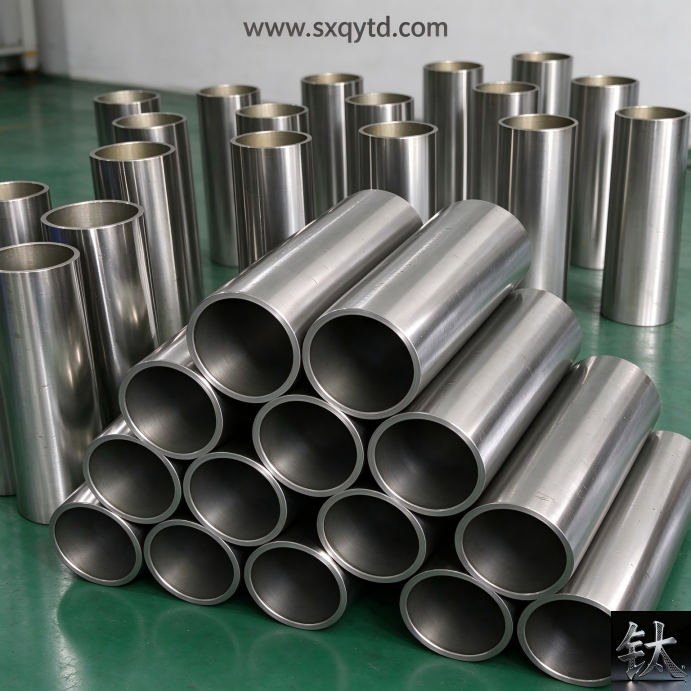
In stock & ready to ship — Titanium Tube
We stock ~80 t in stock (Gr1/Gr2/Gr5/Gr7/Gr9/Gr12) and cut to your size. As a stockist-supplier we read drawings, work to ASTM / ASME / GB standards, export worldwide, and ship same day on stock items. Tell us your spec and get a quote fast.
Tell us your requirement — grade, size and quantity. We reply within 24 hours.
Prefer chat? WhatsApp +86 188 2967 9311 or email sales@sxqytd.com.


- What is Titanium Flange | ASME B16.5 ASTM B381 Gr2 Gr5 Titanium Flan
- ASME B16.5 Titanium Flange Grade2 DN100-DN600 Class150/300 FOB
- Gr2 Titanium Sheet Price FOB Shanghai | ASTM B265 In Stock
- Titanium Price Today (Oct 26, 2026): China Market Report
- Titanium Price Today (23 Oct 2026): Plate, Tube, Rod & Wire
Contact Person: Wang Xiaoning
Tel: +86-917-355-7966
Email: sales@sxqytd.com
WhatsApp: +86 188 2967 9311
Company: Shaanxi Qianyi Tuoda Technology Co., Ltd
Address: Floor 4, Building 4, No. 188 Gaoxin Avenue, High-tech Zone, Baoji City, Shaanxi Province, China