Titanium Oxygen Service Cleaning: When Clean Is a Delivery State
| Specification | Oxygen service / precision cleaning |
|---|---|
| Applicable Standard | Gr2 / Gr7 / Gr12 titanium tube, plate and equipment |
| Material Condition | NVR / particulate / UV / water-break / double bag |
| Inspection & Packaging | ASTM G93 / G94 / G124 / CGA G-4.1 / ISO 21010 |
| Reference Price | $1000.00 – $10000.00 |
Product Description: Oxygen clean is a delivery state, not an adjective: G93 vs CGA G-4.1 levels, why titanium is the fuel, and the PO lines that hold until installation.
Product Overview
Titanium Oxygen Service Cleaning: When Clean Is a Delivery State
A purchase order that says cleaned for oxygen service has usually ordered a visual inspection, because the words name no cleanliness level, no inspection method, no dryness limit and no packaging state. In an oxygen-enriched atmosphere, defined in published guidance as more than 23.5 volume per cent oxygen, a thin hydrocarbon film or a single metal particle is fuel: the most common documented ignition mechanism is adiabatic compression when a valve opens quickly and the downstream gas heats up. For titanium the question is sharper, because an ASTM symposium paper reports the metal is combustible in 100 per cent oxygen at pressures as low as 13.8 kPa (2 psia). This guide covers the layer that sits between material selection and commissioning: how oxygen cleanliness is specified, measured, packaged and evidenced, and where the system boundary has to be drawn so that titanium is used on the wet side of the plant rather than in a dry high-pressure oxygen header. Our pickling and free-iron contamination guide explains how to remove iron so the passive film survives a chloride duty, and our cold drawn titanium spring wire page lists ultrasonic degreasing as a surface option for drawing oil. Neither of them is an oxygen-cleaning specification: in this service the same iron particle is not a corrosion initiator but an ignition source, and the same degreasing step needs a numerical acceptance limit and a document that survives transport. Our HCl corrosion limits guide and process equipment specification guide settle which grades survive which media; this article starts after that decision has been made.
At a Glance: Ten Decisions That Settle an Oxygen Clean Order
| Item | What the buyer must know |
|---|---|
| The short answer | Oxygen clean is not a description of a surface. It is a specified cleanliness level, a named inspection method, a dryness level, a packaging state and a document package that survives until the moment of installation. A purchase order that writes the words without the numbers has ordered a visual check by default |
| The number that matters | An ASTM symposium paper reports that titanium is combustible in 100 per cent oxygen at pressures as low as 13.8 kPa (2 psia). NASA flight hardware guidance calls titanium alloys extremely flammable and limits them to exceptional cases never above 100 psia. Cleaning cannot turn an unsuitable base metal into a suitable one |
| Two contaminants | Non-volatile residue (the hydrocarbon film, measured in mass per area) and particulate (size and count) are independent acceptance lines. Passing one says nothing about the other. A free-iron test does not detect oil, and an oil test does not detect iron |
| The levels disagree | Published summaries of ASTM G93 quote A to C, A to E and A to F grade scales with different NVR numbers; CGA G-4.1 has a published baseline near 220 mg/m²; EIGA figures split at 30 bar; NASA hardware runs much lower. Do not average them. Name the standard, edition, grade letter, unit, area basis and sampling plan |
| G93 is a guide | ASTM G93/G93M defines cleanliness levels and cleaning methods but does not select a level for the project and has no baseline. CGA G-4.1 does have baseline levels for cleanliness, dryness and inspection. The owner must supply the missing choices; ordering generically to G93 without its Section 14 instructions is an incomplete request |
| Where titanium belongs | On an oxygen or chlor-alkali plant the titanium side is the wet side: wet chlorine, seawater cooling, hypochlorite, caustic liquor and moist oxygen carrying free water. German oxygen-plant guidance explicitly allows corrosion-resistant materials or coatings for moist oxygen service. Dry high-pressure oxygen headers, valves and regulators belong to copper, Monel and Inconel, not titanium |
| The wrong chemicals | Hydrofluoric acid, free fluoride, hot reducing acid, chlorinated solvent residues, carbon steel wire brushes, ordinary shop detergent, mineral oil and standard thread compounds are all disqualified here for different reasons. Some attack the passive film, some leave an ignitable residue, some put free iron back on the surface |
| Six tests, no substitutes | White-light visual, 365 nm ultraviolet, water-break, white-cloth wipe, gravimetric solvent extraction for NVR, and particle counting or borescope inspection. Each catches a different class of contaminant. A UV lamp does not see non-fluorescing oil and a wipe test does not give a number |
| Clean until installed | Drying with oil-free nitrogen to a stated dew point, capping every opening, double bagging in clean polyethylene, a tamper-evident CLEANED FOR OXYGEN SERVICE tag, segregated storage, a defined shelf life and an opening record. The clock starts at the final test, not at dispatch |
| The one document to demand | A 14-line RFQ or purchase order that splits the plant into oxygen-side and wet-side rows, plus a Certificate of Cleaning with procedure revision, agent batch, NVR and particle results, dryness record, seal number, packaging date and expiry |
Read rows two, four, five and ten first. The recurring buying error is not a dirty part; it is an order written as though clean were an adjective that any competent workshop would interpret the same way. Every number in this table has a governing document behind it, and several of those documents disagree with each other. Where published sources conflict we say so, name the sources, and give the verification action instead of printing one false-precision value. Treat the table as a list of decisions the system owner must make before a supplier can quote. A supplier can deliver a cleanliness level, a surface state and a document package; the supplier cannot decide which oxygen pressure, concentration and flow velocity the component will see, and cannot certify that a metal is compatible with a service the owner has not described. That division of responsibility is the difference between a defensible package and a stamp on a bag.
The "Oxygen Clean" Trap: A Guide, a Practice and a Missing Decision
Three documents are usually named in an oxygen-clean enquiry and they do three different jobs. ASTM G93/G93M is a standard guide for cleanliness levels and cleaning methods for materials and equipment used in oxygen-enriched environments. It defines a vocabulary of non-volatile residue grades and particle grades and describes cleaning and verification techniques. Precision-cleaning contractors state plainly that G93 is a guide rather than a specification, that it has no baseline level, and that it does not tell the engineer which level to use; ordering cleaning to G93 without following the instructions in its Section 14 is an insufficient request. CGA G-4.1, Cleaning Equipment for Oxygen Service, is the shop-floor practice document that most industrial gas, aerospace and medical oxygen specifications cite. It covers contaminant removal, cleaning methods, inspection, packaging and preservation, and it does carry baseline levels for cleanliness, dryness and inspection. One widely quoted contractors summary gives that baseline as roughly 220 mg/m² of NVR, a dryness level around −22 °F dew point, and inspection by at least ultraviolet light or a wipe test. OSHA regulation 29 CFR 1910.104 adds the legal floor for bulk oxygen systems: equipment must be cleaned of oil, grease and readily oxidizable materials before the system is placed in service.
The trap closes when the order writes only the phrase. With no level, no method and no dryness requirement, the cheapest compliant interpretation is a white-light look and a clean-looking bag. Our equipment arrival acceptance guide makes the same point about certificates and dimensions: whatever is not named in the order becomes the supplier default by omission. On a titanium order there is a second version of the same failure, because three separate acceptance systems are routinely collapsed into one line. The first is material compliance, evidenced by the EN 10204 3.1 mill certificate with heat number, chemistry and mechanical properties. The second is surface compliance, evidenced by the pickling, passivation and free-iron records associated with ASTM B600. The third is oxygen-clean compliance, evidenced by NVR results, particle results, a dryness record, a seal number and a Certificate of Cleaning. A perfect MTC says nothing about the oil on the bore. A clean ferroxyl test says nothing about hydrocarbon film. A beautiful double bag says nothing about the grade of plate underneath. Keep the three file sets separate and require all three at the hold point.
Buyer rule: if the phrase cleaned for oxygen service appears in a purchase order without a standard and edition, a grade letter, an NVR unit and area basis, a particle level, an inspection method with sampling rate, a dew point and a packaging state, then the order is not yet writable. Send it back for the six missing fields before anyone books a cleaning bay.
There is a practical reason the owner must make these choices. Precision-cleaning providers describe a cleaning triangle made up of the specification, the component and the contaminant: the definition of clean, the metallurgy and geometry of the part, and the identity of the soil all have to be known before a method can be selected. A thin-wall ASTM B265 Titanium Plate component with a blind bore, a threaded socket and a welded root presents a completely different cleaning problem from a flat machined flange face, and a drawing-oil residue responds to a different agent than a fluoride-bearing pickle residue. Add the operating envelope (maximum oxygen pressure, concentration, temperature, flow velocity and the consequence of failure) and the cleaning level follows from risk. Without that envelope, the only honest answer a supplier can give is a question.
Two Contaminants, Two Acceptance Lines: NVR and Particles
Oxygen cleanliness is measured along two axes that do not substitute for each other. Non-volatile residue is the mass of hydrocarbon and other non-evaporating film left on a defined surface area, obtained by washing the surface with a clean solvent, evaporating the solvent in a pre-weighed tray and reweighing against a blank control. Particulate is a size-and-count distribution: a level is commonly expressed as the largest permitted particle size with limits on the smaller size bands. Published descriptions of CGA G-4.1 particulate criteria, for example, quote no particles at or above 1000 µm, at most two particles in the 500 to 1000 µm range per square foot, and isolated lint fibres shorter than 2000 µm with no accumulation. Whether those exact numbers belong to the edition cited on a given project must be checked against that edition; the important structural point is that a mass limit and a particle limit are two independent pass or fail lines.
They ignite by different mechanisms. A hydrocarbon film is the most commonly cited trigger: under rapid pressurisation, adiabatic compression of the downstream gas raises the local temperature until the film reaches its ignition point, and the burning film can kindle the metal beneath it. A hard particle travelling at velocity strikes a surface, converts kinetic energy into local heat and can initiate the same chain; particles also lodge in valve seats, interfere with sealing and generate friction. Both mechanisms intensify with oxygen pressure, concentration and flow velocity, which is precisely why the owner must supply those three numbers. In a titanium circuit the second mechanism is especially unwelcome, because the base metal itself is combustible once ignited. On a stainless or copper alloy circuit a small ignition may self-extinguish; on titanium the published burn behaviour is far less forgiving.
Here is where this article deliberately parts company with our free-iron and pickling guide. In a wet chloride duty, a steel sliver or a smear of iron on titanium is a corrosion problem: the iron-titanium potential difference drives local pitting, and the rust stain disappears long before the pit stops growing. In oxygen service the same particle is an ignition problem, and the consequence is measured in a fire rather than in millimetres per year. The two articles are therefore two independent verification lines, not competing advice. Industry guidance on tube interior cleanliness puts it in one sentence: free-iron tests do not detect oil, and oil tests do not detect iron. A supplier that has performed an ASTM B600 ferroxyl check has proved the surface is free of iron; that supplier has not proved it is free of oil. Conversely a passing ultraviolet scan has not proved that a carbon steel wire brush did not leave iron behind. Order both, record both, and keep the reports in different sections of the file.
| Contaminant | Typical source on a titanium job | What it does in oxygen | Test that sees it |
|---|---|---|---|
| Hydrocarbon film (NVR) | Cutting fluid, drawing lubricant, thread compound, fingerprints, solvent residue, ordinary adhesive | Ignites under adiabatic compression or friction and kindles the metal | UV fluorescence, water-break, wipe, gravimetric solvent extraction |
| Metallic and non-metallic particles | Machining chips, weld spatter, grinding dust, blasting grit, lint, packaging fibres | Impact heating, seat damage, friction, local hot spots | White-light visual, particle count on extracted solvent, borescope |
| Free iron smears (third line) | Steel rack, carbon steel sling, shared deburring wheel, bare-hand contact | Corrosion initiator in wet chloride service and an ignitable particle source here | Ferroxyl or other free-iron spot test, not an oil test |
| Residual water | Incomplete drying, dead legs, trapped cavities, humid shop air | Ice in cryogenic fill, stagnant crevices, diluted cleaning agents, recontamination carrier | Dew point of the purge gas, weight or visual dry check |
Two process residues deserve their own line in the enquiry. Dye penetrant, magnetic particle media and ultrasonic couplant used during weld NDT and WPS qualification are organic or particulate soils by definition, so any NDT performed after precision cleaning invalidates the clean state. The same is true of a field weld: our GTAW shielding guide explains the inert-gas discipline needed above 400 °C, and that discipline is a workshop operation, not something to perform next to a bagged, certified component. Write the sequence into the method statement: all hot work, all NDT, all pickling and all dimensional checks first, then final precision cleaning, then verification, then sealing. Any operation that opens the surface after the final test returns the part to the start of the chain.
The Grade Table Nobody Can Agree On, and the Six Fields That Fix It
Buyers routinely ask which ASTM G93 cleanliness level to specify. There is no honest single answer, because the published summaries of the standard do not agree even on the shape of the scale. One precision-cleaning reference lists six NVR levels in mg per 0.1 m² (A 1, B 3, C 6, D 11, E 22, F 55), with particle levels named by the largest permitted size such as Level 100. A second reference to G93/G93M-25 describes five NVR grades from A to E with values such as C below 6, D below 20 and E below 50 mg per 0.1 m², paired with particle levels 100, 300, 500 and 1000. A third published summary describes four grades from A to C with an A limit at or below 0.1 mg per 0.1 m² and a B band from 0.1 to 1. These are not small disagreements, and they come partly from different editions, partly from simplified secondary summaries, and partly from unit confusion between mg per 0.1 m², mg per square foot and mg per square metre. One square foot is about 0.093 m², so the first two bases are numerically close but not identical.
The practice documents add another layer. CGA G-4.1 is widely quoted with a baseline around 20 mg per square foot, roughly 220 mg/m², and one supplier summary notes that this figure is tied to the observation that light hydrocarbon oils begin to migrate and pool near that surface concentration. An industrial-gas comparison slide quotes CGA G-4.1 at 500 mg/m² and EIGA at 500 mg/m² below 30 bar but 200 mg/m² above it, while a published Swagelok cleaning specification equates G93 Level C with 6 mg per square foot, about 66 mg/m², and NASA hardware is quoted in the 10 to 40 mg/m² range. We are not going to declare one of these correct. Each belongs to a named document, edition, service envelope and sampling method, and a number lifted out of that context is worse than no number at all. Verify the current text of the standard your project actually cites before a value goes into a purchase order.
| Source as published | Quoted figure | Basis | Why it cannot be copied blindly |
|---|---|---|---|
| Precision-cleaner summary of G93 | A 1 / B 3 / C 6 / D 11 / E 22 / F 55 | mg per 0.1 m² | Six-grade scale; secondary summary, edition confirmed |
| Summary of G93/G93M-25 | C <6 / D <20 / E <50 with particle levels 100 to 1000 | mg per 0.1 m² | Five-grade scale; particle band definitions differ from the first source |
| Testing-laboratory summary of G93 | A ≤0.1, B 0.1 to 1 | mg per 0.1 m² | Four-grade description; an order of magnitude below the first row for grade A |
| CGA G-4.1 baseline as quoted by contractors | ~20 / ~220 | mg per ft² / mg per m² | Baseline applies only when the owner names nothing else; not a high-purity target |
| EIGA / industrial-gas comparison | 500 below 30 bar; 200 above 30 bar | mg per m² | Pressure-split limit; requires the design pressure on the order |
| Published component-maker G93 Level C | 6 / ~66 | mg per ft² / mg per m² | Company cleaning specification, not the text of G93 itself |
| NASA sensitive hardware, as quoted | roughly 10 to 40 | mg per m² | Programme-specific; includes configurational and acceptance testing |
The fix is not a better number. It is six fields that make any number auditable. First, name the standard and the exact edition, for example G93/G93M with its year or CGA G-4.1 with its edition. Second, name the grade letter and, if a custom level is used, write the value out in full. Third, state the unit and the area basis, including whether the area is the whole wetted surface, a sampled coupon or a defined internal bore length. Fourth, state the sampling plan: how many parts per lot, which locations, which solvent volume, and whether the blank control is subtracted. Fifth, name the inspection method and its parameters, including the ultraviolet wavelength, the white-light illuminance, the wipe material and the balance resolution used for gravimetric work. Sixth, name who issues the report, who witnesses the hold point and how long the record is retained. A purchase order with those six fields is enforceable whether the cited level is 1 mg or 220 mg/m²; one without them is unenforceable at any level.
Geometry decides how hard those fields are to satisfy. Long small-bore ASTM B338 titanium tubes, coiled titanium tube bundles and condenser tube sets have internal surfaces that cannot be inspected by direct vision and cannot be wiped with a cloth. For those, specify a solvent flush or a close-fitting felt plug propelled by clean dry inert gas, define the number of tubes or the percentage of each bend radius to be sampled, and state the pass or fail colour or mass criterion on the extracted plug. One tube standard for feedwater heaters offers a useful template: acetone-soaked felt plugs blown through a defined sample of tubes with dry oil-free gas, where more than light grey discolouration sends the whole affected group back for recleaning. Copy the structure, not the solvent, and have the cleaning contractor confirm that the chosen solvent is compatible with titanium and with the project residue limits.
The Titanium Problem: When the Base Metal Is the Fuel
This is the chapter most titanium suppliers would rather not write, and it is the reason this article is useful. Oxygen cleaning standards exist because contamination ignites and then kindles the metal. For titanium, published combustion work places the metal at the wrong end of that ranking. An ASTM symposium paper on the ignition and combustion of titanium and its alloys reports frictional ignition testing and promoted combustion testing in which titanium was combustible in 100 per cent oxygen at pressures as low as 13.8 kPa (2 psia), with a friction ignition threshold expressed as a pressure-velocity product. NASA Johnson Space Center materials guidance states that titanium alloys are extremely flammable and should be used only in exceptional circumstances and at very low pressures, never above 100 psia; the same document notes that with a few exceptions such as Monel alloys, common structural metals are flammable in oxygen at modest pressures, but that most can still be used safely when the system is designed to eliminate ignition sources. German DGUV oxygen-plant guidance goes further and lists titanium and its alloys, together with zirconium and its alloys, as metallic materials not suitable for oxygen-carrying plant components, while recommending that alloys containing more than 0.7 per cent titanium as an alloying element also be avoided unless suitability is demonstrated by testing such as ASTM G124. A draft revision of ISO 21010 on cryogenic vessel gas and material compatibility carries the same warning for oxygen applications with elevated oxygen concentrations.
These are not corrosion statements and they are not a reason to avoid titanium in general. They are statements about a specific combination of oxygen concentration, pressure, geometry and ignition energy. The same ISO draft notes that metallic materials do not normally present incompatibility in contact with oxygen provided cold embrittlement is evaluated, and that the ignition of non-metallic materials can lead to the ignition and combustion of the metal; it also flags thin sections with high surface-to-volume ratio and high ignition energy as special cases. ASTM G94 is the umbrella guide for evaluating metals in oxygen-enriched atmospheres: it does not prescribe one test, it directs the engineer to methods such as G124 for promoted-ignition combustion behaviour, G125 for burn rate, G86 for mechanical impact, G63 for non-metallic materials and G88 for system design. Which of those applies depends on whether the component is a valve seat, a thin-wall tube, a regulator or a static vessel, and on the maximum pressure and temperature. That selection is a design decision, signed by the system owner, not a cleaning decision made in a workshop.
The sentence that belongs on every titanium oxygen enquiry: cleaning is a necessary condition, not a sufficient one. A part can pass every NVR and particle test in the book and still be the wrong metal for a dry high-pressure oxygen header. Material compatibility is assessed under G94 by the designer; the supplier delivers the surface state and the evidence.
The honest commercial answer is to name where the nickel and copper alloys take over. Published oxygen-service comparisons consistently rank copper and copper alloys and Monel 400 as the low-hazard group, with high ignition thresholds, low flame-propagation rates and a tendency to self-extinguish; Inconel 600 and 625 are commonly accepted for higher-temperature oxygen components. Our Monel 400 versus Inconel comparison covers the same family from a corrosion perspective, our Monel K-500 versus 400 guide explains the age-hardened condition used for shafts and stems, and our C276 versus C22 grade guide covers the nickel-chromium-molybdenum group. Those pages are about media selection; this paragraph is about ignition behaviour, and a valve trim or regulator body on the dry oxygen side should be selected on the second criterion as well as the first. We supply nickel products including N6, Ni201 and Monel 400 alongside titanium for exactly this reason. If a drawing calls for titanium on the dry oxygen side, the correct response is not to offer a better cleaning certificate; it is to ask for the oxygen compatibility assessment and, where the pressure and concentration are high, to propose a material change on the drawing.
Pressure limits quoted in the public sources conflict in the same way the cleanliness levels do. NASA guidance names 100 psia as an absolute ceiling for titanium in exceptional cases, aluminium alloys up to 3000 psia for static components but 100 psia for valves, and stainless or Inconel flammable above roughly 500 psia yet usable to much higher pressures when ignition sources are eliminated by design. Those figures come from a flight-hardware programme with its own test regime, and copying them into an industrial purchase order would be a category error. What transfers is the method: establish maximum oxygen pressure and concentration, identify credible ignition mechanisms for this component, select the test methods, and record the assessment. Where a supplier is asked to quote a titanium component for oxygen duty, that assessment should arrive with the enquiry rather than be requested after the parts are cleaned.
Where Titanium Does Belong: Draw the Wet-Side Boundary First
An oxygen plant is not one atmosphere. A chlor-alkali or water-electrolysis complex has a dry high-pressure oxygen header, valve skids, regulators and compressor stages on one side, and wet chlorine, brine, hypochlorite, caustic liquor, seawater cooling and moist oxygen carrying free water on the other. The German DGUV annex that excludes titanium from oxygen-carrying components explicitly carves out the second case: pipelines and equipment designed for continuous transport of oxygen mixtures where materials may be exposed to free water, such as moist oxygen from a potassium hydroxide electrolysis process, may require corrosion-resistant materials or internal coatings, with a warning that any coating or corrosion inhibitor must be compatible with the oxygen conditions and that flammable coatings are prohibited unless compatibility has been demonstrated. That is the boundary line. Titanium earns its place where water is reliably present and the medium is one it handles well; it does not earn its place in a dry oxygen header simply because it is corrosion resistant.
Our grade-by-grade HCl and halide limits guide already makes the wet-versus-dry distinction for chlorine: titanium is outstanding in wet chlorine, while dry chlorine is a hard exclusion with published ignition around 30 °C. The identical reasoning applies to oxygen. A dead leg that can dry out, a start-up before the moisture seal is established, a failed steam injection or a drained header during a shutdown all have to be reviewed as dry-oxygen cases, not as wet-side cases. Our Grade 2 versus Grade 7 seawater guide and Grade 7 versus Grade 12 comparison cover the grade upgrades for hot brine and reducing media on that wet side, and our process equipment specification guide gives the medium-first selection matrix that should be filled in before cleanliness is ever discussed. When a buyer asks for oxygen-clean titanium, the first useful question is therefore not which cleaning level, but which side of the boundary the component sits on and whether free water is guaranteed at every operating and transient condition.
| Plant zone | Medium state | Typical material decision | Cleanliness and documentation |
|---|---|---|---|
| Dry oxygen header, valve skid, regulator, compressor discharge | Dry, elevated pressure, fast valve actuation | Copper alloys, Monel 400, selected Inconel; titanium excluded by published guidance | Full oxygen cleaning level, quantitative NVR, particle count, G94 compatibility assessment |
| Wet chlorine, hypochlorite and brine circuits | Free water continuously present | Grade 2 titanium; Grade 7 or 12 where hot brine or reducing conditions demand it | Surface cleanliness for corrosion control (B600 free iron), not an oxygen-fire criterion |
| Moist oxygen from KOH electrolysis, gas cooling and washing | Oxygen plus free water or alkaline mist | Corrosion-resistant material or qualified internal coating per project assessment | Both lines: oxygen cleanliness plus evidence that coating or inhibitor is oxygen compatible |
| Seawater and utility cooling of the oxygen plant | Aqueous, no oxygen enrichment | Titanium tube and plate, selected by chloride and temperature | Normal fabrication cleanliness; do not pay for an oxygen-clean package that buys nothing |
| Interfaces, drains, dead legs, start-up bypasses | Can dry out during transients | Review as dry oxygen; apply the stricter material and cleaning rules | Flag as a hold point on the P and ID and in the purchase order line item |
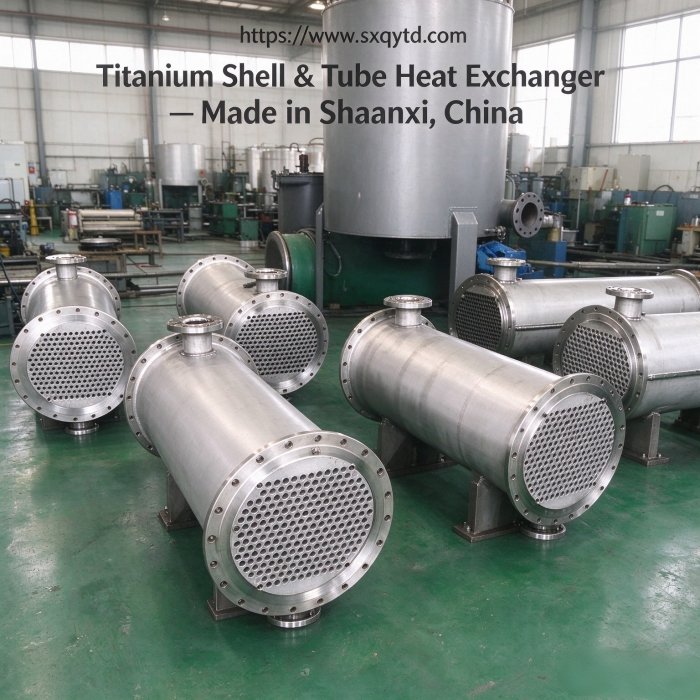
The equipment on the wet side looks nothing like a valve trim. It is titanium storage tanks, titanium reactors and custom titanium reactors and heat exchangers built to a duty, with coiled tube bundles and condenser tube sets inside them. Those units still need a documented clean surface, and a buyer may still ask for oxygen-clean packaging on a component that will be installed into an oxygen plant, but the reason is contamination control at the interface, not a belief that a titanium shell can serve as a dry oxygen pressure boundary. Writing the boundary into the drawing and the order prevents two expensive mistakes in opposite directions: over-specifying an entire titanium vessel to aerospace cleaning levels it does not need, and under-specifying a small titanium fitting that actually sits on the dry side of a valve.
Cleaning Agents and Tools That Are Wrong for Titanium
Precision cleaning for oxygen service normally runs in stages: mechanical pre-clean, aqueous alkaline or solvent cleaning, ultrasonic cleaning where geometry demands it, deionised water rinsing to a neutral pH, drying with clean oil-free gas, and immediate packaging. That sequence is not material-neutral. On titanium, the agents that are effective on stainless steel can destroy the passive film, add hydrogen, leave a residue that no UV lamp will see, or put free iron back onto a surface that was clean ten minutes earlier. Our acid cleaning and free-iron guide sets out why ASTM A967 and A380 are stainless steel documents and why the titanium route runs through ASTM B600 and the fluoride-nitric balance instead. Hydrofluoric acid and free fluoride dissolve titanium outright, and hot reducing acids are the hard exclusions in our grade limits guide; neither belongs in a cleaning bay for titanium parts, and a shop that proposes them has confused a steel pickling line with a titanium one.
Chlorinated solvents deserve a careful paragraph rather than a blanket slogan. Vapour degreasing with chlorinated solvents was historically standard oxygen-cleaning practice, and modern precision-cleaning references still list fluorinated and other solvent options alongside aqueous alkaline cleaning. Three separate objections now apply. Environmental and occupational restrictions have removed many legacy chlorinated solvents from normal use. Any solvent residue left in a blind bore, a threaded socket or a tube-to-tubesheet gap is itself a contaminant that must be driven off and verified. And on titanium, a chloride-bearing residue in a warm, occluded location is a different problem from bulk chloride in seawater: titanium resists the latter because a continuous aqueous phase maintains the passive film, while a concentrated trapped residue in a crevice is exactly the geometry where local attack and hydrogen pickup are documented. Our hydrogen embrittlement guide explains why hydrogen added during pickling is not removed by the low-temperature bake-out used for plated steel. The practical rule is to name the solvent, require a residue and drying verification step, and prohibit any chlorinated agent on titanium unless the cleaning contractor documents both its removal and its compatibility.
The physical tools are as important as the chemistry. Carbon steel wire brushes, shared deburring wheels, steel racks, carbon steel slings and bare-hand contact are all documented sources of free iron smears; on a wet titanium circuit that causes pitting, and in oxygen service it also adds an ignitable metallic particle. Our galvanic corrosion guide explains the electrochemical consequence of mixing steel and titanium in a wet joint, and our passivated titanium fastener page shows the downstream dedicated-tool and segregated-packing discipline that keeps a cleaned surface clean. Use dedicated non-ferrous tooling after the final clean, clean lint-free gloves, segregated storage and non-metallic supports. Assembly consumables need the same scrutiny: ordinary PTFE thread tape, hydrocarbon thread compound, mineral-oil lubricant and general-purpose adhesive tape all introduce organic material at the exact moment the bag is opened. Oxygen-compatible fluorinated lubricants are available and are named in industry checklists, but they must be listed by product in the cleaning and assembly procedure rather than left to the fitter. Our flange, bolt and gasket three-piece guide covers the pressure-class and sealing-face synchronisation for Titanium Flanges; oxygen service adds a fourth constraint, which is that every seal and lubricant in that joint has to be oxygen compatible and documented.
Finally, the sequence must be fixed. Dye penetrant and couplant residues from weld inspection, heat tint and alpha case from welding, and any field repair carried out with Gr2 chemical repair wire all occur before the final precision clean, never after it. Our Grade 7 versus Grade 12 comparison is a reminder that grade identification also matters here: the cleaning records, the MTC and the physical part must all carry the same UNS designation and heat number, because a cleaning certificate attached to the wrong lot is not evidence of anything. Write one sentence into the method statement that settles every argument on site: after the final verification test, no hot work, no NDT, no machining, no abrading and no unwrapped handling is permitted; the next operation is capping and bagging.
Six Tests That Do Not Substitute for Each Other, Then the Clean-Until-Installed Chain
Verification is a sequence, not a single certificate. Direct visual inspection under high-intensity white light finds dust, scale, discolouration, visible particles and weld spatter. A 365 nm ultraviolet or black-light pass then reveals many hydrocarbon films that fluoresce and are invisible to the eye, though it will not reveal non-fluorescing oils and it gives no mass value. The water-break test is a fast surface-energy check: clean water sheets into a continuous film on a truly clean metal surface and beads up where hydrophobic residue remains, but rough, pickled or heavily oxidised surfaces can make the interpretation ambiguous. A white-cloth or filter-paper wipe gives a qualitative particle and residue check with a defined solvent and sampling area, and it is only as good as the pass or fail colour criterion written beside it. Gravimetric solvent extraction is the quantitative NVR method: wash a known area with clean solvent, filter to collect particles, evaporate the filtrate in a pre-weighed tray and reweigh against a blank control. Particle counting or microscopy on that filtrate, plus borescope examination of bores, blind holes and weld roots, closes the geometry gap. Each method catches a class of contaminant that the others miss, which is why an owner who orders only a UV scan has ordered an incomplete verification.
| Method | What it detects | What it misses | Parameter to write into the order |
|---|---|---|---|
| White-light visual | Visible particles, scale, lint, discolouration | Thin films and sub-visible particles | Illuminance, viewing distance, coverage, acceptance description |
| Ultraviolet fluorescence | Many hydrocarbon oils and greases | Non-fluorescing oils, metals, inorganic particles, any mass value | Wavelength (commonly 365 nm), lamp intensity, ambient darkness, trace fluorescence rule |
| Water-break | Hydrophobic film on a smooth surface | Rough or oxidised surfaces, particle counts, quantitative residue | Water quality, surface finish precondition, observation time |
| White-cloth or plug wipe | Loose particles and gross residue in accessible areas or bores | A numerical NVR value, blind cavities beyond the plug | Cloth or felt type, solvent, sampled area, sample rate, pass colour |
| Gravimetric solvent extraction (NVR) | Mass of non-volatile residue per area | Particle size distribution; volatile residues that evaporate with the solvent | Area basis, solvent, blank control, balance resolution, report unit |
| Particle count, microscopy, borescope | Size bands, counts, internal defects and trapped debris | Dissolved or molecular film | Size bands, count limits, coverage of internal surfaces, image retention |
The moment a part passes, the clean state begins to decay. Precision-cleaning practice treats the interval between final verification and installation as the vulnerability window: drying is performed with clean oil-free nitrogen or air to a specified dew point, every opening is capped or plugged with high-purity closures, small components are heat-sealed or taped into clean polyethylene bags and commonly double bagged, and a tamper-evident label reading CLEANED FOR OXYGEN SERVICE is applied with a serial number. Where the service demands the highest levels, final cleaning and packaging take place in a controlled environment, frequently quoted as an ISO 7 cleanroom, because an open shop can redeposit particles and NVR faster than an inspection can detect them. Cleaned parts are stored separately from general inventory, because a bag sitting next to uncleaned stock in a shared warehouse is an administrative failure waiting to become a technical one. The record chain should carry a cleaning date, the procedure revision, the agent batch, the verification results, the dryness reading, the seal number, the packaging date, a defined shelf life and an opening record signed at installation. Our three-step arrival acceptance guide is a sensible place to add that opening record as a fourth check, alongside the MTC, the dimensional check and the NDT file.
Two details are titanium-specific. First, drying is not only about oxygen purity. Residual water in a dead leg or under a gasket is also the carrier for concentrated chloride and the medium in which a carbon steel clamp or plug becomes a galvanic couple, which is why our material upgrade ladder guide treats crevice geometry as a design variable rather than a housekeeping issue. Second, any dimensional or surface rework after sealing voids the certificate. A cut-to-size Titanium Plate from held stock that needs a field trim has to go back through cleaning and verification, so it is almost always cheaper to settle the final dimensions on the drawing before the cleaning bay is booked. The Certificate of Cleaning is required by CGA G-4.1 practice to state the cleaning date, the method used and the signature of the technician who performed the verification; that single page is what an auditor or an incident investigator will ask for first. Treat it as a controlled document, not a packing slip.
One Plant, Two Cleanliness Rules: The 14-Line RFQ and PO Template
Most oxygen-plant orders fail at the boundary between disciplines. The piping engineer specifies an oxygen cleaning level for the header, the equipment engineer specifies a titanium vessel for the wet side, and the purchase order merges them into one line with one cleanliness note. The result is either a titanium vessel quoted to an aerospace cleaning level it does not need, or a small titanium component on the dry side shipped with nothing but a visual check. The fix is structural: split the order into oxygen-side rows and wet-side rows, and give each row its own material, cleanliness, inspection and documentation columns. This is the same move as our upgrade ladder guide when a single phrase such as 316L or equivalent tries to cover two incompatible passive-film systems, and the same two-witness-column approach used for barrier versus inherent corrosion resistance. Here the two columns are oxygen-side and wet-side, and neither may inherit requirements from the other by default.
| Line | Field | Oxygen-side row | Wet-side titanium row |
|---|---|---|---|
| 1 | System tag and boundary | Tag, P and ID, dry or transient-dry flag | Tag, proof that free water is present in all states |
| 2 | Service envelope | Max O2 pressure, concentration, temperature, velocity | Medium, impurities, pH, chloride, temperature |
| 3 | Material and UNS | Copper alloy, Monel 400 or selected Inconel as assessed | Gr2 / Gr7 / Gr12 with UNS and product standard |
| 4 | Compatibility assessment | G94 assessment with named test methods and approver | Not applicable; record why |
| 5 | Cleanliness standard | G93 or CGA G-4.1 with exact edition | ASTM B600 surface route with free-iron test |
| 6 | Level, unit and area basis | Grade letter, NVR value, mg per stated area | Not applicable; state surface finish instead |
| 7 | Particle level and sampling | Size bands, counts, parts per lot, sample locations | Visual debris criterion at dispatch |
| 8 | Inspection methods | White light, UV wavelength, wipe, gravimetric, borescope | Visual plus free-iron spot test |
| 9 | Cleaning agents and prohibitions | Named agent, batch, SDS, no chlorinated residue without verification | B600-compatible route, no HF or free fluoride |
| 10 | Sequence and hold points | All hot work and NDT before final clean; witness after final test | Pickle, rinse, dry, free-iron check, then release |
| 11 | Drying and dew point | Oil-free nitrogen, stated dew point and measurement point | Drain and dry, no standing water in dead legs |
| 12 | Packaging and preservation | Capped openings, double clean bag, tamper-evident seal and number | Segregated non-ferrous packing, no steel contact |
| 13 | Shelf life and opening record | Expiry date, storage class, signed opening record at installation | Dispatch date and arrival check |
| 14 | Document package | Certificate of Cleaning, NVR and particle reports, dryness record, MTC | EN 10204 3.1 MTC, pickling log, free-iron record |
Line 4 is the one procurement teams omit. The oxygen compatibility assessment belongs to the designer and the system owner, it is referenced to ASTM G94 and the test methods that guide points to, and it must be signed before a material is released for the dry side. Line 14 is the one suppliers omit. A complete oxygen-clean file contains the Certificate of Cleaning with date, procedure revision and technician signature, the cleaning agent batch and safety data sheet, the NVR report including the blank correction and the sampled area, the particle and UV records, the dew point record, the seal number and packaging date, the stated shelf life, and the material certificate tying the part to its heat number. Our ASTM B265 plate guide, B338 tube guide and mill certificate page describe the material half of that file. When a buyer sends us a drawing with these 14 lines filled in, we can quote both rows honestly: a nickel or copper component for the dry side, and a cut-to-size titanium component with a documented surface state for the wet side. When the order arrives with a single line saying oxygen clean, the only responsible response is to send the six missing fields back.
Limitations and Failure Conditions: Eight Places the Clean Chain Breaks
Each condition below either moves the enquiry to a different material family, sends it back for missing specification fields, or turns it into a verification programme rather than a cleaning order. Several of them are places where titanium itself is the wrong answer, and we would rather say so here than in an incident report.
High-pressure dry oxygen on a titanium pressure boundary
This is the hard stop. ASTM combustion work reports titanium combustible in 100 per cent oxygen at pressures as low as 13.8 kPa (2 psia); NASA flight hardware guidance calls titanium alloys extremely flammable and restricts them to exceptional low-pressure cases; German DGUV guidance and a draft ISO 21010 revision list titanium and zirconium alloys as unsuitable for oxygen-carrying components or elevated oxygen concentrations. No cleanliness level changes that ranking. If the drawing places a titanium valve body, regulator, thin-wall tube or compressor discharge spool in dry pressurised oxygen, the correct action is a material change supported by a G94 compatibility assessment, not a tighter NVR limit. Escalate to the designer before a cutting tool touches stock.
A purchase order that says oxygen clean with no level, edition or area basis
The phrase names no standard, no grade letter, no unit, no sampling plan, no dew point and no packaging state, so the supplier default becomes a visual check by omission. ASTM G93 is a guide with no baseline and does not pick a level for the project; CGA G-4.1 has baselines but those baselines are a floor, not a high-purity target. Published summaries of G93 also disagree on the number of levels and their values. Require the six fields named earlier and verify the current edition of whichever standard the owner cites. A number without an edition, a unit and an area basis is not a specification.
Chlorinated solvent residue trapped in a blind bore or a warm crevice
Legacy vapour degreasing solvents are restricted in many jurisdictions, and any residue left in a threaded socket, a tube-to-tubesheet gap or a blind bore is a contaminant that must be driven off and verified. On titanium the concern is not bulk chloride in seawater, which the passive film handles, but a concentrated trapped residue in an occluded warm location where local attack and hydrogen uptake are documented. Require the solvent to be named, require a drying and residue verification step, require a blank-corrected NVR result, and prohibit chlorinated agents on titanium unless the contractor documents both removal and compatibility.
Free iron from a steel rack, sling, wire brush or shared deburring wheel
In a wet chloride circuit a free-iron smear is a pitting initiator with a large potential difference against titanium, and the rust stain vanishes while the pit keeps growing. In oxygen service the same particle is an ignitable impact source. These are two different failure mechanisms and two different tests: ferroxyl or an equivalent free-iron spot test does not detect oil, and a UV scan or wipe does not detect iron. Dedicated non-ferrous tooling downstream of final cleaning, clean gloves, segregated racking and a documented final free-iron check as close to dispatch as practical are the controls.
Cleaned parts rewrapped in ordinary shop packaging
A part that passes verification can be recontaminated in seconds by shop air, a bare hand, a general-purpose adhesive tape, a carbon steel support or a bag stored beside uncleaned inventory. The chain is drying with oil-free gas to a stated dew point, capping every opening, doub
Tell us your requirement — grade, size and quantity. We reply within 24 hours.
Prefer chat? WhatsApp +86 188 2967 9311 or email sales@sxqytd.com.


- What is Titanium Flange | ASME B16.5 ASTM B381 Gr2 Gr5 Titanium Flan
- ASME B16.5 Titanium Flange Grade2 DN100-DN600 Class150/300 FOB
- Gr2 Titanium Sheet Price FOB Shanghai | ASTM B265 In Stock
- Titanium Price Today (Oct 26, 2026): China Market Report
- Titanium Price Today (23 Oct 2026): Plate, Tube, Rod & Wire
Contact Person: Wang Xiaoning
Tel: +86-917-355-7966
Email: sales@sxqytd.com
WhatsApp: +86 188 2967 9311
Company: Shaanxi Qianyi Tuoda Technology Co., Ltd
Address: Floor 4, Building 4, No. 188 Gaoxin Avenue, High-tech Zone, Baoji City, Shaanxi Province, China