When Titanium DOES Corrode: Dry Chlorine, HCl & 5 Cases
| Спецификация | Topic: Ti & Ni Failure Casebook |
|---|---|
| Применимый стандарт | Covers: weld contamination, chloride crevice, grade mix-up, galvanic area ratio, dry chlorine ignition |
| Состояние материала | Sources: TIMET, NASA PRC-0015 Rev.A, NRC/OSTI, Special Metals, Haynes, ATI Wah Chang |
| Контроль и упаковка | Service: chemical processing, seawater, chlor-alkali, pickling, heat exchangers |
Описание продукции: Titanium does corrode: 5 failure cases with spec-cited thresholds (dry chlorine, HCl, blue welds, crevice attack) and the PO lines that prevent them.
Обзор продукции
When Titanium DOES Corrode: Dry Chlorine, HCl & 5 Cases
Titanium does corrode. In published service data the failures cluster into five repeatable patterns: a weld that oxidised on its root face, a crevice that ran above 82°C in seawater, a grade swap a PMI gun could not see, a painted steel joint that perforated faster because of area ratio, and a dry chlorine line where the hazard was ignition rather than corrosion rate. Almost all are specification or fabrication errors, not material limits. TIMET records wet chlorine at 10–88°C giving Nil–0.02 mpy, and dry chlorine at 30°C giving rapid attack and ignition — the same metal, a different moisture content, and a safety classification instead of a corrosion rate. Boundary: the numbers below come from public specifications, government evaluations and producer handbooks, not from incident files we investigated, and none is a design allowable without coupon data in your actual medium. The At a Glance table maps each failure to its mechanism, the governing document, the change that fixed it, and the single PO or MTC line that would have caught it first.
What these five cases are, and are not. They are repeatable engineering failure patterns documented in public specifications, government evaluations and producer handbooks (TIMET, NASA PRC-0015 Rev. A, NRC, OSTI, Special Metals, Haynes, ATI Wah Chang). They are not incident reports we reviewed, and we do not claim access to any operator’s accident file. Where public sources give no single value for a medium, we say so and ask you to request coupon data in your actual medium from the supplier. That distinction is the whole point of this article: a buyer who knows which document a number came from can write a PO that prevents the failure, and a buyer who only knows the number cannot.
At a Glance: 5 Failures, 4 Columns
| Failure pattern | Boundary value (with source) | Governing document | The PO / MTC line that would have caught it |
|---|---|---|---|
| Case 1 — blue / grey weld root | Shield gas O₂ ≤ 50 ppm; dew point ≤ −60°F (−51°C); keep the shield on until the metal is below 316°C (600°F) | NASA PRC-0015 Rev. A §5.1.1; colour criteria commonly traced to AWS D10.6 Table 7 (verify the current table) | WPS naming trailing shield AND root back-purge, plus a weld-colour acceptance class written into the ITP |
| Case 2 — Grade 2 crevice attack | Seawater > 82°C (180°F) attack possible; < 70°C (158°F) unlikely; ~93°C (200°F) in near-neutral saturated brine with a sharp crevice | TIMET corrosion handbook; NRC ML010400254 / OSTI 94656 CCT evaluations | Service medium declaration naming temperature, pH, oxidisers, crevice geometry; CCT verified in the actual medium |
| Case 3 — grade mix-up / missing light elements | XRF / OES PMI cannot quantify O, N, H, C; EN 10204 3.2 cannot be upgraded from a 3.1 after manufacture | ASTM E1409 / E1447 / E1941 / E2371; EN 10204; ASME BPVC IX is weld qualification, not material proof | Grade + UNS + full measured chemistry including interstitials + heat number + MTC type, all stated on the PO |
| Case 4 — galvanic perforation at a Ti / steel joint | Cathode-to-anode area ratio governs; painting only the anode accelerates attack at every pinhole | ASTM G82 (galvanic series construction) / G71 (test method); TIMET on nascent hydrogen at the Ti side | Insulation kit, coating applied to the cathode side or both sides, CP potential window with its reference electrode |
| Case 5 — dry chlorine ignition | Dry Cl₂ at 30°C: rapid attack and ignition; wet Cl₂ at 10–88°C: Nil–0.02 mpy; ~1.5% moisture needed to passivate at 199°C | TIMET corrosion tables; RFNA ignition boundary H₂O < 1.34% with NO₂ > 6% | Minimum moisture content, a forbidden-media list, and a material suitability declaration including cleaning chemicals |
How to read this table: the fourth column is the deliverable. Every failure below ends with one line you can paste into a purchase order, because a number without a contractual owner is just a number.
1. Does Titanium Corrode? The Short Answer
Yes, but rarely for the reason people assume. Titanium failures in chemical and marine service fall into four repeatable mechanisms: interstitial contamination of a weld, localised crevice attack in hot chlorides, galvanic attack at dissimilar-metal joints, and film destruction in a medium the oxide cannot survive (dry chlorine, fluorides, strong reducing acid, red fuming nitric). In most of these the material performed exactly as the handbook says; the specification, the fabrication procedure or the medium declaration was wrong. That reattribution matters commercially, because a “bad batch of metal” is a warranty argument, while a missing PO line is something a buyer can fix before the next order. The full alloy family matrix is useful here: it shows where titanium stops and nickel or zirconium starts.
The commercial consequence is simple. A buyer who specifies by the word “corrosion-resistant” buys a metal; a buyer who specifies by concentration, temperature, pH, oxidiser, moisture, crevice geometry and joint design buys a service life. Everything below is written to make the second kind of order easy to place.
2. Case 1 — The Blue Weld That Passed a Visual Check
A titanium tube or pipe joint looks fully fused, has no lack-of-fusion indication on radiography, and still leaks or cracks at the root months after commissioning. The heat tint on the root face is blue, purple or grey-white; the face bead is often a clean silver, which is why a one-sided visual check passes it.
Why it happens. At welding temperature titanium has an extreme affinity for oxygen and nitrogen. If the inside of the tube is not purged, or the trailing shield is removed too early, the root picks up interstitial O/N, forms a hard alpha-case layer, loses ductility and becomes anodic to the surrounding metal. The damage is a chemistry change, not a geometric defect — which is exactly why RT and PT can both come back clean. A cosmetic discolouration argument misses the mechanism entirely.
Where the boundary sits. NASA PRC-0015 Rev. A §5.1.1 requires shielding / purge gas with a dew point of −60°F (−51°C) or lower and oxygen at or below 50 ppm, and says the shield must stay on until the base metal has fallen below 600°F (about 316°C). Its purity test accepts only bright silver or light straw; even dark straw is a reject, and blue, purple and grey-white are rejects without discussion. Colour acceptance tables are commonly traced to AWS D10.6 Table 7 — verify the current table in the standard before you write a colour class into an ITP, because quoted shield-removal temperatures of 260°C, 316°C and 400°C circulate interchangeably on the internet. A PMI gun will not detect any of this: oxygen and nitrogen are precisely the elements XRF cannot quantify.
What to change. Re-pickle or bright-anneal a discoloured joint, and reject it if the tint remains grey. For new work, use GTAW with a trailing shield on the face AND an argon back-purge on the root, verified with a hand-held oxygen meter before the arc is struck and maintained until the seam is cool; match the filler to the base UNS (AWS A5.16 family). Our ASTM B338 titanium tube can be supplied cut to length with the filler and a WPS note so the shop is not improvising the purge.
The line that would have caught it: “WPS to ASME BPVC IX with trailing shield and root back-purge; purge gas dew point and O₂ ppm recorded per pass; weld colour acceptance limited to bright silver / light straw and written into the ITP and drawing; alpha-case sampling on the first production joint.” Note that ASME IX qualifies the welder and procedure — it is not a material certificate, so do not let a PQR substitute for the MTC.
The same trap appears in zirconium and tantalum fabrication, which is why our titanium versus zirconium notes treat welding as part of material selection rather than as a downstream workshop detail.
3. Case 2 — The 82°C Crevice Grade 2 Could Not Survive
A seawater heat exchanger runs for years and then perforates under a gasket, beneath a tube-sheet deposit or inside a lap joint, while the freely exposed surfaces are untouched. The failure is local, hidden and fast once it starts. Replacing the same Grade 2 part reproduces the failure.
Why it happens. Titanium’s oxide film protects boldly exposed surfaces, but inside a tight crevice oxygen is depleted, the local chemistry turns acidic and reducing, and the film cannot repassivate. Temperature, pH, oxidiser content and crevice geometry all move the threshold; there is no single “safe temperature” for Grade 2 in chlorides. Alloying with palladium ( Grades 7 and 16 ) or with Mo and Ni ( Grade 12 ) raises the critical crevice temperature by catalysing repassivation, but the headroom differs enormously between a clean seawater crevice and an acidic oxidising chloride.
Where the boundary sits. TIMET puts localised attack in seawater as possible above 82°C (180°F), unlikely below 70°C (158°F), and around 93°C (200°F) in near-neutral saturated brine with a sharp crevice; falling pH lowers the threshold. TIMET also records Grade 7 / Grade 12 seawater service as high as 260°C, but that figure is tied to specific seawater conditions and is not a general design ceiling. Government evaluations (NRC ML010400254 / OSTI 94656) tell the harder story: in acidic oxidising chlorides Grade 12 has a critical crevice temperature of only about 75–85°C, while Pd / Ru-bearing grades reach roughly 210–300°C. In pH 1, 90°C, chlorine-saturated solution, Grade 12 coupons suffered severe attack in 12 of 12 tests while Grade 16 and Grade 7 showed 0 of 12; PGM additions at or above about 0.04 wt% change the result materially.
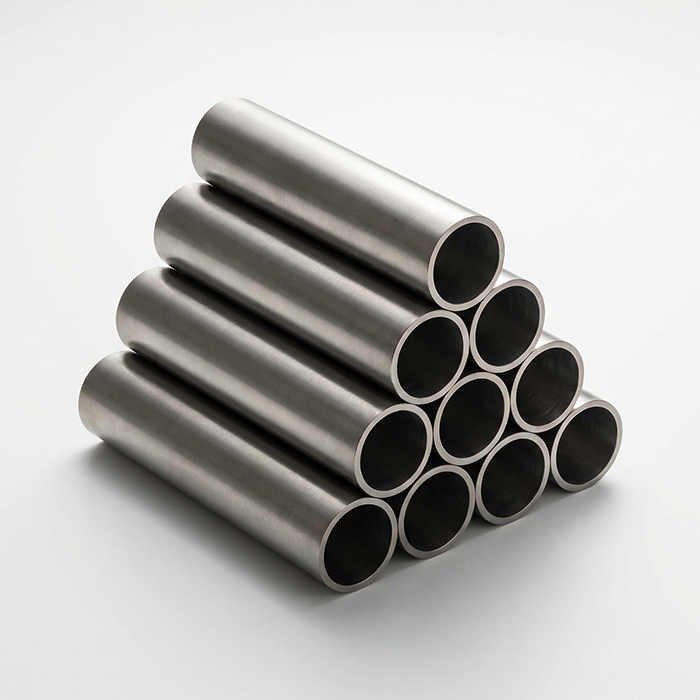
What to change. If the crevice geometry can be designed out, do that first: avoid lap joints and stagnant gasket faces, keep surfaces clean and flowing. If it cannot, specify the grade for the worst-case crevice chemistry, not for the bulk fluid. Our Grade 2 versus Grade 7 seawater comparison walks through the decision; Grade 7 plate and Grade 7 seamless tube are the usual upgrades, and palladium-bearing stock is held for chlor-alkali duty. For the equipment side see the corrosion-resistant titanium heat exchanger notes.
The line that would have caught it: “Complete medium declaration: concentration, normal and upset temperature, pH range, chloride and fluoride, oxidisers, flow velocity and crevice geometry. For any hot chloride service above 70–80°C, provide a crevice-corrosion assessment and the critical crevice temperature measured in the actual medium.” The word “seawater” on a datasheet is not a medium declaration.
The fastest way to make sure none of the five failures reaches your plant is to send a complete specification on the first enquiry. Here are the nine lines we ask buyers to copy; a complete spec returns a firm price instead of a second email asking for the grade.
|
What to send us for an exact titanium quote Copy these nine lines into your enquiry. A complete spec means a firm price on the first reply, not a second email asking for the grade. |
||||||||||||||||||||
|
||||||||||||||||||||
|
Ready? Copy the nine lines above into the Requirement Details box on our Request a Quotation page and we will come back with a firm price and a dispatch date within 24 hours. |
4. Case 3 — The Grade Swap a PMI Gun Could Not See
A batch of plate is certified and positively identified on receipt, and still fails: either the strength is far below what the design assumed, or a corrosion-resistant grade is quietly replaced by a stronger but less suitable one. The received material looks identical, weighs the same and passes a handheld PMI scan.
Why it happens. Commercially pure Grades 1 through 4 are separated chiefly by oxygen and iron limits, and Grade 5 by aluminium and vanadium. A handheld XRF or OES PMI gun reads the alloying metals beautifully and cannot quantify oxygen, nitrogen, hydrogen or carbon. So PMI happily confirms “titanium” while being structurally unable to tell Grade 1 from Grade 4, or to detect the interstitial pickup that embrittles a weld. The second half of the trap is documentary: EN 10204 3.2 requires third-party or purchaser-representative witness during manufacture and cannot be issued retroactively by upgrading a 3.1 certificate after the fact.
Where the boundary sits. Light-element verification belongs to laboratory methods: ASTM E1409 (oxygen and nitrogen by inert-gas fusion), E1447 (hydrogen), E1941 (carbon) and E2371 (ICP / ICP-MS analysis). Grade 5 offers high strength but lower resistance to reducing acids and to crevice corrosion than CP or Pd-bearing grades, so a strength-driven substitution can be a corrosion failure in disguise. Our Grade 5 versus Grade 23 guide and Grade 5 bar stock notes explain where that trade-off is safe and where it is not; Grade 2 plate to ASTM B265 covers the CP side.
What to change. Tie every physical piece to one heat number with a hard stamp that matches the MTC, require the full measured chemistry including interstitials, and run laboratory light-element verification on the first lot of a new supplier rather than relying on a PMI gun. State the MTC type on the PO before manufacture, not after. If 3.2 is needed, name the witnessing party and the hold points in the order; a 3.1 plus a polite email will not become a 3.2 later.
The line that would have caught it: “Grade 2, UNS R50400, ASTM B265 current revision, no ‘or equivalent’; EN 10204 3.1 MTC with melt chemistry including O / N / H / C, tensile results and heat number hard-stamped on each plate; PMI plus E1409 / E1447 light-element confirmation on first article.” Add the mechanical test results and a document-consistency check between MTC, stamp and packing list.
For nickel and zirconium lines the same logic applies with different grades: see our alloy family matrix and Zr702 versus Zr705 notes.
5. Case 4 — The Painted Steel That Perforated Faster
A titanium component is bolted to carbon steel in a wet, conductive service. The steel is painted to protect it, and within a short campaign it perforates at a handful of tiny pinholes — often faster than an unpainted joint would have. The titanium looks perfect.
Why it happens. Galvanic corrosion is governed by the cathode-to-anode area ratio, not by which metal is “more corrosion resistant” in a handbook table. Titanium is the noble cathode; steel is the anode. Coating only the anode leaves a very small exposed steel area at each pinhole coupled to a very large titanium cathode, so the anodic current density at that pinhole becomes enormous and perforation accelerates. The intuitive fix is the dangerous one. TIMET also notes that the titanium side is not automatically safe: galvanic coupling can generate nascent hydrogen at the titanium surface and drive hydrogen uptake.
Where the boundary sits. ASTM G82 covers construction of a galvanic series and ASTM G71 the laboratory test method; use them to rank the couple in your own electrolyte rather than quoting a generic potential difference. Published first-hand compilations do not give a single reliable potential value for every titanium / steel couple in every electrolyte, so public sources do not give one number here — ask your supplier for coupon data in your actual medium. Hydrogen uptake in titanium is slow below 77°C (170°F) and promoted by pH below 3 or above 12, temperatures above 77°C, potentials more negative than about −0.70 V, abrasion and iron smearing; TIMET places Grade 2 hydride precipitation at roughly 100–150 ppm of dissolved hydrogen and embrittlement at several hundred ppm.
What to change. Break the electrical path with an insulation kit (isolating gasket, sleeves and washers), coat the cathode side or both sides rather than only the anode, and if cathodic protection is used, specify the potential window with its reference electrode. Keep the steel area small relative to the titanium only if you have deliberately designed for it. Our Grade 2 titanium flange and Grade 2 fittings notes cover the mechanical side of mixed-material joints; for an all-nickel alternative see the nickel product programme.
The line that would have caught it: “Dissimilar-metal joint schedule: insulation kit with measured electrical resistance acceptance, coating applied to the cathode side or both sides, CP potential window with reference electrode stated, and a galvanic compatibility assessment for the actual electrolyte.” A purchase order that says only “paint the steel” has specified the failure.
6. Case 5 — The Dry Chlorine Line That Was Not a Corrosion Problem
A chlorine line is designed from corrosion-rate tables, commissioned with a dry gas, and suffers rapid attack with ignition at essentially ambient temperature. The incident is logged as a corrosion failure; the root cause is a moisture specification that nobody wrote down.
Why it happens. Titanium’s passivity in chlorine depends on water. With sufficient moisture the oxide film holds and the metal is essentially inert; strip the water out and the metal reacts exothermically with chlorine. That is a fire and safety classification, not a difference of a few mils per year. The same pattern recurs wherever a “dry” version of a normally benign medium appears: red fuming nitric acid and low-water methanol are the two classic neighbours.
Where the boundary sits. TIMET records wet chlorine at 10–88°C as Nil–0.02 mpy and dry chlorine at 30°C as rapid attack with ignition; at 199°C roughly 1.5% moisture is needed for passivation, and below 0.5% H₂O at room temperature the metal may react. Red fuming nitric acid can ignite titanium when H₂O is below 1.34% and NO₂ above 6%. Methanol with water below about 1.5% can cause stress-corrosion cracking. Published first-hand tables do not give a single exact mpy value for hydrofluoric acid attack, and hydrofluoric acid and fluorides defeat titanium outright.
What to change. Specify a minimum water content with an alarm and an operating procedure, forbid drying the stream upstream of titanium, and audit the cleaning chemicals as well as the process fluid. If the service cannot guarantee moisture, change the material: Hastelloy C-276 / C-22 for oxidising and mixed media, Monel 400 or pure nickel for fluoride and reducing service, and Ni200 / Ni201 notes where caustic is the dominant medium. Our Monel versus Inconel comparison covers the nickel-side choice.
The line that would have caught it: “Minimum moisture content ___% with continuous monitoring; forbidden-media list including dry chlorine, HF / fluorides, red fuming nitric acid and low-water methanol; material suitability declaration covering normal operation, upset conditions and all cleaning-in-place chemicals.” Cleaning chemicals are the most commonly omitted item on this list.
7. Where the 5 mpy Line Actually Falls in HCl
“Titanium does not handle hydrochloric acid” is both true and useless. TIMET publishes room-temperature 5 mpy (about 0.125 mm/y) iso-corrosion lines at roughly 7% HCl for Grade 2, about 9% for Grade 12 and about 27% for Grade 7, with all three dropping significantly near the boiling point. The grade choice moves the line; the temperature moves it faster. Treat these as screening figures, not design allowables, and always confirm with a coupon in your own acid.
| Grade | Room-temperature 5 mpy line (TIMET) | What it means for a buyer |
|---|---|---|
| Grade 2 (CP) | about 7% HCl | Common default; the film fails above the line |
| Grade 12 (Ti-0.3Mo-0.8Ni) | about 9% HCl | Modest improvement, not a licence for hot acid |
| Grade 7 (Pd-bearing) | about 27% HCl | PGM addition substantially pushes the reducing-acid envelope |
| All of the above near the boiling point | significantly lower | Temperature narrows the window faster than grade changes widen it |
This is why Grade 7 plate exists for strong reducing acid and why Grade 12 plate is a modest, not dramatic, improvement over Grade 2. When the concentration or temperature exceeds the whole titanium window, the honest answer is another metal: our titanium versus zirconium comparison for acetic service and Hastelloy C-276 / C-22 guide cover the two usual next steps. For a general plate specification start with Grade 2 plate to ASTM B265.
8. The 8 Myths That Keep Repeating
Each of these statements is common in supplier literature and in purchasing specifications. Each is wrong in a way that costs money. We use the same three-part structure for all eight: what people say, what the document actually says, and the PO line that fixes it.
The “150 ppm Hydrogen Is a Service Limit” Myth
What people say: the 150 ppm hydrogen figure on the certificate is how much hydrogen the part may absorb in service. What the spec actually says: ASTM B265 and sister product specifications set H ≤ 0.015% (150 ppm) as a delivery / chemical-composition limit on the as-supplied mill product. TIMET puts Grade 2 hydride precipitation at roughly 100–150 ppm of dissolved hydrogen and embrittlement and cracking at several hundred ppm, with uptake slow below 77°C and promoted by pH below 3 or above 12, higher temperature, negative potential, abrasion and iron contamination. Moisture of at least 2% in hydrogen gas can suppress uptake, but galvanically generated nascent hydrogen is not suppressed by moisture. What to write in your PO: require the as-delivered H value on a heat-specific 3.1 MTC, ban iron-tool contact and carbon-steel abrasion during fabrication, and specify the service pH, temperature, potential and cathodic-protection window separately. The certificate limit and the service allowance are two different numbers.
The “Straw, Brown and Gold Are All Fine” Myth
What people say: silver, straw and brown welds all pass; only blue, grey and white need rework, and the colour chart on the wall is universal. What the spec actually says: NASA PRC-0015 Rev. A accepts only bright silver and light straw on its purity test; dark straw already fails. It also fixes the purge gas at ≤ 50 ppm O₂ with a dew point of −60°F or lower and requires the shield to remain until the metal is below 600°F (about 316°C). Shield-removal temperatures of 260°C, 316°C and 400°C are quoted interchangeably online; none of them overrides the WPS or the governing specification. Colour criteria are commonly traced to AWS D10.6 Table 7 — verify the current table before citing it. What to write in your PO: name the exact acceptance class in the ITP and drawing, require a recorded purge O₂ reading per pass, and make the first production joint a hold point with alpha-case sampling. Do not leave colour acceptance to the welder’s judgement.
The “Titanium Embrittles Above 540°C in Air” Myth
What people say: titanium loses oxidation resistance and becomes brittle above about 540°C in air, so 540°C is the air-service ceiling. What the spec actually says: TIMET gives four distinct boundaries: excellent oxidation resistance to about 371°C; a thick oxide scale possible at 426°C; loss of oxidation resistance and embrittlement only above 649°C (1200°F); rapid scaling near 927°C. The 540°C figure belongs to the chromium-carbide precipitation and sensitisation range of Inconel 600 (540–980°C), not to titanium in air. Carrying a nickel-alloy number into a titanium datasheet is one of the most common ways a technically worded specification becomes wrong. What to write in your PO: state the design temperature, the atmosphere and the governing code temperature limit as three separate lines, and cite the source document for whichever one controls structural allowables. If a supplier quotes 540°C for titanium in air, ask which handbook it came from.
The “Gr7, Gr12 and Gr16 All Reach 260°C” Myth
What people say: all the crevice-resistant grades are broadly equivalent, so Grade 12 is a cheap substitute for Grade 7 up to 260°C. What the spec actually says: the 260°C figure in TIMET is an experience limit for specific seawater conditions, not a general ceiling. In acidic oxidising chlorides, NRC ML010400254 and OSTI 94656 report a Grade 12 critical crevice temperature of only about 75–85°C against roughly 210–300°C for Pd / Ru-bearing grades; at pH 1 and 90°C in chlorine-saturated solution Grade 12 was severely attacked in 12 of 12 coupons while Grade 16 and Grade 7 showed 0 of 12. What to write in your PO: require the critical crevice temperature measured in the actual medium, name the pH and oxidiser content, and do not accept an “equivalent” grade substitution without a coupon result. Our Grade 2 versus Grade 7 comparison shows why the medium, not the grade label, decides.
The “Just Paint the Steel” Myth
What people say: galvanic corrosion is about the potential difference, so coating the less noble steel solves a titanium-to-steel joint. What the spec actually says: the decisive variable is the cathode-to-anode area ratio. Coating only the anode leaves a tiny exposed steel area at each pinhole coupled to a large titanium cathode and accelerates perforation. ASTM G82 and G71 cover series construction and laboratory testing, and TIMET notes that galvanic coupling can generate nascent hydrogen on the titanium side as well. What to write in your PO: specify an insulation kit with a measured resistance acceptance, apply coating to the cathode side or both sides, and state any cathodic-protection window together with its reference electrode. Public sources do not give one reliable potential value for every couple in every electrolyte — ask your supplier for coupon data in your actual medium.
The “PMI Passed, So the Grade Is Confirmed” Myth
What people say: a positive material identification scan on receipt proves the grade and the certificate type can be upgraded later if the client asks. What the spec actually says: XRF / OES PMI confirms Al, V, Mo, Ni and Pd but cannot quantify O, N, H or C — the very elements that separate Grade 1 from Grade 4 and that embrittle a weld. Light elements belong to ASTM E1409, E1447, E1941 and E2371. EN 10204 3.2 requires third-party or purchaser-representative witness during manufacture and cannot be issued retroactively from a 3.1. ASME BPVC IX qualifies welding procedures and welders; it is not a material certificate. What to write in your PO: demand full measured chemistry including interstitials, laboratory light-element confirmation on the first article, a heat number hard-stamped on every piece, and the MTC type fixed before manufacture with named witness hold points if 3.2 is required.
The “Rank C-276 Against C-22 With PREN” Myth
What people say: compare nickel alloys by their Pitting Resistance Equivalent Number, the same way duplex stainless steels are ranked. What the spec actually says: PREN was built for stainless and duplex stainless compositions. For Ni-Cr-Mo alloys the meaningful measures are critical pitting temperature, critical crevice temperature and crevice corrosion temperature from ASTM G48 methods. Haynes data for C-276 in 6% FeCl₃ give a CPT above 150°C but a CCT of only 55°C; the Yellow Death solution gives a CCT near 60°C. A single PREN number hides exactly the gap that decides service life. What to write in your PO: ask for G48 CPT / CCT / CCCT results in the actual medium instead of a PREN value, and verify the method used. Our C-276 versus C-22 guide covers the alloy-level differences.
The “Ni200 and Ni201 Are Interchangeable” Myth
What people say: Ni200 and Ni201 differ only in carbon content, and Monel 400 is a safe general choice for sulfuric acid. What the spec actually says: ASME BPVC VIII Div. 1 approves Ni200 only to 315°C (600°F) and Ni201 to 677°C (1250°F); above its limit Ni200 graphitises. Inconel 600 is nearly immune to chloride SCC at Ni ≥ 72% but suffers IGSCC in high-temperature concentrated caustic, mercury and PWR primary water, with chromium carbides precipitating in the 540–980°C range. Monel 400 resists sulfuric acid only under reducing conditions: above about 85% H₂SO₄ corrosion rises sharply and at boiling it is usable only to roughly 15%. What to write in your PO: state the maximum metal temperature and force Ni201 above 315°C, require a Monel 400 corrosion coupon in the actual acid if sulfuric is present, and specify stress-relief requirements for Inconel 600. Our Ni200 versus Ni201 notes explain the caustic case.
9. Limits and Failure Conditions
: The Full Map
This is the section to read before you write a medium declaration. Every row is a condition under which titanium stops being the right answer; the last column names the alternative. Values are screening boundaries from the sources listed below, not design allowables.
| Medium / condition | Boundary | What happens | Use instead / action |
|---|---|---|---|
| Hydrofluoric acid / fluorides, any concentration | Absolute exclusion | Rapid film destruction; no published single mpy value we will quote | Monel 400 / pure nickel |
| Dry chlorine, ~30°C | < 0.5% H₂O may react; ~1.5% moisture needed to passivate at 199°C | Rapid attack and ignition — a fire hazard | Guarantee moisture, or Hastelloy C-276 / C-22 |
| Wet chlorine, 10–88°C | Sufficient moisture maintained | Nil–0.02 mpy (TIMET) | Titanium is the standard choice here |
| Red fuming nitric acid | H₂O < 1.34% with NO₂ > 6% | Ignition / pyrophoric reaction | Avoid titanium; reassess the whole system |
| HCl, room temperature, 5 mpy line | Gr2 ~7%, Gr12 ~9%, Gr7 ~27%; all lower near boiling | Reducing-acid film failure above the line | Grade 7 / Pd-bearing or Grade 12 plate |
| Hot seawater / chloride crevice | > 82°C possible; < 70°C unlikely; ~93°C sharp crevice | Localised crevice attack under gaskets and deposits | Grade 7 / Grade 16 plus geometry change |
| Acidic oxidising chlorides | Grade 12 CCT ~75–85°C; Pd / Ru grades ~210–300°C | Grade 12 fails where Grade 7 / 16 survive | Grade 7 tube; verify CCT in your medium |
| Strong caustic | Generally ≤ 5 mpy, but pH ≥ 12 with T > 77°C | Hydrogen uptake and hydride embrittlement | Ni200 / Ni201 |
| Air, elevated temperature | 371°C excellent / 426°C thick scale / > 649°C embrittlement / ~927°C rapid scaling | Oxidation and embrittlement only above the upper boundaries | Nickel alloys for high-temperature structural duty |
| Methanol, low water | H₂O < ~1.5% | Stress-corrosion cracking | Maintain water content; reassess material |
| Titanium coupled to steel in electrolyte | Area ratio governs, not the potential difference alone | Pinhole perforation of the steel; possible H uptake on Ti side | Insulation kit; coat cathode side or both sides |
| Contaminated weld / no root purge | O₂ ≤ 50 ppm, dew point ≤ −51°C, shield until < 316°C | Hard alpha case, brittle and preferentially corroding root | Qualified WPS with double-side purge; reject blue / grey |
Takeaway. Two patterns explain almost every row: the oxide film needs an oxidising-but-not-drying environment to reform, and local chemistry inside a crevice is never the chemistry on the process datasheet. Design for the crevice, the upset and the cleaning chemical, not for the steady-state bulk fluid.
10. The Sources Behind Every Number
Most supplier articles give numbers with no provenance at all. We would rather show the document type, because a producer handbook, a government evaluation and a process specification do not carry the same authority, and a buyer should know which one a threshold came from before quoting it in a design review.
| Source | What we used it for | Nature of the document |
|---|---|---|
| TIMET, Corrosion Resistance of Titanium (producer handbook) | Wet / dry chlorine tables, 5 mpy HCl lines, 82 / 93 / 70°C crevice boundaries, 371 / 426 / 649 / 927°C air limits, hydrogen solubility, RFNA limits, methanol SCC | Producer technical handbook, not an incident report |
| NASA PRC-0015 Rev. A §5.1.1 | 50 ppm O₂, −60°F dew point, 600°F shield removal, bright silver / light straw acceptance | Process specification / requirement document |
| NRC ML010400254 and OSTI 94656 | Grade 12 CCT ~75–85°C, Pd / Ru ~210–300°C, 12/12 versus 0/12 coupon results | Government / laboratory corrosion evaluations |
| Special Metals (Inconel 600, Monel 400, Ni200 / Ni201 publications) | 315°C / 677°C code limits, 540–980°C carbide range, Monel 400 > 85% and ~15% sulfuric limits | Producer data bulletins |
| Haynes (C-276 / C-22 corrosion data) | CPT > 150°C versus CCT 55°C in 6% FeCl₃; PREN is not a Ni-Cr-Mo ranking tool | Producer corrosion tables |
| ATI Wah Chang, ZirSul-018 | < 5 mpy criterion, 50–70% H₂SO₄ zones, 200 ppm oxidising ions, 775±15°C weld heat treatment | Producer technical bulletin |
| ASTM / ASME / AWS / EN standard families | E1409, E1447, E1941, E2371; G82, G71; G48; B265, B338; BPVC IX; A5.16; EN 10204 | Standard numbers only — verify the current revision and clause in force on your PO date |
Three-layer data discipline. (1) Values above are first-hand verified and written as hard numbers. (2) Standard numbers, standard revisions, AWS D10.6 Table 7, ASTM G48 method variants and grade chemistry ranges must be checked against the current publication in force on your PO date — we do not assert a revision here. (3) Where public sources give no single value — individual galvanic potentials for every couple, a full-concentration HCl window for zirconium, exact minimum strength values, an HF corrosion rate, or G48 numbers for C-22 — we do not invent one. The correct action is to ask your supplier for coupon data in your actual medium.
If your medium is anywhere near one of these boundaries, the cheapest next step is a ten-minute review: send the concentration, temperature, pH, oxidiser and moisture figures plus the drawing to our request a quotation page and our engineers will return the grade split and the PO wording before you commit to an order.
11. The 15-Line RFQ Failure-Proof Checklist
Copy this table into an enquiry or an internal specification template. It is the condensed form of all five cases and all eight myths — fifteen lines that turn a vague request into a defensible order.
| # | What to write | Why it is there |
|---|---|---|
| 1 | Grade + UNS + product standard and its revision; no “or equivalent” | Blocks the Case 3 substitution at the source |
| 2 | Material condition, form, dimensions and dimensional tolerance | Removes ambiguity on rolled / annealed / pickled state |
| 3 | MTC type: EN 10204 3.1 or 3.2; if 3.2, name the witness and hold points | 3.2 cannot be issued retroactively from a 3.1 |
| 4 | Heat number per lot, hard-stamped to match the certificate | The only traceability link back to the melt |
| 5 | Full measured chemistry including O / N / H / C, arbitration by E1409 / E1447 / E1941 / E2371 | PMI cannot quantify light elements |
| 6 | PMI on receipt plus laboratory light-element re-check on first article | Confirms both alloying metals and interstitials |
| 7 | Measured mechanical properties, not typical values | Catches a strength-driven grade error |
| 8 | Complete medium declaration: concentration–temperature window, pH, Cl⁻ / F⁻, oxidisers, moisture, velocity, upset cases | The line that prevents Cases 2 and 5 |
| 9 | Forbidden-media list plus a material suitability declaration including cleaning chemicals | Dry chlorine, HF, RFNA and CIP fluids are commonly omitted |
| 10 | Welding package: ASME IX WPS / PQR / WPQ, AWS A5.16 filler, trailing shield + root back-purge, recorded dew point and O₂ ppm | The line that prevents Case 1 |
| 11 | Weld-colour acceptance class written into the drawing and ITP; alpha-case sampling | Makes colour a contractual hold point, not an opinion |
| 12 | Crevice / galvanic design: insulation kit with resistance acceptance, coating side, CP window with reference electrode | The line that prevents Case 4 |
| 13 | For hot chloride above 70–80°C: crevice-corrosion assessment and CCT in the actual medium | 260°C is not a general ceiling |
| 14 | Alloy-specific clauses: G48 CPT / CCT instead of PREN for Ni-Cr-Mo; Ni201 above 315°C; Monel 400 coupon in sulfuric | Prevents Myth 7 and Myth 8 |
| 15 | NDE scope, dimensional report, third-party witness, and document consistency across MTC / stamp / packing list | Closes the audit trail before shipment |
Takeaway. Nine of the fifteen lines cost nothing to add and none of them changes the unit price. What they change is who carries the risk when a joint turns blue or a crevice perforates.
12. Choose by Service, Not by Habit
Choose Grade 2 / CP titanium if:
- The service is wet chlorine, seawater or a mild chloride below 70°C with no tight crevice.
- The fabrication has a qualified WPS with a root back-purge and a recorded weld-colour acceptance class.
- Budget leads and the medium declaration is complete enough to prove the film will hold.
- You need plate, tube, bar, fittings and flange from one heat-traceable stock lot.
Choose an upgraded or different metal if:
- Hot chloride crevices above 70–80°C → Grade 7 / Grade 16 with CCT verified in your medium.
- Reducing HCl above the Grade 2 line → Grade 7 / Pd-bearing titanium, or zirconium where the window is exceeded.
- Dry chlorine, HF / fluorides, red fuming nitric acid or low-water methanol → guarantee the moisture, exclude the medium, or move to Hastelloy C-276 / C-22 or Monel / pure nickel.
- Hot concentrated caustic or service above 315°C in nickel → Ni200 / Ni201 selection with the code temperature limit stated.
There is no metal that wins all four. Specifying by stream is cheaper than over-specifying one alloy across a plant, and far safer than assuming the cheapest grade covers an oxidiser it has never seen.
13. Why Source This From Us
Reading a failure map is one thing; getting a certified, correctly specified part on site is another. We are a stockholder plus light fabricator in Baoji, at the centre of China’s Titanium Valley, and the way we work is built around exactly the failure modes above:
- Cut-to-size, zero-cut, no mill minimum. About 800 t of titanium, nickel and zirconium stock across plate, tube, bar, wire, fittings, flange and fasteners — one plate, one spool or a full kitted line is a normal order.
- We read your drawing. Send the P&ID, the fabrication drawing or just the medium declaration; we return the grade split, the PO wording and a quote, not a list of questions.
- Standards literacy. We work across ASTM, ASME and GB, understand why a 3.1 cannot become a 3.2, why PMI cannot measure oxygen, and why a weld-colour class belongs in the ITP.
- One shipment, one certificate pack. EN 10204 3.1 MTC per heat, full chemistry including interstitials on request, hard-stamped heat numbers, WPS / PQR and NDE where welded, plus third-party SGS / BV witness if you need it.
- Export-ready. VCI protection, seaworthy crating and the documentation your customs broker needs, to global ports.
- Fast where it counts. Stock sizes can dispatch the same day; fabricated items ship on a firm lead time quoted up front.
Our Grade 2 plate, ASTM B338 tube, flange and fittings pages give the forms and sizes; the alloy matrix shows how a mixed-material line is kitted from one shipment.
14. What a Datasheet Cannot Tell You
Some questions do not have a published single answer, and pretending otherwise is how specifications fail. Public sources do not give one reliable galvanic potential for every titanium / steel couple in every electrolyte; do not give a single full-concentration HCl window for zirconium; do not give exact minimum strength values for every product form without the governing specification and revision; do not give one trustworthy mpy figure for HF attack on titanium; and do not give an ASTM G48 CPT / CCT / CCCT set for C-22 that we would quote without checking the method. For all of those the correct engineering action is the same: ask your supplier for coupon data in your actual medium, with the concentration, temperature, pH, oxidiser content and crevice geometry of your plant rather than a generic test solution.
That is also the practical test of a supplier. A quote that answers every question with a confident number is less useful than one that tells you which number needs a coupon test and offers to run it. If you want that conversation, send the medium and the drawing through the inquiry page below; a named engineer replies within 24 hours with the grade split, the PO wording and a firm dispatch date.
|
Get a firm titanium quote within 24 hours Same-day dispatch from ~800 t of Baoji stock · cut-to-size and waterjet blanks · free drawing review by our engineering team · EN 10204 3.1 MTC with every lot. |
Request my quote →
No obligation. A named engineer replies, not an auto-responder. |
|
EN 10204 3.1 MTC on every lot · ISO 9001 quality system · ASTM / ASME / GB standard literacy · Third-party inspection (SGS / BV) on request · Mill heat & lot traceability · Export packing & full documentation |
15. FAQ — When Titanium DOES Corrode
Does titanium corrode in seawater?
Rarely on openly exposed surfaces, but it can fail inside a crevice. TIMET reports localised attack in seawater as possible above 82°C (180°F), unlikely below 70°C (158°F), and around 93°C in near-neutral saturated brine with a sharp crevice. Falling pH lowers the threshold, so specify Grade 7 or Grade 16 and verify the critical crevice temperature in your actual medium.
What weld colour is acceptable for titanium?
Only bright silver or light straw under NASA PRC-0015 Rev. A; even dark straw fails, and blue, purple, yellow and grey-white are rejects. The same specification requires shielding gas at or below 50 ppm oxygen with a dew point of −60°F or lower, and the shield must stay on until the metal drops below 600°F (about 316°C). Verify the colour table in the current AWS D10.6 before writing it into an ITP.
Is 150 ppm hydrogen a service limit for titanium?
No. The 150 ppm (H ≤ 0.015%) on an ASTM B265 certificate is a delivery limit for the as-supplied mill product. TIMET places Grade 2 hydride precipitation at roughly 100–150 ppm of dissolved hydrogen and embrittlement at several hundred ppm. Keep the certificate limit and the service allowance as two separate numbers in your specification.
Can PMI verify the titanium grade on a delivered plate?
Only partly. XRF and OES PMI confirm alloying elements such as Al, V, Mo, Ni and Pd, but cannot quantify oxygen, nitrogen, hydrogen or carbon — the elements that separate Grade 1 from Grade 4 and embrittle a weld. Use ASTM E1409, E1447, E1941 and E2371 for light elements, and require a heat-specific EN 10204 3.1 MTC with full measured chemistry.
Why is dry chlorine dangerous for titanium but wet chlorine is not?
Because titanium needs water to stay passive in chlorine. TIMET records wet chlorine at 10–88°C as Nil–0.02 mpy, but dry chlorine at 30°C as rapid attack with ignition; roughly 1.5% moisture is needed to passivate at 199°C. That is a fire hazard, not a corrosion-rate difference, so specify a minimum moisture content and a forbidden-media list.
What should I put in a titanium RFQ to avoid a grade mix-up?
State the grade and UNS with the product standard and its revision, ban “or equivalent”, require an EN 10204 3.1 MTC with full chemistry including O / N / H / C plus a heat number hard-stamped on every piece, and add PMI plus laboratory light-element confirmation on the first article. If 3.2 certification is needed, name the witness and hold points before manufacture; a 3.1 cannot be upgraded afterwards.
Do you supply cut-to-size titanium with a 3.1 MTC and a 24-hour quote?
Yes. From about 800 t of titanium, nickel and zirconium stock in Baoji we cut plate, tube, bar, fittings and flange to your drawing with no mill minimum, ship an EN 10204 3.1 MTC with every heat-numbered lot, and confirm stock and pricing within 24 hours. Stock sizes can dispatch the same day. Send the medium and the drawing through our inquiry page and a named engineer replies.
Summary: One Rule Beats a Catalogue
Specify the metal for the medium, and put the boundary into the purchase order. All five failures above were decided long before the part reached service: by a purge line missing from a WPS, a temperature absent from a medium declaration, a grade name without a UNS number, a coating applied to the wrong side of a joint, or a moisture content nobody wrote down. Titanium is an outstanding corrosion metal inside its window and the wrong choice outside it, and the difference is entirely documentary. Copy the 15-line checklist, or open our request a quotation page with your medium, concentration, temperature and drawing — we confirm stock and pricing within 24 hours, and stock sizes can dispatch the same day.
Need a quote on this specification?
Click below and your email app opens with the 6-point RFQ already typed out. Just fill in your grade, size and quantity - no form, no captcha.
ПРЕДЫДУЩАЯ:Zirconium in Sulfuric & Reducing-Acid Service СЛЕДУЮЩАЯ:111
Опишите ваши требования — марка, размер и количество. Ответим в течение 24 часов.
Предпочитаете чат? WhatsApp +86 188 2967 9311 или напишите на [email protected].
- Titanium Price Today (17 Nov 2026): Plate, Tube, Rod, Wire
- Цены на титан, 13 ноября 2026 г.: плиты, трубы, прутки, проволока, г
- Цена на титан сегодня (11 ноября 2026 г.): лист, труба, пруток и про
- Цена на титан сегодня (9 ноября 2026 г.): лист, труба, пруток и пров
- Что такое титан фланец| ASME B16.5 ASTM B381 Gr2 Gr5 титановые флажк
Контактное лицо: Wang Xiaoning
Телефон: +86-917-355-7966
Эл. почта: [email protected]
WhatsApp: +86 188 2967 9311
Компания: Shaanxi Qianyi Tuoda Technology Co., Ltd
Адрес: Floor 4, Building 4, No. 188 Gaoxin Avenue, High-tech Zone, Baoji City, Shaanxi Province, China