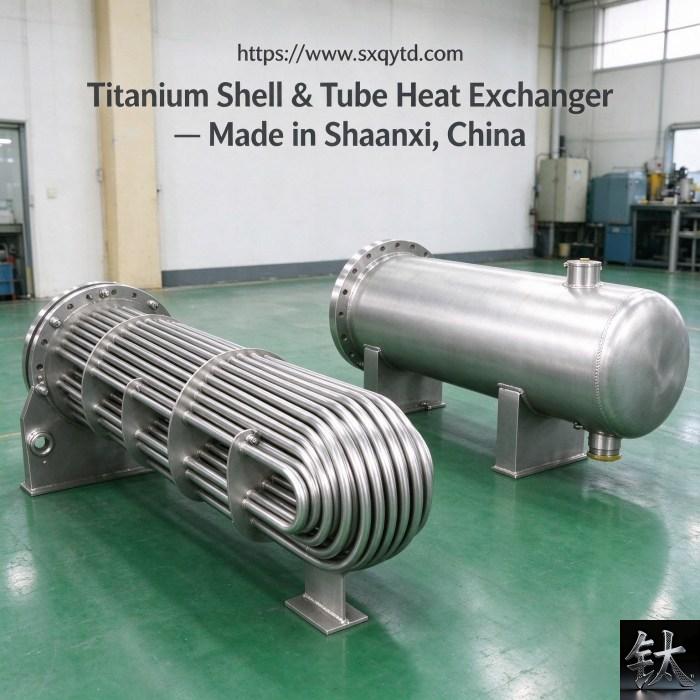
Corrosion Resistant Titanium Heat Exchanger for Chlor-Alkali Industry
| Specification | Gr2/Gr7/Gr12, ASTM B338, ASME VIII + TEMA, MTC 3.1, Baoji |
|---|---|
| Applicable Standard | corrosion resistant titanium heat exchanger chlor alkali industry, titanium condenser tube for chlorine plant, Gr7 Ti-0.2Pd wet chlorine heat exchanger, ASTM B338 titanium exchanger tube chlor alkali, |
Product Description: corrosion resistant titanium heat exchanger chlor alkali industry, titanium condenser tube for chlorine plant, Gr7 Ti-0.2Pd wet chlorine heat exchanger, ASTM B338 titanium exchanger tube chlor alkali,
Product Overview
Corrosion Resistant Titanium Heat Exchanger for Chlor-Alkali Industry | Gr2/Gr7/Gr12, ASTM B338, ASME VIII
Meta Description: Corrosion resistant titanium heat exchanger for chlor-alkali industry — wet chlorine, brine electrolysis, caustic evaporation and hypochlorite duty. Gr2 for oxidizing brine and wet Cl₂, Gr7 (Ti-0.2Pd) for hot crevice and reducing segments, Gr12 for hot brine strength. ASTM B338 tubes, ASME VIII + TEMA, PMI per heat, EN 10204 3.1, 3.2 TPI PO-fronted.
Chlor-Alkali Is Not One Stream — It Is Three
Chlor-alkali plants run three corrosive streams at once, and titanium does not handle them identically:
- Wet chlorine side — saturated Cl₂ + H₂O + hypochlorous acid; oxidizing, aggressive, moisture-dependent
- Brine side — 200–300 g/L NaCl, aerated or deaerated, hot, scaling, crevice-rich
- Caustic side — NaOH 32–50%, hot, with a hard temperature ceiling for titanium (and a different ceiling for nickel)
Specifying "titanium heat exchanger" without naming the side and the temperature is not engineering — it is hope. We grade by side, by temperature, and by oxidation state.
Grade Selection by Chlor-Alkali Segment
| Process segment | Recommended tube | Why |
|---|---|---|
| Wet chlorine cooler / condenser | Gr2 (R50400) | Passive in wet Cl₂; standard chlor-alkali choice |
| Brine heater / pre-heater | Gr2 (aerated) / Gr7 (deaerated, hot) | Gr2 for oxidizing brine; Gr7 where stagnant crevices exceed ~80°C |
| Hypochlorite cooler | Gr2 | Excellent in NaOCl / ClO⁻ oxidizing stream |
| Cell-room cooling / deaerated hot brine | Gr7 (Ti-0.2Pd) | Pd shifts potential into passive region; resists hot deaerated chloride |
| Caustic cooler (<315°C, oxidizing) | Gr2 | Titanium resists NaOH in oxidizing conditions |
| Caustic evaporator (>315°C) | Nickel 201 (N02201) | Titanium not for hot concentrated caustic — this is nickel territory |
| High-pressure U-bundle | Gr9 (Ti-3Al-2.5V) | Higher strength, thinner wall; only when chemistry confirmed |
The most common chlor-alkali mistake: putting titanium on the hot caustic evaporator. Titanium resists wet chlorine and brine; it does not resist hot concentrated NaOH. Above 315°C, that job belongs to Nickel 201 (C≤0.02%).
Why Gr7 Earns Its Place in Chlor-Alkali
- Gr2 crevice threshold in chloride ≈ 80°C; above that, stagnant crevices can localize
- Gr7 (0.12–0.25% Pd) holds passive film in deaerated/reducing chloride — crevice corrosion threshold extended dramatically
- In cell-room cooling and hot brine heaters, deposits + low-flow dead legs are unavoidable → Gr7 is the insurance
- HCl acid-regeneration segments: Gr7 resists far higher HCl concentration/temperature than Gr2
Design & Code Baseline
- Code: ASME BPVC Section VIII Div.1; TEMA Class R/C/B per duty
- Tube: ASTM B338 Gr2/Gr7/Gr9/Gr12, seamless or welded (weld on neutral axis for U-bend)
- Tubesheet: ASTM B265 Gr2/Gr7, integral or loose-lined; explosively/clad optional
- Shell/heads: titanium-lined carbon steel or full titanium per pressure & cost target
- Joint: hydraulic roll → orbital TIG weld, argon backing ≥99.999%, dye-penetrant on critical welds
- U-bend radius: 1.5–2×OD (≤25mm), 2–2.5×OD (>25mm); mandrel bend, PT after bend
- Corrosion allowance: typically zero for titanium — lifecycle cost is in the uptime, not the wall
Typical Duty Window
| Item | Range |
|---|---|
| Tube OD | 12.7 / 15.9 / 19.1 / 25.4mm (custom to 38mm+) |
| Wall | 0.7–2.5mm (B338 tight tolerance) |
| Length | 3–12m straight; U-bundle to drawing |
| Cl⁻ | Up to saturated brine (process-confirmed) |
| Temp | Ambient to boiling/crystallization; Gr7 for hot crevice zones |
| Side | Tube-side or shell-side, per thermal design |
QC & Traceability
- ASTM B338 tube MTC EN 10204 3.1 — heat-specific chemistry + tensile + flatten/flare (seamless) or reverse-flatten (welded)
- Eddy-current or hydrostatic per B338 election (state which on PO)
- PT on U-bend + tubesheet welds
- PMI on tubes/tubesheet (grade verification, not tag trust)
- Heat No. = tube tag = MTC = fabrication weld map
- Hydro test per ASME VIII; passivation/cleaning validated (no Fe contamination)
- 3.2 (SGS/BV/TÜV/DNV) TPI PO-fronted for PED/offshore/mega-project
Anti-Fouling & Operability Notes (real, not marketing)
- Titanium resists corrosion, not scaling — brine scaling needs side-stream softening, periodic acid wash, or velocity control
- Design velocity 1.5–2.5 m/s tube-side to limit deposit; confirm with process licensor
- Acid wash chemistry must be approved: no HF / fluoride cleaners on titanium surfaces
- Dry chlorine excursion → separate review; titanium wants moisture to stay passive
- Galvanic contact with carbon steel in reducing brine → isolate / insulate
Hard Boundaries (no overclaim)
- HF and fluoride-bearing streams attack TiO₂ film — zirconium/C-276/PTFE-lined review required
- Gr2 not for hot deaerated reducing acid — that is Gr7/Gr12 territory
- Titanium is not for hot concentrated caustic evaporator — Nickel 201 only
- Dry chlorine (<0.5% H₂O) excluded — moisture required for passive film
- 3.2 cannot be back-issued; TPI named at PO
RFQ Template (copy-paste)
Process step: wet Cl₂ cooler / brine heater / hypochlorite / cell-room / caustic cooler ___
Side: tube-side ___ / shell-side ___
Chemistry: Cl₂ ___%, NaCl ___g/L, NaOH ___%, pH ___
Max tube-wall temp: ___°C (upset excursion ___°C)
Aerated / oxidizing vs reducing: ___
Scaling tendency: yes/no, scale type ___
Duty: heating/cooling/evaporation, Q = ___kW
Tube: ASTM B338 Gr___, OD×wall ___, straight / U-bend qty ___
Tubesheet: Gr___, integral / loose / clad ___
Shell: titanium / Ti-lined CS ___
Code: ASME VIII Div.1 + TEMA Class ___
Joint: roll / weld / roll+weld ___
Cert: 3.1 / 3.2 TPI (SGS/BV/TÜV ___)
Cleaning chem (CIP/acid wash): ___ (NO HF confirmation ___)
Incoterm: EXW / FOB / CIF / DAP ___
FAQ — Titanium Heat Exchanger for Chlor-Alkali
Q1: Is Gr2 enough for chlor-alkali?
A: For wet chlorine, hypochlorite, and aerated brine — yes. For hot deaerated crevices and reducing acid wash — Gr7/Gr12.
Q2: Why not just thicken Gr2 instead of upgrading to Gr7?
A: Wall thickness does not fix crevice electrochemistry. Hot deaerated chloride attacks the passive film locally; Gr7 changes the potential. Thicker Gr2 still pits in the gap.
Q3: Can titanium handle the acid wash?
A: Gr7/Gr12 handle reducing HCl/H₂SO₄ wash within defined concentration/temperature windows. No HF. Wash recipe must be on the RFQ.
Q4: Welded tube or seamless?
A: Both B338-valid. Welded with annealed seam + reverse-flatten is cost-effective for most bundles; seamless when spec mandates or high-vibration duty. Say which on PO.
Q5: Can titanium be used on caustic evaporator?
A: No. Hot concentrated caustic above 315°C is Nickel 201 territory. Titanium is for wet chlorine and brine sides.
Q6: ASME + TEMA deliverable?
A: Yes — VIII Div.1 calc package, TEMA sheet, weld map, MTC 3.1, hydro + ET, PT on welds.
Q7: How long is service life?
A: In confirmed oxidizing chloride, 20+ years is normal. Life is decided by cleaning discipline and fluoride exclusion, not by the alloy alone.
Q8: Can you supply tube-only or full exchanger?
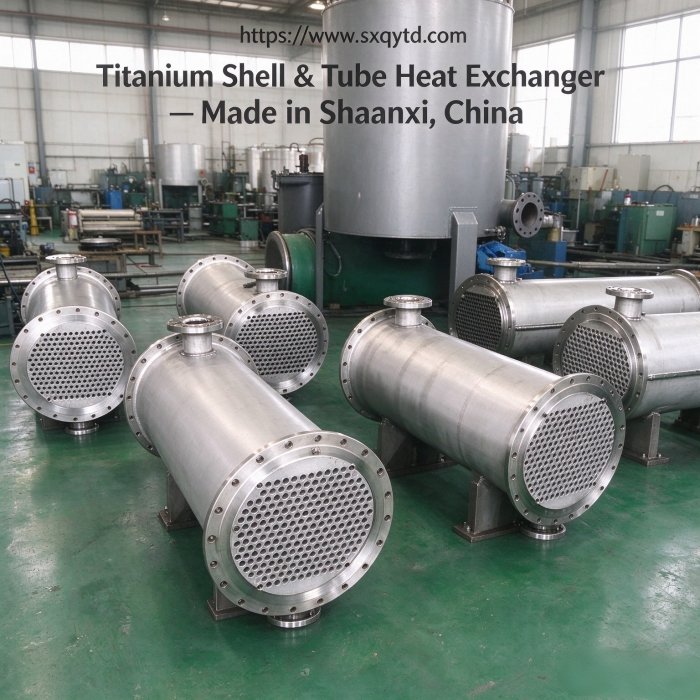
A: Both — B338 tube bundles only, or turnkey shell-and-tube with titanium tubesheet and lined shell.
Q9: HS code?
A: Exchanger unit and bare tube follow different headings; Broker confirms by configuration/destination.
Q10: Biggest EPC mistake?
A: Specifying "titanium exchanger" with no segment chemistry. Gr2 bought for a hot caustic evaporator = repeat failure. The PO must name the grade per pass.
Request a Quote
Email: sales@[yourdomain].com
Send process segment + chemistry + max temp + duty + tube spec + code level. We return grade-per-pass recommendation, not a one-grade-fits-all quote.
About: Baoji titanium heat-transfer desk for chlor-alkali — shell and tube exchangers and B338 tube bundles in Gr1/Gr2/Gr7/Gr9/Gr12. Grade assigned per process segment (wet Cl₂ / brine / hypochlorite / cell-room / caustic cooler), ASME VIII + TEMA, rolled-welded tubesheet, PMI per heat, EN 10204 3.1, 3.2 TPI PO-fronted. No fluoride service, no Gr2-in-hot-crevice substitution, no broken heat chain. Heat No. = tube tag = MTC = weld map.
Tell us your requirement — grade, size and quantity. We reply within 24 hours.
Prefer chat? WhatsApp +86 188 2967 9311 or email sales@sxqytd.com.


- Titanium Price Today (Oct 26, 2026): China Market Report
- Titanium Price Today (23 Oct 2026): Plate, Tube, Rod & Wire
- Read titanium wire and titanium alloy wire: diameter classification
- Titanium wire: from brand selection to manufacturing process (2026 r
- Read titanium tube and titanium alloy tube: OD classification + comm
Contact Person: Wang Xiaoning
Tel: +86-917-355-7966
Email: sales@sxqytd.com
WhatsApp: +86 188 2967 9311
Company: Shaanxi Qianyi Tuoda Technology Co., Ltd
Address: Floor 4, Building 4, No. 188 Gaoxin Avenue, High-tech Zone, Baoji City, Shaanxi Province, China