TA2 Titanium Tee B363: Branch Thinning and NDT Scope
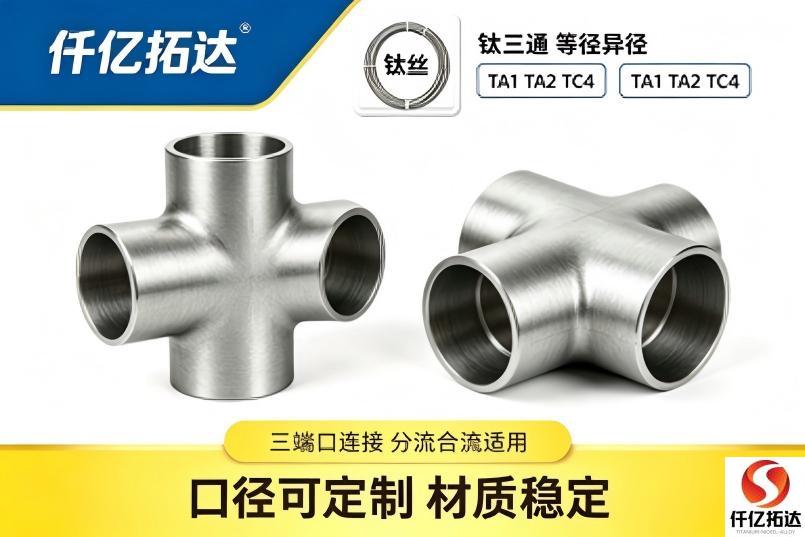
TA2 equal and reducing titanium tees to ASTM B363 are available from stock, but "NDT inspection available" is not the same sentence as "NDT inspection performed". The first describes a supplier's capability; the second describes what will be done to your parts, at which locations, to which acceptance standard, with a report attached. On a hot-formed reducing tee the branch crotch can lose roughly 10–20% of its wall during forming, and combined with a -12.5% mill tolerance the delivered wall at that point can be around 0.7–0.8 times nominal. That is the exact spot where a chemical branch line cracks.
This guide is for buyers ordering tees for corrosive pipeline branching — manifold headers, bypass lines, vessel nozzle take-offs and sampling points. It covers the B363/B16.9 boundary, equal versus reducing geometry, where a formed tee thins, how to write an NDT scope that means something, wrought versus fabricated construction, the service limits of TA2, the cost of a branch failure, and the eight fields that belong on the RFQ. For the wider fitting family, see our titanium pipe fittings category and the fitting selection decision tree.
| Standards | ASTM B363 (wrought Titanium Fittings); ASME B16.9 (dimensions); B16.25 (butt-weld bevel ends) |
| Grades | TA2 / Gr2 / UNS R50400; match tee grade to run and branch pipe grade; Gr7, Gr12 available |
| Service | Chemical pipeline branching, manifold headers, bypass and recirculation lines, vessel nozzle take-offs |
| Core distinction | A formed tee is thinnest exactly where stress concentrates. NDT capability is not an inspection scope. |
The "NDT Available" Trap: A Branch That Cracked at the Crotch
A coastal chemical plant installed a DN100 run with DN50 reducing tees on a hot chloride-bearing header in 2022. The purchase order read "ASTM B363 Gr2 reducing tee 4 in x 2 in Sch 10S, NDT inspection available". The supplier quoted a slightly lower price than two competitors, shipped fittings with valid B363 material certificates, and stated on the offer that non-destructive testing could be arranged. Nobody specified what would be examined.
Eleven months later a branch root leaked. Sectioning the tee showed a crack initiating at the crotch — the transition where the pulled branch meets the run — and a wall at that location measurably thinner than the nominal schedule. The forming operation had stretched the metal there; the incoming pipe or tube had already been at the low end of its permitted wall tolerance; the two effects multiplied. The default B363 inspection had been performed and passed, because default inspection is aimed at gross discontinuities in the fitting as a whole, not at a thickness survey of the branch crotch of every reducing tee in a hot cyclic line.
The rule: "NDT available" is a marketing statement. An inspection scope names the method, the location, the coverage (sample or 100%), the acceptance standard, and the report that will be delivered with the parts. If any of those five are missing, you have bought a capability, not an inspection.
The repair required isolating the header, cutting out the tee, re-welding with full argon backing purge, and re-testing — several days on a line that could not be bypassed. The saving on the fitting order was trivial by comparison. Our B363 fitting guide and the tee and reducer selection notes cover the geometry side in more depth.
What ASTM B363 Actually Covers, and Where B16.9 Fits
ASTM B363 is the material and manufacturing standard for wrought titanium and titanium alloy butt-welding fittings. It controls the permitted grades, chemical composition, mechanical properties, the wrought forming route, heat treatment, surface condition, dimensional tolerances, and the baseline tests and inspection. ASME B16.9 is the dimensional standard: centre-to-end dimensions, outside diameters, wall schedules, tolerances and bevel preparation for factory-made butt-welding fittings of any material. B16.25 defines the weld bevel geometry.
These two standards are complementary, and confusing them is the most common cause of a nonconforming delivery. A PO that names only B16.9 buys a shape; it does not buy titanium, does not control chemistry, does not require a B363 forging or forming route, and does not specify hydrogen control or surface cleanliness. A PO that names only B363 buys a qualified titanium fitting but leaves the dimensions ambiguous. Professional orders cite both: "ASTM B363 Gr2, dimensions per ASME B16.9, bevel per B16.25".
There is a second boundary that matters for tees. B363 covers wrought fittings — formed from a single piece of tube or pipe by hot forming, extrusion or drawing, with continuous grain flow. A fabricated tee, built by cutting a hole in a run pipe and welding on a branch, is a different construction. It is not covered by B363 as a wrought fitting; it falls under the applicable piping code with qualified welding procedures, and its fatigue performance is typically lower because the branch weld introduces a stress concentration and a heat-affected zone. Fabricated tees are legitimate and sometimes necessary for large diameters or non-standard ratios, but they must be specified as fabricated, with a WPS/PQR and full NDT of the branch weld — not quietly substituted for a wrought tee.
Equal vs Reducing Tee: The Branch Is the Problem
An equal tee has the same nominal size on all three ends. A reducing tee has a smaller branch. Both are common, and the reducing tee is where most of the engineering interest lies, because the branch is formed by pulling material out of the run. That operation necessarily thins the wall at the crotch and shoulder, and the smaller the branch relative to the run, the more localised the deformation tends to be.
| Location on a formed tee | What happens in forming | What to specify |
|---|---|---|
| Branch crotch (transition to run) | Highest stretch, typically the thinnest point; roughly 10–20% local reduction is common | UT thickness mapping, minimum wall with no minus tolerance, 100% coverage on critical lines |
| Branch shoulder and straight | Moderate thinning, ovality possible | Dimensional check, ovality limit, bevel concentricity |
| Run opposite the branch | Can be thinned by the forming pressure and local heating | Include in the same UT survey grid |
| All three bevel ends | Machined after forming; must match pipe schedule and bevel angle | B16.25 bevel, clean oxide-free surface, no iron contamination |
The multiplication effect is worth spelling out. If the starting pipe is already at the low end of a -12.5% mill tolerance, and forming reduces the crotch by a further 10–15%, the delivered wall at that point can be around 0.75–0.79 times nominal. On a Sch 10S line the absolute margin is small to begin with. A PO that says only "Sch 10S" gives the supplier no instruction to check or guarantee the wall after forming, because the schedule describes the nominal pipe wall, not the thinnest formed point of the fitting.
Also match the schedule on all three ends to the pipes they join. A tee with a heavier branch than the branch pipe creates an internal step that trips the flow, collects deposits and becomes a crevice. This is the same schedule-mismatch problem described for elbow, tee and reducer sets, and it is far easier to prevent at the PO than to grind out after installation.
NDT Scope: Five Fields or It Is Not a Specification
A usable inspection clause has five parts. Method — ultrasonic thickness mapping, dye penetrant, radiography, eddy current, or a combination. Location — for a tee, explicitly the branch crotch and shoulder, the run opposite the branch, and all three bevel ends. Coverage — 100% of parts, or a defined sampling plan tied to lot and heat. Acceptance — minimum wall in millimetres, or a named standard and acceptance class. Deliverable — a report with heat numbers, measured values and the inspector's qualification, shipped with the parts.
For a hot-formed titanium tee in chemical service, a sensible baseline is: UT thickness mapping at a defined grid including the crotch, with a stated minimum wall; dye penetrant on all formed surfaces and bevel ends to a named acceptance criteria; dimensional inspection to B16.9; PMI on every fitting; and a final acid pickling plus free-iron test. Add radiography of the branch weld only if the tee is fabricated rather than wrought. Add hydrostatic testing if the fitting will see pressure cycling or the project code requires it.
The default inspection under B363 is a floor. It is adequate for a low-pressure, non-cyclic, clean utility line. It is not adequate for a hot chloride header with a small reducing branch, which is precisely where the opening case failed. The phrase to add is short: "UT thickness map of branch crotch and run, 100% of parts, minimum wall X.XX mm, report attached to MTR". Our ASTM B363 fittings reference and the fitting grade verification notes set out the documentation we normally supply.
Wrought vs Fabricated: Do Not Let One Be Substituted for the Other
A wrought tee is formed from one piece, with continuous grain flow around the branch transition and no weld at the crotch. It is the correct default for corrosive, cyclic or high-pressure duty and for sizes within the standard range, typically up to around NPS 12. A fabricated tee is assembled from cut pipe sections with one or more welds; it is used for large diameters, unusual branch ratios, or short-run specials where a forming die does not exist.
Fabricated construction is not a defect. It is a different specification with different requirements: a qualified welding procedure, full-penetration branch weld with argon backing purge, radiographic or ultrasonic examination of that weld, post-weld pickling, and a fatigue assessment that accounts for the weld's stress concentration. Fatigue life is commonly 30–50% lower than a comparable wrought fitting — an approximate planning figure, not a design value. If a supplier delivers a fabricated tee against a B363 wrought order, the certificate may look fine while the joint is entirely different from what the designer assumed.
Ask for a photograph of the branch transition before shipment. A wrought tee shows a smooth, continuous pulled contour; a fabricated tee shows a weld line around the branch root. It takes one image to prevent a substitution that would otherwise be discovered during a shutdown.
Where TA2 Tees DO Fail: Read This Before You Approve the Branch
Hot chloride crevices at the branch and at welded joints
A branch is a geometry change, and geometry changes collect deposits and create stagnant pockets. Above roughly 60–70 C in chloride service, the resulting crevices acidify and attack the passive film. Incomplete-penetration branch welds, backing strips that were not removed, and internal steps from schedule mismatch are all crevice generators. Design them out before considering a more expensive grade; see the Gr2 vs Gr7 guide for the zoning logic.
Erosion and turbulence at the crotch
Flow splitting into a branch accelerates locally at the crotch, especially with two-phase flow, entrained solids or flashing. Combined with the thinnest wall in the fitting, that is a short path to perforation. Inlet ferrules, flow straighteners, velocity limits and a minimum-wall clause belong together.
Reducing acids, fluoride and dry chlorine
TA2 has no useful resistance to HF or fluoride contamination, performs poorly in hot concentrated HCl and H2SO4, and needs trace water to repassivate in dry chlorine and water-free organics. Check cleaning chemicals and upset cases, not only normal operation. These are absolute exclusions rather than grade-selection questions.
Iron contamination from forming tools
Carbon steel dies, shared grinding wheels and steel workbenches embed free iron in the titanium surface. In a wet chloride environment those particles form local galvanic cells and produce pitting that can be mistaken for a material defect. Dedicated titanium or stainless tooling, HF/HNO3 pickling after forming, and a free-iron test to ASTM A380 practice are standard controls. This is the same mechanism we describe for chemical piping fittings.
Hydrogen pickup and galvanic couples
Cathodic protection, galvanic contact with more active metals, and over-long pickling can charge hydrogen into the surface. Hydride platelets embrittle the fitting over time. On lined or mixed-material headers, manage the couple with insulation and inspect for hydrogen pickup at shutdowns.
Do not accept "NDT available" as an inspection clause, do not order a reducing tee without a crotch minimum wall, do not mix schedules between the tee and adjoining pipes, and do not let a fabricated tee be substituted for a wrought B363 fitting without a revised welding and NDT package.
Cost Economics: What a Branch Leak Costs
A reducing tee is a low-value component on a high-value line. Upgrading the inspection scope — UT mapping at the crotch, PT on formed surfaces, PMI on every part — adds a modest amount per fitting. Replacing a leaking branch on a hot chloride header requires isolation, draining, cutting, full argon purge for the new weld, re-testing and often a full line requalification. On a plant without a bypass, the lost production dominates the arithmetic by a wide margin.
Where saving is genuine: low-pressure, ambient-temperature, non-cyclic utility lines where the default B363 inspection is adequate and a standard equal tee is a commodity. Where saving is false: any reducing tee on a hot, cyclic or erosive duty. The bracket between a basic fitting and a fully documented fitting is small; the bracket between a fitting and an unplanned outage is not.
There is a second economic lever on mixed-grade headers. If only the branch zones sit in hot crevice conditions, a zoned approach — TA2 for the bulk of the header and Gr7/Gr12 at the branch fittings — puts the premium alloy only where it earns its keep. See the fitting decision tree for when that is worth doing, and the price index plus the latest daily report for base material context. All multiples quoted here are approximate planning figures.
Seven Procurement Mistakes That Show Up at the Branch
- Citing B16.9 without B363. You have specified a shape, not titanium, chemistry or forming route.
- Treating "NDT available" as an inspection. Name method, location, coverage, acceptance and report.
- No crotch minimum wall. The thinnest point of a reducing tee is the point that fails.
- Mismatched schedules and bevels. Internal steps create turbulence and crevices.
- Accepting a fabricated tee as wrought. Different WPS, different NDT, different fatigue life.
- Skipping PMI. Gr2, Gr7 and Gr12 fittings are visually identical after installation.
- No pickling or free-iron test. Forming tools leave iron that pits after hydrotest.
Stock, Small Batch and Lead Time
We stock TA2 equal and reducing tees in the common NPS sizes and Sch 10S / Sch 40S schedules, along with matching elbows, tees and reducers so that a branch assembly comes from one consistent material lot. Exact sizes and quantities are on our inventory page; confirm live availability when you enquire. Non-standard branch ratios, heavy-wall fittings, custom bevels and cut-to-spec ends are supplied through our cut-to-spec service.
Small-batch and single-piece orders are normal for us. A replacement tee for one shutdown repair, or a small number of fittings for a pilot plant, is as valid as a full piping bill of materials — and small-batch fitting supply is exactly where a stockholder beats a mill minimum order. We can also supply the matching pipe, flanges and welding filler for the same repair.
Lead time depends on whether the size, ratio and schedule are in stock, and what inspection and third-party witnessing is required. We quote a firm date with the offer. Send the run size, branch size, schedule, grade, forming route, minimum wall, NDT scope and document set to our quotation desk; our enquiry response procedure lists what we need to reply within 24 hours. For export orders, state the certificate language and packing requirements — bevel ends need caps and protection.
Supplier Verification: What to Ask Before the PO
Ask whether the tee is wrought or fabricated, and request a photograph of the branch transition. Ask what the measured wall is at the crotch, not only the nominal schedule, and how it was measured. Ask which NDT methods will be used, at which locations, on what percentage of parts, and to which acceptance criteria — then ask to see a sample report. Ask whether PMI is performed on every fitting and how the heat number is marked. Ask what pickling and free-iron test are performed after forming.
Then ask the question that reveals whether the supplier thinks in assemblies: can you supply the tee, the matching elbow and reducer, and the adjoining pipe from one grade-controlled lot with a single documentation package? A supplier who can do that has already solved the schedule-mismatch and grade-mixing problems that cause most branch failures. Our certifications page, materials overview and B363 reference give the document set and grade range.
Frequently Asked Questions
Q1: Where does a formed tee lose wall thickness?
At the branch crotch — the transition where the pulled branch meets the run — and to a lesser degree at the branch shoulder and the run opposite the branch. Local reduction of roughly 10–20% during hot forming is common, and it multiplies with the incoming pipe's minus tolerance. Specify a minimum wall at the crotch and require UT thickness mapping there.
Q2: Is NDT included by default under ASTM B363?
A baseline test and inspection regime is included, but it is a floor aimed at gross discontinuities in the fitting as a whole. It is not a thickness survey of the branch crotch on every reducing tee. For hot, cyclic, erosive or chloride service, add an explicit NDT scope with method, location, coverage, acceptance and report.
Q3: Should I choose an equal or reducing tee?
Use an equal tee when the branch is the same nominal size as the run and no reducer is needed downstream. Use a reducing tee when a smaller branch is required, but treat it as a higher-risk component: the smaller the branch relative to the run, the more localised the forming strain. Always match all three end schedules to the adjoining pipes.
Q4: What is the difference between B363 and B16.9?
B16.9 is the dimensional standard — centre-to-end dimensions, tolerances, schedules and bevels — and applies to fittings of any material. B363 is the titanium material and wrought-manufacturing standard, controlling chemistry, mechanical properties, forming route, heat treatment and surface condition. A complete PO cites both, plus B16.25 for the bevel.
Q5: How is branch crotch thinning verified?
By ultrasonic thickness mapping on a defined grid that explicitly includes the crotch and shoulder, with a stated minimum wall and a report tied to each fitting's heat number. Dye penetrant on the formed surfaces and bevels complements it. Specify 100% coverage on critical lines rather than a lot sample.
Q6: Why is pickling required after forming?
Hot forming leaves oxide scale and, depending on tools, embedded free iron from carbon steel dies. Both cause problems in chloride service: the scale interferes with welding and the iron creates local galvanic pitting. Controlled HF/HNO3 pickling followed by a thorough rinse and a free-iron test is the standard remedy.
Q7: Can tees be supplied with custom bevel ends?
Yes. We supply standard B16.25 bevels and custom end preparation, cut-to-spec lengths and non-standard branch ratios. Send the run and branch sizes, schedule, grade, minimum wall and NDT scope to the quotation desk and we will confirm against live stock with a firm date.
Choose a TA2 Wrought Tee if / Choose Something Else if
Choose a TA2 wrought B363 tee if the branch is within the standard size range; the line is a chemical process header, bypass or nozzle take-off with an oxidising or mildly reducing medium; you can specify the crotch minimum wall and a real NDT scope; and the schedules on all three ends match the adjoining pipes. It is also the right choice for small-batch repairs where mill minimum quantities are impractical.
Choose something else if the branch is very large, non-standard or requires a fabricated construction (specify the WPS and full branch-weld NDT explicitly); if hot chloride crevices, fluoride, hot concentrated reducing acids or dry chlorine are present (re-design the branch or move to Gr7/Gr12, zirconium or a lined system); or if the duty is high-cycle or highly erosive, where a forged or integrally reinforced branch fitting with a documented fatigue assessment is the safer specification.
Summary: The Eight Fields That Belong on the RFQ
- Standards: ASTM B363, dimensions per ASME B16.9, bevel per B16.25, with grade TA2 / Gr2 / UNS R50400.
- Geometry: run size, branch size, equal or reducing, schedule on all three ends, centre-to-end dimensions.
- Construction: wrought (single-piece formed), or fabricated with a named WPS/PQR and branch-weld NDT.
- Minimum wall: stated in millimetres at the branch crotch, shoulder and run, with no minus tolerance at any measured point.
- NDT scope: method, location, coverage, acceptance criteria and report — UT thickness map, PT on formed surfaces, dimensional check.
- Cleanliness: dedicated tooling, controlled pickling and rinsing, free-iron test, clean oxide-free bevels with protective caps.
- Documentation: MTR with heat number, UT and PT reports, PMI on every fitting, dimensional report, certificate of origin, third-party witnessing if required.
- Commercial terms: quantity (single fittings accepted), export packing with end protection, target date, incoterms.
Send those eight items with your line list, design pressure, temperature, medium and upset cases to our quotation desk, or use the contact page to discuss the branch geometry first. Related reading: the pipe fittings category, the fitting decision tree, and the full product range.
- Titanium Price Today (11 Nov 2026): Plate, Tube, Rod & Wire
- Titanium Price Today (9 Nov 2026): Plate, Tube, Rod & Wire
- What is Titanium Flange | ASME B16.5 ASTM B381 Gr2 Gr5 Titanium Flan
- ASME B16.5 Titanium Flange Grade2 DN100-DN600 Class150/300 FOB
- Gr2 Titanium Sheet Price FOB Shanghai | ASTM B265 In Stock
Contact Person: Wang Xiaoning
Tel: +86-917-355-7966
Email: [email protected]
WhatsApp: +86 188 2967 9311
Company: Shaanxi Qianyi Tuoda Technology Co., Ltd
Address: Floor 4, Building 4, No. 188 Gaoxin Avenue, High-tech Zone, Baoji City, Shaanxi Province, China