TA2 Weld Neck Titanium Flange B16.5: Sealing Rules
TA2 weld neck Titanium Flanges to ASME B16.5 are stocked in NPS 1/2 to 24, but "Class 150" is not 150 psi at 200 C. Pressure ratings are tabulated against temperature and material group, and a Class 150 flange that is comfortable at ambient can lose roughly 40–50% of its allowable pressure by 200 C. Add two more frequently missed clauses — ASTM B381 forging rather than bar-machined blanks, and a bolt/gasket system designed for titanium's low modulus — and you have the three reasons flanged titanium piping leaks before the pipe itself does.
This guide is for buyers specifying flanges for chemical process piping. It covers what B16.5 controls and what it does not, pressure-temperature derating, flange type selection, the gasket and bolt three-piece system, the forging requirement, the service limits of TA2, the economics of a leak, and the eight fields that belong on the RFQ. If you are comparing flange types across a whole piping specification, our titanium flange category and the pressure rating derating article are the wider references.
| Standards | ASME B16.5 (NPS 1/2–24, Class 150–2500); B16.47 (NPS 26–60); ASTM B381 (forgings) |
| Grades | TA2 / Gr2 / UNS R50400 forged per B381; Gr3, Gr5, Gr7, Gr12 available |
| Service | Chemical process piping, vessel nozzles, heat exchanger connections, blind ends, orifice assemblies |
| Core distinction | B16.5 is a dimensional and pressure-temperature standard. Material, forging route, bolting and gasket must be specified separately. |
The "Class 150" Trap: A Flange Rated for the Wrong Temperature
A chlor-alkali plant ordered 6-inch Class 150 TA2 flanges in 2024 for a line operating around 0.9 MPa at roughly 180 C. The purchase order read "ASME B16.5 Class 150 titanium flange, WNRF". The flanges arrived dimensionally correct, with a certificate for TA2 material, and were installed without comment. During the first scheduled shutdown, several joints showed weeping at the raised face and one had visible fretting on the sealing surface.
Three separate specification gaps produced that result. First, the buyer treated "Class 150" as a pressure in psi rather than as a rating class whose allowable pressure falls with temperature; at 180 C the allowable for that material group is well below the ambient figure. The commonly cited rating tables show a Class 150 allowable in the range of roughly 235 psi at ambient falling to around 125 psi by 200 C for comparable material groups — an approximate illustration only, since the exact values must be read from the current ASME B16.5 table for the titanium material group actually used. Second, the supplier machined the flanges from TA2 bar stock rather than from B381 forgings, because the PO named B16.5 but never named a material standard; a bar-machined flange has grain flow along the bar axis and a weak plane at the hub fillet. Third, the joint used PTFE gaskets and carbon steel B7 studs, a combination that relaxes under thermal cycling and sets up a galvanic couple with the titanium flange.
The rule: a flange is a system, not a part. Rating class must be checked at operating temperature, the forging route must be named, and the gasket and bolt set must be chosen as a package. Naming only B16.5 specifies the bolt circle and little else.
We have documented the bolt-load side of this problem in our flange, bolt and gasket three-piece analysis and the purchasing errors in five common flange procurement mistakes. This article stays on the decisions that belong in the flange PO itself.
What ASME B16.5 Actually Controls, and What It Does Not
ASME B16.5 is a standard for pipe flanges and flanged fittings from NPS 1/2 through NPS 24. It defines dimensions, tolerances, bolt circles, bolting, facing types, pressure-temperature ratings by material group, marking, and testing. It is deliberately material-neutral in the sense that it applies across many material groups; the allowable pressure comes from the rating table for the group your material falls into.
What it does not define is the material specification, the manufacturing route, the gasket, the bolt material, or the corrosion behaviour of the joint. A PO that says only "ASME B16.5 Class 150 flange" can legally be fulfilled with a carbon steel flange, a cast component, or a bar-machined titanium blank, provided the dimensions and rating class match. This is why titanium flange orders must carry ASTM B381 (or the accepted equivalent) alongside B16.5, and why the grade and UNS number must be stated explicitly.
B381 matters because it is a forging specification. It controls the hot-working route, grain flow, reduction ratio, heat treatment, mechanical properties and NDT of titanium forgings. A forged flange has grain flow that follows the hub into the flange body, which is exactly where the highest stress sits. A flange machined from bar has grain running along the original bar axis and exposes transverse grain at the hub fillet. For a pressurised, thermally cycled line that difference is not cosmetic; it is the difference between a code-compliant component and a shop-made lookalike. See our ASTM B381 forgings notes for the forging and test requirements.
Pressure-Temperature Rating: Read the Table at Operating Temperature
Every rating class in B16.5 has an allowable working pressure at each temperature for each material group. The class number is a label, not a pressure. Ambient allowable pressure for Class 150 is commonly quoted around 235 psi (approximately 1.6 MPa) for many groups, but that number declines as temperature rises because the allowable stress of the material declines. By roughly 200 C the derating is commonly in the 40–50% range. These are orientation figures; the design value must come from the current edition of the standard for the specific titanium material group, and from the project's piping code.
Three practical rules follow. First, always state the design temperature and design pressure on the enquiry, not just the operating values — the flange is selected against design conditions including upset cases. Second, if the line sits anywhere near the derated allowable, move up one class rather than arguing about table interpolation; the cost difference between Class 150 and Class 300 Titanium Flanges is small compared with a leaking joint in corrosive service. Third, remember that the gasket and bolts have their own temperature limits, and PTFE in particular has a much lower effective ceiling than titanium.
There is a related trap on mixed-material lines. A titanium flange bolted to a carbon steel or stainless steel flange brings two different thermal expansion rates and two different moduli into the same joint, and creates a galvanic couple. The rating table for the titanium side governs the titanium component, but the joint as a system must be checked for both. Insulating gasket kits and isolation sleeves exist for this, but they change the bolt-load behaviour and must be included in the assembly calculation rather than added on site.
Flange Types: Which Ones to Use and Two to Reject
| Type | Verdict for chemical service | Reason |
|---|---|---|
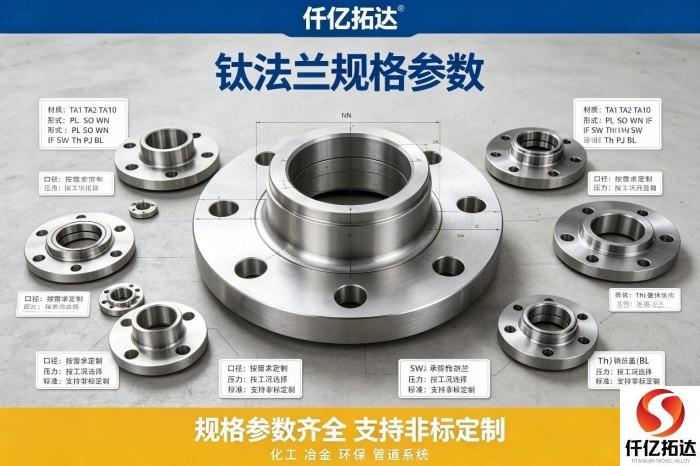
| Weld neck raised face (WNRF) | Preferred | Tapered hub transfers load into the pipe; best fatigue and thermal-cycling behaviour; full-penetration butt weld |
| Lap joint + stub end | Preferred where cost matters | Only the stub end is titanium; backing ring can be carbon steel, saving 60–80% of flange metal cost |
| Slip-on (SO) | Low-pressure, non-cyclic only | Two fillet welds, lower fatigue strength, crevice at the pipe-to-flange fit |
| Blind (BL) | Correct for permanent closure | Size the thickness for the full design pressure; do not substitute a thin plate |
| Socket weld (SW) | Reject | Leaves a roughly 0.8 mm stagnant gap — a crevice-corrosion cell in chloride service |
| Threaded | Reject | Spiral thread root is a crevice and a leak path; titanium threads also gall |
The lap joint and stub end arrangement deserves particular attention for buyers watching cost. Because only the stub end wets the process fluid, the loose backing ring can be carbon steel; on larger diameters the saving in titanium is substantial. The trade-off is a lower fatigue rating and an extra sealing face, so it belongs on steady, low-pressure, low-cycle lines rather than on vibrating or thermally cycled ones. The Gr2 WNRF flange page and B16.5 stock listing show the configurations we normally supply.
Gasket and Bolt: A Three-Piece System, Not Three Line Items
Titanium has an elastic modulus around 105 GPa, roughly half that of carbon steel at around 200 GPa. A titanium flange stores less elastic strain energy at a given bolt preload, so any relaxation of the gasket eats the sealing stress faster than it would on a steel flange. PTFE gaskets creep under load, and after roughly 50–100 thermal cycles the residual gasket stress can fall below the seating requirement. That is the classic "it was tight at hydrotest and weeps after three months" failure.
Three gasket families cover most chemical duties. Plain PTFE is fine for steady, low-cycle, low-temperature service. Flexible graphite with a stainless steel tang insert resists creep and is the usual choice for thermal cycling. Spiral-wound gaskets with the correct filler and inner/outer rings handle high pressure and cycling. Whichever is chosen, verify the seating stress against the available bolt load on a titanium flange rather than copying a steel-flange specification.
Bolting has its own trap. Carbon steel B7 studs against a titanium flange set up a galvanic couple; in a wet chloride environment the steel corrodes and the titanium, as the cathode, can pick up hydrogen. Three options are defensible: A193 B8/B8M stainless studs as the default (typically 3–4 times the cost of carbon steel, but the couple is eliminated or greatly reduced), coated carbon steel for dry indoor service only, or titanium bolts to B348 with the appropriate B18 dimensions and F467/F468 mechanical requirements — noting that TA2 bolts have much lower allowable stress than steel and may need to be larger. Never mix a titanium flange, a PTFE gasket and plain carbon steel studs on a cyclic hot line and expect the joint to stay tight. Our Titanium Fasteners category and Gr2 vs Gr5 bolt comparison cover the strength question.
Forging vs Machined-from-Bar: What the Certificate Should Say
Ask for the B381 forging certificate, the reduction ratio, the heat treatment record and the NDT report. A forged flange has continuous grain flow from the hub through the flange body, which is why codes require it for pressure service. A bar-machined flange can be dimensionally perfect and still have a transverse-grain weak plane at the hub fillet — the exact location where bending stress concentrates when the joint is bolted up and thermally cycled.
On larger diameters, also check the facing finish and flatness. A raised face with a serrated finish in the correct roughness range grips the gasket; a polished or warped face does not. Machining damage, tool marks running radially across the sealing face and free-iron contamination from shared tooling all create leak paths or pitting sites. Ask for a photograph of the face and a flatness check on large or high-class flanges, and require a final pickling and free-iron test after machining. This is the same contamination control described for butt-weld fittings.
Where TA2 Flanges DO Fail: Read This Before You Approve the Joint
Hot chloride crevices at the sealing face and socket joints
Any stagnant gap — a socket weld land, a threaded root, a slip-on fit, a damaged raised face, a gasket that has crept — becomes a crevice above roughly 60–70 C in chloride service. The mechanism is geometry-driven and is not fixed by a more expensive grade. Eliminate the gap with full-penetration welds and crevice-free joint design. See the corrosive-service flange selection notes.
Reducing acids, fluoride and dry chlorine
TA2 has no useful resistance to HF or fluoride contamination, degrades in hot concentrated HCl and H2SO4, and needs trace water to repassivate in dry chlorine and water-free organics. Check the cleaning chemicals and the upset cases as well as normal operation. Where the medium is genuinely aggressive, the whole joint — flange, stub end, gasket and bolts — has to be re-specified together.
Galvanic coupling and hydrogen pickup
Carbon steel studs, carbon steel backing rings without isolation, and cathodic protection systems all put titanium in a galvanic role. The risk is accelerated corrosion of the steel and hydrogen absorption on the titanium side, which can embrittle the hub fillet over time. Insulating kits, correct bolt material and controlled CP potentials are design decisions, not site fixes.
Thermal cycling and bolt-load relaxation
Low modulus plus gasket creep plus differential thermal expansion is the dominant leak mechanism on hot cyclic lines. It is not a material defect and it will not appear on an MTR. Address it with a creep-resistant gasket, correct bolt material, a controlled bolt-load sequence, and a retorque plan after the first thermal cycle.
Over-pressure at elevated temperature
The failure mode from the opening case: selecting a rating class by its ambient figure. Always check the allowable at design temperature for the specific material group in the current standard, and include upset and startup conditions.
Do not buy a bar-machined titanium flange for pressure service, do not use socket weld or threaded flanges in chloride duty, do not pair PTFE gaskets with plain carbon steel studs on a hot cyclic line, and do not read "Class 150" as a pressure. All four have produced leaks that no material certificate would have predicted.
Cost Economics: What a Leaking Joint Costs
A titanium flange is a small part of a piping loop, but a leaking flanged joint in corrosive service stops the line, requires isolation and draining, may require re-machining the raised face, and can damage adjacent insulation, supports and instrumentation. On a plant with a long shutdown interval, one unplanned outage easily exceeds the entire flange budget for the loop.
Where the money is best spent: B381 forging rather than bar-machined blanks (a modest premium), B8M studs rather than B7 (typically 3–4 times the stud cost, still small in the joint total), a creep-resistant gasket (a small absolute cost), and one rating class higher if the design temperature sits near the derated allowable. A lap joint plus stub end can save 60–80% of the titanium flange metal cost on larger diameters — an approximate planning figure that varies with size and class — and that saving is real on steady low-pressure lines.
Where saving is false economy: buying a flange without a forging certificate because it is 15% cheaper, or reusing PTFE gaskets and carbon steel studs from a steel-flange specification. For current base material context see the titanium price index and the latest daily price report. All multiples here are approximate planning figures, not quotations.
Seven Procurement Mistakes That Show Up at the Raised Face
- Naming B16.5 without a material standard. Add ASTM B381, the grade and the UNS number.
- Treating the class number as a pressure. Check the allowable at design temperature for the correct material group.
- Accepting a bar-machined flange. Require a forging certificate with reduction ratio and heat treatment record.
- Choosing socket weld or threaded flanges. Both create crevices; reject them for chemical service.
- Buying gasket and bolts as unrelated items. Specify the three-piece system with a creep and galvanic review.
- No facing finish and flatness requirement. Especially on large or high-class flanges.
- Skipping pickling and free-iron testing. Shared tooling leaves iron that pits after hydrotest.
Stock, Small Batch and Lead Time
We stock TA2 / Gr2 weld neck raised face flanges in the common NPS sizes and classes, with lap joint stub ends, blind flanges and other facing types available from forging allocation. Exact sizes, classes and quantities are published on our inventory page and in the Baoji stock and dispatch note; confirm live availability when you enquire. Non-standard drilling, special facings, oversize blanks and machined-to-drawing flanges are supplied through our non-standard fabrication route.
Small-batch orders are normal: two replacement flanges for a shutdown repair are as valid as a full piping bill of materials. We can assemble the complete joint package — flange, stub end, gasket, studs, nuts and washers — so that the three-piece system is consistent rather than assembled from three different suppliers' assumptions. Matching fittings, pipe and fasteners can be included in the same shipment.
Lead time depends on whether the size and class are in stock, and whether B381 forging certification, third-party witnessing or special machining is required. We quote a firm date with the offer. Send the size, class, facing, grade, design pressure and temperature, gasket and bolt requirements, and document set to our quotation desk; our enquiry procedure lists what we need to reply within 24 hours. For export orders, state the certificate language and packing requirements — raised faces need physical protection in transit.
Supplier Verification: What to Ask Before the PO
Ask which standard the forging is certified to, what reduction ratio was achieved, and whether the heat treatment and NDT records are available. Ask for the actual material group used to check the pressure-temperature rating at your design temperature. Ask for the facing finish range and the flatness measurement. Ask how free-iron contamination is prevented and tested after machining. Ask whether the flange will be marked with grade, class, heat number and manufacturer's identification as B16.5 requires.
Then ask the system question: can you supply and take responsibility for the flange, gasket and bolt set as one compatible package, with the gasket seating stress checked against the bolt load available on a titanium flange? A supplier who answers that question has thought about the joint rather than the component. Our certifications page, the materials overview and the B16.5/B16.47 flange reference give the document set and size coverage.
Frequently Asked Questions
Q1: What pressure can a Class 150 titanium flange hold at 200 C?
Not the ambient figure. Allowable pressure declines with temperature for every material group; a commonly cited illustration for comparable groups is roughly 235 psi at ambient falling to around 125 psi by 200 C, a derating of about 40–50%. These are orientation figures only. Read the current ASME B16.5 pressure-temperature table for the titanium material group actually used, and apply your project piping code at design conditions including upsets.
Q2: Why is weld neck preferred over slip-on?
The tapered hub of a weld neck flange transfers bending and thermal loads smoothly into the pipe and is joined with a single full-penetration butt weld. Slip-on flanges use two fillet welds, have lower fatigue strength, and leave a crevice at the pipe-to-flange fit. For corrosive or cyclic chemical service, WNRF is the default choice.
Q3: Should socket weld Titanium Flanges be avoided?
Yes. Socket welding leaves a small stagnant gap at the pipe end, typically around 0.8 mm, which behaves as a crevice in chloride service above roughly 60–70 C. Threaded flanges are worse, because the spiral thread root is a continuous crevice and titanium threads also gall. Use butt-welded or lap joint constructions instead.
Q4: Which bolt material prevents galvanic corrosion?
A193 B8/B8M stainless studs are the usual default; they cost roughly 3–4 times plain carbon steel but greatly reduce the couple. Titanium bolts to B348 with F467/F468 requirements eliminate it entirely but have lower allowable stress and may need to be larger. Coated carbon steel is acceptable only in dry, indoor, non-critical service. Isolate any carbon steel backing rings on lap joint assemblies.
Q5: What gasket works best under thermal cycling?
Flexible graphite with a stainless steel tang insert resists creep and is the common first choice for cycling. Spiral-wound gaskets with appropriate rings handle higher pressure and cycling. Plain PTFE is fine for steady low-temperature duty but creeps and can lose seating stress after roughly 50–100 cycles. Check the seating stress against the bolt load available on a titanium flange.
Q6: Does B16.5 alone define the material?
No. B16.5 defines dimensions, tolerances, facings, bolting, marking and pressure-temperature ratings by material group. The material specification must be added separately — ASTM B381 forging, TA2 / Gr2 / UNS R50400, and the required certification. Without those lines, a bar-machined or even non-titanium flange can satisfy the dimensional requirement.
Q7: Can you supply small batch flanges from stock?
Yes, including matched gasket and bolt sets for repair work. Send the size, class, facing, grade and design conditions to the quotation desk and we will confirm live stock with a firm date. Check the stock listing for the sizes normally held.
Choose TA2 WNRF if / Choose Something Else if
Choose a TA2 B381-forged WNRF flange if the line is pressurised, cyclic or vibration-exposed; the medium is an oxidising or mildly reducing chemical stream, seawater below roughly 60 C, or wet chlorine; you can check the pressure rating at design temperature; and you can specify the gasket and bolt set as a compatible package. It is the safest default for chemical process piping.
Choose something else if the line is large-diameter, low-pressure and steady (a lap joint with a titanium stub end and carbon steel backing ring saves substantial titanium cost); if hot chloride crevices cannot be designed out (consider Gr7/Gr12 wetted parts and a crevice-free joint); if the medium contains fluoride, hot concentrated reducing acid or dry chlorine (re-specify the whole material system); or if the service is high-pressure, high-temperature or high-cycle to the point where a higher class or a Gr5 forging is required by calculation.
Summary: The Eight Fields That Belong on the RFQ
- Standard and material: ASME B16.5 plus ASTM B381 forging; TA2 / Gr2 / UNS R50400, with B16.47 for NPS 26–60.
- Size, class and facing: NPS, rating class, raised face or other facing type, and a check of allowable pressure at design temperature for the correct material group.
- Flange type: WNRF, lap joint + stub end, blind or slip-on, with socket weld and threaded explicitly excluded for chemical service.
- Forging evidence: B381 certificate, reduction ratio, heat treatment record, NDT report, permanent marking with heat number.
- Sealing face: finish roughness range, flatness limit, and protection during transport.
- Three-piece joint: gasket family with creep review, bolt and nut material, galvanic isolation, bolt-load sequence and retorque plan.
- Cleanliness: dedicated tooling, final pickling, free-iron test, no carbon steel contamination.
- Commercial terms: quantity (small batches accepted), export packing with face protection, certificate language, target date, incoterms.
Send those eight items with your design pressure, design temperature, medium and upset cases to our quotation desk, or use the contact page to discuss the joint design first. Related reading: the titanium flange category, the derating article, and the full product range.
- Titanium Price Today (11 Nov 2026): Plate, Tube, Rod & Wire
- Titanium Price Today (9 Nov 2026): Plate, Tube, Rod & Wire
- What is Titanium Flange | ASME B16.5 ASTM B381 Gr2 Gr5 Titanium Flan
- ASME B16.5 Titanium Flange Grade2 DN100-DN600 Class150/300 FOB
- Gr2 Titanium Sheet Price FOB Shanghai | ASTM B265 In Stock
Contact Person: Wang Xiaoning
Tel: +86-917-355-7966
Email: [email protected]
WhatsApp: +86 188 2967 9311
Company: Shaanxi Qianyi Tuoda Technology Co., Ltd
Address: Floor 4, Building 4, No. 188 Gaoxin Avenue, High-tech Zone, Baoji City, Shaanxi Province, China