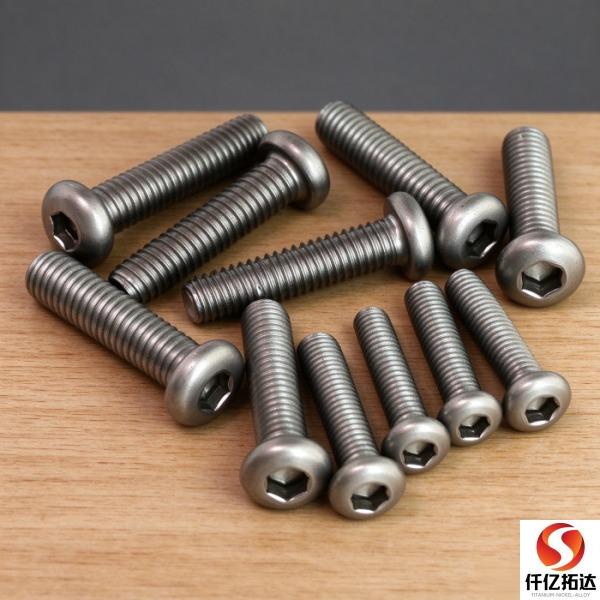
Is Grade 5 Titanium Stronger Than Grade 2 for Bolts?
| Specification | Grades Compared: Commercially pure Grade 2 (R50400) and Ti-6Al-4V Grade 5 (R56400) |
|---|---|
| Applicable Standard | Selection Basis: Service medium first, load second, cost third |
| Material Condition | Upgrade Paths: Grade 7, Grade 12, Grade 16 and Grade 23 ELI by duty |
| Inspection & Packaging | Standards Referenced: ASTM F468 / F468M, ASTM F467, ASTM B348, EN 10204 3.1 |
| Reference Price | $5.00 – $30.00 |
Product Description: Compare Gr2 and Gr5 titanium fasteners on strength, ductility, corrosion, weldability and cost, with a Choose Gr2 if / Choose Gr5 if checklist
Product Overview
Is Grade 5 Titanium Stronger Than Grade 2 for Bolts?
Yes. Grade 5 (Ti-6Al-4V) has a published nominal minimum tensile strength of approximately 895 MPa, against approximately 345 MPa for commercially pure Grade 2 — roughly 2.6 times higher, marked approx, from standard reference tables rather than any specific lot. But that answer is close to useless for procurement, because strength is rarely the first selection criterion for a titanium fastener; the service medium is. Ask which grade survives the medium first, then whether the extra strength lets you reduce diameter or bolt count, and only then compare price. The table below is the decision order we use.
| Grade | Nominal min tensile (approx) | Where it earns its place | Where it does not |
|---|---|---|---|
| Grade 2 (CP) | 345 MPa | Oxidising media, flowing seawater, chemical equipment, formability, lower cost, easy cold heading | High clamp loads, hot stagnant chloride crevices, hot reducing acids |
| Grade 5 (Ti-6Al-4V) | 895 MPa | High strength-to-weight, smaller diameters, aerospace and racing, high preload joints | Any medium where the TiO2 film fails — extra strength does not add corrosion resistance |
| Grade 7 / 12 | Comparable to Gr2 | Reducing acids and hot chloride crevices, where palladium or Mo-Ni additions stabilise the film | Not a strength upgrade; do not specify for load reasons |
| Grade 16 | Comparable to Gr2 | Chloride crevice resistance with a leaner Pd addition | Not a strength upgrade |
| Grade 23 ELI | High, lower interstitials | Medical and high-toughness duty where fracture toughness matters | Cost premium without a toughness requirement |
1. The "3x Strength" Short Answer — and Why It Misleads
The strength gap is real and it is the reason Grade 5 dominates aerospace and motorsport bolting. It is also the reason buyers over-specify it. A bolt does not fail because its tensile strength was 345 MPa rather than 895 MPa; it fails because the joint lost preload, because the threads galled, because a crevice went acidic, or because nobody controlled the nut factor during tightening. All four of those failures are indifferent to the grade label.
Our Titanium Fasteners Guide already publishes the strength and proof-load comparison in detail, so this article does not repeat that table. What it adds is the decision order: medium → geometry → load → cost. If the medium rules out commercially pure titanium, choosing Grade 5 does not rescue the design — you need a different grade or a design change. If the medium is benign but the clamp load is high, Grade 5 may let you drop one bolt size, and that is the point at which the strength premium becomes an engineering saving rather than a line-item expense.
2. What the Two Grades Actually Are (One Paragraph Each)
Grade 2 is commercially pure titanium with tight limits on oxygen, nitrogen, carbon and iron. The low interstitial content gives it excellent ductility and formability, which is why it cold-heads well into bolts, screws and rivets, and why it is the default for chemical equipment, heat exchangers and marine hardware. Its protective TiO2 film is the same film that Grade 5 has; the alloying elements in Grade 5 do not make that film nobler.
Grade 5 is the alpha-beta alloy Ti-6Al-4V: approximately 6% aluminium and 4% vanadium as nominal composition. It is heat-treatable, roughly 2.6 times stronger in nominal minimum tensile terms, and about half as formable in practice. It is the workhorse for high load in a light package. Its bar feedstock is governed by ASTM B348 Gr5 bar, while the finished bolt is specified against ASTM F468 / F468M — two documents with different scopes, and a frequent source of RFQ errors.
3. Where Gr2 Earns Its Keep
Specify Grade 2 when the medium is the challenge and the load is modest: oxidising acids, wet chlorine, flowing seawater, chemical process equipment, or any assembly where the parent material is already commercially pure titanium. It forms and heads cleanly, machines into complex non-standard shapes more forgivingly than the alloy, and costs less per piece. It is also the grade most likely to be available from stock in a wide size range, which removes the single largest cost penalty on small orders.
Two practical checks belong in the purchase order regardless of grade: a permanent manufacturer and grade marking on the head, and an EN 10204 3.1 certificate tying chemistry and mechanicals to a heat number. A "titanium bolt" with no grade mark cannot be sorted from a Grade 5 bolt by eye, and PMI/XRF is the only quick way to tell them apart — Gr5 reads approximately 6% Al and 4% V, Gr2 reads as near-pure titanium. Our Gr2 bolts, nuts and washers in M6–M36 and EN 10204 3.1 mill certificate pages show how those fields are stated on a quote.
4. Where Gr5 Earns Its Premium
Grade 5 pays for itself when strength actually changes the design: a smaller diameter that fits a confined bolt circle, fewer bolts in a joint, higher installed preload without yielding, or a lighter assembly where mass is a specification. Aerospace brackets, racing suspension, high-cycle vibration joints and compact flange designs are the classic cases. In each, the comparison is not "Gr5 bolt versus Gr2 bolt" but "Gr5 joint versus a larger, heavier Gr2 joint".
The premium comes with assembly consequences that are easy to under-budget. Higher strength means higher achievable preload, which means more care with the nut factor K, deliberate lubrication and a properly matched nut to ASTM F467. A Gr5 bolt with a soft or mismatched nut strips or galls before it ever reaches its rated load. Our Grade 5 bolt, nut and washer sets are kitted for exactly that reason, and the F468/F467 torque-boundary guide explains why the standard sets strength but not clamp force. If your joint is neither weight- nor space-constrained, that extra assembly discipline buys you nothing.
Specification line to copy: "Bolt to ASTM F468 Gr2 (R50400) [or Gr5 / R56400], UNR thread, permanent grade marking, EN 10204 3.1 with heat number, PMI on one piece per lot." State the grade as a number and a UNS designation — "titanium bolt" alone is not a specification.
5. When Neither Grade Should Be Specified
This is the section most grade-comparison articles omit. In the following media, Grade 2 and Grade 5 fail for the same reason — the TiO2 film breaks down — and no amount of extra strength helps. No concentration or temperature limits are given here: these are qualitative exclusions from published corrosion guidance and must be verified against isocorrosion data and coupon testing for your exact service.
Hydrofluoric acid and acidic fluoride solutions
The oxide film dissolves; both grades corrode rapidly. Neither is a candidate. Specify a different alloy system entirely, and treat the fastener selection as part of the materials review for the whole assembly.
Hot reducing acids (HCl, H2SO4 without an oxidiser)
Commercially pure titanium and Ti-6Al-4V both lose protection. Move to Grade 7 for strong reducing acid or the leaner Grade 12 reducing-acid alternative, and make sure the fastener grade follows the parent plate or tube.
Dry chlorine and anhydrous oxidisers
Wet chlorine is a titanium success story; dry chlorine is a published exclusion with a fire risk. Red fuming nitric acid and anhydrous methanol are similar red-line cases. This is a safety decision, not a grade selection.
Stagnant hot chloride crevices
Under a bolt head, in a thread engagement or beneath a gasket, a tight crevice can develop an oxygen-depleted acidic cell where Grade 2 pits and Grade 5 is no better. The fix is Grade 16 or Grade 7 chloride-crevice resistance — note that the Grade 16 page describes wire, not a finished fastener — or a design change that removes the crevice. Our marine-environment titanium screws page covers the assembly details.
Fuming nitric acid and strong oxidiser combinations
Although titanium generally resists oxidising acids, specific anhydrous oxidiser combinations are published exclusion cases. Confirm the full chemistry, including trace water and contaminants, before assuming an oxidising medium is automatically safe.
6. Frequently Asked Questions
Is Grade 5 always the better bolt?
No. It is stronger, not more corrosion-resistant. In an oxidising or flowing-seawater joint with modest load, Grade 2 is cheaper, more formable and equally protected by the same TiO2 film. Grade 5 earns its premium only when strength changes the geometry or the preload budget.
Can I mix a Grade 5 bolt with a Grade 2 nut?
It is a common cause of thread stripping and galling. Pair the nut grade and standard (ASTM F467) deliberately with the bolt, and lubricate both. A mismatched, softer nut can fail before the bolt reaches its rated load.
Does Grade 5 resist seawater crevice corrosion better than Grade 2?
No. The alloying additions that raise strength do not stabilise the oxide film in a tight hot crevice. For stagnant hot chloride duty the upgrade path is Grade 7, Grade 12 or Grade 16, or a design change that eliminates the crevice.
How can I tell a Grade 2 bolt from a Grade 5 bolt on incoming inspection?
Not by colour, weight or magnet. Use a permanent grade mark plus handheld XRF/PMI: Grade 5 shows approximately 6% aluminium and 4% vanadium, Grade 2 reads as near-pure titanium. Confirm the heat number against the EN 10204 3.1 certificate.
Which grade should I use for medical device assembly?
That depends on whether the fastener is for equipment assembly or an implant, and on the customer's regulatory file. Our fasteners for medical device assembly page covers equipment-side use; Grade 23 ELI bar is a separate material route that requires its own review. We make no implant-grade certification claim here.
7. Summary, Choose X if / Choose Y if, and Request a Quotation
Choose Gr2 if
- The medium is oxidising, wet chlorine or flowing seawater with no hot stagnant crevice.
- Load is low to moderate and the diameter is not space-constrained.
- You need formability, cold heading or a complex non-standard shape.
- You want a stock size and a lower unit cost on a small order.
- The parent equipment is already commercially pure titanium.
Choose Gr5 if
- Higher strength lets you reduce diameter, bolt count or assembly mass.
- The joint needs high installed preload and you will control K, lubrication and nut pairing.
- The duty is aerospace, racing or high-cycle vibration with a qualified assembly procedure.
- You have confirmed the medium is one where the TiO2 film is stable.
- The grade mark, PMI result and 3.1 certificate will be recorded against the lot.
The question "is Grade 5 stronger" has a one-word answer. The question worth asking is whether your joint needs strength at all, or whether it needs a grade that survives the medium. Get the medium right first; the strength comparison is the easy part.
To request a quotation, send: item, grade with UNS designation, applicable standard, size and length, thread standard and pitch, head style, finish, quantity, certificate and PMI requirement, and the service medium. One action, one list.
Send your fastener RFQ or browse the Titanium Fasteners hub for bolts, screws, studs and nuts.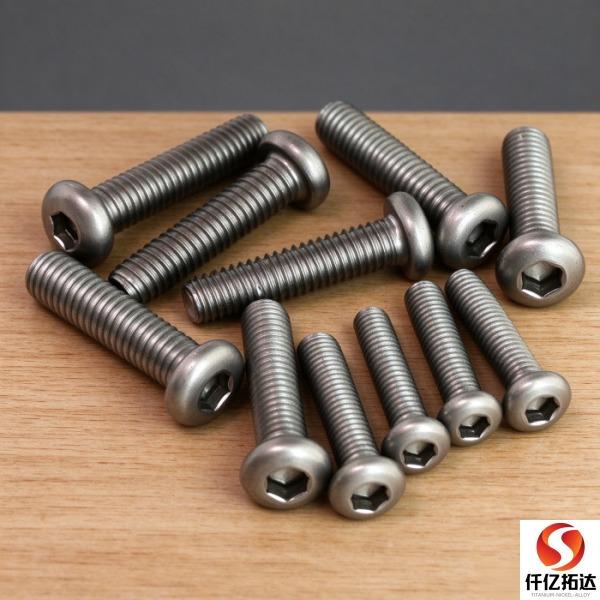
Data note and attribution: tensile figures are published nominal minimums marked approx, not lot-specific test results. No proof-load, fatigue, hardness or creep data is repeated here because the site's existing fastener guide covers those tables. The five media in section 5 are qualitative exclusions from published corrosion guidance with no concentration or temperature thresholds; verify against isocorrosion data and coupon testing for the exact service. No implant-grade certification, inventory count, lead time or test report is claimed. Reviewed and maintained by the Engineering Team, Shaanxi Qianyi Tuoda Technology Co., Ltd., Baoji, China.
Need this specification in titanium? Get a quote.
Send us your grade, size and quantity. We check live stock and reply with price and lead time the same day.
Stock holder in Baoji Titanium Valley · ~800 t inventory · cut-to-size · drawing-based machining · ASTM / ASME / GB · export-ready · same-day response
Tell us your requirement — grade, size and quantity. We reply within 24 hours.
Prefer chat? WhatsApp +86 188 2967 9311 or email [email protected].


- Titanium Price Today (9 Nov 2026): Plate, Tube, Rod & Wire
- What is Titanium Flange | ASME B16.5 ASTM B381 Gr2 Gr5 Titanium Flan
- ASME B16.5 Titanium Flange Grade2 DN100-DN600 Class150/300 FOB
- Gr2 Titanium Sheet Price FOB Shanghai | ASTM B265 In Stock
- Titanium Price Today (Oct 26, 2026): China Market Report
Contact Person: Wang Xiaoning
Tel: +86-917-355-7966
Email: [email protected]
WhatsApp: +86 188 2967 9311
Company: Shaanxi Qianyi Tuoda Technology Co., Ltd
Address: Floor 4, Building 4, No. 188 Gaoxin Avenue, High-tech Zone, Baoji City, Shaanxi Province, China