What Does ASTM F468 Cover—and What Does It Not?
| Specification | Primary Standard: ASTM F468 / F468M for titanium bolts, screws and studs |
|---|---|
| Applicable Standard | Companion Standards: ASTM F467 nuts, ASTM B348 bar, ASME B18 / DIN / ISO dimensions |
| Material Condition | Documentation: Permanent grade marking, PMI / XRF, EN 10204 3.1 with heat number |
| Inspection & Packaging | Scope Boundary: Material and mechanical properties only; no torque, no dimensions, no certificate |
| Reference Price | $5.00 – $30.00 |
Product Description: What ASTM F468 / F468M actually specifies for titanium bolts and screws, how it differs from bar standard B348, and what to put in an RFQ
Product Overview
What Does ASTM F468 Cover—and What Does It Not?
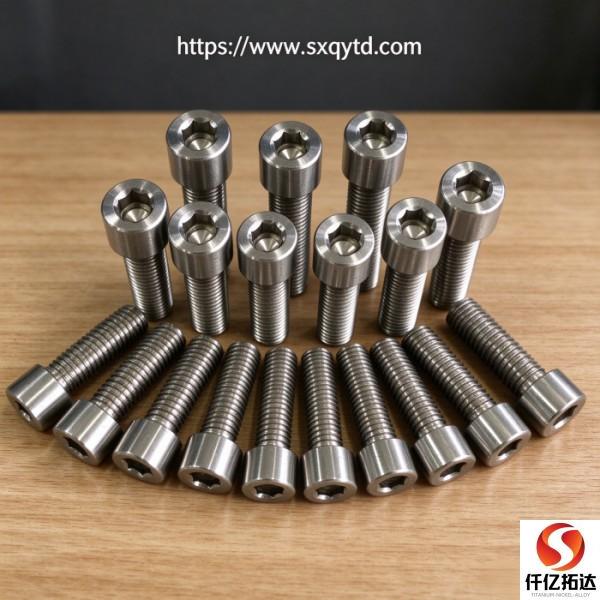
Writing "ASTM F468" on a purchase order covers roughly one third of what a titanium bolt actually needs. ASTM F468 (and its metric edition F468M) governs finished externally threaded Titanium Fasteners: bolts, screws and studs — specifically their grade and chemistry, minimum tensile / yield / proof-load properties, and thread form. It does not specify head dimensions or drive geometry (those belong to ASME B18, DIN or ISO standards), does not cover the nut (ASTM F467), does not certify the bar stock the bolt was machined from (ASTM B348), does not issue the mill certificate (EN 10204 3.1), and does not tell you the tightening torque. The table below is the scope map we use when reading an RFQ.
| Document | What it governs | What it does NOT govern | How to cite it in an RFQ |
|---|---|---|---|
| ASTM F468 / F468M | Finished titanium bolts, screws, studs: grade, chemistry, mechanical minimums, thread form | Head dimensions, nut, certificate, torque | "Bolt to ASTM F468 Gr5 (R56400)" or "F468M" for metric |
| ASTM F467 / F467M | Titanium nuts: grade, chemistry, mechanical properties | The bolt; the washer; the assembly preload | "Nut to ASTM F467 Gr5", matched to the bolt grade |
| ASME B18.2.1 / B18.3 | Hex bolt and socket cap screw dimensions, head height, across-flats, drive recess | Material, strength, corrosion behaviour | "Dimensions to ASME B18.2.1" alongside the F468 line |
| DIN 933 / 931 / ISO 4017 / 4014 | Metric hex bolt fully vs partially threaded forms and dimensions | Grade, certificate, torque | "Form DIN 933, fully threaded, M10 × 1.5" |
| ASTM B348 | Titanium bar and rod feedstock: chemistry, mechanicals, condition | The finished bolt, its head, its threads, its proof load | Cite as feedstock only, never as the bolt specification |
| EN 10204 3.1 | Mill test certificate: heat chemistry, mechanical results, traceable heat number | Dimensional report, PMI result, surface condition | "EN 10204 3.1 with heat number per shipment" |
| PMI / XRF | Positive material identification of alloying elements on a sample | O / N / C interstitials, heat treatment, tensile strength | "PMI on one piece per lot, recorded against heat" |
| Torque / clamp | Set by nut factor K, lubrication, mating nut and target preload — assembly engineering | Not specified by any of the above | "State K used and target clamp; do not quote a generic torque table" |
1. The "One Standard" Trap
Most specification errors in titanium bolting come from assuming a single standard describes a single physical object end to end. It does not. A bolt is simultaneously a material (a titanium grade with a chemistry and a heat number), a product (an externally threaded fastener with mechanical minimums), a shape (a head style, drive, thread series and length), and a component of a joint (a nut, a washer, a lubrication state and a target preload). Four different document families govern those four aspects, and they were written by different committees for different purposes.
When an RFQ says only "titanium bolt M10 × 60, ASTM F468", every supplier will fill in the blanks differently: one will assume a DIN 933 fully threaded form, another a partially threaded DIN 931, one will quote a 3.1 certificate and another will not. The quotes then look incomparable, and the buyer concludes that titanium fastener pricing is opaque. It is not opaque; the specification was incomplete. The fix is to name the governing document for each of the four aspects, which takes one extra line in the purchase order.
Our Titanium Fasteners hub lists the standards we quote against for bolts, screws, studs and nuts; the ASTM F467 titanium nuts and ASTM F468 marine screws pages show how those scope lines appear on individual items.
2. What ASTM F468 and F468M Actually Specify
F468 is a material and mechanical property specification for finished externally threaded Titanium Fasteners. It identifies permitted grades by UNS designation, sets chemical composition limits, and states minimum tensile strength, yield strength and proof load. Published nominal minimum tensile values are approximately 345 MPa for Grade 2 and approximately 895 MPa for Grade 5 — approximate reference figures, not measurements from any lot. It also addresses thread form: UNR, a thread with a controlled root radius, is the form commonly specified for external threads because the radius improves fatigue behaviour over a flat-bottom root.
F468M is the metric (SI) edition. It carries the same intent under SI units, which matters more than buyers expect: if your project is metric, cite the M edition explicitly so that the inspector, the mill and the machine shop read the same numbers. Mixing an inch-series F468 citation with a metric drawing is a classic source of a rejected lot. Dimension and thread-series detail then comes from the dimensional standards referenced in section 5, not from F468 itself.
Grades available under the standard extend beyond Gr2 and Gr5 to palladium- and molybdenum-bearing grades for more aggressive media. That is a useful reminder of the scope boundary: F468 tells you which grades are permitted and what their minimum properties are; it does not tell you which grade survives your medium. That decision belongs to the corrosion review, and no standard clause will make it for you.
3. Six Things F468 Does Not Cover
The fastest way to audit a specification is to check for the six gaps below. If a purchase order names only F468, each one is an open decision that the supplier will make on your behalf.
| Gap | Who governs it | What goes wrong if omitted |
|---|---|---|
| Head style and dimensions | ASME B18.2.1 / B18.3, DIN 912 / 933 / 931, ISO 7380 / 4017 / 4014 | Wrong across-flats, head height or drive; wrench will not fit |
| Nut and washer | ASTM F467 / F467M; washer by drawing or DIN 125 | Mismatched nut strips or galls before the bolt reaches its rated load |
| Feedstock | ASTM B348 bar / B381 forgings | No control over the starting stock or its heat traceability |
| Certificate | EN 10204 3.1, plus dimensional report and PMI as required | Nothing to produce in an audit or tie to a heat number |
| Surface condition | Passivation / anodising / anti-seize by specification or drawing | Assembly galling, or a colour mistaken for a grade |
| Torque and clamp | Assembly procedure: T = K × D × F, using the K for the actual lubrication state | Under-preloaded joint that walks loose, or a yielded shank |
Note that the last gap is deliberately not expanded here. Our F468/F467 torque-boundary guide already covers K factors, modulus, UNR, reuse and the eight-field RFQ in depth. This article is the index of who owns what; that article is the assembly engineering follow-on. Link them rather than duplicating them.
4. Finished-Product Standard vs Material Standard
: Why B348 Is Not a Bolt Spec
This is the single most consequential scope boundary in the category. ASTM B348 governs titanium bar and rod — the cylindrical or hexagonal feedstock a fastener is machined from. It sets chemistry, mechanical minimums, condition and dimensional tolerance for that bar. ASTM F468 governs the finished fastener after heading or turning, thread forming, heat treatment where applicable, and finishing.
They are not interchangeable, for three reasons. First, the geometry changes: machining a head and rolling a thread introduce stress concentrations, a reduced shank, a thread root and a bearing face that did not exist in the bar. Second, the properties can change: cold work at the thread root, any heat treatment and the surface condition all affect the finished part. Third, the acceptance tests differ: a bar tensile coupon and a finished fastener proof-load test are different tests on different objects.
The practical error looks like this: an engineer takes the B348 minimum tensile value for Gr5 bar, multiplies it by the bolt's stress area, and uses the result as the allowable working load of the joint. That is a specification mistake, not a testing problem. The correct chain is: cite B348 for the feedstock if you need to control it; cite F468 / F468M for the finished bolt; derive the working clamp from the assembly calculation with the actual nut factor; and hold the proof load as a ceiling, not as a target. Our Grade 5 B348 bar stock, TC4 B348 rod and rod for aerospace fasteners pages describe feedstock only — they are not finished-fastener specifications.
5. Who Owns the Dimensions
: ASME B18, DIN and ISO
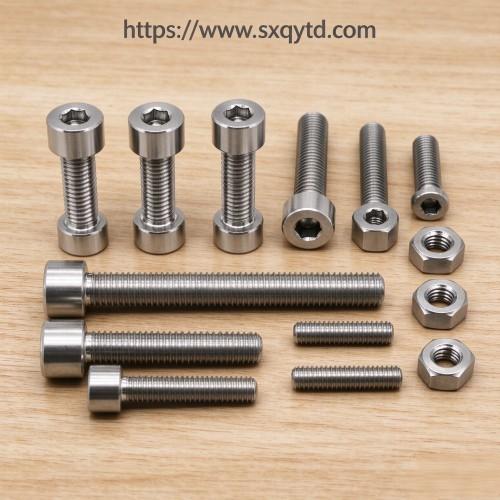
Once the material and mechanical line is settled, the physical shape needs its own citation. In the inch series, ASME B18.2.1 covers hex bolts and B18.3 covers socket cap screws. In the metric series, DIN 933 / ISO 4017 define a fully threaded hex bolt and DIN 931 / ISO 4014 a partially threaded one; DIN 912 is the socket cap screw and ISO 7380 the button head. These documents govern across-flats, head height, thread length, drive recess and tolerance — everything a wrench or a counterbore actually touches.
Why the distinction matters on titanium: the fully versus partially threaded choice decides whether a shear plane falls on the smooth shank or in the thread root, which is a fatigue and strength question no material standard answers. Head style decides bearing area and tool clearance, and titanium's lower modulus makes bearing-area mistakes more visible. Our stocked M6 / M8 / M10 hex bolts and Gr2 bolts, nuts and washers in M6–M36 list the dimensional forms alongside the material grades for exactly this reason. When the required form is not in any standard, the drawing becomes the governing document — see non-standard fasteners by drawing.
6. F467 for Nuts and the Matching Rule
ASTM F467 is the companion standard for titanium nuts. It is not a sub-clause of F468 and it is not optional: an F468 bolt with an unspecified nut is an incomplete joint. The usual rule is that the nut's strength grade must not be lower than the bolt's, so a Grade 5 bolt is paired with a Grade 5 F467 nut rather than a softer commercially pure one. Pairing matters for a second reason on titanium — galling is a bolt-plus-nut-plus-lubricant problem, not a property of either part alone.
Write both lines in the purchase order, explicitly: "Bolt to ASTM F468 Gr5; nut to ASTM F467 Gr5; washer per drawing." Our ASTM F467 fasteners page and Grade 5 bolt, nut and washer sets are kitted so the pairing is decided before shipping rather than discovered during assembly.
7. Where Conformance Actually Lives
: Marking, PMI, EN 10204 3.1
A standard states requirements; it does not prove that your shipment meets them. Three documents and one physical mark do that. A permanent manufacturer and grade marking on the head ties a loose part to a grade. PMI / XRF on a sample from the delivered lot confirms the alloying elements — Grade 5 reads approximately 6% Al and 4% V, Grade 2 as near-pure titanium — though it cannot measure oxygen, nitrogen or carbon and cannot see heat treatment. An EN 10204 3.1 mill test certificate declares heat chemistry and mechanical results against a traceable heat number. A dimensional report closes the geometry gap left by section 5.
None of these is required by F468 simply because you cited F468. They are separate purchase-order lines. Our EN 10204 3.1 mill certificate page and Certifications page set out the wording we use; the passivation and anti-gall treatment page covers the surface condition that the certificate does not describe. For critical bolting, add a dimensional report and, where the risk justifies it, sample tensile or hardness verification from the delivered lot.
8. The "Bar Tensile as Allowable Load" Mistake
Because this error is so common — and so easy to quote out of context — it is worth stating again as a rule rather than a footnote. Bar tensile values belong to the bar. They are not the allowable load of a finished bolt, and they are not a clamp target. Between the two sit a thread root, a bearing face, a head-to-shank transition, a lubrication state, a mating nut and an installation scatter band. A joint designed from a bar coupon has skipped all six.
The correct hierarchy is: F468 minimums establish the floor the fastener must clear; the proof load is a ceiling used in proof testing; the working preload sits well below it and is derived from the assembly calculation; and the torque used to reach that preload is derived from the K for the actual lubrication state. If a supplier's drawing quotes a bar tensile value in the "allowable load" column, ask which finished-product standard and which proof-load test the number came from. The question is diagnostic.
9. What the Standard Still Cannot Tell You
: Six Service Questions
A fully conforming F468 fastener can still be the wrong purchase. These are the questions the standard leaves open, and each one is a service condition rather than a clause. No concentration or temperature limits are given here; verify against isocorrosion data and coupon testing for your exact medium.
Will Grade 2 or Grade 5 survive hydrofluoric acid or acidic fluoride?
No. The protective oxide dissolves; conformance to F468 is irrelevant. This is a material-exclusion decision made before any standard is cited.
What about hot reducing acids such as HCl?
Without an oxidising species the film cannot re-form. Grade 7 or Grade 12 fasteners — following the Gr7 strong reducing-acid plate or Gr12 reducing-acid equipment material route — are the usual direction. F468 permits the grades; it does not select one for you.
Is dry chlorine safe if wet chlorine is?
No. Dry chlorine and certain anhydrous oxidisers are published exclusion cases with a fire risk. The standard says nothing about the medium at all.
Will a stagnant hot chloride crevice under the head be a problem?
It can be. A tight crevice under a head or inside a thread engagement can develop an acidic, oxygen-depleted cell. Grade 16 or Grade 7, or a design change that removes the crevice, is the fix — not a higher strength grade. See our marine-environment screws page.
Who is sacrificed in a galvanic couple with aluminium or steel?
Usually the parent metal, because titanium is the noble, cathodic side. Insulating washers, coatings and area-ratio control belong in the joint design, not in F468.
Can the bolt be removed and re-torqued?
Not reliably in critical joints. Breakaway galling on removal is common, and the standard does not address reuse. Write a single-use clause into the assembly procedure where safety or sealing matters.
10. How to Write the Standard Line in an RFQ
The following line closes all six gaps in one paragraph. Copy it, delete what genuinely does not apply, and keep the grade and the two standard numbers.
"M10 × 60 hex bolt, fully threaded DIN 933 / ISO 4017 form, dimensions to ASME B18.2.1 where applicable; material and mechanical properties to ASTM F468 (or F468M) Gr5 (R56400), UNR thread; nut to ASTM F467 Gr5; washer per drawing; feedstock to ASTM B348; permanent manufacturer and grade marking; passivated, MoS2 anti-seize on threads and under head at assembly; PMI on one piece per lot recorded against heat; EN 10204 3.1 with heat number per shipment; dimensional report; state the nut factor K and target clamp used for torque; single-use in critical joints."
Two fields in that line are frequently dropped and should not be: the mating nut standard and the lubrication state. One decides whether the joint galls; the other decides whether the torque you specified produces the clamp you designed for. Our Titanium Fasteners export desk and FAQ pages answer the paperwork questions that follow; send the full line to the inquiry desk and the quote comes back against the same specification you sent.
11. Frequently Asked Questions
Does ASTM F468 specify the dimensions of a titanium hex bolt?
No. F468 / F468M specify material, chemistry, mechanical minimums and thread form for finished externally threaded fasteners. Head dimensions, across-flats, thread length and drive geometry come from ASME B18.2.1 / B18.3 or the relevant DIN / ISO dimensional standard, and must be cited separately.
Is F468M just a metric conversion of F468?
It is the SI edition carrying the same grade and property intent under metric units. Cite the M edition explicitly on a metric drawing so the mill, the inspector and the machine shop read the same numbers; mixing an inch citation with a metric drawing is a common cause of rejected lots.
Can I use ASTM B348 bar tensile values as the bolt's allowable load?
No. B348 certifies the bar stock, not the finished fastener. Machining introduces a thread root, a head-to-shank transition and a bearing face, and the acceptance tests differ. Cite B348 for feedstock, F468 for the finished bolt, and derive working preload from the assembly calculation.
Does an F468-conforming bolt need an EN 10204 3.1 certificate?
F468 does not issue or require the certificate as part of your purchase order — it is a separate line. For any load-bearing, pressure-containing or corrosive joint, require a 3.1 certificate with a traceable heat number, PMI on a sample, and a dimensional report.
Which standard covers the nut?
ASTM F467 (F467M for metric). Pair the nut grade with the bolt grade so the nut is not the weaker component, and state both standards in the PO. Galling is a bolt-plus-nut-plus-lubricant problem.
Does F468 tell me the tightening torque?
No. Torque depends on the nut factor K, which is set by lubrication, surface finish and the mating nut — none of which the bolt standard controls. Our F468/F467 torque-boundary guide covers the derivation; do not apply a generic steel torque table.
What should a PO say to guarantee a conforming titanium bolt?
Name the finished-product standard and grade with UNS designation, the dimensional standard and thread series, the nut standard and grade, the marking, the PMI requirement, the EN 10204 3.1 certificate with heat number, and the lubrication state used for the torque basis. State that broken traceability is grounds for rejection.
12. Summary, Choose X if / Choose Y if, and Request a Quotation
Choose F468 alone if
- You are buying a stocked, standard-form bolt for a non-critical assembly.
- The dimensional form is unambiguous from the supplier's catalogue and the mating hardware is already defined.
- No certificate, PMI or auditable heat traceability is required.
- The service is benign and the assembly procedure controls lubrication and nut pairing.
Choose F468 + dimensional standard + drawing + 3.1 if
- The joint is load-bearing, pressure-containing or installed in a corrosive medium.
- The head form, thread length or shear-plane location affects the design.
- You need a result that can be recorded against a heat number and produced in an audit.
- The fastener is non-standard, or the customer has specified positive material identification.
- Your quote must be comparable across more than one supplier.
"ASTM F468" is a necessary line, not a complete specification. It tells you what the bolt is made of and how strong it must be at minimum. It does not tell you its shape, its nut, its feedstock, its paperwork, its torque or whether its grade survives the medium. Name the governing document for each of those, and the quote you receive stops being a guess.
To request a quotation, send: item, grade with UNS designation, finished-product standard (F468 / F468M), dimensional standard and head style, size / length / pitch, nut standard and grade, finish and lubrication, quantity, certificate and PMI requirement, and a drawing if the part is non-standard. One action, one list.
Send your fastener RFQ or use the Titanium Fasteners hub as the index for the whole standard cluster.
Data note and attribution: standard scopes are described qualitatively from published standard summaries; no clause numbers, tolerance values or limit tables are quoted. Tensile figures are published nominal minimums marked approx. The PO line in section 10 is a template, not a claim of certification or conformity for any specific lot. Media in section 9 are qualitative exclusions from published corrosion guidance with no concentration or temperature thresholds; verify against isocorrosion data and coupon testing. No third-party certification, inventory count, lead time or test report is claimed. Reviewed and maintained by the Engineering Team, Shaanxi Qianyi Tuoda Technology Co., Ltd., Baoji, China.
Need this specification in titanium? Get a quote.
Send us your grade, size and quantity. We check live stock and reply with price and lead time the same day.
Stock holder in Baoji Titanium Valley · ~800 t inventory · cut-to-size · drawing-based machining · ASTM / ASME / GB · export-ready · same-day response
Tell us your requirement — grade, size and quantity. We reply within 24 hours.
Prefer chat? WhatsApp +86 188 2967 9311 or email [email protected].


- Titanium Price Today (9 Nov 2026): Plate, Tube, Rod & Wire
- What is Titanium Flange | ASME B16.5 ASTM B381 Gr2 Gr5 Titanium Flan
- ASME B16.5 Titanium Flange Grade2 DN100-DN600 Class150/300 FOB
- Gr2 Titanium Sheet Price FOB Shanghai | ASTM B265 In Stock
- Titanium Price Today (Oct 26, 2026): China Market Report
Contact Person: Wang Xiaoning
Tel: +86-917-355-7966
Email: [email protected]
WhatsApp: +86 188 2967 9311
Company: Shaanxi Qianyi Tuoda Technology Co., Ltd
Address: Floor 4, Building 4, No. 188 Gaoxin Avenue, High-tech Zone, Baoji City, Shaanxi Province, China