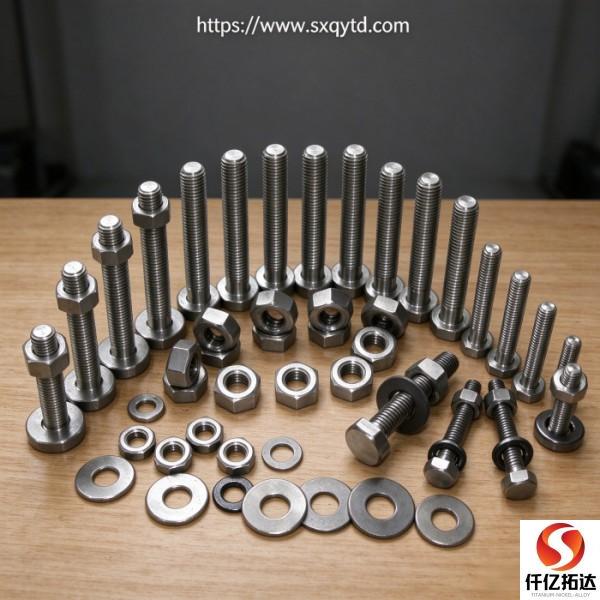
Why Are Titanium Bolts So Expensive? A Cost Breakdown
| Specification | Cost Drivers: Sponge titanium, ASTM B348 bar, machining speed, tool wear, scrap rate, testing |
|---|---|
| Applicable Standard | Grades Compared: Commercially pure Gr2 and Ti-6Al-4V Gr5 versus 316L stainless |
| Material Condition | Standards Referenced: ASTM F467 / F468 / F468M, ASTM B348, DIN 933 / 931, EN 10204 3.1 |
| Inspection & Packaging | Buying Modes: Stock sizes, small batches, non-standard by drawing, consolidated lots |
| Reference Price | $5.00 – $20.00 |
Product Description: A line-by-line breakdown of titanium bolt cost: sponge and B348 bar, slow machining, tool wear, scrap rate, passivation and small-batch testing.
Product Overview
Why Are Titanium Bolts So Expensive? A Cost Breakdown
A titanium hex bolt typically costs roughly 5 to 15 times as much as an equivalent 316L stainless bolt, depending on grade, diameter and order quantity — an approximate industry range, not a quotation. That gap is not mostly the price of the element. It is six compounding inefficiencies: sponge titanium has to be melted and converted to ASTM B348 bar before machining starts; titanium's low thermal conductivity forces slow cutting speeds; tool wear is high; scrap cannot be diluted the way steel scrap can; every lot needs passivation, PMI and an EN 10204 3.1 certificate; and a 200-piece order pays the same setup as a 20,000-piece one. Three of these can be reduced by how you buy, and three cannot. The table below is the short version.
| # | Cost driver | Why it is higher than steel | Can the buyer reduce it? |
|---|---|---|---|
| 1 | Feedstock | Sponge → melt → forge/roll → ASTM B348 bar; every step is batch, vacuum or inert-atmosphere work | Partly — buy a stock bar size, avoid a special melt |
| 2 | Machining speed | Low thermal conductivity keeps heat at the tool tip instead of carrying it into the chip | No — physics, not supplier inefficiency |
| 3 | Tool wear | Chemical affinity with tool materials plus galling tendency; more tool changes per 100 parts | Partly — standard geometry, rolled threads, fewer setups |
| 4 | Scrap and yield | Contaminated titanium scrap has a narrow re-melt route; a rejected blank loses most of its value | Partly — freeze the drawing before cutting |
| 5 | Inspection and paper | Passivation, PMI/XRF, dimensional report, heat-number traceability, EN 10204 3.1 | Yes — specify it once per lot, not once per item |
| 6 | Small-batch amortisation | Setup, first-article inspection and certificate are fixed costs spread over very few pieces | Yes — consolidate sizes into one PO |
| — | The premium buys nothing when | HF, hot reducing acid, dry chlorine, stagnant hot chloride crevices, or a dry indoor non-corrosive joint | Choose a different material or a cheaper grade instead |
1. The "Material Price" Myth
: Six Stages, Not One Invoice
The most common buyer explanation for a titanium bolt quote is "titanium metal is expensive". That is true but incomplete, and it leads to the wrong negotiation. Ask a supplier to discount the raw material and you are bargaining over the one line item where the supplier has the least room. Titanium is not a rare element in the crust; what costs money is reducing TiCl4 into sponge under inert gas, vacuum-arc melting it into an ingot, and converting that ingot into bar or rod that meets ASTM B348 chemistry and mechanical requirements. Each of those steps is energy-intensive, batch-based and slow, and each adds inspection before the next one can start.
By the time a fastener maker receives bar stock, a substantial part of the final price is already fixed. The remaining stages — heading or CNC turning, thread rolling, passivation, marking, inspection, packing — are where the supplier actually has control. A useful way to read a quote is therefore to ask which of the six stages the number covers. A quote that bundles bar, machining and a 3.1 certificate into one unit price is not opaque by accident; it hides the three stages you can influence by changing the order.
For a live feedstock reference, our Grade 5 ASTM B348 bar stock and titanium price index pages separate material from finished fastener pricing. Finished Gr2 bolts, nuts and washers in M6–M36 are quoted against a different cost stack entirely.
2. Cost Item 1 — Feedstock
: What ASTM B348 Bar Actually Costs
Fastener-grade titanium starts as bar or rod, not as a bolt-shaped blank. ASTM B348 governs that bar: chemistry limits, tensile and yield minimums, condition, dimensional tolerance. For Grade 2 the published nominal minimum tensile strength is approximately 345 MPa; for Grade 5 (Ti-6Al-4V) approximately 895 MPa. These are nominal minimums from standard reference tables, marked approx, not measurements from any lot.
Two feedstock decisions move the price more than any haggling. The first is whether you need a special melt or a stock size. A non-standard diameter, an unusual interstitial limit or a small custom heat forces the mill to schedule a dedicated run. The second is the buy-to-fly ratio: a hexagon bolt machined from round bar removes a great deal of metal as chips, while a part made from hexagon titanium bar ready stock starts closer to the final shape. On larger diameters the difference in swarf is significant.
There is also a documentation boundary that buyers routinely miss. B348 certifies the bar. It does not certify the finished bolt. The finished external-thread item is specified against ASTM F468 (or F468M for metric), and the mating nut against F467. If a quote says "material to B348" and nothing else, you have been quoted a bar with a thread cut in it, not a fastener conforming to a finished-product standard. That distinction is worth more than a small discount.
3. Cost Item 2 — Machining Speed and the Low Thermal Conductivity Tax
In steel turning, most of the heat generated at the cutting edge leaves with the chip. Titanium's thermal conductivity is far lower — roughly a quarter of carbon steel's on commonly published nominal figures — so the heat stays at the tool tip and in the workpiece. The practical consequence is a restricted cutting speed, generous coolant, rigid setups and light, continuous passes. Cycle time per bolt rises, and it rises again on deep holes, long threaded lengths and thin shanks that deflect.
This is the one cost driver that no purchasing tactic removes. It is physics. A supplier quoting an unusually short lead time for a complex titanium fastener has either stocked the blank, accepted a tool-life penalty, or is planning to run the part at a speed that will show up as surface damage. Ask which. Slow machining also interacts with the next item: the longer the tool stays in the cut at elevated temperature, the faster it wears.
Thread forming is a good example of a legitimate cost trade. Rolled threads are faster and produce a work-hardened, smoother flank than cut threads, which matters because titanium threads are prone to galling. But rolling needs the right blank diameter and dedicated dies, so it only pays back above a certain quantity. For a 50-piece prototype, cutting is cheaper; for a repeat order, rolling is usually cheaper per part and better in service. Our passivation and anti-gall treatment page describes the surface side of the same decision.
4. Cost Item 3 — Tool Wear and the Galling Tax
Titanium is chemically reactive with many tool materials at cutting temperature, and it has a strong tendency to adhere to a mating surface under load. On the shop floor that appears as built-up edge, smeared flanks and short, unpredictable insert life. Tooling cost per accepted part is therefore higher than for 316L, and so is the labour of checking and changing inserts before they ruin a thread.
The same adhesion mechanism that wears tools is the one that seizes a bolt in its nut during assembly. That is why Titanium Fasteners are almost never shipped "dry and hope": an anti-seize compound, a controlled surface finish and a matched nut are part of the delivered specification, not optional extras. They add cost, but they prevent a far more expensive failure — a seized stud cut out of a flange during shutdown.
There is a purchasing lever here. Every extra setup, every non-standard head form and every special drive recess adds a tool and a changeover. Standardising on a common head style across an assembly, and using a stocked M6 / M8 / M10 hex bolt where the design permits, removes several of those setups at once. When a special form is genuinely needed, our non-standard fasteners by drawing route lets the drawing change be agreed before any bar is cut.
5. Cost Item 4 — Scrap Rate and the Buy-to-Fly Ratio
Steel swarf is a low-value but high-volume commodity with a mature recycling path. Titanium swarf is not. It must be kept clean, segregated by grade and kept free of coolant contamination and tool particles before it can be re-melted, and oxygen pickup during machining can make a fraction of it unsuitable for the original grade. A rejected titanium blank therefore loses much more of its embedded cost than a rejected steel blank does.
That makes yield a first-order cost item rather than a footnote. Three shop practices dominate it: choosing a starting stock close to the final envelope, freezing the drawing before the first article is cut, and inspecting the first article before the rest of the lot is machined. A drawing revision issued halfway through a 300-piece run can scrap the whole batch. This is also why a supplier asks for a signed drawing on non-standard work — it is a cost control, not bureaucracy.
Buyers can help directly. Send the grade, standard, thread series, head style, length, tolerance, finish, quantity and certificate requirement in the first enquiry rather than across six emails, and state whether the drawing is final. Consolidating a Gr2 and a Gr5 requirement into one purchase order with two clearly separated line items also lets the shop plan one inspection and one certificate package. Our Grade 5 bolt, nut and washer sets exist because kitted items are cheaper to inspect and ship than loose parts ordered separately.
6. Cost Item 5 — Passivation, PMI and the 3.1 Certificate
A finished titanium fastener usually carries several documents and treatments that a plain carbon-steel bolt does not: a controlled oxide surface (passivation, or anodising where colour coding is required), permanent manufacturer and grade marking, dimensional inspection, positive material identification by XRF/PMI on a sample, and an EN 10204 3.1 mill test certificate tying chemistry and mechanicals to a heat number. Each is a real cost, and each is also the reason a buyer can put the item into a pressure-containing or corrosive joint with a defensible audit trail.
The cost is largely fixed per lot, which makes it highly sensitive to order size. One certificate for 5,000 pieces is a rounding error; one certificate for 12 pieces is a large share of the unit price. This is the single most effective place to reduce cost without changing the material: consolidate line items, accept one lot-based certificate package instead of per-item paperwork, and avoid requiring third-party witness testing unless the service actually justifies it. Our EN 10204 3.1 mill certificate and Certifications pages set out what those documents do and do not declare.
One caution. Do not delete the certificate line to save money on a critical joint and then try to reconstruct traceability later. PMI taken after the fact proves the alloy in front of the analyser; it does not recreate the heat-to-shipment chain. If the joint is load-bearing, pressure-containing or installed in a corrosive medium, keep the certificate and reduce cost elsewhere in the stack.
7. The Small-Batch Trap
: Why 200 Pieces Cost More Per Piece
Setup, programming, first-article inspection, tool preparation, passivation bath scheduling and documentation are all fixed costs. Divide them by 200 instead of 20,000 and the per-piece overhead grows by two orders of magnitude. This is the "small-batch trap", and it is the most misunderstood part of a titanium fastener quote because the supplier usually presents it as a single unit price with no explanation.
The trap has a legitimate flip side, and it is relevant to how we work. Small quantities are exactly where a stockist adds value: if the size already exists in inventory, the setup was amortised on an earlier run and you are buying a piece, not a production campaign. That is why the practical advice is not "always order more" — it is "order a stock size when you can, and when you cannot, consolidate the custom work into one drawing, one PO and one certificate package". For export orders, a Titanium Fasteners exporter that holds mixed sizes can combine Gr2 and Gr5 line items into one shipment and one document set.
8. Where the Money Does NOT Go
: Three Items Buyers Overestimate
Three line items are routinely blamed for the premium and usually are not the main cause. First, the colour. Anodised blue, purple or gold on a titanium bolt is a thin interference oxide produced in a bath; it is a low-cost marking and identification step, not a precious coating. A coloured bolt is not inherently more expensive than a plain one, and colour says nothing whatsoever about grade. Second, shipping weight. Titanium's nominal density is approximately 4.51 g/cm³ for Grade 2 versus approximately 7.9 g/cm³ for 316 stainless, so air freight on a small fastener order is rarely the deciding term — the paperwork and inspection are. Third, "scarcity" of the metal. Titanium is abundant as an oxide; the cost sits in reduction and processing, not in geological scarcity.
Recognising these three matters because they are where a negotiation tends to stall. A buyer who argues about anodising colour while accepting a custom melt, a special head form and per-item certificates has conceded the three largest controllable costs. Ask instead for the six-stage split described above. If the supplier can tell you which standard the bar meets, which standard the finished fastener meets and what the certificate covers, you have far more room to reduce the quote than any colour discussion will give you.
9. When the Premium Does Not Buy You Anything
: Six Failure Conditions
A higher price is only justified when the service uses the properties you paid for. Titanium's value is its stable TiO2 film in oxidising and chloride media, its strength-to-weight ratio and its non-magnetic character. Where those are irrelevant — or where the film itself fails — the premium buys nothing. This is the chapter most suppliers omit, and the one a procurement engineer should read first.
Hydrofluoric acid and fluoride-containing media
The protective oxide dissolves in HF and in acidic fluoride solutions. A titanium bolt in that service can corrode faster than a cheaper alloy. No concentration or temperature threshold is given here: verify against isocorrosion data and coupon testing for your exact medium.
Hot reducing acids (HCl, H2SO4 at elevated temperature)
Without an oxidising species, the TiO2 film cannot re-form fast enough. Commercially pure grades and Grade 5 are poor choices here; palladium-bearing Grade 7 for strong reducing acid or the lower-cost Grade 12 reducing-acid alternative are the usual directions, and the fastener grade must follow the parent equipment.
Dry chlorine and anhydrous oxidisers
Titanium resists wet chlorine well but can react violently in dry chlorine; red fuming nitric acid and anhydrous methanol are other published exclusion cases. Specifying a titanium bolt here is not a cost question but a safety one.
Stagnant hot chloride crevices
Under a bolt head, inside a threaded engagement or under a gasket, a tight crevice in hot chloride can develop an acidic, oxygen-depleted micro-environment where Grade 2 loses protection. Grade 7 or a design change that eliminates the crevice is the fix; paying more for Grade 5 strength does not fix it. Our marine-environment titanium screws page covers the assembly side of this boundary.
High-temperature oxidising service
Above the moderate temperature range where the alloy retains its mechanical advantage, creep, oxidation and galvanic pairing dominate. A nickel alloy or a coated steel fastener can be both cheaper and more durable; see our nickel products and Monel range.
Dry, indoor, non-corrosive assemblies
If there is no corrosive medium, no weight constraint and no non-magnetic requirement, the premium purchases no performance at all. A 316L or coated steel bolt is the rational buy. Saying this plainly is more useful than pretending titanium is always the upgrade.
10. What a Cost Breakdown Cannot Tell You
A cost structure is not a quotation. The 5–15× range quoted at the start is an approximate industry observation that varies with grade, diameter, quantity, certificate requirements and market conditions; it is not a price from any supplier and not a statistic from a published survey. We have deliberately not given per-stage percentages, tool-life minutes, machining rates or scrap-rate figures, because no single verifiable dataset covers the range of shops and geometries involved. If you need those numbers, ask for them as line items against your own drawing and quantity, and treat any unsourced universal percentage as a red flag.
Two documents do more for a purchase decision than a cost model: a finished-product standard reference (F467 / F468) and a heat-traceable certificate. With those in hand, a quote becomes comparable across suppliers. Without them, you are comparing two different objects at two different prices.
11. Frequently Asked Questions
Why is a titanium bolt 5 to 15 times the price of a stainless one?
Because six fixed or semi-fixed cost stages — sponge-to-bar conversion, slow machining, tool wear, low scrap value, inspection and documentation, and small-batch amortisation — stack on top of each other. The multiple is an approximate industry range, not a quotation; it narrows considerably on stock sizes and large consolidated lots.
Is Grade 5 always more expensive than Grade 2?
Usually yes per kilogram of bar and per finished part, because the alloying elements and the processing window are tighter. But a Grade 5 bolt can be cheaper per joint if it lets you use a smaller diameter, and a Grade 2 bolt in a custom small melt can cost more than a stocked Grade 5 item. Compare the finished assembly, not the grade label.
Can I reduce the cost by dropping the EN 10204 3.1 certificate?
Technically yes, and it is often the largest single saving on a small lot. Do not do it on a load-bearing, pressure-containing or corrosive joint, because PMI after delivery cannot recreate heat-to-shipment traceability. Reduce cost by consolidating line items instead.
Does anodised colour add cost?
Very little. Anodising is a thin oxide bath step used for identification and appearance. It is not a precious metal coating, and the colour itself is not evidence of grade — a permanent grade mark and PMI are.
Why do small orders cost so much more per piece?
Setup, first-article inspection, tooling and the certificate are fixed per lot. Dividing them across 200 pieces instead of 20,000 multiplies the overhead per part. Buying an in-stock size is the cleanest workaround because that setup was already amortised.
Is the raw titanium the biggest cost driver?
Often not. On a small custom order the inspection, documentation and setup can exceed the material cost. Ask the supplier to split the quote into feedstock, machining, tooling, yield allowance, treatment/inspection and order overhead before negotiating.
When is titanium simply not worth the premium?
In HF or acidic fluoride, hot reducing acids, dry chlorine, stagnant hot chloride crevices, high-temperature oxidising duty, and dry indoor non-corrosive joints. In each case a cheaper material or a different grade performs as well or better.
12. Summary, Choose X if / Choose Y if, and Request a Quotation
Choose titanium if
- The joint sees oxidising media, wet chlorine, flowing seawater or chloride service where the TiO2 film is stable.
- Strength-to-weight or non-magnetic behaviour is a design requirement, not a nice-to-have.
- You can buy a stock diameter and a common head style, amortising setup over an existing run.
- You need a heat-traceable EN 10204 3.1 certificate and are willing to pay for it once per lot.
- The parent equipment is already titanium or a noble alloy, so galvanic pairing is controlled.
Choose 316L, duplex or coated steel if
- The service is dry, indoor and non-corrosive, with no weight or magnetic constraint.
- The medium is HF, a hot reducing acid or dry chlorine, where titanium's film fails.
- The design is still changing and scrap risk on an expensive blank is high.
- The order is a one-off prototype with no certificate requirement.
- Your budget is fixed and the assembly can accept periodic replacement.
The honest answer to "why so expensive" is that you are buying a chain of controlled processes, not a metal. Three of the six stages are physics and cannot be negotiated away; three are purchasing decisions and can. Identify which three your order is paying for, then decide whether the service actually needs what the premium buys.
To request a quotation, send the following fields and we will confirm stock, grade and shipping date: item (bolt / screw / nut / washer / stud), grade, applicable standard, size and length, thread standard and pitch, head style, surface finish or colour, quantity, certificate requirement, PMI requirement, and a drawing or photograph if the part is non-standard. One action, one list — no need to guess which cost stage your supplier padded.
Send your fastener RFQ or browse the full titanium bolts, screws, studs and nuts catalogue. For small quantities and mixed sizes, our Gr2 stock range and Grade 5 sets are quoted by the piece rather than by the tonne.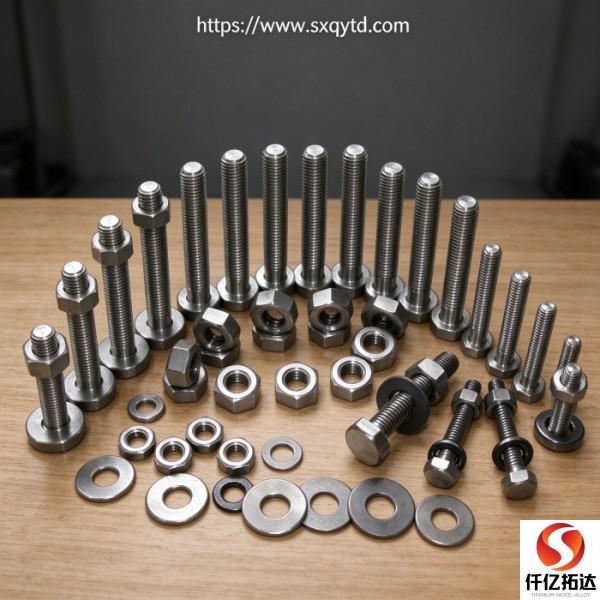
Data note and attribution: the 5–15× price multiple is an approximate industry range, not a quotation or a published survey result. All density and strength figures are published nominal values marked approx. No per-stage cost percentages, tool-life data, scrap rates, machining rates, inventory counts, lead times or test report numbers are given, and none are claimed. The six media in section 9 are qualitative exclusions from published corrosion guidance; no concentration or temperature limits are given and verification against isocorrosion data and coupon testing for the exact service is required. Reviewed and maintained by the Engineering Team, Shaanxi Qianyi Tuoda Technology Co., Ltd., Baoji, China.
Tell us your requirement — grade, size and quantity. We reply within 24 hours.
Prefer chat? WhatsApp +86 188 2967 9311 or email [email protected].


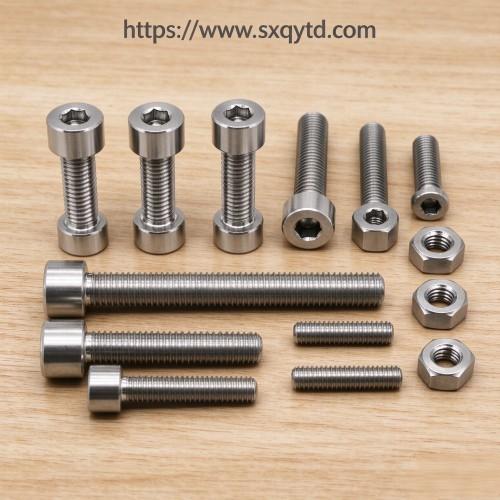
- Titanium Price Today (9 Nov 2026): Plate, Tube, Rod & Wire
- What is Titanium Flange | ASME B16.5 ASTM B381 Gr2 Gr5 Titanium Flan
- ASME B16.5 Titanium Flange Grade2 DN100-DN600 Class150/300 FOB
- Gr2 Titanium Sheet Price FOB Shanghai | ASTM B265 In Stock
- Titanium Price Today (Oct 26, 2026): China Market Report
Contact Person: Wang Xiaoning
Tel: +86-917-355-7966
Email: [email protected]
WhatsApp: +86 188 2967 9311
Company: Shaanxi Qianyi Tuoda Technology Co., Ltd
Address: Floor 4, Building 4, No. 188 Gaoxin Avenue, High-tech Zone, Baoji City, Shaanxi Province, China