ASTM B381 Titanium Forgings & Flanges: F-Grades, Ring Rolling & RFQ Guide
ASTM B381 Titanium Forgings & Flanges: F-Grades, Ring Rolling, Flange Blanks & Procurement Guide

Table of Contents
- 1. What Is ASTM B381?
- 2. F-Grades: F-1/F-2/F-5/F-7/F-12 vs Gr.2/Gr.5
- 3. Forging Forms: Flange Blank, Ring, Disc, Block, Shaft
- 4. Open-Die, Closed-Die & Ring Rolling
- 5. Why Forged Flanges Beat Bar-Machined Flanges
- 6. Annealed, STA, Stress-Relieved
- 7. UT, PT, Grain-Flow & Dimensional Inspection
- 8. How to Write an ASTM B381 Forging RFQ
- 9. Forging Procurement Mistakes
- 10. Our Forging → Flange → Machining Chain
- 11. FAQs
- 12. Related Standards
1. What Is ASTM B381?
ASTM B381 is the standard specification for titanium and titanium alloy forgings. It covers annealed forgings in many grades — flanges, rings, discs, blocks, shafts, valve bodies, and custom pressure-part shapes. The ASME version is SB-381, used for code-stamped pressure equipment. [4](@ref)
A forging is not “a bar with a fancy shape”. The whole point of B381 is controlled hot deformation: the cast structure of the ingot/billet is broken down, the grain flow follows the part contour, and internal soundness improves versus saw-cut plate or machined bar.
B348 = bar/billet mill product.
B265 = plate/sheet/strip.
B381 = shaped, hot-worked part with directional grain flow.
2. F-Grades: F-1/F-2/F-5/F-7/F-12 vs Gr.2/Gr.5
ASTM B381 uses F-prefix grades (F-1, F-2, F-5, F-7, F-9, F-12…). Chemically they map to the familiar mill grades, but the mechanical basis comes from the forging or its prolongation, not from bar stock.
| B381 Grade | Equivalent mill grade | Why specify | Typical forging |
|---|---|---|---|
| F-1 / F-2 | Gr.1 / Gr.2 CP Ti | Corrosion resistance, weldability | WN flanges, blind flanges, valve bodies, seawater fittings |
| F-5 | Gr.5 Ti-6Al-4V | High strength, fatigue resistance | Aerospace brackets, landing-gear parts, high-stress hubs |
| F-7 | Gr.7 Ti-Pd | Reducing-acid / crevice corrosion resistance | Chemical-plant flanges, acid-service valve bodies |
| F-9 | Gr.9 Ti-3Al-2.5V | Medium strength + formability | Aerospace hydraulic fittings, light structural forgings |
| F-12 | Gr.12 Ti-0.3Mo-0.8Ni | Hot chloride / FGD service | Geothermal flanges, scrubber nozzles |
| F-23 | Gr.23 Ti-6Al-4V ELI | Medical implant toughness | Orthopedic implant forgings, surgical instrument bodies |
On a PO, writeASTM B381 F-2for the forging — not just “Gr.2”. If the customer means “Gr.2 chemistry”, fine; but forging inspection, reduction ratio, and test-coupon location are B381 matters. [1](@ref)
3. Forging Forms: Flange Blank, Ring, Disc, Block, Shaft
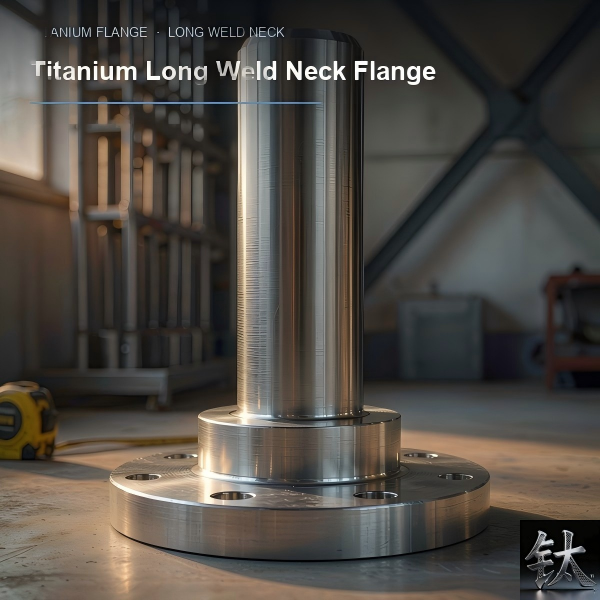
- Flange blank / flange forgings: WN, blind, slip-on, lap-joint, socket-weld blanks; later CNC-machined to ASME B16.5
- Seamless rolled ring: bearing housings, structural rings, gear blanks, large WN hubs
- Disc forging: turbine discs, tube-sheet blanks, thick round blocks
- Block forging: pump bodies, valve chambers, machined structural blocks
- Shaft forging: rotor shafts, actuator rods, high-fatigue cylindrical parts
- Custom die forging: valve bonnets, subsea connectors, aerospace brackets
Typical capability: forged rounds φ40–φ3000 mm, blocks up to ~1500 mm wide, single forgings from a few kg to several tonnes depending on press capacity. [2,5](@ref)
4. Open-Die, Closed-Die & Ring Rolling
| Process | Best for | Pros | Cons |
|---|---|---|---|
| Open-die forging | Blocks, discs, shafts, low-volume blanks | Flexible, large sizes, low tooling cost | More machining allowance |
| Closed-die forging | Repeatable aerospace / valve shapes | Near-net shape, less scrap | Die cost, MOQ |
| Ring rolling | Flanges, seamless rings, WN hubs | Grain follows circumference, good fatigue | Limited to ring-like geometry |
For a large weld-neck flange hub, a ring-rolled or open-die preform + CNC finish usually beats a plate-cut disc: the grain flow around the bore reduces radial weakness.
5. Why Forged Flanges Beat Bar-Machined Flanges
- Grain flow: follows the flange contour instead of running straight through like bar
- Fatigue: better in cyclic-load and rotating-equipment service
- Internal soundness: porosity/stringers from cast structure are broken and healed by hot working
- Reduction of area: B381 forgings emphasize RA and directional properties more than plain bar
- Pressure parts: code reviewers prefer forged blanks for flanges, bonnets, and nozzle necks
Small low-pressure flanges can be machined from B348 bar. But for WN flanges, high-pressure classes, subsea, and rotating service, B381 forgings are the right call. [1,7](@ref)
6. Annealed, STA, Stress-Relieved
- Annealed: default for F-2/F-7/F-12; good ductility and corrosion resistance
- Stress-relieved: used after heavy machining to control distortion
- Solution treated + aged (STA): F-5 / F-23 high-strength condition; aerospace often references AMS 4928 / AMS 6931
For chemical/marine flanges, specify annealed. For aerospace Ti-6Al-4V forgings, the PO may require STA plus orientation-dependent tensile results.
7. UT, PT, Grain-Flow & Dimensional Inspection
- UT: internal soundness for rings/discs/large flanges; acceptance class must be stated — “100% UT” without criteria is not enough [6](@ref)
- PT: surface-breaking defects after rough/finish machining, not on heavy scale
- VT: 100% visual, no laps, cracks, folds, iron contamination
- Grain-flow / macroetch: for critical aerospace or directional-load parts
- Tensile: UTS, YS, elongation, sometimes reduction of area
- Hardness: supporting check, not a substitute for tensile/UT
- Certificate: EN 10204 3.1; 3.2 with TPI; heat/nozzle/lot traceability
UT is not automatic under B381. If you need it, the PO must name the procedure, coverage, calibration, and acceptance level. [6](@ref)
8. How to Write an ASTM B381 Forging RFQ
Weak: "Titanium flange 4 inch Gr2"
Strong: ASTM B381 F-2 forged WN flange blank, 4" 150# class envelope, OD 152 mm × hub length 90 mm, annealed, open-die preform + CNC finish to ASME B16.5, machining allowance 6 mm, UT per ASTM B594/AMS 2631 acceptance class A, PT after machining, EN 10204 3.1, heat no. on forging
Must specify:
- Standard: ASTM B381 / ASME SB-381 + edition
- Grade: F-2 / F-5 / F-7 / F-9 / F-12 / F-23
- Form: flange blank, ring, disc, block, shaft, custom die
- Forged dims + finished dims + machining allowance
- Process: open-die / closed-die / ring-rolled
- Condition: annealed / STA / stress-relieved
- Surface: as-forged / pickled / rough-machined / finish-machined
- NDE: UT procedure + class, PT timing, VT
- Test coupon: location, orientation, represented lot
- Marking + MTC: heat no., lot no., PO no.
9. Forging Procurement Mistakes
| Mistake | Result | Fix |
|---|---|---|
| “Gr.2 forging” with no F-grade | Inspector argues bar vs forging basis | Write ASTM B381 F-2 |
| Only finished dimensions given | Supplier can’t quote forging envelope/allowance | Give forged size + finished drawing + allowance |
| “100% UT” with no acceptance class | Disputes on indications | Name ASTM B594 / AMS 2631 / MIL-STD-2154 class |
| Plate-cut ring sold as forged ring | Wrong grain flow for rotating/pressure service | State open-die/ring-rolled explicitly |
| No heat/lot link after machining | Traceability breaks at QC gate | Re-stamp heat no. on each machined piece |
10. Our Forging → Flange → Machining Chain
- ASTM B381 / SB-381 F-2, F-5, F-7, F-9, F-12, F-23
- Open-die, closed-die, ring rolling; flange blanks & seamless rings
- From billet (B348) to forged blank to CNC-finished flange
- Finish to ASME B16.5 / B16.47 dimensions and facing
- UT per ASTM B594 / AMS 2631, PT after machining, 100% VT
- Annealed / stress-relieved / STA for Ti-6Al-4V
- Weld neck, blind, slip-on, lap-joint, socket-weld, custom nozzles
- Anti-mix control: titanium-only area, no carbon-steel grit
- Laser/dot-peen mark: grade + heat no. + PO + item no.
- EN 10204 3.1 / 3.2, dimensional report, heat-treat record
We don’t just forge titanium — we deliver machined, inspected, code-ready flange assemblies.
11. FAQs
Q: Is ASTM B381 F-2 the same as Gr.2?
Chemically yes, procedurally no. F-2 is the forging grade; Gr.2 is the mill-product grade. Forgings add grain-flow, reduction-ratio, and test-coupon rules.
Q: Do all titanium forgings need UT?
No. UT is specified by service criticality, size, code, or customer PO. “UT” without procedure and acceptance class is not a complete requirement. [6](@ref)
Q: Can a flange be machined from bar instead of forged?
Yes for small/low-pressure flanges. For WN flanges, high-pressure classes, and fatigue/subsea service, forged blanks are preferred.
Q: What’s better for a big WN flange — plate cut or ring rolled?
Ring-rolled/open-die forged: grain follows the ring, better fatigue and pressure performance. Plate-cut is cheaper but retains plate rolling structure.
Q: Can F-5 forgings be solution treated and aged?
Yes. Ti-6Al-4V forgings are often supplied STA for aerospace; commercial F-2/F-7 flanges are normally annealed.
12. Related Standards
Request ASTM B381 Titanium Forging / Flange Quote
Send us:
- Standard + grade (ASTM B381 F-2 / F-5 / F-7 / F-12)
- Forging form (flange blank / ring / disc / block / shaft)
- Forged dims + finished drawing + machining allowance
- Process (open-die / closed-die / ring-rolled)
- Condition (annealed / STA / stress-relieved)
- NDE + certificate (UT class, PT, 3.1 / 3.2)
We reply within 4 business hours with forging route, inspection plan, and lead time.
- Read titanium wire and titanium alloy wire: diameter classification
- Titanium wire: from brand selection to manufacturing process (2026 r
- Read titanium tube and titanium alloy tube: OD classification + comm
- Titanium pipe knowledge·tee + reducer selection 5 steps
- TA series vs TC series comparison: pure titanium vs titanium alloy s
Contact Person: Wang Xiaoning
Tel: +86-917-355-7966
Email: sales@sxqytd.com
WhatsApp: +86 188 2967 9311
Company: Shaanxi Qianyi Tuoda Technology Co., Ltd
Address: Floor 4, Building 4, No. 188 Gaoxin Avenue, High-tech Zone, Baoji City, Shaanxi Province, China