ASME B16.5 & B16.47 Titanium Flanges: WN, RF/RTJ, Class 150–2500, Series A/B
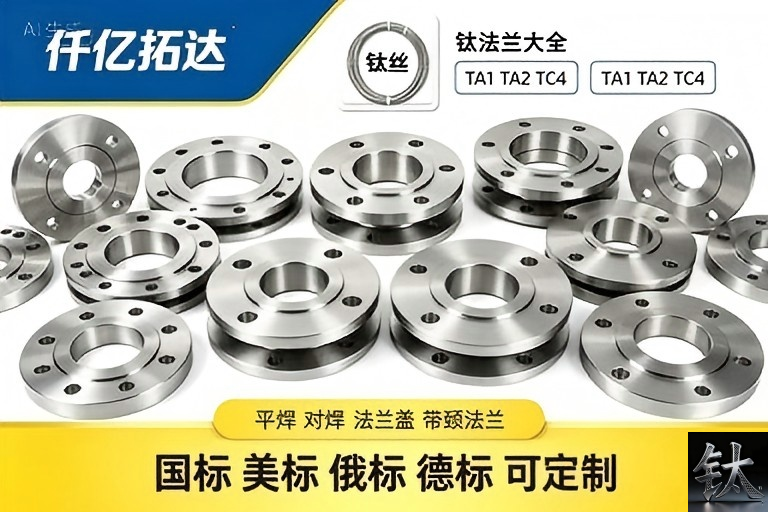
ASME B16.5 & B16.47 Titanium Flanges: Weld Neck, Slip-On, Blind, RF/RTJ, Class 150–2500 & Series A/B

Table of Contents
- 1. B16.5/B16.47 vs ASTM B381: Who Does What
- 2. ASME B16.5: NPS 1/2–24
- 3. Flange Types: WN, SO, Blind, Lap-Joint, Threaded, LWN
- 4. Faces: RF, FF, RTJ, Tongue & Groove
- 5. Class 150 / 300 / 600 / 900 / 1500 / 2500
- 6. Bore & Schedule Matching
- 7. ASME B16.47: NPS 26–60, Series A vs Series B
- 8. Machining Titanium Flanges Without Galling
- 9. How to Write a Titanium Flange RFQ
- 10. Flange Procurement Mistakes
- 11. Our Titanium Flange Capability
- 12. FAQs
- 13. Related Standards
1. B16.5 / B16.47 vs ASTM B381: Who Does What
| Standard | Controls | Does NOT control |
|---|---|---|
| ASTM B381 / SB-381 | Forging material, grade, chemistry, mechanicals | Bolt-hole circle, facing dimensions |
| ASME B16.5 | Flange dimensions, facings, bolt holes, Class 150–2500, NPS 1/2–24 | Titanium chemistry |
| ASME B16.47 | Large flanges NPS 26–60, Series A / Series B | Forging metallurgy |
A correct PO reads like this:Flange forged to ASTM B381 F-2, machined to ASME B16.5 Class 150 WN RF, NPS 4", Sch 10S, annealed, pickled.
2. ASME B16.5: NPS 1/2–24
- Size range: NPS 1/2" to 24" (DN 15 to DN 600)
- Classes: 150, 300, 400, 600, 900, 1500, 2500
- Face types: RF, FF, RTJ, T&G, male-female
- Flange types: WN, SO, BL, LJ, SW, TH, LWN
- Material: titanium forgings per B381; bar-machined only for low-risk small SO flanges
For titanium chemical/marine lines, Class 150 RF Sch 10S and Class 300 RF Sch 10S/40S are the most common. [4](@ref)
3. Flange Types: WN, SO, Blind, Lap-Joint, Threaded, LWN
| Type | Code | Joint | When to use in titanium |
|---|---|---|---|
| Weld Neck | WN | Full-penetration butt weld | High pressure, thermal cycling, fatigue, seawater pumps |
| Slip-On | SO | Two fillet welds | Low-pressure, low-cost, easy alignment |
| Blind | BL | Bolted closure | Vessel nozzles, line ends, spectacle blinds |
| Lap-Joint | LJ | Float on stub end | Frequent dismantling: pharma, food, CIP lines |
| Socket-Weld | SW | Single fillet | Small NPS instrument lines; galling risk if over-torqued |
| Threaded | TH | No weld | Instrument connections; titanium threads gall easily |
| Long Weld Neck | LWN | Nozzle extension | Reactor / exchanger nozzles |
4. Faces: RF, FF, RTJ, Tongue & Groove
- Raised Face (RF): default; pairs with spiral-wound / sheet gaskets
- Flat Face (FF): full-face gaskets; used against cast iron / FRP equipment
- Ring Type Joint (RTJ): metal ring gasket, Class 600+ and hydrocarbon service; B16.47 Series A supports RTJ, Series B does not [3,6](@ref)
- Tongue & Groove / Male-Female: confined gasket, less common in titanium process lines
Titanium is soft and work-hardens. RF finish must be clean, scratch-free, and free of embedded iron. A scratched titanium RF face is a future leak path.
5. Class 150 / 300 / 600 / 900 / 1500 / 2500
ASME “Class” is not the same as pressure in bar/psi. The allowable pressure depends on material and temperature. For titanium:
- Class 150: low-pressure seawater, brine, utility lines
- Class 300: chemical process, heat exchanger nozzles
- Class 600: higher-pressure reactors, pumps, compressors
- Class 900–2500: high-pressure hydrocarbon / aerospace ground support
Always read the project pressure-temperature rating table for the actual titanium grade, not carbon-steel A105 numbers.
6. Bore & Schedule Matching
- WN flange bore should match pipe ID/OD and schedule (Sch 5S / 10S / 40S / 80S)
- Don’t put a Sch 10S bore on Sch 80S pipe — you create a step and turbulence/erosion
- Stub end + lap-joint flange: stub end wall matches pipe; flange bore is oversized
- For B363 fittings: flange bore, pipe wall, and fitting wall must be in the same schedule family
7. ASME B16.47: NPS 26–60, Series A vs Series B
Above NPS 24, ASME B16.5 stops and B16.47 takes over for weld neck and blind flanges NPS 26–60. [6](@ref)
| Feature | Series A (MSS SP-44) | Series B (API 605) |
|---|---|---|
| Outside diameter | Larger | Smaller |
| Bolting | Fewer, larger bolts | More, smaller bolts |
| Weight | Heavier | Lighter |
| External load capacity | Higher | Lower |
| RTJ face | Supported (Class 300–900) | Not covered |
| Class 75 | No | Yes |
| Typical use | New build, high external load | Retrofit, weight/cost saving |
Series A and Series B are not interchangeable. Same NPS/Class can have different OD, bolt circle, and bolt count. [3,8](@ref)
8. Machining Titanium Flanges Without Galling
- Sharp carbide tooling, low speed, positive rake, flood coolant
- No carbon-steel chips in the titanium machining area
- Chamfer/bevel per WPS; protect RF/RTJ face after cutting
- Deburr without smearing iron; chloride-free cleaning only
- PMI / XRF to confirm grade before marking
- Permanent mark: grade + NPS + class + facing + heat no. + PO
9. How to Write a Titanium Flange RFQ
Weak: "Titanium flange 4 inch 150 lb"
Strong: Flange forged to ASTM B381 F-2, machined to ASME B16.5 Class 300 Weld Neck RF, NPS 4", bore Sch 10S, annealed, pickled, PT after machining, EN 10204 3.1, heat no. on hub
Must specify:
- Material standard: ASTM B381 F-2 / F-5 / F-7 / F-12
- Dimensional standard: ASME B16.5 or B16.47
- Type: WN / SO / BL / LJ / SW / TH / LWN
- Class: 150 / 300 / 600 / 900 / 1500 / 2500
- Size: NPS + bore schedule
- Face: RF / FF / RTJ / T&G
- Large flange: B16.47 Series A or Series B
- Condition: annealed, pickled, machined face protected
- NDE: PT, UT, PMI, dimensional
- Certificate: 3.1 / 3.2
10. Flange Procurement Mistakes
| Mistake | Consequence | Fix |
|---|---|---|
| “B16.5 Gr.2 flange” with no B381 | Material basis unclear | Add “forged to ASTM B381 F-2” |
| B16.47 Series A vs B wrong | Bolts don’t align at site | State Series A or Series B explicitly |
| RF gasket on RTJ face | Leak / damaged groove | Match gasket type to facing |
| Flange bore not matched to schedule | Erosion, turbulence, crevice | Specify Sch 5S/10S/40S/80S bore |
| Carbon-steel tools used on titanium | Iron contamination, local corrosion | Use dedicated titanium cell |
11. Our Titanium Flange Capability
- Material: ASTM B381 F-2 / F-5 / F-7 / F-9 / F-12 / F-23
- B16.5: NPS 1/2–24, Class 150–2500, WN/SO/BL/LJ/SW/TH/LWN
- B16.47: NPS 26–60, Series A & Series B, WN & Blind
- Faces: RF, FF, RTJ, T&G
- Bore: Sch 5S / 10S / 40S / 80S, custom bores
- Finish: annealed, pickled, face-protected, export packed
- Paired with: B861/B862 pipe, B363 fittings, B863 ERTi filler
- Inspection: PMI/XRF, PT, dimensional, UT on request
- Cert: EN 10204 3.1 / 3.2, TPI (SGS/LR/DNV/TÜV) on request
We deliver bolt-up-ready titanium flanges, not just machined discs.
12. FAQs
Q: Is a titanium flange “B16.5 Gr.2”?
Loosely yes, strictly no. B16.5 is dimensions; Gr.2/F-2 is material. Write “B381 F-2, machined to B16.5”.
Q: Can titanium flanges use carbon-steel bolts?
They can, but galvanic corrosion is a risk in seawater. Use titanium, Hastelloy, or insulated/non-metallic washer sets with proper design.
Q: When do I need RTJ instead of RF?
High-pressure / hydrocarbon / toxic-service lines often use RTJ. For titanium chemical lines, RF + spiral-wound gasket is very common.
Q: What’s the max size in B16.5?
NPS 24". Above that, use ASME B16.47 (NPS 26–60). Above NPS 60, flanges are custom-engineered. [6](@ref)
Q: Are B16.47 Series A and B interchangeable?
No. Different OD, bolt circle, bolt count/size. Never mix them. [3,8](@ref)
13. Related Standards
Request Titanium Flange Quotation
Send us:
- Material: ASTM B381 F-2 / F-5 / F-7 / F-12
- Standard: ASME B16.5 or B16.47 Series A/B
- Type: WN / SO / BL / LJ / SW / TH / LWN
- Class + NPS + bore schedule
- Face: RF / FF / RTJ
- NDE + certificate (PMI, PT, UT, 3.1 / 3.2)
We reply within 4 business hours with dimensional check, facing options, and lead time.
- Read titanium wire and titanium alloy wire: diameter classification
- Titanium wire: from brand selection to manufacturing process (2026 r
- Read titanium tube and titanium alloy tube: OD classification + comm
- Titanium pipe knowledge·tee + reducer selection 5 steps
- TA series vs TC series comparison: pure titanium vs titanium alloy s
Contact Person: Wang Xiaoning
Tel: +86-917-355-7966
Email: sales@sxqytd.com
WhatsApp: +86 188 2967 9311
Company: Shaanxi Qianyi Tuoda Technology Co., Ltd
Address: Floor 4, Building 4, No. 188 Gaoxin Avenue, High-tech Zone, Baoji City, Shaanxi Province, China