Titanium Tube Supplier: Seamless or Welded, Then Specify
Two titanium tube quotes can sit within a few cents per metre of each other and still be completely different products. One is seamless condenser tubing to ASTM B338 with eddy-current testing and a 3.1 certificate; the other is welded tube with no named standard edition, no NDT and an unmarked weld seam. Both carry a price per metre. Only one is a real answer to your duty. The first decision is not the grade or the price — it is whether the tube should be seamless or welded at all. That one choice drives the standard, the testing, the failure risk and the cost more than any other line on the quote. This page gives you the order in which to specify titanium tube — tube type, standard and grade, OD and wall, length and ends, certificate and NDT, then the cut list — so the numbers you get back can actually be compared. We are a Baoji stockist with seamless and welded tube in stock, and we cut to the length you need.
How to use this page. This is a specification-order guide for buyers, not a metallurgy textbook and not a price list. It tells you what to decide before you ask for a number, and what to write so two suppliers answer the same question. It does not publish fixed pressure or velocity limits: those depend on the current standard, the design code and your actual duty, so confirm them with the standard text and your design authority. The seamless-versus-welded engineering detail is covered in a linked guide; this page focuses on the buying sequence.
The short answer: decide the tube type before you ask for the price
A titanium tube quote is only comparable when both suppliers are answering the same specification. The first line to fix is the tube type. Seamless and welded tube can share a grade and an outside diameter and still be different products with different standards, tests and failure behaviour. Ask for a price before you decide which one your duty needs, and you will get a set of numbers that look close and cannot be ranked.
The order matters. Tube type and standard define what the product is; grade and dimensions define what it can take; length and ends define how it fits; certificate and NDT define what you can prove; the cut list defines what you actually install. Skip an early step and every later quote inherits the gap. This is the tube-level companion to the Buy Titanium buyer hub.
The “price per metre” trap on titanium tube
Price per metre is the last thing you should look at. Two quotes for Grade 2 tubing can differ because one is seamless and the other welded, because one carries eddy-current testing and a heat number and the other does not, or because one tolerance class allows more wall variation. None of that appears in the per-metre number. A low quote on an undefined tube is not a bargain; it is a set of decisions deferred to later, usually against you.
Our why titanium quotes differ per kg guide breaks down the cost variables in detail. This page does something different: it gives you the order in which to fix them so that when you do compare per metre, the comparison is real.
Seamless or welded: the decision that drives everything else
This is the highest-value question on a tube RFQ and the one buyers most often leave open. The seamless vs welded selection guide carries the full engineering comparison; here is the buying logic. Get this line wrong and no amount of price negotiation helps, because you will be comparing two different products.
Where seamless earns its premium
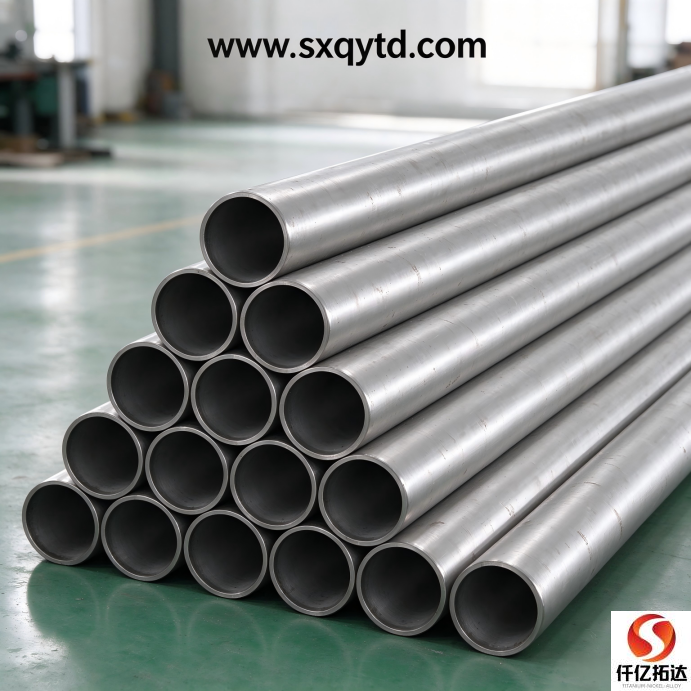
A seamless tube is formed from solid billet by extrusion and cold rolling or drawing, with no longitudinal weld. That is why it is the default for condenser and heat-exchanger tube bundles, high-pressure and cyclic service, and any line where one tube failure forces an unplanned shutdown. Under ASTM B338 seamless condenser tube is the common specification; seamless pipe for industrial duty falls under ASTM B861. You pay more for the process and the testing, and that premium buys the absence of a weld.
Where welded is the honest, economical answer
Welded tube is made from strip that is formed into a cylinder and seam-welded. It is faster and cheaper, and for lower-pressure, non-critical piping or large diameters it is often the correct call rather than a compromise. Note that ASTM B338 also covers welded exchanger tube, while welded industrial pipe is specified under ASTM B862. The point is to choose it with open eyes and state the weld inspection you require.
Why the weld is not a cosmetic detail
The weld seam is a band of different metallurgical structure where residual stress, grain differences and micro-porosity concentrate. In cyclic pressure or a crevice-prone medium it is the usual first-failure location. That does not make welded tube bad; it means you should specify weld inspection and reserve welded tube for duties where the seam is acceptable. Design authority sets the limit, not a supplier’s reassurance.
Step 1–2: lock the standard and the grade
Name the standard and its edition. For condenser and heat-exchanger tube the reference is ASTM B338 with the year, or ASME SB338 when the work sits under an ASME code. Industrial seamless pipe uses B861 and welded pipe uses B862. A quote that says only “titanium tube” without a standard has left the most important line undefined.
Then fix the grade. Grade 2 commercially pure titanium is the general choice for seawater and oxidising media and the most common tube grade. Grade 1 is more formable for tight bends; Grade 12 tube and Grade 7 are chosen where crevice corrosion at tube sheets is the real risk; Grade 5 is for strength. Do not select a grade by price. Our Grade 2 vs Grade 5 guide and ASTM / GB / EN equivalence guide show where an apparent equivalent is not interchangeable. Gr3 and Gr2 are often confused; if the drawing names one, supply that one and confirm on the certificate.
Step 3: outside diameter, wall and tolerance
Outside diameter and wall thickness are obvious; tolerance is not. Heat-exchanger tube is commonly specified to a tight OD and wall tolerance because it must fit a tube sheet and roll correctly. A looser tolerance can mean a tube that will not seal, and a tighter one than the part needs simply raises cost. State the tolerance you actually inspect against. Use the tube weight calculator to check the mass line on any quote before you commit.
Step 4: length, ends and U-bends
Declare the length condition: random mill length, a fixed cut length, or finished pieces. Then state the end finish — plain cut, deburred, or bevelled for welding. Condenser work often calls for U-bent tube; bending is a separate operation with its own radius, ovality and thinning limits, so price and specify it separately rather than assuming it comes with the tube. Our cut-to-length tubing page shows how finished lengths are handled from stock.
Step 5: certificate and NDT — tube is tested before it ships
Ask for EN 10204 3.1 naming the producer, the heat number, the grade, the specification and edition, and the chemistry and mechanical results. For heat-exchanger tube, add the inspection scope to the RFQ: eddy-current testing and a hydrostatic test are common requirements, and welded tube should state the weld examination. The EN 10204 3.1 certificate guide sets out which fields must be present. The traceability and PMI guide explains what a certificate proves and where PMI adds value on receipt. For receiving checks, the tube receiving-inspection guide is a usable template.
Step 6: send the cut list, not a generic request for tube
Most buyers need lengths and pieces, not full sticks. Send the finished lengths, the quantity of each and the end condition, and ask how the heat number follows the cut pieces. A stockist that cuts in house can price the finished lengths and keep the certificate tied to what you receive. If you are still deciding tube type, send both a seamless and a welded option with the same dimensions so you can see what the premium actually buys.
Limits and failure conditions: where a tube quote goes wrong
Eight situations decide the outcome before the price does. Check them against your duty and do not let an undefined quote carry the risk. These are the conditions that turn a good-looking tube into a failure in service.
Dry chlorine and hot chloride crevices
Titanium is excellent in wet chlorine and seawater but must not be used in dry chlorine, and hot chloride crevices at tube sheets can initiate crevice corrosion. If the medium or temperature puts you near that boundary, raise it with the design authority and consider Gr7 or Gr12. Confirm the service before you pick the grade.
Hydrofluoric acid and hot reducing acids
Titanium tube fails in hydrofluoric acid and in strong hot reducing acids. No supplier and no grade makes it suitable there. If your process includes these media, the answer is a different material, not a better tube quote.
The weld as the first-failure site
On welded tube under cyclic pressure or in a crevice-prone medium, the seam is where residual stress and porosity concentrate. If the duty is cyclic or critical, either specify seamless or state the weld inspection you require. Do not let a supplier substitute welded for seamless silently.
Erosion-corrosion from excessive velocity
High flow velocity thins the tube wall over time, especially where the feed carries solids. The allowable velocity is a design question tied to the medium and temperature; get it from the design basis rather than a rule of thumb, and confirm the wall tolerance you ordered.
Vibration and tube-bundle fretting
Tubes that are not adequately supported can fret at the baffles and leak. This is a bundle-design and installation issue, not a material defect, but it is worth asking whether the tube tolerance and straightness suit your support spacing. A supplier who understands exchangers will ask about the bundle.
Grade confusion between Gr2, Gr3 and Gr7
Grade 3 has higher strength and different interstitial limits from Grade 2, and Grade 7 adds palladium for crevice resistance. Substituting one for another changes performance. Name the grade and UNS number and verify it on the certificate; a catalogue description is not enough.
Certificate with no heat or no test values
A document that only says the tube meets ASTM B338, without a producer, heat number or test results, is not a usable certificate. Ask for a recent sample before you order and cross-check the fields against the certificate guide.
Heat number lost after cutting
Once certified tube is cut to length, the identity must follow the pieces. If your supplier cannot tell you how the heat number is documented on each length, traceability ends at the saw. See the heat-number transfer guide for the chain.
Comparison table: what to normalise before you rank quotes
Copy this into a spreadsheet and fill one column per supplier. Until every row matches, a lower total is not a cheaper tube.
| Line | What to write on the RFQ | What a vague answer hides |
|---|---|---|
| Tube type | Seamless or welded, stated | A weld where you needed none |
| Standard and edition | ASTM B338-2022 or SB338 | Loosener tolerance or wrong test scope |
| Grade and UNS | Gr2 R50400, Gr7 R52400 | Grade 3 or 7 substituted silently |
| OD, wall, tolerance | OD × wall, named tolerance | A tube that will not roll into the sheet |
| Length and ends | Cut length, plain / bevelled / U-bend | Bending and bevels excluded |
| Certificate and NDT | 3.1, eddy current, hydrotest, PMI | Untested or untraceable tube |
| Trade term and port | FOB Ningbo, Incoterms 2020 | Freight and risk moved to you |
| Payment and inspection | Terms, hold points, third party | Cost deferred to later steps |
The supply-model guide explains who signs the certificate and who owns the stock behind each answer. Read the two together: this page fixes what to ask, that page fixes who is qualified to answer. The plate specification page applies the same sequence to flat product.
Where the price actually moves: a short reality check
Once the specification is fixed, the remaining differences are real and explainable: seamless versus welded process, yield from the size and length you ordered, testing and certification, quantity and setup, and freight and documentation to your port. A supplier who can explain those lines will also tell you when a stock length is cheaper than a mill order and when your quantity is below a sensible minimum.
We hold seamless and welded titanium tube in common grades and sizes in Baoji; see the buyer hub for the wider product map and our buy-from-China guide for the cross-border schedule. For sizes on the shelf the answer starts from a cut list and a dispatch date, not a rolling plan.
A ten-line RFQ you can send today
Send this to three suppliers. Ask each to answer line by line, not with a single number.
| # | Line | Example answer |
|---|---|---|
| 1 | Tube type | Seamless, condenser tube |
| 2 | Standard and edition | ASTM B338 |
| 3 | Grade and UNS | Gr2, R50400 |
| 4 | OD and wall | 25 mm × 0.7 mm |
| 5 | Length and ends | 6000 mm, plain cut, deburred |
| 6 | Bending | U-bend to stated radius, if any |
| 7 | Certificate | EN 10204 3.1 with heat number |
| 8 | NDT and test | Eddy current, hydrotest, PMI if needed |
| 9 | Quantity and destination | 2 t, FOB Ningbo, Incoterms 2020 |
| 10 | Delivery target | Stock dispatch date or mill schedule |
Send yours to our inquiry page and we will answer the same ten lines for your grade and size, with a stock position and a quote.
Choose seamless / choose welded / choose stock cut length
Choose seamless if the duty is a heat-exchanger bundle, high pressure, cyclic loading, or any line where one tube failure stops the plant. Accept the premium and specify the testing that goes with it.
Choose welded if the duty is lower-pressure, non-critical piping or a large diameter where the seam is acceptable, and you want the cost and lead-time advantage. State the weld examination you require.
Choose a mill lot if the order names a specific melt route, a code stamp, a certified full heat or a tonnage beyond any holding. Accept the longer schedule and check the certificate at receipt.
Why source this from us
We are a Baoji stockist and light fabricator, not a melting mill, and we say so. We hold seamless and welded titanium tube, cut to your lengths, carry the heat number to each piece and export with the documents a buyer needs. We read ASTM, ASME and GB drawings and will tell you when a requirement needs a mill rather than a stock heat. Our Grade 12 tube page and receiving-inspection guide show the detail behind that claim.
Send the ten-line RFQ to our inquiry page. You will get the specification answered line by line, a stock position and a quote within 24 hours.
Summary: tube type first, specification second, price last
A titanium tube quote is comparable only after six things are fixed: tube type, standard and grade, OD and wall with tolerance, length and ends, certificate with NDT, and the cut list. Decide seamless or welded from the duty first, because that choice drives the rest. Lock the six in order and a per-metre number finally means something. Send the same ten-line RFQ to three suppliers, answer every line, and choose on the offer rather than on the guess.
FAQ
Should I buy seamless or welded titanium tube?
It depends on the duty, not on which is cheaper. A seamless tube has no longitudinal weld, so it is the default for heat exchanger tube bundles, high-pressure or cyclic service, and any line where one tube failure means an unplanned shutdown. Welded tube is made from strip that is formed and seam-welded; it is economical and fast for lower-pressure, non-critical piping and large diameters. The weld is a metallurgical discontinuity where residual stress and micro-porosity concentrate, so it is the usual starting point for fatigue or crevice attack. Confirm the choice against the design code and your medium; our selection guide compares the two in detail.
What is the difference between ASTM B338, B861 and B862?
ASTM B338 covers seamless and welded titanium and titanium alloy tube for condensers and heat exchangers, and it is the reference most heat-exchanger data sheets cite. ASTM B861 covers seamless titanium and titanium alloy pipe, generally for higher-pressure industrial piping. ASTM B862 covers welded titanium and titanium alloy pipe. Naming the right standard for the product form matters because each carries different tolerances and test requirements. Always state the standard and its edition year on the RFQ when your specification names one.
Which titanium grade should I specify for condenser tubing?
Grade 2 commercially pure titanium is the general default for seawater and oxidising media and is the most common condenser and heat-exchanger tube grade. Grade 1 is more formable when tight bending is needed. Grade 7 and Grade 12 earn their premium where crevice corrosion is the real risk, such as hot chloride or reducing conditions at tube-to-tubesheet joints. Grade 5 alloy is chosen for strength, not for universal corrosion resistance. Pick the grade from the medium and temperature, then check the equivalent designation if your drawing uses GB or EN names.
What inspection should come with titanium heat exchanger tube?
At minimum a mill test certificate with the heat number, chemistry and mechanical results naming the producer, plus a dimensional check. For condenser and heat-exchanger tube, eddy-current testing and a hydrostatic test are common requirements and should be stated on the RFQ. For traceability-critical work add positive material identification on receipt, and note that a handheld instrument confirms the grade family rather than every element. State the inspection in writing before you order, because adding it after production is expensive.
Why do two titanium tube quotes per metre differ so much?
Usually because several lines were not the same: seamless versus welded, the standard and edition, the grade, the outside diameter and wall tolerance, the length and end condition, and the certificate and NDT scope. A lower number often means welded where you needed seamless, a looser tolerance, or no eddy-current test rather than a better supplier. Normalise those lines in writing before you compare. Our price guide explains each cost driver with examples.
Can I order titanium tube cut to length or in small quantities?
Yes. As a stockist we cut tube to your lengths and handle small and one-off quantities without a mill minimum. Send the finished lengths, the quantity of each and the end condition you need — plain cut, bevel for welding, or U-bend — rather than a generic request for tube. U-bending is a separate operation with its own radius and ovality limits, so quote it as such. Ask how the heat number follows the cut pieces so your certificate still describes what you receive.
When should I insist on a direct mill rather than a stockist for tube?
When the purchase order names a requirement a stock cannot satisfy: a specific melt route, aerospace or defense clauses, a code stamp, a certified full heat of one size, or a tonnage beyond any holding. A stockist can supply from a qualifying heat, but the certificate and melt route must come from the mill and be checked at receipt. Route contract language such as DFARS to your own contracts team. Our supply-model guide explains which obligations each supplier type can actually sign for.
Контактное лицо: Wang Xiaoning
Телефон: +86-917-355-7966
Эл. почта: [email protected]
WhatsApp: +86 188 2967 9311
Компания: Shaanxi Qianyi Tuoda Technology Co., Ltd
Адрес: Floor 4, Building 4, No. 188 Gaoxin Avenue, High-tech Zone, Baoji City, Shaanxi Province, China