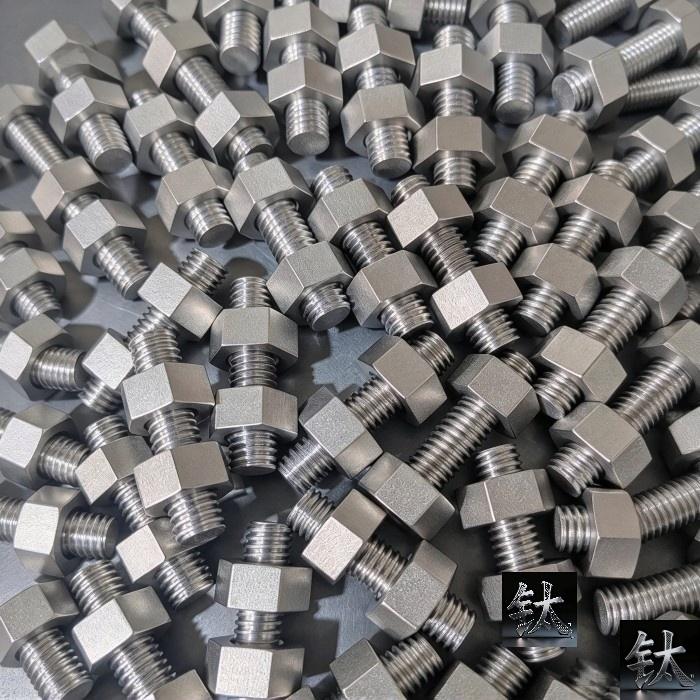
Gr9 vs Gr5 Titanium: Strength, Cold Forming and When to Specify Each
| Specification | Ti-3Al-2.5V / Ti-6Al-4V (UNS R56320 / R56400) |
|---|---|
| Applicable Standard | Gr9 / Gr5 titanium alloy |
| Material Condition | titanium alloy grade selection |
| Inspection & Packaging | ASTM B338 / AMS 4943 / AMS 4928 |
| Reference Price | $100.00 – $200.00 |
Product Description: Gr9 vs Gr5 titanium: Gr5 is 45% stronger (895 vs 620 MPa), but Gr9 cold-bends where Gr5 cracks. Strength, formability, 8 failure modes, when to pick each.
Product Overview
Gr9 vs Gr5 Titanium: Strength, Cold Forming and When to Specify Each
Grade 5 (Ti-6Al-4V) is roughly 45% stronger than Grade 9 (Ti-3Al-2.5V) — 895 vs 620 MPa minimum tensile strength — but that is usually the wrong number to start with. The question that actually decides the order is whether the part has to be bent. Grade 9 cold-forms at room temperature down to a bend radius of about 2–3 times the wall thickness; Grade 5 cracks on the same bender and needs hot forming at 540–650 °C with dedicated tooling. That single manufacturing difference is why aircraft hydraulic lines, bicycle frames and bellows are almost always Grade 9 seamless tube, while airframe fittings, engine hardware and high-load fasteners stay on Grade 5. This guide gives the composition and property numbers, the eight ways each grade is specified into failure, and a short decision rule you can hand to a purchasing or design team.
At a Glance: Gr9 vs Gr5 Specification Snapshot
| Spec | Gr9 (Ti-3Al-2.5V) | Gr5 (Ti-6Al-4V) |
|---|---|---|
| UNS / type | R56320, near-alpha / alpha-beta | R56400, alpha-beta |
| Chemistry | Al 2.5-3.5%, V 2.0-3.0%, O ≤0.15%, Fe ≤0.25% | Al 5.5-6.75%, V 3.5-4.5%, O ≤0.20%, Fe ≤0.40% |
| Tensile / yield (min) | 620 / 483 MPa (annealed) | 895 / 828 MPa (annealed) |
| Elongation | ≥15% (up to 20%) | ≥10% |
| Cold bend radius | 2-3 × wall thickness, room temperature | 4-6 × t, hot forming 540-650 °C |
| Density / modulus | 4.48 g/cm³ / ~107 GPa | 4.43 g/cm³ / ~110-114 GPa |
| Max service temp | ~300-350 °C | ~400-450 °C |
| Main standards | ASTM B338 / B861 / B862, AMS 4943 / 4944 | ASTM B265 / B348 / B381, AMS 4911 / 4928 |
| Typical form | Seamless tube, thin strip, wire, foil | Plate, bar, forging, fastener, wire |
| Default job | Cold-bent hydraulic lines, frames, bellows | Load-bearing structures, hot parts, implants |
What Gr9 Actually Is: The “Half 6-4” Alloy
Grade 9 is Ti-3Al-2.5V, UNS R56320, often called “half 6-4” in the tube trade because its aluminium and vanadium are roughly half of Ti-6Al-4V: Al 2.5–3.5% and V 2.0–3.0%, against 5.5–6.75% and 3.5–4.5% in Grade 5. Interstitials are tighter too (O ≤0.15%, Fe ≤0.25% versus O ≤0.20%, Fe ≤0.40%). It is a near-alpha / alpha-beta alloy with a density of 4.48 g/cm³ and an elastic modulus near 107 GPa. Compared with commercially pure Grade 2 it delivers roughly 20–50% higher tensile strength at room and elevated temperature while staying weldable and, critically, cold-workable to reductions of 75–85%.
That chemistry was not designed to win a strength contest. It was designed to make thin-wall tubing that can be drawn, bent, flared and welded without cracking. So the product form tells you most of the story: Grade 9 lives in aerospace hydraulic and pneumatic tubing, honeycomb foil, bellows, expansion joints and subsea low-temperature hydraulic wire and line; Grade 5 lives in bar and plate stock, forgings, ASTM B381 forged rings and fasteners. If a drawing calls for a 12 mm OD by 0.9 mm wall seamless line with a 90° bend, it is a Grade 9 job before anyone checks a stress calculation.
Grade 5 (Ti-6Al-4V, R56400) is the workhorse alpha-beta alloy: heat-treatable, about 4.43 g/cm³, modulus 110–114 GPa, and the default wherever maximum specific strength is the governing requirement. Our titanium grade overview places both on the same map, and the Gr2 vs Gr5 comparison explains where the commercially pure grades still win on cost and formability.
The “Gr9 Is Just a Weak Gr5” Myth
If you rank titanium alloys by tensile strength alone, Grade 9 always loses, and the conclusion "buy Grade 5 to be safe" looks reasonable. It is also how a lot of tube orders go wrong. Real tube failures in hydraulic and process lines are dominated by forming cracks, weld-seam fatigue, contamination and springback scatter, not by a static load exceeding 620 MPa. Specifying Grade 5 into a bent line adds cost at every step — vacuum melting, hot forming tooling, slower machining, higher scrap — while introducing a material that is harder to bend and less forgiving to weld in thin gauges.
Consider an aircraft hydraulic line at 3,000 psi with a 19 mm OD and a 1 mm wall. Hoop stress is far below the yield of either alloy; what kills the part is a wrinkle on the inside of a tight bend, a heat-affected-zone crack at a fitting, or a batch whose springback varies enough that CNC bend compensation misses the angle. Grade 9 addresses all three: ductility for the bend, low restraint for the weld, and a uniform annealed grain structure that makes over-bend predictable. Grade 5 addresses none of them, because its advantage — strength — was never the constraint.
The mirror-image mistake happens on the structure side. A bracket carrying cyclic load, a landing-gear-adjacent fitting or a part running above 350 °C genuinely needs Grade 5, and substituting Grade 9 to save material cost trades a small saving for a fatigue or creep margin that is not there. This is the same logic we applied in the Gr5 vs Gr23 comparison: a grade is only "better" relative to a stated duty, and the first job is to name the duty.
Strength Numbers: Where the 45% Gap Goes
In the annealed condition, Grade 5 guarantees 895 MPa tensile / 828 MPa yield / 10% elongation. Grade 9 guarantees 620 MPa tensile / 483 MPa yield / 15% elongation, with real annealed stock frequently reaching 620–690 MPa tensile and 15–20% elongation. The gap comes from aluminium solid-solution strengthening and the higher beta-phase fraction that vanadium stabilises; it is a real, certifiable 44–45% difference in tensile and about 70% in yield. Fatigue follows the same direction: roughly 240 MPa endurance at 107 cycles for Grade 5 against about 180 MPa for Grade 9, and fracture toughness in the region of 75 versus 65 MPa√m.
There is a second Grade 9 condition that often gets missed. CWSR (cold worked and stress relieved, AMS 4944) raises the minimums to about 860 MPa tensile / 725 MPa yield / 10% elongation. That closes much of the yield gap while retaining a seamless, cold-finished tube — useful when a hydraulic system needs higher pressure rating but still needs to be bent. The trade is ductility: CWSR tube has less forming room than annealed tube, so tight-radius bends should be done on annealed stock with any strengthening applied afterwards, or the bend geometry relaxed.
Temperature is the third axis. Grade 5 keeps useful strength to roughly 400–450 °C and is the standard answer for engine-adjacent hardware; Grade 9 is generally limited to about 300–350 °C before its strength falls off noticeably. Both are far lighter than steel at 4.4–4.5 g/cm³, so even Grade 9 beats most stainless alternatives on specific strength. Use the Ti-6Al-4V high-strength selection guide when the driver really is load and heat, and this page when the driver is geometry.
The Cold-Bending Trap: Where Gr5 Actually Fails
Grade 9 is designed for cold work. It can be stamped, drawn, roll-formed, spin-formed, hydroformed and bent at room temperature, and it is available as coil, strip, wire and foil down to very thin gauges. Typical minimum bend radius is 2–3 × wall thickness, with moderate springback. Grade 5 cold forming is very limited and prone to cracking: minimum bend radius is roughly 4–6 × t, deep drawing needs heating plus multiple passes with intermediate anneals, and tube bending generally requires forming at 540–650 °C. On a thin-wall rotary draw bender, Grade 5 tends to crack on the outer radius or wrinkle on the inner one.
Springback is the quieter problem. Titanium’s modulus is about half that of steel, so a 90° bend released from the bender springs back several degrees. If the tube’s mechanical properties vary from heat to heat, the CNC over-bend angle cannot be predicted and whole batches end up scrapped. This is why aerospace tube supply is specified with a controlled vacuum anneal and tight property scatter, plus 100% ultrasonic or eddy-current inspection, hydrostatic or pneumatic proof testing and an EN 10204 3.1 MTR with melt chemistry and tensile results. Buying on "Grade 9 to ASTM B338" alone does not buy that consistency; the delivery condition and NDT clause do.
Welded Grade 9 tube exists, but for dynamic, vibrating duty — aircraft lines, racing bicycle frame tubing, subsea umbilicals — seamless cold-pilgered tube is strongly preferred to remove the weld seam as a fatigue initiation site. Our ASTM B338 tube guide and heat-exchanger tube guide cover how to write the seamless, cut-to-length and test clauses into the purchase order.
Corrosion: The Same TiO2 Film, Not a Different One
Both grades are protected by the same self-healing titanium dioxide passive film. In neutral seawater, chloride-bearing cooling water and industrial atmospheres their behaviour is effectively identical: immersion data in 3.5% NaCl at room temperature give corrosion rates below 0.001 mm/year for both, and neither pits or suffers crevice attack at moderate temperature. Neither is a substitute for a palladium-bearing or molybdenum-bearing grade when the environment turns reducing. If your medium is hot concentrated chloride, hydrochloric acid or a reducing organic acid, both grades need help from a different alloy family.
There is a small, frequently overstated difference: Grade 9’s lower aluminium content gives it a slight edge in some reducing-acid and cold-marine corrosion-fatigue tests, while Grade 5 holds its oxide and strength better at elevated temperature in hot corrosive service. In practice these nuances are far smaller than the effect of crevice geometry, stagnant flow, temperature and contaminants. Do not let a supplier use "better corrosion resistance" to justify a grade change; ask instead about the medium, concentration, temperature, chloride level and crevice design.
The hard exclusions are shared and non-negotiable: hydrofluoric acid and fluoride-containing solutions, dry chlorine, fuming nitric acid with low water content, and hot strong reducing acids attack both grades rapidly. For those duties a Grade 7 / Grade 12 titanium, zirconium or nickel alloy is the correct conversation, as set out in the grade selection overview.
Welding, HAZ and Inert Shielding
Both grades weld by GTAW, plasma arc, electron beam or laser under full inert shielding, and both must be protected from oxygen and nitrogen pickup once the metal is hot — roughly above 250–400 °C depending on the specification. The practical difference is tolerance. Grade 9’s lower strength means less restraint and distortion in thin gauges, a less sensitive heat-affected zone, and a much lower risk of HAZ cracking. Grade 5 needs tighter heat-input control, matching ERTi-5 filler and often a post-weld stress-relief anneal to recover ductility; its HAZ is where embrittlement shows up first.
Filler should match the base grade: ERTi-9 / matching Ti-3Al-2.5V wire for Grade 9 assemblies, ERTi-5 Gr5 wire for Grade 5. Qualification for aerospace work follows AWS D17.1 and the relevant AMS specification. A silver to light-straw weld colour is acceptable; blue, grey or white powder means the shielding failed and the joint is contaminated. Any alpha case formed on the surface must be removed by machining or pickling before service, and critical joints are verified by dye penetrant, radiography and hardness rather than colour alone. Our titanium welding wire selection guide and ASTM B863 wire guide cover which wire to buy; our GTAW shielding article covers how to keep that wire clean while welding.
Welding a Grade 9 tube to a Grade 5 fitting is possible with matching filler and a qualified procedure, but it creates a mixed joint whose properties sit between the two and whose HAZ behaviour is dominated by the more sensitive Grade 5 side. Where the design allows, keep the whole wetted assembly on one grade and put any transition at a mechanical joint rather than a weld.
When Gr9 DOES Lose: Heat, Fatigue and Crevices
Three boundaries should stop a Grade 9 substitution. First, high-cycle or high-load structural duty: at roughly 180 MPa endurance against 240 MPa for Grade 5, a rotating or cyclically loaded part sized on Grade 9 has meaningfully less margin. Second, temperature: above roughly 300–350 °C Grade 9 loses strength faster and is not the right answer for engine-adjacent hardware. Third, fracture-critical or implant work: orthopaedic and dental implants are specified to ASTM F136 / ISO 5832-3 using the ELI chemistry of Grade 23, not Grade 9 — a substitution here is a regulatory failure, not an engineering optimisation. Those cases are covered in the Gr5 vs Gr23 guide.
A fourth, more physical limit is shared by both grades: stagnant crevices in hot chloride. Neither Grade 9 nor Grade 5 resists tight lap joints, under-deposit zones or gasket faces in hot concentrated brines once the passive film breaks down locally and the crevice acidifies. Design out the crevice — full-penetration welds instead of lap joints, drainable geometry, flow above stagnation — or move to Grade 7 / Grade 12 for the wetted part. Thin-wall Grade 9 tube makes this worse in one specific way: a 0.7–1.0 mm wall leaves almost no corrosion allowance, so a small local attack becomes a through-wall leak quickly.
Finally, cost is not a universal win for Grade 9. It is cheaper to process as coil or strip and supports continuous cold forming and just-in-time ordering, but a small quantity of non-standard CWSR aerospace tube with full NDT and AMS paperwork can cost more per kilogram than stock Grade 5 bar. Compare landed part cost, not billet price, and include tooling and scrap in the number.
Standards, Mill Cert and Annealed vs CWSR
For Grade 9 the governing tube specifications are ASTM B338 (seamless and welded condenser/heat-exchanger tube), ASTM B861 (seamless pipe), ASTM B862 (welded pipe), ASME SB-338, and the aerospace set AMS 4943 (annealed), AMS 4944 (CWSR), 4945 and 4946. For Grade 5 the usual references are ASTM B265 (plate), B348 (bar), B381 (forgings), AMS 4911 / 4928, and AWS A5.16 for ERTi-5 filler. Our ASTM B338 tube guide explains which standard to name for a given product form.
The MTR is where the order is won or lost. Require EN 10204 3.1 certification with the melt/heat number, full chemistry (Al, V, Fe, O, N, C, H), actual tensile and yield results, flattening and flaring or bend test results, dimensional report, NDT coverage (100% UT or eddy current for seamless tube), hydrostatic or pneumatic test record and the delivery condition. For annealed Grade 9 tube, ask specifically for a controlled vacuum anneal and note any requirement on property scatter if the tube will be CNC bent; this is the clause that makes springback predictable. For CWSR, confirm the strength minimums on the certificate match AMS 4944 and relax the bend geometry accordingly.
A workable specification line looks like this: "Material: Ti-3Al-2.5V Grade 9, UNS R56320, seamless tube to ASTM B338 / AMS 4943, annealed, 19.05 mm OD × 0.9 mm wall × cut 3,000 mm, EN 10204 3.1 MTR, 100% UT, hydrostatic test, O ≤ 0.15%, for CNC-bent aircraft hydraulic line." That one sentence removes the ambiguity that produces most quote discrepancies, and it gives incoming inspection something objective to check.
Limitations and Failure Conditions: Where Each Grade Breaks
Neither alloy fails because it was "the weaker one"; both fail when the duty ignores a boundary. The eight conditions below are organised by medium and shop-floor situation, in the order they show up in real RFQs and rejection reports.
Cold bending thin-wall Gr5 tube
The most common shop-floor failure in this comparison. Grade 5 has very limited cold formability; a tight rotary-draw bend on a 0.9–1.2 mm wall produces outer-radius cracking, inner-radius wrinkling or wall collapse. Minimum cold bend radius is around 4–6 × t and usually requires forming at 540–650 °C. If the drawing shows a 2D bend and no heat treatment note, the material is wrong: move to annealed Grade 9.
High-cycle or high-load structural duty on Gr9
Grade 9’s ~483 MPa yield and ~180 MPa endurance at 107 cycles are adequate for pressure lines, not for landing-gear-adjacent fittings, rotating hardware or heavily loaded brackets. Failures here are fatigue cracks at stress concentrators and bolt holes, often after a long apparently healthy service life. Where load governs, use Grade 5 bar or plate and keep the section sized to the higher allowable.
Service above 350 °C with Gr9
Grade 9 is generally limited to ~300–350 °C. Above that its strength falls off faster than Grade 5’s, and creep and oxidation become the design constraints. A line rerouted near an exhaust or a hot process vessel can quietly cross the boundary. Grade 5 remains useful to ~400–450 °C; beyond that neither grade is the right answer.
Reducing acids and hot concentrated chlorides
Both grades rely on the same TiO2 film, which breaks down in hot HCl, hot concentrated sulphuric acid and reducing organic acid mixtures. Grade 9’s lower aluminium gives a marginal edge in some reducing media, but not enough to design on. Specify Grade 7, Grade 12, zirconium or a suitable nickel alloy instead; see the grade overview.
HF, fluorides, dry chlorine and low-water fuming nitric acid
Hard exclusions for both grades, and for titanium generally. Hydrofluoric acid and fluoride contamination dissolve the passive film faster than it can reform; dry chlorine can react vigorously; fuming nitric acid with insufficient water can cause violent oxidation. Trace fluoride in a cleaning pickle or a contaminated gasket is enough. No grade change fixes this — change the material family or the process chemistry.
Weld contamination, alpha case and HAZ embrittlement
Oxygen, nitrogen and hydrogen absorbed by hot titanium form a hard, brittle alpha case and embrittle the heat-affected zone. Gr5 is the more sensitive of the two; thin-gauge Gr9 is more forgiving but not immune. Silver or light-straw weld colour is the acceptance criterion, blue/grey/white is reject. Use full inert shielding with a trailing shield and back purge below 50 ppm O2, and remove any alpha case by machining or pickling. Our wire guide and the GTAW shielding article cover the procedure.
Stagnant seawater crevices and tight lap joints
Flowing seawater is harmless to both grades; stagnant hot chloride in a crevice is not. Under-deposit zones, gasket faces, tube-to-tubesheet gaps and lap joints acidify locally and break down the passive film. With a 0.7–1.0 mm Grade 9 wall there is essentially no corrosion allowance, so a small crevice becomes a leak. Design for drainage and flow, use full-penetration welds, or select a crevice-resistant grade for the wetted area.
Hydrogen pickup, galvanic couples and thin-wall handling damage
Hydrogen absorbed during pickling, welding or cathodic protection can exceed ~150–200 ppm and cause hydride embrittlement, especially in thin sections. Coupling titanium to a less noble metal in a large-area cathode / small-area anode arrangement accelerates hydrogen charging. Separate from these chemical risks is a mechanical one: thin-wall Grade 9 tube dents and scratches easily, and a dent from handling becomes the initiation site for fatigue or crevice attack. Specify protected packaging and reject visible damage on receipt.
Application Map and How to Specify
Use the duty, not the strength column, to place the order. Grade 9 default work: aircraft hydraulic and pneumatic lines, aerospace ducting and honeycomb, bellows and expansion joints, bicycle frames and sports tubing, subsea low-temperature hydraulic lines, precision thin-gauge components and medical instrument housings. Grade 5 default work: airframe and engine components, high-load fasteners and fittings, downhole and motorsport hardware, hot chemical-process parts, and medical implants via the ELI Grade 23 chemistry. Where the two overlap — a modestly loaded bracket that also needs a bend, or a high-pressure line that must be formed — the manufacturing route usually decides: choose the grade that lets the shop make the part once, correctly, without hot tooling or a rework loop.
On the commercial side, Grade 9 tube is normally ordered as seamless annealed stock with 100% NDT and a 3.1 certificate, then bent and welded in the fabricator's shop. Grade 5 is normally ordered as bar, plate or forging stock for machining. That means the two grades rarely compete on the same line item in a bill of materials; they compete at the design stage, when someone decides whether the part is a tube or a machined solid. Getting that decision right early removes more cost than any negotiation on price per kilogram.
| Duty | Specify | Why |
|---|---|---|
| CNC-bent hydraulic line, thin wall | Gr9 annealed | 2-3t cold bend, predictable springback |
| Higher pressure, same line | Gr9 CWSR (AMS 4944) | Yield ~725 MPa, relax the bend radius |
| Load-bearing bracket, cyclic load | Gr5 | 828 MPa yield, ~240 MPa endurance |
| Part above 350 °C | Gr5 | Useful strength to ~400-450 °C |
| Orthopaedic / dental implant | Gr23 ELI, ASTM F136 | Regulatory requirement, not a strength call |
| Hot reducing acid / HF service | Neither — Gr7 / Gr12 / Zr / Ni alloy | TiO2 film breaks down |
Summary: Choose Gr9 if, Choose Gr5 if
Choose Gr9 (Ti-3Al-2.5V) if:
- The part is a bent or formed tube, especially thin wall and tight radius.
- You need cold forming, spinning, hydroforming or drawing without hot tooling.
- Design loads are within 483 MPa yield and service stays below ~300 °C.
- You want predictable CNC springback from controlled-anneal seamless tube.
- The assembly is thin-gauge and welded, where low restraint reduces HAZ cracking.
Choose Gr5 (Ti-6Al-4V) if:
- Static or cyclic load governs and you need 828 MPa yield or ~240 MPa endurance.
- Service temperature exceeds ~350 °C, or the part sits near engines or hot vessels.
- You are machining bar, plate or forgings rather than bending tube.
- Fracture toughness, hot strength or heat treatment response is the design driver.
- The part is an implant — then go further to ELI Grade 23 / ASTM F136.
Write the duty into the purchase order and the grade follows. A one-line brief — medium, temperature, pressure, geometry, bend radius, delivery condition, standard, MTR and NDT — gets you a real quote instead of a guess, and it is the single biggest lever on both cost and lead time. We hold roughly 800 tonnes of titanium and nickel stock across plate, tube, bar, wire, fittings and fasteners, cut to non-standard sizes, work from customer drawings, certify to ASTM / ASME / GB and ship export orders the same day. Send your brief and we will confirm which grade and delivery condition actually fits. Request a quote →
Frequently Asked Questions
Is Grade 9 titanium stronger than Grade 2?
Yes. Annealed Grade 9 guarantees 620 MPa tensile and 483 MPa yield, against roughly 345 MPa tensile and 275 MPa yield for commercially pure Grade 2 - about 20-50% higher depending on product form and temperature. It keeps most of Grade 2 weldability and cold formability, which is why it is the standard step up for hydraulic lines and frames.
Can I cold-bend Grade 5 titanium tube?
Not reliably. Grade 5 has very limited cold formability; a tight bend on thin wall tends to crack on the outer radius or wrinkle on the inner one. Minimum bend radius is around 4-6 times wall thickness and hot forming at 540-650 °C is normally required. For a cold-bent line, specify annealed Grade 9 instead.
Is Grade 9 really just "half 6-4"?
That is the trade nickname, and it is broadly right on chemistry: Al 2.5-3.5% and V 2.0-3.0% versus 5.5-6.75% and 3.5-4.5% in Ti-6Al-4V. It is not a diluted or off-spec Grade 5 - it is a separate UNS number (R56320) designed for cold work, with its own ASTM and AMS specifications.
Which grade should I use for aircraft hydraulic lines?
Grade 9, as seamless tube to ASTM B338 / AMS 4943 (annealed) or AMS 4944 (CWSR for higher pressure). It cold bends, welds with low HAZ sensitivity and is supplied with 100% UT or eddy-current inspection plus an EN 10204 3.1 MTR. Seamless is preferred over welded for vibrating duty.
Do Gr9 and Gr5 corrode differently in seawater?
Not in any way that should drive the decision. Both rely on the same self-healing TiO2 film and both show corrosion rates below 0.001 mm/year in room-temperature 3.5% NaCl. The real risks are stagnant hot crevices, reducing acids and fluoride contamination, which affect both grades equally.
Can I substitute Grade 9 for Grade 5 to save cost?
Only if the load and temperature case allows it. Grade 9 is usually cheaper to form and machine, but it gives up roughly 45% tensile strength, meaningful fatigue margin and high-temperature capability. Substituting it into a load-bearing, cyclic or hot part is a downgrade; substituting it into a bent line is often an upgrade.
What is CWSR and when do I need it?
CWSR means cold worked and stress relieved (AMS 4944). Cold drawing raises Grade 9 minimums to about 860 MPa tensile / 725 MPa yield, then a light heat treatment relieves residual stress while keeping the strength. Use it for higher-pressure lines, but note elongation drops to about 10%, so tight bends should be made on annealed tube.
Tell us your requirement — grade, size and quantity. We reply within 24 hours.
Prefer chat? WhatsApp +86 188 2967 9311 or email sales@sxqytd.com.


- What is Titanium Flange | ASME B16.5 ASTM B381 Gr2 Gr5 Titanium Flan
- ASME B16.5 Titanium Flange Grade2 DN100-DN600 Class150/300 FOB
- Gr2 Titanium Sheet Price FOB Shanghai | ASTM B265 In Stock
- Titanium Price Today (Oct 26, 2026): China Market Report
- Titanium Price Today (23 Oct 2026): Plate, Tube, Rod & Wire
Contact Person: Wang Xiaoning
Tel: +86-917-355-7966
Email: sales@sxqytd.com
WhatsApp: +86 188 2967 9311
Company: Shaanxi Qianyi Tuoda Technology Co., Ltd
Address: Floor 4, Building 4, No. 188 Gaoxin Avenue, High-tech Zone, Baoji City, Shaanxi Province, China