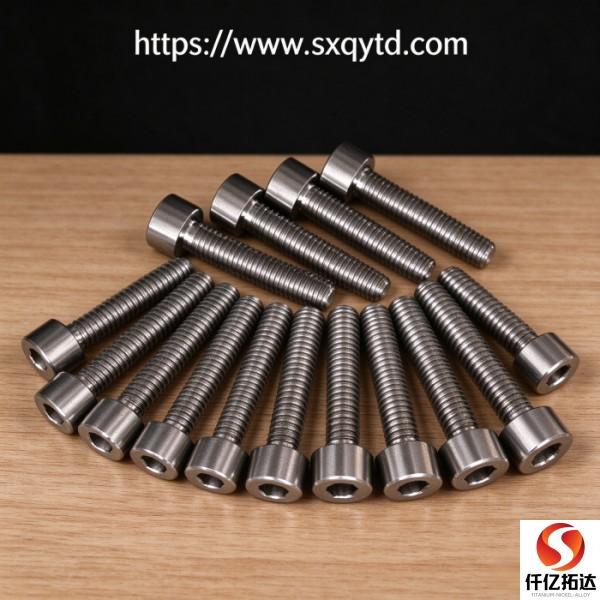
What Is the Difference Between ASTM F467 and F468?
| Specification | External Thread: ASTM F468 / F468M for bolts, screws and studs |
|---|---|
| Applicable Standard | Internal Thread: ASTM F467 / F467M for titanium nuts |
| Material Condition | Kitted Scope: Bolt, matched nut, flat washer, lubrication state and certificate |
| Inspection & Packaging | Matching Rule: Nut strength grade not lower than bolt grade; pairing stated in the PO |
| Reference Price | $5.00 – $100.00 |
Product Description: F467 covers titanium nuts, F468 covers bolts and screws. See the scope of each, matching rules, and how to specify a bolt-nut-washer set
Product Overview
What Is the Difference Between ASTM F467 and F468?
ASTM F468 governs externally threaded Titanium Fasteners — bolts, screws and studs. ASTM F467 governs internally threaded Titanium Fasteners — nuts. F468M and F467M are the metric editions. That is the whole scope difference, and it is the easy half of the answer. The useful half is this: a bolt is not a joint. A purchase order that names F468 but leaves the nut, washer and lubrication state undefined has specified one part out of three, and the assembly will fail at the parts nobody wrote down. The table below is the minimum set of lines a kitted order needs.
| Item | Governing document | What must be stated | Common omission |
|---|---|---|---|
| Bolt / screw / stud | ASTM F468 / F468M | Grade + UNS, diameter, length, pitch, head form, UNR thread | Citing B348 bar instead of the finished-product standard |
| Nut | ASTM F467 / F467M | Grade matched to the bolt; dimensional form (e.g. DIN 934) | "Nut included" with no grade or standard at all |
| Washer | Drawing or dimensional standard (e.g. DIN 125) | Material, dimensions, and isolating function if needed | A carbon-steel washer under a titanium head in a wet joint |
| Lubrication | Assembly procedure | Compound, where applied, and the K used for torque | Torque quoted dry, parts assembled lubricated |
| Documentation | EN 10204 3.1 + PMI + dimensional report | One package per lot, tied to a heat number | Certificate covers the bar only, not the finished set |
| Matching rule | Engineering practice, not a clause of either standard | Nut strength grade not lower than the bolt grade | Soft Gr2 nut on a Gr5 bolt — strips or galls first |
1. The "One Standard" Trap
: F467 Is the Nut, F468 Is the Bolt
If you only remember one line: F468 is the bolt, F467 is the nut. Both are material-and-mechanical specifications for finished Titanium Fasteners, both have a metric M edition, and neither sets head dimensions, torque, certificates or the service medium. Our ASTM F467 titanium nuts page shows the internal-thread side of that split, while the Titanium Fasteners hub indexes the whole product range.
The scope question is already answered in the cluster's main standard-map article, so this page does not repeat that comparison. What buyers actually get wrong is the boundary between the two documents in a single order: the nut gets treated as an accessory rather than a separately specified, separately certified part. That is where a kitted order either works or galls.
2. Why the Nut Is a Separate Specification
A nut has its own chemistry, its own mechanical minimums, its own thread tolerance and its own proof-load test. It is not a bolt with a hole in it. F467 exists because those properties need their own acceptance criteria — a nut that is too soft strips its internal thread before the bolt reaches its rated load, while one that is too hard or mismatched in material can accelerate galling on titanium.
Two consequences for procurement. First, the nut grade should be stated explicitly and should not be lower than the bolt grade; a Grade 5 F468 bolt wants a Grade 5 F467 nut, not a commercially pure one chosen because it was in stock. Second, the nut's dimensional form is a separate citation — DIN 934 for a standard hex nut, or a prevailing-torque / flange form where the design needs it — because F467, like F468, does not govern the shape. Our Gr2 bolts, nuts and washers in M6–M36 page lists the forms we hold against those standards.
3. The "Nut Included" Trap
: Four Mismatches on the Assembly Bench
These are the four errors we see most often when a "complete set" arrives and the parts do not behave as a set. None is a material defect; all four are missing PO lines.
A carbon-steel nut on a titanium bolt
Usually chosen for price or availability. It changes the galvanic relationship, introduces a different thermal expansion and can dominate the galling behaviour. In a wet joint the parent metal becomes the sacrificial side.
A Grade 2 nut on a Grade 5 bolt
The nut strips before the bolt develops its designed clamp. The strength of a bolted joint is the strength of its weakest threaded component, not the number on the bolt head.
A washer with no material specified
A plain steel washer under a titanium head in a chloride environment is a corrosion cell and a crevice at the same time. State the washer material, and where galvanic isolation is needed, state that function too.
Torque quoted dry, parts assembled lubricated
The nut factor K is a property of the assembled pair, not of the bolt alone. Once the nut material, surface finish or compound changes, the torque basis changes. Our F468/F467 torque-boundary guide explains the derivation; the Titanium Fasteners Guide covers the galling mechanism. The fix is to write the lubrication state into the PO and record the K used.
4. Where a Set Earns Its Keep
: How to Order in One PO
Write the three parts as three separate line items under one purchase order, then add the two assembly lines and one documentation line. That single change removes most incoming-inspection disputes, because each part has a grade, a standard and a certificate path.
- Line 1 — Bolt: ASTM F468 (or F468M) Gr5 (R56400), M10 × 60, pitch 1.5, fully threaded DIN 933 form, UNR thread, permanent grade mark.
- Line 2 — Nut: ASTM F467 (or F467M) Gr5, M10 × 1.5, DIN 934 form, matched to Line 1.
- Line 3 — Washer: commercially pure titanium flat washer, DIN 125 form, dimensions per drawing, isolating function stated if required.
- Line 4 — Assembly state: anti-seize compound on threads and under the head, K and target clamp to be stated on the assembly sheet.
- Line 5 — Documentation: EN 10204 3.1 with heat number, PMI on one piece per lot, dimensional report, all covering the finished set rather than the bar alone.
Our Grade 5 bolt, nut and washer sets are kitted on that basis, and the export desk consolidates the certificate package into one shipment. If the geometry is not standard, the drawing becomes the governing document for the washer and the nut form — see non-standard fasteners by drawing.
PO line to copy: "Set = 1 × bolt to ASTM F468 Gr___ (R___) + 1 × nut to ASTM F467 Gr___ (grade not lower than bolt) + 1 × titanium flat washer per drawing; UNR thread; anti-seize on threads and under head; state K and target clamp; EN 10204 3.1 with heat number, PMI one piece per lot, dimensional report; single-use in critical joints."
5. When the Pairing Rules Do Not Save You
A correctly matched F467/F468 set can still be the wrong purchase. These are the service conditions that no standard pairing fixes. No concentration or temperature limits are given; verify against isocorrosion data and coupon testing for your exact medium.
Stagnant hot chloride crevices
Under the head, under the washer and in the thread engagement, a tight crevice can develop an oxygen-depleted acidic cell. Grade 7 or Grade 16 material, or a design that removes the crevice, is the fix; matching grades does not help.
Seawater immersion and galvanic couples
In a wet joint with aluminium or steel structure, titanium is the noble cathodic side and the parent metal is sacrificed. Insulating washers, coatings and area-ratio control belong in the joint design. Our marine-environment screws page covers that hardware.
HF and hot reducing acids
The oxide film fails regardless of how well the nut is matched. This is a grade-exclusion decision made before the standards are cited; see the Grade 7 reducing-acid route.
Cyclic loading and removal for maintenance
Breakaway galling on removal is common on titanium. Where safety or sealing matters, write a single-use clause and plan replacement sets rather than re-use. The standards are silent on reuse.
Non-standard hardware controlled by customer drawing
When the customer drawing defines a special nut form or washer, that drawing overrides the catalogue form. F467 still governs the nut material, but the dimensional and functional requirements come from the drawing — and the drawing must be frozen before cutting.
6. Frequently Asked Questions
Can I use an F468 bolt with a stainless steel nut?
It is physically possible and frequently done, but it changes the galvanic relationship and the galling behaviour. For a wet or chloride joint, state the pairing deliberately, isolate dissimilar metals and confirm the nut grade is not the weakest component. Do not leave it to "nut included".
Does the nut grade have to match the bolt grade exactly?
The usual rule is that the nut's strength grade must not be lower than the bolt's. An exact match is the simplest way to satisfy it. A higher-grade nut is generally acceptable if the material pairing and lubrication are qualified, but a lower-grade nut strips first.
Is F467M the metric version of F467?
Yes, the SI edition carrying the same intent under metric units. Cite the M edition explicitly on a metric drawing so the mill, the inspector and the shop read the same numbers.
What standard governs the washer?
There is no single material standard equivalent to F467 for washers in this context. State the material, the dimensional form (for example DIN 125) and any isolating function in the drawing or PO line, and include it in the certificate package.
Does an F467 nut need its own certificate?
It should be covered by the same lot-based EN 10204 3.1 package and PMI plan as the bolt, with traceability to its own heat. A certificate that covers only the bar stock, or only one component of a three-part set, leaves an audit gap.
7. Summary, Choose X if / Choose Y if, and Request a Quotation
Choose a kitted F467 + F468 set if
- The joint is load-bearing, pressure-containing or installed in a corrosive medium.
- You want the nut grade, washer material and lubrication state fixed before shipping.
- One certificate package and one PMI plan per lot is enough for your audit trail.
- The assembly procedure records the nut factor K and the target clamp.
- Stock sizes and standard forms meet the design.
Choose drawing-controlled non-standard hardware if
- The head, nut form or washer geometry is defined by a customer drawing.
- Galvanic isolation requires a specific insulating washer or barrier.
- The service demands a grade outside the standard stocked range.
- You need a dimensional report against the drawing rather than a catalogue form.
- The joint is single-use and the replacement set must be identical each time.
F468 and F467 split cleanly at the thread: external versus internal. The purchase order should not split at all. Order the bolt, the nut, the washer, the lubrication state and the documentation as one specified set, and the assembly stops being a guessing game.
To request a quotation, send: bolt grade and standard, nut grade and standard, washer material and form, size / length / pitch, head style, lubrication and torque basis, quantity, certificate and PMI requirement, and the service medium. One action, one list.
Send your fastener RFQ or browse the titanium fasteners hub.
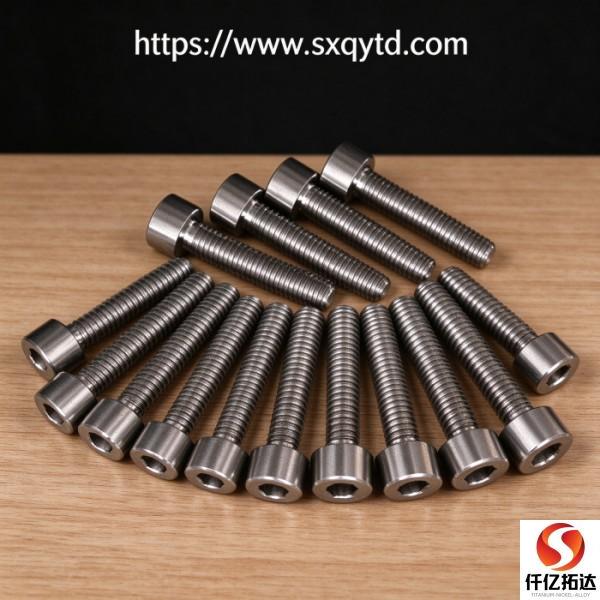
Data note and attribution: standard scopes are described qualitatively from published standard summaries; no clause numbers, proof-load values or tolerance tables are quoted. The nut-matching rule is general engineering practice, not a quoted clause. DIN 934 / DIN 125 are cited as dimensional form examples only, with no dimensions given. Media in section 5 are qualitative exclusions from published corrosion guidance with no concentration or temperature thresholds; verify against isocorrosion data and coupon testing. No third-party certification, inventory count, lead time or test report is claimed. Reviewed and maintained by the Engineering Team, Shaanxi Qianyi Tuoda Technology Co., Ltd., Baoji, China.
Need this specification in titanium? Get a quote.
Send us your grade, size and quantity. We check live stock and reply with price and lead time the same day.
Stock holder in Baoji Titanium Valley · ~800 t inventory · cut-to-size · drawing-based machining · ASTM / ASME / GB · export-ready · same-day response
Tell us your requirement — grade, size and quantity. We reply within 24 hours.
Prefer chat? WhatsApp +86 188 2967 9311 or email [email protected].


- Titanium Price Today (9 Nov 2026): Plate, Tube, Rod & Wire
- What is Titanium Flange | ASME B16.5 ASTM B381 Gr2 Gr5 Titanium Flan
- ASME B16.5 Titanium Flange Grade2 DN100-DN600 Class150/300 FOB
- Gr2 Titanium Sheet Price FOB Shanghai | ASTM B265 In Stock
- Titanium Price Today (Oct 26, 2026): China Market Report
Contact Person: Wang Xiaoning
Tel: +86-917-355-7966
Email: [email protected]
WhatsApp: +86 188 2967 9311
Company: Shaanxi Qianyi Tuoda Technology Co., Ltd
Address: Floor 4, Building 4, No. 188 Gaoxin Avenue, High-tech Zone, Baoji City, Shaanxi Province, China