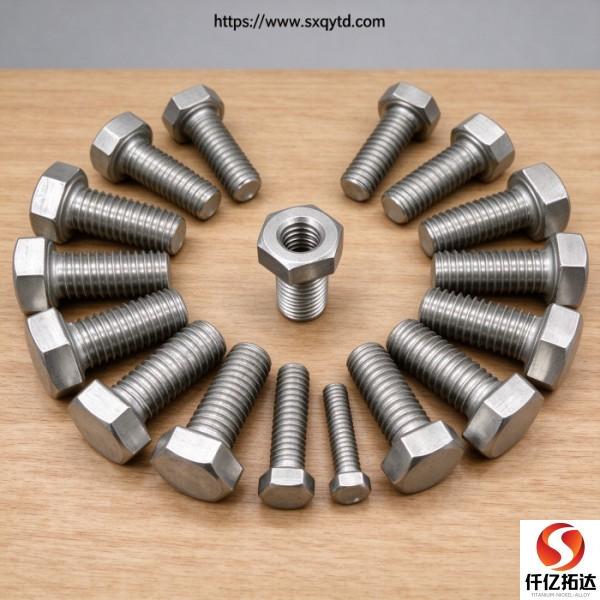
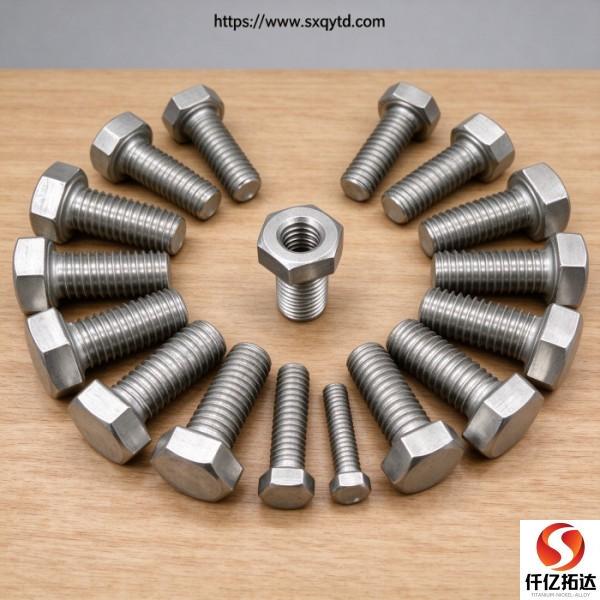
Which DIN Standard Fits a Titanium Hex Bolt: 933 or 931?
| Specification | Fully Threaded: DIN 933 / ISO 4017 hex bolt, thread to under-head |
|---|---|
| Applicable Standard | Partially Threaded: DIN 931 / ISO 4014 hex bolt with an unthreaded shank |
| Material Condition | Selection Basis: Shear plane location, shank fit, bearing face, fatigue sensitivity |
| Inspection & Packaging | Paired Hardware: ASTM F467 nut, DIN 934 form, DIN 125 flat washer |
| Reference Price | $5.00 – $100.00 |
Product Description: DIN 933 is fully threaded, DIN 931 is partially threaded. How to choose, and how DIN maps to ISO 4017 / 4014 on a titanium RFQ
Product Overview
Which DIN Standard Fits a Titanium Hex Bolt: 933 or 931?
DIN 933 is a fully threaded hex bolt; DIN 931 is a partially threaded hex bolt with an unthreaded smooth shank. Their ISO equivalents are ISO 4017 and ISO 4014 respectively. The choice is not a matter of habit — it decides whether a shear plane in your joint falls on the smooth shank or inside a thread root, and titanium makes that more consequential than it is on steel: published nominal elastic modulus is approximately 103–113 GPa for titanium versus approximately 200 GPa for steel, so the alloy is more elastic and thread-root stress concentrations deserve more respect. Here is the decision table.
| Item | DIN 933 / ISO 4017 | DIN 931 / ISO 4014 |
|---|---|---|
| Thread | Runs the full length up to under the head | Threaded portion at the end; smooth shank above |
| Shear plane | Often lies in the thread root in a through-bolted joint | Can be placed on the smooth shank by choosing the right length |
| Location / fit | No smooth pilot diameter | Shank can act as a locating diameter in a reamed hole |
| Adjustment | Full thread gives maximum nut travel | Nut travel limited by the threaded length |
| Typical use | Tapped holes, clamping over a variable stack, general fastening | Through holes, aligned parts, shear-loaded joints |
| What to write in the RFQ | "DIN 933 / ISO 4017, fully threaded, M10 × 1.5 × 60" | "DIN 931 / ISO 4014, partially threaded, M10 × 1.5 × 60, state b (thread length)" |
1. The "Just a DIN Number" Trap
: What Fully Threaded Really Means
Both standards describe the same hex head family; the difference is where the thread stops. In DIN 933 / ISO 4017 it does not stop — the threaded portion runs the full shank to under the head. In DIN 931 / ISO 4014 a defined thread length b runs from the tip, leaving a smooth, full-diameter shank between the thread and the head. That smooth section is the whole point of the 931 form.
On a titanium order this needs to be stated explicitly, because "M10 × 60 hex bolt" is ambiguous: a supplier may ship either form from the same bar stock and both will fit the same nut. Our stocked M6 / M8 / M10 hex bolts and the Gr2 bolt, nut and washer range in M6–M36 list the dimensional forms alongside the material standard for that reason. Note the split of responsibility: DIN and ISO govern the shape; ASTM F468 / F468M govern the material and mechanical properties of the finished bolt. Citing one does not satisfy the other.
2. Why the Shear Plane Decides It
In a through-bolted joint, the interface between the two clamped parts is a shear plane. If that plane falls inside a thread root, the local cross-section is smaller and the stress concentration is higher than on a smooth shank of the same nominal diameter. For a fatigue- or vibration-loaded joint, that is where a crack starts. Choosing DIN 931 with the correct bolt length puts the smooth shank across the interface and moves the thread root out of the shear plane.
Titanium adds two reasons to care. First, its lower elastic modulus means the joint is more elastic, so cyclic loading is shared differently between bolt and clamped parts. Second, thread roots on titanium are already the preferred site for galling damage during assembly; adding a shear plane there compounds two problems in one location. The engineering answer is not "always use 931" — a fully threaded bolt is often the right choice in a tapped hole or where the stack thickness varies — but the decision should be made from the joint drawing, not left to the supplier's default.
There is a practical trap: specifying a partially threaded bolt without stating the required thread length b. The unthreaded shank then lands wherever the supplier's standard puts it, which may put the shear plane back in the thread anyway. On a custom or non-standard length, put b on the drawing. Our non-standard fasteners by drawing route exists for exactly these cases.
3. The "Both Numbers" Trap
: Which One Governs the RFQ
For metric hex bolts the widely used mapping is DIN 933 ↔ ISO 4017 (fully threaded) and DIN 931 ↔ ISO 4014 (partially threaded). They are commonly treated as equivalent in form, but the responsible way to cite them is to name one primary standard and, where the customer works to the other system, add it in parentheses. Do not write both without a primary — if an edition or tolerance detail differs, the inspector needs to know which document governs.
Two more lines belong next to it: the thread series and pitch (for example M10 × 1.5 coarse metric), and the nut standard (ASTM F467 for a titanium nut, with DIN 934 as a common dimensional form). Our ASTM F467 titanium nuts page and Titanium Fasteners hub show how those fields are paired on a quote. Feedstock, if you need to control it, is cited separately to ASTM B348 bar — a bar standard is not a bolt form.
4. The "Length Only" Trap
: Three Procurement Mistakes
- Ordering by length alone. "M10 × 60" does not say whether the thread runs the full 60 mm. State the form, and for 931 state the thread length b.
- Citing DIN 933 as a material specification. It is a dimensional standard. Material, grade and mechanical minimums come from ASTM F468 / F468M, and the certificate from EN 10204 3.1. Our Titanium Fasteners Guide separates those scopes.
- Assuming a metric DIN form and an inch-series thread are interchangeable. They are not. An M10 × 1.5 bolt and a 3/8-16 UNC bolt can look deceptively similar across a parts bin, but the pitches differ and the threads will not mate. State the thread series and pitch on every line.
RFQ line to copy: "Hex bolt, DIN 933 / ISO 4017 fully threaded [or DIN 931 / ISO 4014 partially threaded with b = ___ mm], M10 × 1.5 × 60, material and mechanical properties to ASTM F468 (or F468M) Gr___ (R___), nut to ASTM F467 Gr___, EN 10204 3.1 with heat number, PMI one piece per lot, dimensional report." Verify all dimensional values against the current standard edition and the supplier drawing before ordering.
5. Where the 933/931 Choice DOES NOT Help
Choosing the right thread length solves a geometry problem. It solves none of the following, which are material, medium or assembly conditions. No concentration or temperature limits are given here; verify against isocorrosion data and coupon testing for the exact service.
Stagnant hot chloride crevices
A tight crevice under the head or inside the thread engagement can develop an acidic, oxygen-depleted cell. Grade 7 or Grade 16 material, or a design change, is the fix — not a different thread length.
HF and hot reducing acids
The TiO2 film fails; both forms of the bolt corrode equally. This is a grade-exclusion decision made before any dimensional standard is cited. See the Grade 12 reducing-acid route.
Dry chlorine and anhydrous oxidisers
Published exclusion cases with a fire risk, independent of bolt form. Confirm the full medium chemistry, including trace water, before specifying titanium at all.
Galvanic pairing with aluminium or steel
Titanium is the noble cathodic side; the parent metal is sacrificed in a wet joint. Insulating washers, coatings and area-ratio control belong in the design, not in the DIN number.
Vibration loading and re-torque after the first cycle
A smooth shank across the shear plane helps, but it does not replace a controlled lubrication state, a matched nut, a stated nut factor K and a single-use rule for critical joints. The F468/F467 torque-boundary guide covers that assembly side.
6. Frequently Asked Questions
Is DIN 933 the same as ISO 4017?
They are commonly treated as equivalent fully threaded metric hex bolt forms. Cite one as primary and add the other in parentheses for clarity; do not leave the inspector guessing which edition governs. Verify dimensional details against the current standard version.
When should I choose DIN 931 instead?
When the joint has a through hole and you want a smooth shank across the shear plane, or when the shank acts as a locating diameter. State the required thread length b on the drawing, or the shank may not land where you need it.
Does the DIN standard specify the titanium grade?
No. DIN 933 / 931 and ISO 4017 / 4014 are dimensional standards. Grade, chemistry and mechanical minimums come from ASTM F468 / F468M, and the mill certificate from EN 10204 3.1. Cite both lines.
Can I substitute a 3/8-16 UNC bolt for M10 × 1.5?
No. They can look similar in a parts bin but the thread pitches differ and the threads will not mate. State the thread series and pitch on every PO line and verify with a thread gauge on incoming inspection.
Do I need to state the thread length for a fully threaded bolt?
Not separately — the thread runs to under the head by definition. You do need the overall length, pitch and head form, and you still need the material standard and certificate lines.
7. Summary, Choose X if / Choose Y if, and Request a Quotation
Choose DIN 933 / ISO 4017 if
- The bolt goes into a tapped hole or clamps a variable stack thickness.
- You need maximum nut travel and full-thread adjustment.
- The shear plane is not a design driver, or the joint is primarily in tension.
- You want a widely stocked form for a small order.
Choose DIN 931 / ISO 4014 if
- The joint is through-bolted and the shear plane can be placed on the smooth shank.
- The shank is used as a locating diameter in a reamed hole.
- Fatigue or vibration loading makes a thread root at the interface undesirable.
- You can state the thread length b on the drawing and verify it on receipt.
DIN 933 and 931 differ by one thing — where the thread stops — and that one thing decides where the weakest section of your joint sits. Name the form, the ISO equivalent, the thread series and pitch, and the material standard in the same PO line; then the quote describes the bolt you actually designed for.
To request a quotation, send: grade and finished-product standard, DIN / ISO form, diameter / length / pitch, thread length b if partially threaded, head style, nut standard and grade, quantity, certificate and PMI requirement, and a drawing if non-standard. One action, one list.
Send your fastener RFQ or browse the Titanium Fasteners hub.
Data note and attribution: DIN / ISO form definitions are qualitative descriptions from published standard summaries. No head dimensions, across-flats values, thread-length tables or tolerance values are given; verify against the current standard edition and the supplier drawing. Modulus figures are published nominal values marked approx. Media in section 5 are qualitative exclusions from published corrosion guidance with no concentration or temperature thresholds; verify against isocorrosion data and coupon testing. No third-party certification, inventory count, lead time or test report is claimed. Reviewed and maintained by the Engineering Team, Shaanxi Qianyi Tuoda Technology Co., Ltd., Baoji, China.
Need this specification in titanium? Get a quote.
Send us your grade, size and quantity. We check live stock and reply with price and lead time the same day.
Stock holder in Baoji Titanium Valley · ~800 t inventory · cut-to-size · drawing-based machining · ASTM / ASME / GB · export-ready · same-day response
Tell us your requirement — grade, size and quantity. We reply within 24 hours.
Prefer chat? WhatsApp +86 188 2967 9311 or email [email protected].


- Titanium Price Today (9 Nov 2026): Plate, Tube, Rod & Wire
- What is Titanium Flange | ASME B16.5 ASTM B381 Gr2 Gr5 Titanium Flan
- ASME B16.5 Titanium Flange Grade2 DN100-DN600 Class150/300 FOB
- Gr2 Titanium Sheet Price FOB Shanghai | ASTM B265 In Stock
- Titanium Price Today (Oct 26, 2026): China Market Report
Contact Person: Wang Xiaoning
Tel: +86-917-355-7966
Email: [email protected]
WhatsApp: +86 188 2967 9311
Company: Shaanxi Qianyi Tuoda Technology Co., Ltd
Address: Floor 4, Building 4, No. 188 Gaoxin Avenue, High-tech Zone, Baoji City, Shaanxi Province, China