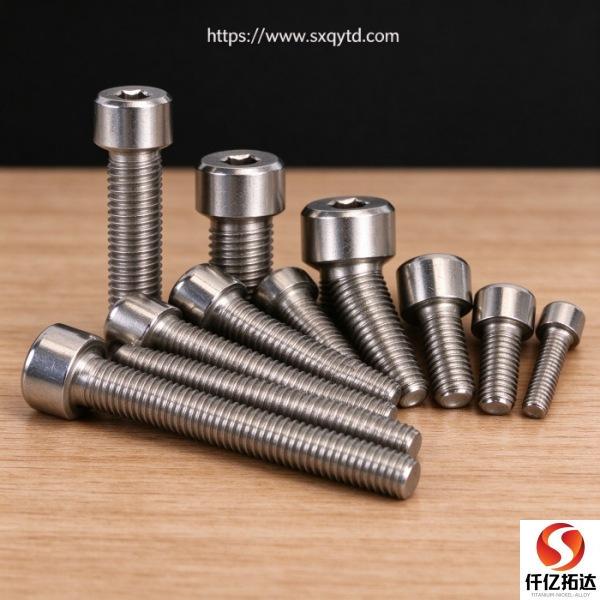
Does ASTM B348 Cover Finished Titanium Fasteners?
| Specification | Feedstock Standard: ASTM B348 for titanium bar and rod |
|---|---|
| Applicable Standard | Finished Product: ASTM F468 / F468M for bolts, screws and studs |
| Material Condition | Traceability: Heat number from melt to finished lot, EN 10204 3.1, PMI, dimensional report |
| Inspection & Packaging | Break Points: Multi-heat blending, outsourced machining, re-heat treatment, offcut reuse |
Product Description: B348 certifies the bar stock, not the finished bolt. Why quoting bar tensile values as bolt allowable loads is wrong, and which standards to cite instead
Product Overview
Does ASTM B348 Cover Finished Titanium Fasteners?
No. ASTM B348 governs titanium bar and rod — the feedstock. A finished externally threaded bolt is governed by ASTM F468 (or F468M for metric), with its head form and dimensions coming from ASME B18 / DIN / ISO standards. That is the scope answer, and the cluster's main standard-map article already covers it. The more useful question for a buyer is different: can one B348 heat number be traced all the way to the bolts in your box? Four routine shop events can break that chain — multi-heat blending, outsourced machining, a second heat treatment, and offcut reuse. When it breaks, the certificate proves that a good bar once existed, not that your fasteners came from it. The table below is the chain and its four weak points.
| Stage | Governing document / record | What can break the chain |
|---|---|---|
1. Melt and ingot |
Heat number, melt chemistry | Two heats blended before conversion with no segregation record |
2. Bar / rod conversion |
ASTM B348 bar certificate | Certificate covers the bar lot, not a specific cut length |
3. Machining / heading |
Job traveller, lot identification | Outsourced turning with mixed bar remnants; offcuts reused on another job |
4. Heat treatment / finish |
Treatment record, passivation record | A second treatment changes properties the bar certificate described |
5. Finished fastener |
ASTM F468 / F468M, dimensional report | Grade marking omitted; no link between finished lot and heat |
6. Shipment |
EN 10204 3.1 + PMI on delivered lot | Certificate copied from a previous shipment; PMI never performed |
| What closes it | Four documents, one heat number, same lot | See section 4 |
1. The "Bar Certificate" Trap
: B348 Does NOT Cover the Finished Bolt
A B348 certificate is a valuable document and a limited one. It declares the bar's heat chemistry, mechanical test results, condition and dimensional tolerance against the bar standard. It says nothing about the thread root that was later rolled into the surface, the head that was formed, the bearing face, the surface treatment, or the proof load of the finished part. Those belong to F468 / F468M and to the dimensional standard.
The trap is a quote that says "material to ASTM B348" and stops. That is a bar with a thread cut in it, described by a document that does not apply to the object being bought. It is also why a bar tensile value must never be quoted as a finished bolt's allowable load — a rule stated in detail by our F468/F467 torque-boundary guide and in the standard-map article. Here we move past the scope question to the one that causes audit failures: traceability.
2. What B348 Actually Certifies — and What It Leaves Behind
At the mill, a heat is melted, an ingot is cast, and bar or rod is converted and tested. The B348 certificate ties those results to a heat number. For a fastener maker, that heat number is the start of a chain, not the end. Our Grade 5 ASTM B348 bar stock, TC4 B348 rod and titanium rod for aerospace fasteners pages describe feedstock at this stage — they are material pages, not finished-fastener specifications, and that is exactly the point of keeping them separate.
What the bar certificate leaves behind is identity after conversion. Once a long bar is cut into blanks, and blanks are machined into bolts, the physical link between a bolt and the original heat is a paperwork link: job travellers, lot numbers, marking and a certificate that names the right heat. If the shop keeps those aligned, the chain holds. If not, the bolt can be perfectly good titanium and still be untraceable — which for a critical joint is a rejection, not a detail.
3. Where the Heat Number DOES Disappear
: Four Break Points
Multi-heat blending before conversion
If material from two heats is combined to make a production lot, a single heat number can no longer describe the whole lot. Ask whether the supplier segregates by heat and how a mixed lot is documented. A certificate that names one heat for a blended lot is not traceable.
Outsourced machining and job travellers
Bar is often cut and turned by a subcontractor. When the traveller sheet does not carry the heat number through to the finished lot, the link dies at the shop door. Ask to see the lot-identification method, not just the final certificate.
A second heat treatment or surface process
Any treatment after the bar test can change the mechanical properties or the surface condition the certificate described. The record for that treatment must be attached to the same lot, and the finished fastener should be verified after it — not before.
Offcut reuse and remnant material
Titanium bar remnants are valuable, so they get reused. Unless remnants are re-identified and kept with their own heat records, a later small order can contain material from a different heat than the certificate names. This is the most common break point on small-batch custom work, and the reason a signed drawing and a clear lot definition matter.
4. Why Four Documents Work
: Closing the Chain
You do not need a thicker folder; you need four records that all point at the same lot and the same heat.
- EN 10204 3.1 mill test certificate naming the heat chemistry and mechanical results, issued for the shipment in front of you. Our 3.1 certificate page sets out the wording; the Certifications page carries the company-level statements.
- PMI / XRF result on at least one piece from the delivered lot, recorded against that heat number. PMI confirms alloying elements on a clean surface — Grade 5 reads approximately 6% Al and 4% V, Grade 2 as near-pure titanium — but it cannot measure oxygen, nitrogen or carbon, and cannot see heat treatment. It is a consistency check, not a full mechanical test.
- Dimensional report for the finished bolt against the drawing and the dimensional standard. This closes the geometry gap that neither B348 nor F468 fills.
- Permanent manufacturer and grade marking on the part itself. A loose bolt in a bin with no mark cannot be tied back to any of the above.
Write all four into the purchase order as lot-based requirements, and state that broken traceability is grounds for rejection. Our passivation and anti-gall treatment page covers the surface condition that the certificate does not describe, and the export desk consolidates the package into one shipment. For critical bolting, add sample tensile or hardness verification from the delivered lot — a bar coupon from six months earlier is not that.
PO line to copy: "Feedstock to ASTM B348 with heat number; finished bolt to ASTM F468 (or F468M) Gr___ (R___); nut to ASTM F467; permanent grade marking; EN 10204 3.1 issued for this shipment; PMI on one piece per delivered lot recorded against the heat; dimensional report against drawing; no undocumented blending or re-heat treatment; broken traceability is grounds for rejection."
5. When the Paperwork Still Does Not Help
A perfect traceability chain proves what the bolt is. It does not prove the bolt belongs in your service. These are the conditions where documentation is necessary and insufficient. No concentration or temperature limits are given here; verify against isocorrosion data and coupon testing for the exact medium.
HF and hot reducing acids
The oxide film fails. Traceability does not change chemistry; see the Grade 7 reducing-acid route and the Grade 12 alternative.
Dry chlorine and anhydrous oxidisers
Published exclusion cases with a fire risk. Confirm the full medium chemistry, including trace water, before specifying titanium at all.
Stagnant hot chloride crevices
Under a fully certified head, a tight crevice can still develop an acidic cell. Grade 7 / 16 material or a design change is the fix; see our marine-environment screws page.
Galvanic pairing with aluminium or steel
In a wet joint the parent metal is sacrificed while the bolt stays pristine. Insulating washers and area-ratio control belong in the joint design, not in the certificate.
Cyclic loading and removal for maintenance
Breakaway galling on removal and preload loss after the first thermal cycle are assembly problems. A traceable bolt can still be a single-use bolt; write that into the procedure.
6. Frequently Asked Questions
Can I accept a B348 certificate instead of a finished-fastener specification?
No. B348 certifies the bar. The finished bolt needs ASTM F468 / F468M, the dimensional standard and form, plus the certificate and inspection package. Cite B348 as feedstock control only.
Does an EN 10204 3.1 certificate prove my bolts came from that heat?
Only if the supplier's lot-identification system links that heat to the finished parts in your shipment. Pair it with PMI on a sample from the delivered lot and check that the certificate was issued for this shipment, not copied from an earlier one.
What does PMI / XRF not detect?
It reads alloying elements near the surface. It cannot measure oxygen, nitrogen, carbon or hydrogen, cannot see heat treatment or tensile strength, and can be fooled by a plated surface unless the reading is taken on a freshly abraded flat.
Why does a second heat treatment matter for traceability?
Because it can change the mechanical properties the bar certificate recorded. The treatment record must attach to the same lot, and the finished fastener should be verified after treatment, not before.
What should I ask for on a small custom order?
A signed drawing, a defined lot, the four documents in section 4, and a statement that no undocumented blending or offcut reuse occurred. Small batches are where remnant material most often breaks the heat-number link.
7. Summary, Choose X if / Choose Y if, and Request a Quotation
Choose bar-only documentation if
- You are buying bar or rod as raw material, not finished fasteners.
- The part will be re-tested and re-certified by your own qualified process.
- The joint is non-critical and no audit trail is required.
Choose full-chain verification if
- The joint is load-bearing, pressure-containing or installed in a corrosive medium.
- Your customer requires positive material identification or third-party verification.
- The order involves outsourced machining, re-heat treatment or non-standard blanks.
- You need a result that can be produced in an audit and tied to a heat number.
- The supplier is new, or the lot is large enough that a rejection is expensive.
B348 does not cover a finished titanium bolt — that is the easy answer. The better question is whether one heat number survives the whole journey from melt to your goods-in desk. Name the four documents that keep it alive, and the certificate stops being a piece of paper and starts being a traceable claim.
To request a quotation, send: grade and UNS designation, finished-product standard, feedstock standard, size / length / pitch, head style, nut standard and grade, finish, quantity, certificate / PMI / dimensional report requirements, and a drawing if non-standard. One action, one list.
Send your fastener RFQ or browse the Titanium Fasteners hub and the ASTM F467 fasteners page.
Data note and attribution: standard scopes are described qualitatively from published standard summaries; no clause numbers, tensile tables or tolerance values are quoted. The four break points are general process-risk descriptions and do not refer to any specific supplier, order or lot. PMI limitations are widely published analytical constraints. Media in section 5 are qualitative exclusions from published corrosion guidance with no concentration or temperature thresholds; verify against isocorrosion data and coupon testing. No third-party certification, inventory count, lead time or test report is claimed. Reviewed and maintained by the Engineering Team, Shaanxi Qianyi Tuoda Technology Co., Ltd., Baoji, China.
Need this specification in titanium? Get a quote.
Send us your grade, size and quantity. We check live stock and reply with price and lead time the same day.
Stock holder in Baoji Titanium Valley · ~800 t inventory · cut-to-size · drawing-based machining · ASTM / ASME / GB · export-ready · same-day response
Tell us your requirement — grade, size and quantity. We reply within 24 hours.
Prefer chat? WhatsApp +86 188 2967 9311 or email [email protected].


- Titanium Price Today (9 Nov 2026): Plate, Tube, Rod & Wire
- What is Titanium Flange | ASME B16.5 ASTM B381 Gr2 Gr5 Titanium Flan
- ASME B16.5 Titanium Flange Grade2 DN100-DN600 Class150/300 FOB
- Gr2 Titanium Sheet Price FOB Shanghai | ASTM B265 In Stock
- Titanium Price Today (Oct 26, 2026): China Market Report
Contact Person: Wang Xiaoning
Tel: +86-917-355-7966
Email: [email protected]
WhatsApp: +86 188 2967 9311
Company: Shaanxi Qianyi Tuoda Technology Co., Ltd
Address: Floor 4, Building 4, No. 188 Gaoxin Avenue, High-tech Zone, Baoji City, Shaanxi Province, China