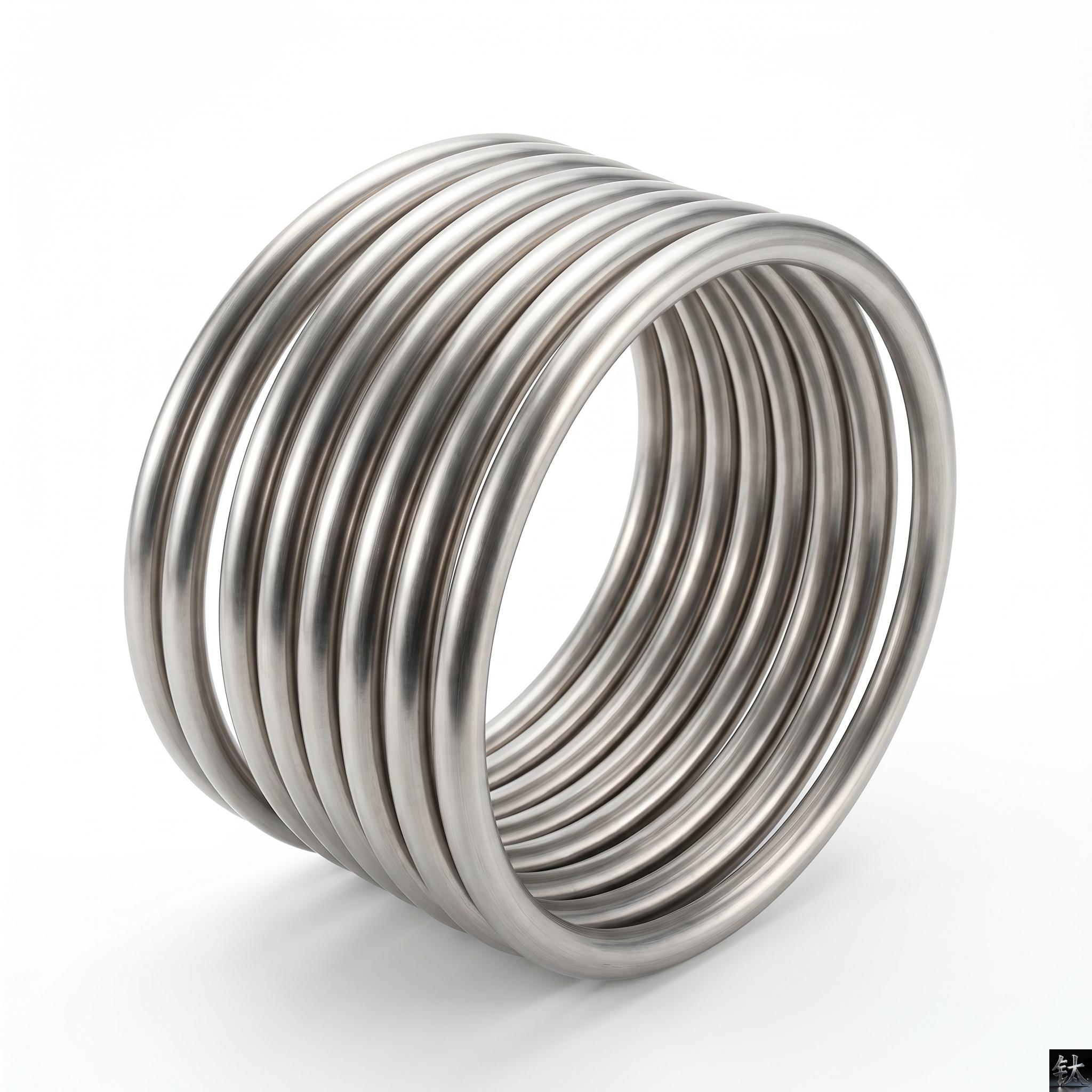
Titanium Coil Tube Selection: Grades, Failure Modes and When to Specify
| Specification | ASTM B338 |
|---|---|
| Applicable Standard | Gr1 / Gr2 / Gr7 / Gr9 / Gr12 |
| Material Condition | titanium coil selection |
| Inspection & Packaging | heat exchanger coil |
| Reference Price | $35.00 – $40.00 |
Product Description: Titanium coil tube selection: ASTM B338 Gr2/Gr7/Gr12, 8 failure modes (crevice, erosion, hydrogen), coil vs shell-and-tube, and when to specify each grade.
Product Overview
Titanium Coil Tube Selection: Grades, Failure Modes and When to Specify
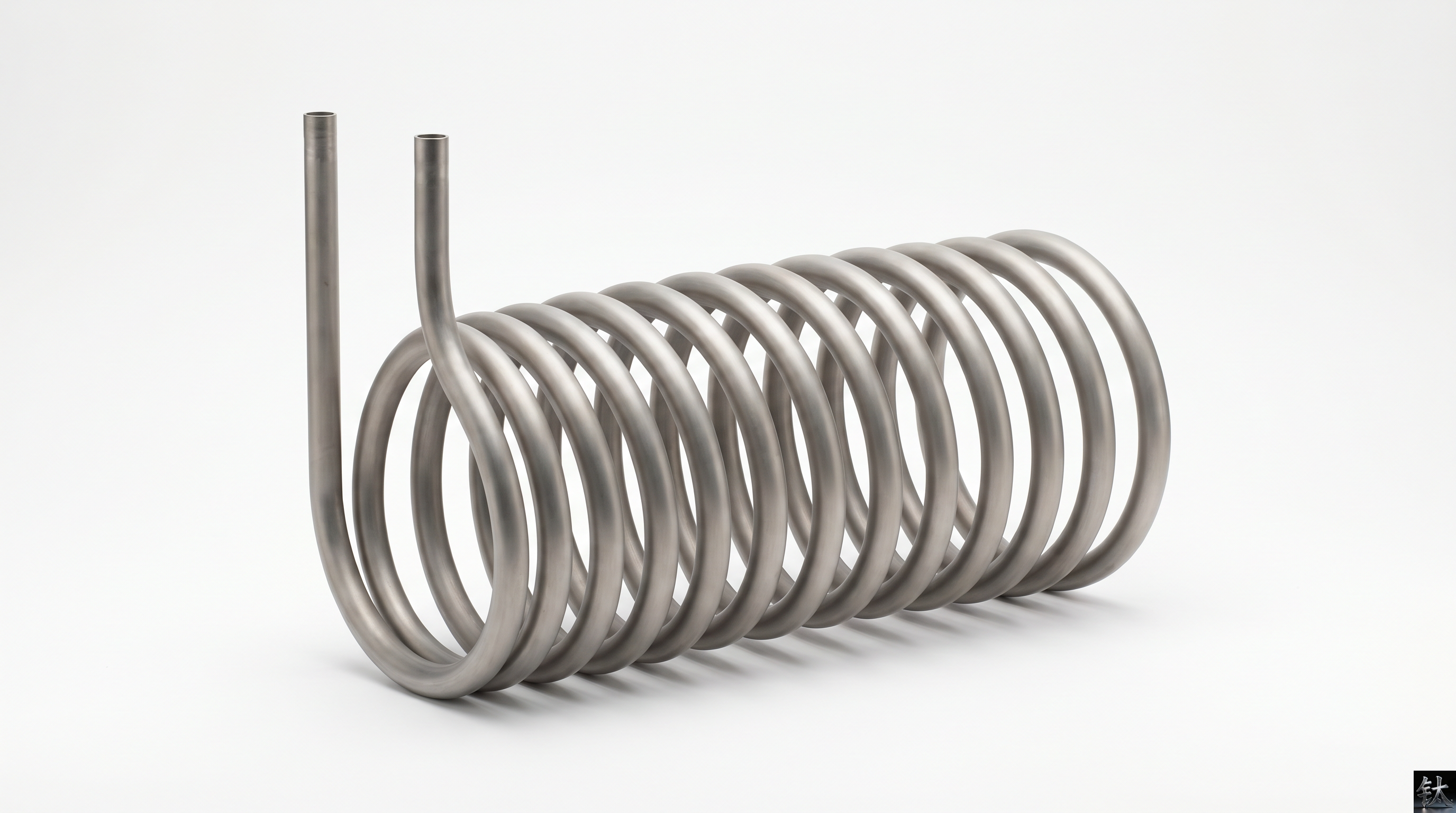
A titanium coil tube is a seamless or welded ASTM B338 tube bent into a spiral, serpentine, pancake or U shape for compact heat transfer. For roughly 90% of duty you should specify Grade 2; step up to Grade 7 only when reducing acid or crevice corrosion is the real risk, and to Grade 12 for hot chloride brines. In clean seawater below 80°C, a Gr2 coil runs 20-30 years with no measurable wall loss; above that temperature, or inside stagnant crevices, upgrade the grade before you uprate the wall. This guide covers what a coil actually is, how to pick the grade, the eight ways coils fail, and the coil-vs-shell-and-tube decision - so you can write a specification the mill can actually quote.
At a Glance: Titanium Coil Tube Specification
| Spec | What to Specify |
|---|---|
| Base tube | ASTM B338 / ASME SB338 seamless or welded titanium tube, then bent |
| Common grades | Gr1, Gr2, Gr7 (Ti-0.15Pd), Gr9 (Ti-3Al-2.5V), Gr12 (Ti-0.3Mo-0.8Ni) |
| Typical size | OD 6-25.4 mm (to 50 mm), wall 0.5-2.5 mm, coil Ø 150-1800 mm, length ≤100 m |
| Min bend radius | ≥ 1.5 × OD; tighter radii need custom mandrel tooling |
| Seawater temp limit | Gr1/Gr2 ≤ 80°C; Gr7 resists crevice to ~200°C |
| Min flow velocity | ~1.5 m/s in seawater to avoid fouling and stagnation |
| Failure watch | Crevice > pitting; erosion; hydrogen embrittlement; SCC from cold-bend stress |
| Coil vs shell-tube | Coil = compact / immersion; shell-and-tube = high-pressure / mechanically cleanable |
What a Titanium Coil Tube Actually Is
A coil is not a separate product family - it is a titanium tube that has been formed after manufacture. The base tube is ordered to ASTM B338 (seamless or welded), inspected, then wound on a mandrel into the final geometry. That single fact drives three things buyers underestimate: the bend radius sets the minimum wall you can safely hold; cold bending leaves residual stress that must be relieved; and the coil geometry, not the alloy, often decides whether your heat exchanger stays clean.
Common shapes are helical (spiral) for tank immersion, serpentine for plate-style coolers, U-bend for vessel nozzles, and pancake for low-profile stacks. Our own titanium coiled-tubes page shows the range; this article is the decision layer on top of it.
Coils are produced in a defined sequence for a reason. The mill verifies chemistry with PMI, draws or pilgers the tube to size, anneals between passes, then winds it on a CNC mandrel to your coil diameter and pitch. Because the tube is formed after it is already a finished tube, you can order an extreme length - up to roughly 100 m - as a single coil with no longitudinal weld in the heat-transfer section. That continuous length is itself a reliability feature: fewer joints, fewer leak paths. The trade is that every bend becomes a formed feature that must be controlled, not a straight run you can ignore.
The "It Is Just a Bent Tube" Myth
The most expensive coil mistakes start with that sentence. A formed coil behaves differently from the same tube run straight, for four reasons. First, bending thins the wall on the outside radius and thickens it on the inside; a coil bent below ~1.5×OD can ovalise and localise stress. Second, cold work hardens the bend and leaves residual stress that, in a chloride environment, is the precondition for stress corrosion cracking. Third, a tight pitch packs surface area into a small volume - great for heat transfer, terrible for manual cleaning and inspection. Fourth, every bend is a fatigue site under thermal cycling. Treating a coil as a commodity tube is how plants end up with a leak six months after commissioning.
The fix is not a thicker wall everywhere - it is controlling the geometry on the drawing: state outside diameter, wall, centreline radius, pitch, total length, end orientation, allowable ovality and dimensional tolerance. A mill quoting from a loose sketch will either refuse or pad the price. Give them the numbers and you get a realistic quote and a coil that survives.
On wall thinning: at a bend the outside radius can lose several percent of wall while the inside gains it; below 1.5×OD the loss accelerates and ovality climbs past what a pressure code will accept. Springback also grows as the radius shrinks, so the as-wound coil will not match the mandrel unless the programmer compensates. These are not theoretical - they are why two mills quoting the same sketch return coils that behave differently in service. The drawing is the contract; the bend radius and allowable ovality on it decide the outcome.
Grade Selection: Gr1, Gr2, Gr7, Gr9, Gr12
Grade choice is the single biggest cost and reliability lever. The rule of thumb: clean, neutral service = Gr1 or Gr2; reducing acid or crevice risk = Gr7; hot chloride brine = Gr12; high strength or fatigue = Gr9. Commercially pure Gr2 is the workhorse - it balances formability, strength and price, and it is what most seawater desalination coils and geothermal coils are made from.
| Grade | Why specify | Watch-out |
|---|---|---|
| Gr1 | Highest ductility, tightest bend radii | Lowest strength; rarely needed over Gr2 |
| Gr2 | Best cost / form / corrosion balance | Crevice risk above 80°C seawater |
| Gr7 | 0.15% Pd; resists crevice & reducing acid | Premium price; only where risk is real |
| Gr9 | Ti-3Al-2.5V; higher strength / fatigue | Less formable; hydraulic / aerospace |
| Gr12 | 0.3Mo-0.8Ni; hot chloride brine crevice | Use when Gr7 still crevices hot |
For a chlor-alkali duty, lean on Gr7 seamless tube; for petrochemical reducing streams, Gr12 earns its premium. Do not let a supplier default you to Gr2 in a reducing acid just because it is in stock - see the crevice trap below.
Do not specify titanium where a cheaper metal would do. In low-chloride, near-neutral, ambient duty - closed-loop soft water, for example - a properly selected stainless steel is often adequate and far cheaper, and titanium's long life in seawater does not justify its cost there. Conversely, do not downgrade from Gr2 to save money in a reducing acid just because a supplier has Gr2 in stock; the crevice or acid failure you invite costs more than the grade premium. The grade decision should follow the chemistry, not the inventory.
Corrosion Resistance by Medium
Seawater and brine: titanium's passive film is stable in chlorides, so Gr2 is the default for desalination and marine cooling. Service is reliable from 0 to ~80°C at neutral pH; above that, or with stagnation, specify Gr7. Chlor-alkali: the warm, concentrated, often acidic side of a chlor-alkali cell is exactly where Gr7 pays for itself. Reducing acids (HCl, H2SO4 below boiling, phosphoric): Gr2 resists them at moderate concentration and temperature; in aggressive reducing service, Gr7 or Gr12. Geothermal / produced water: high chloride plus elevated temperature plus abrasion points straight at Gr2 coil with good filtration, upgraded to Gr7/Gr12 where brine is hot. Oxidising acids (nitric, chromic) and most organics: titanium is excellent, but always confirm the exact concentration and any fluoride contamination - fluoride is the one common species that attacks titanium fast.
Two cautions repeat across plants. First, any fluoride - even trace hydrofluoric acid carried over from another unit, or some cleaning agents - attacks titanium fast and is the one common species that defeats the passive film; ban fluorides from any coil that contacts titanium. Second, titanium is excellent in oxidising acids such as nitric and chromic, but mixtures that turn reducing, or that contain heavy-metal ions like ferric or cupric chloride, can shift behaviour the wrong way; when the chemistry is mixed, ask for a test coupon before committing a full coil.
The Crevice Trap: Why Pitting Is the Wrong Thing to Fear
Buyers worry about pitting; in clean seawater, commercially pure titanium essentially does not pit. The failure that actually bites coils is crevice corrosion - under gaskets, at tube-sheet joints, inside deposits, and in stagnant low-oxygen pockets. Crevice risk rises with temperature and falls with flow: keep velocity around 1.5 m/s, avoid tight rubber-to-titanium crevices, and use metal gaskets where possible. When the service is hot or the crevice cannot be designed out, the grade upgrade - Gr7, then Gr12 - is cheaper than the leak it prevents.
This is also why a U-bent SB338 condenser tube and a coil are not interchangeable on corrosion grounds alone: the U-bend has one large controlled bend; a coil has many small ones, each a potential crevice and fatigue site if under-specified.
A practical crevice checklist: keep velocity at or above about 1.5 m/s so deposits do not settle; specify metal or PTFE gaskets rather than tight rubber-to-titanium faces; avoid dead legs and capped stubs where fluid stagnates; and design tube-sheet joints so they can be rolled or welded tight, not just slipped on. Where the crevice is unavoidable and the temperature is high, stop debating wall thickness and move the grade to Gr7, or Gr12 if the brine is also hot and concentrated. The grade, not the wall, is the lever.
Limitations & Failure Modes
Titanium coils are not fragile, but they fail in predictable ways. Listed by condition, not by textbook category, so you can map each to your own plant:
Crevice Corrosion (gaskets, joints, deposits)
The leading coil killer. Forms in tight, low-oxygen spaces - under gaskets, at tube-sheet rolls, inside fouling. Worse hot and stagnant. Mitigate with flow ≥1.5 m/s, metal gaskets, and Gr7/Gr12 where crevice cannot be removed.
Erosion from Solids and High Velocity
Raw seawater, slurry, brine and poorly filtered cooling water carry sand and scale that erode the wall at high velocity. This is the argument for filtration and velocity control, not for a thicker wall alone. Keep design velocity in a sane band and screen the intake.
Fouling and Biofouling
Titanium stops corrosion but not marine growth. Fouling cuts heat transfer, raises pressure drop, and - worse - creates the crevices that then corrode. A chlorination or biocide programme plus a cleaning schedule is part of the material specification, not an afterthought.
Hydrogen Embrittlement
Hydrogen from cathodic over-protection, or picked up during welding or plating, diffuses into titanium and makes it brittle. The classic sign is a blue or straw-coloured (contaminated) weld. Control the protection potential, and weld under proper argon shielding.
Stress Corrosion Cracking from Cold-Bend Residual Stress
Cold bending stores residual stress in the coil. In an aggressive environment that is the trigger for SCC. The standard safeguard is stress-relief annealing after forming (typically 650-800°C depending on grade). Ask for it explicitly - do not assume it was done.
Fatigue (Thermal Cycling and Vibration)
Repeated heating/cooling and pump vibration cyclically load the bends. Proper supports, expansion allowances and not forcing the coil into alignment during installation prevent fatigue cracks. Rigid supports that fight thermal growth are a common installation error.
Galvanic Attack of Adjacent Metals
Titanium is noble in seawater. Bolt it to carbon steel or aluminium in an electrolyte and the other metal corrodes faster, not the titanium. Manage this with isolation sleeves, non-conductive gaskets and coatings; review the whole assembly, not just the tube.
Fabrication Damage (Contaminated Weld, Embedded Iron)
A weld made without adequate gas shielding, or iron particles embedded from dirty tools, becomes the first place to fail. Require PMI, pickling, and clean titanium-only tooling; a blue weld should be rejected on sight.
Coil vs Shell-and-Tube / U-Bend: The Compactness Trade-Off
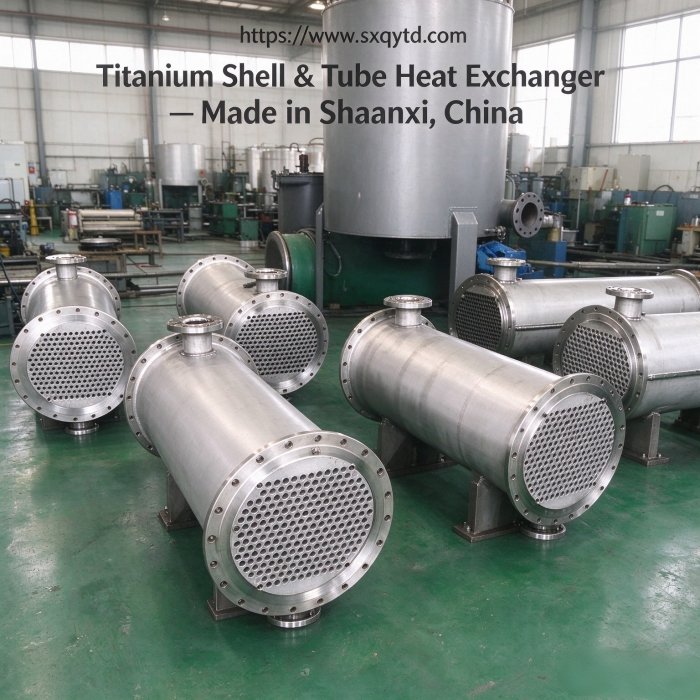
A coil wins on footprint and immersion: drop it into a tank for heating or cooling, and you get huge surface area in a small volume with no shell. That is why desalination brine heaters and electroplating baths use immersion coils. A shell-and-tube or U-bent exchanger wins on pressure and cleanability: higher design pressure, mechanical tube cleaning, and easier inspection for large process streams. Rule: pick a coil for compact immersion and small-to-medium duty; pick shell-and-tube when pressure is high, fouling is aggressive, or you must clean tubes mechanically. A coil you cannot clean will foul and then crevice - exactly the failure chain above.
Cost follows the same logic. A coil is usually cheaper to fabricate for a tank duty because there is no shell, no tube-sheet labour, and the footprint is small - often it drops into existing vessels. A shell-and-tube unit costs more up front but earns it back when you must pull and clean tubes on a fouling service, or hold 30 bar plus. For a retrofit where you cannot fit a shell, the coil is sometimes the only option; for a new large duty with dirty fluid, the shell-and-tube is the safer total-cost choice.
Manufacturing, Testing and Sizing You Should Require
Specify the process so the quote is comparable across mills. Expect: PMI grade verification, cold drawing or pilgering to size, intermediate and final annealing (650-800°C), mandrel coiling, pickling, then inspection. Testing should include eddy-current or UT on the raw tube, hydrostatic at ~1.5× design pressure, and air-under-water leak test for pinholes. For size, give OD, wall, coil diameter, pitch, total length and bend radius; confirm the minimum bend radius against wall to avoid ovality. Always require an MTR / MTC with heat number - for export coils this is non-negotiable for traceability.
On tolerances and documents: confirm OD and wall to the B338 table you specify rather than leaving it to mill standard, and state straight-length leg dimensions where the coil meets the vessel nozzle. Require the MTR to list heat number, chemistry and tensile results, and keep that certificate with the equipment file - years later, when a question arises, the heat number is what lets you trace the coil to its melt. For export, pair the coil with a clean MTC and, where the project demands it, third-party inspection.
Applications by Industry
- Desalination: brine heaters, evaporators, condensers - Gr2 coiled tube for multi-effect evaporators.
- Chlor-alkali: warm, acidic, chloride-rich side - Gr7 tube and coil.
- Geothermal & produced water: hot high-chloride brine - Gr2 with filtration, upgrade to Gr7/Gr12 if hot.
- Electroplating / anodizing: heating and cooling coils in plating baths.
- Marine & offshore: topside cooling, seawater temp control, aquarium / aquaculture.
- Pharma & food: sanitary, non-reactive heat transfer; pair with Gr2 plate equipment.
- Power: condenser and cooling-coil duty where condenser tube reliability matters.
Across all of these, the coil succeeds when the spec matches the duty: a desalination evaporator coil lives or dies on crevice control and grade; a chlor-alkali coil is a Gr7 job from the start; a geothermal coil needs filtration as much as it needs titanium. Matching grade and geometry to the actual fluid - not to a catalogue default - is the whole game.
Summary: How to Specify a Titanium Coil
Start from the medium and the temperature, not the price list. For clean seawater or neutral service at or below 80°C, Grade 2 is the right default and will outlast the plant. The moment the service turns reducing, crevice-prone, or hot, move to Gr7, and to Gr12 for hot chloride brines. Hold the bend radius at ≥1.5×OD, demand stress-relief annealing after forming, keep velocity near 1.5 m/s, and require an MTR. Choose a coil for compact immersion duty and a shell-and-tube exchanger when pressure or cleanability rules.
Choose shell-and-tube / U-bend instead if ✓ design pressure is high ✓ you must mechanically clean tubes ✓ duty is very large ✓ fouling is aggressive with poor access.
Choose Gr2 if clean seawater / neutral, cost-focused. Choose Gr7 if reducing acid or crevice risk / >80°C seawater. Choose Gr12 if hot chloride brine crevice. Choose Gr9 if high strength / fatigue / hydraulic.
Ready to quote? Send us the medium, temperature, pressure, chloride level, pH, flow velocity and a sketch with OD, wall, coil diameter, pitch and length. We stock Gr2 seamless tube and can supply coiled tubes with MTC. Request a quote →
As a concrete example of what to send the mill: medium = seawater plus 3% brine; temperature = 75°C max; pressure = 6 bar; chloride = ~30,000 ppm; pH = 7.5; velocity = 2 m/s; duty = immersion heater in a tank; size = 19.05 mm OD × 1.2 mm wall, 600 mm coil diameter, 8 turns, 40 m total. From that, Grade 2 is correct, a 1.5× bend radius is fine, stress-relief anneal is required, and an MTR with heat number is mandatory. A half-page brief like this gets you a real quote instead of a guess.
One practical note buyers forget: a coil ships as a compact spool, which is a real advantage on freight and on-site handling, but it must be supported on its full diameter and never dragged by one leg, or the bends take a set you cannot straighten. Mark the hand of the coil (left- or right-hand wind) and the end orientation on the drawing so it drops into the vessel the right way. A coil delivered with the wrong hand is a rebuild, not a rotation.
Frequently Asked Questions
What grade of titanium should I specify for a coil in seawater?
For clean seawater at or below about 80 C and neutral pH, Grade 2 is the right default and typically lasts 20 to 30 years. Above 80 C, or where crevices cannot be avoided, step up to Grade 7, which resists crevice corrosion to roughly 200 C. Grade 1 is only needed for very tight bend radii because of its higher ductility.
What is the minimum bend radius for a titanium coil tube?
As a practical rule, keep the centreline bend radius at 1.5 times the outside diameter or greater. Tighter radii can ovalise the tube, thin the wall on the outside of the bend, and store residual stress. Radii below 1.5x OD require custom mandrel tooling and a stress-relief anneal after forming.
Why does my titanium coil need stress-relief annealing after bending?
Cold bending stores residual stress in the metal. In a chloride or acidic environment that residual stress is the trigger for stress corrosion cracking. Stress-relief annealing, typically 650 to 800 C depending on grade, removes the stress and restores ductility. Ask for it explicitly rather than assuming it was done.
What kills titanium coils in real service?
Crevice corrosion is the leading cause, not pitting - it forms under gaskets, at tube-sheet joints and inside deposits, and worsens with heat and stagnation. The next causes are erosion from solids at high velocity, fouling that creates new crevices, hydrogen embrittlement from over-protection or bad welds, fatigue, and galvanic attack of adjacent carbon steel or aluminium.
Coil or shell-and-tube exchanger - which should I choose?
Choose a coil for compact immersion heating or cooling in a tank, a tight footprint, or small-to-medium and retrofit duty. Choose a shell-and-tube or U-bent exchanger when design pressure is high, you must mechanically clean the tubes, the duty is very large, or fouling is aggressive with poor access.
Can titanium coils handle reducing acids like hydrochloric acid?
Commercially pure Grade 2 resists hydrochloric and sulphuric acid at moderate concentration and temperature, but in aggressive reducing service it can be outclassed. For reducing acids and crevice-prone duties, Grade 7 with its palladium addition is the safer choice, and Grade 12 for hot chloride brines. Always confirm concentration, temperature and any fluoride content.
What documentation should I require with titanium coil tubing?
Require a material test report or mill test certificate with heat number, chemical composition, mechanical properties, ASTM B338 confirmation, dimensional report, and surface inspection. For export and critical service also ask for PMI, hydrostatic, eddy-current or UT reports as specified. The heat number is what makes the coil traceable if a problem appears years later.
Tell us your requirement — grade, size and quantity. We reply within 24 hours.
Prefer chat? WhatsApp +86 188 2967 9311 or email sales@sxqytd.com.


- What is Titanium Flange | ASME B16.5 ASTM B381 Gr2 Gr5 Titanium Flan
- ASME B16.5 Titanium Flange Grade2 DN100-DN600 Class150/300 FOB
- Gr2 Titanium Sheet Price FOB Shanghai | ASTM B265 In Stock
- Titanium Price Today (Oct 26, 2026): China Market Report
- Titanium Price Today (23 Oct 2026): Plate, Tube, Rod & Wire
Contact Person: Wang Xiaoning
Tel: +86-917-355-7966
Email: sales@sxqytd.com
WhatsApp: +86 188 2967 9311
Company: Shaanxi Qianyi Tuoda Technology Co., Ltd
Address: Floor 4, Building 4, No. 188 Gaoxin Avenue, High-tech Zone, Baoji City, Shaanxi Province, China