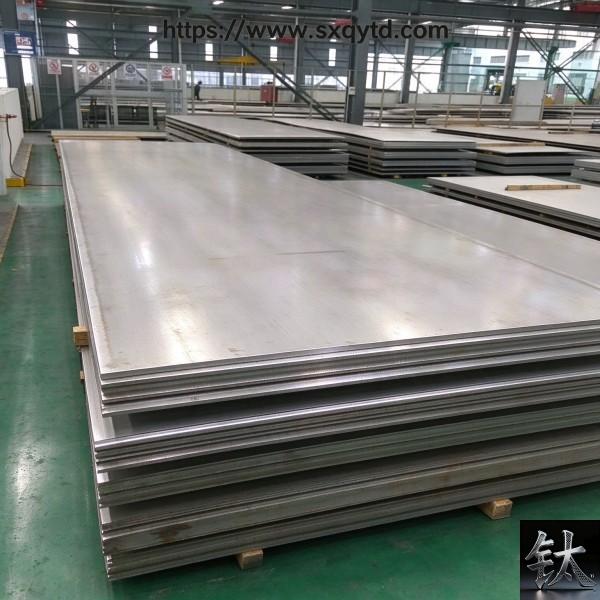
Nickel-Steel Explosive Clad Plate: When to Specify Clad Instead of Solid Nickel
| Specification | ASTM B898 |
|---|---|
| Applicable Standard | Ni200 / Ni201 |
| Material Condition | explosive welding |
| Inspection & Packaging | caustic soda clad plate |
Product Description: Nickel-steel explosive clad plate bonds Ni200/201 or Monel to steel by detonation — no melt zone. ASTM B898, 8 failure modes, when to choose clad vs solid.
Product Overview
Nickel-Steel Explosive Clad Plate: When to Specify Clad Instead of Solid Nickel
If you remember only one number from this page: a nickel-steel explosive clad plate gives you the corrosion face of solid nickel — a corrosion rate below about 0.025 mm/year in 50% NaOH at 150 °C — at roughly 30–60% of the material cost, because only the thin surface layer (typically 1–10 mm) is nickel and the backing is carbon steel. The catch is the bond: it must meet ASTM B898 with a minimum shear strength of 140 MPa (20 ksi) and at least 95% bonded area. Specify nickel-steel clad when the equipment is large, the duty is caustic, seawater or reducing, and you cannot justify the cost and weight of solid nickel. Both grades stay away from hydrofluoric acid, mercury, and strong oxidizers. Read the At a Glance table, then the failure-mode section before you write the specification.
At a Glance: Clad Plate vs Solid Nickel vs Titanium-Clad
| Property | Nickel-steel clad | Solid nickel |
|---|---|---|
| Cladding (face) | Ni200 / Ni201 / Monel 400 | Same, full thickness |
| Backing | Carbon / low-alloy steel | None |
| Bond shear (min) | 140 MPa (20 ksi) per ASTM B898 | n/a |
| Caustic (NaOH) resistance | Excellent (face = nickel) | Excellent |
| Relative cost | 1.0 (baseline) | ~2–3× higher |
| Weight | Lighter (steel backing) | Heavy (density 8.9) |
| Best for | Large vessels, tanks, linings | Small, high-purity parts |
The steel backing carries the mechanical load; the nickel layer only has to survive the process fluid. That division of labor is the whole point of cladding.
What a Nickel-Steel Clad Plate Actually Is
A nickel-steel clad plate is a bimetal: a thin layer of corrosion-resistant nickel or nickel alloy metallurgically bonded to a thicker, cheap, strong steel substrate. Typical cladding is 1–20 mm over a base of SA516 Gr.70, Q345R, 16Mn or similar, with a cladding-to-total ratio of roughly 10–20% (for example 3 mm nickel on 10 mm steel). The cladding alloys are commercial-purity nickel (N6 ≈ Ni200, or low-carbon Ni201), and sometimes Monel 400 (N04400) when seawater plus alkalinity is present.
The bond is made by explosive welding (EXW): an explosive charge detonates and drives the nickel “flyer” plate into the steel at high velocity. The collision forms a wavy metallurgical interface with no melt zone — the two metals are joined below their melting points. The result is a solid-state weld over at least 95% of the surface. For the full nickel product family and where each grade fits, see our nickel products guide; for how a titanium face is bonded to steel in the same way, see our titanium-steel clad plate article.
It helps to picture the finished plate as a sandwich with only the bread on top being the expensive metal. The steel underneath is not a filler — it is the structural member. That is why a clad evaporator shell can be ordered in the same wall thickness a solid-nickel shell would need for pressure, yet cost a fraction because the volume of nickel is a few millimeters, not the whole wall. The bond line is the only place the two metals meet, and getting that line right is the entire quality story.
Deciding the cladding thickness is a corrosion-allowance calculation, not a guess: take the design life, multiply by the corrosion rate in the actual service, add a safety margin, and that is the minimum nickel you must keep at the end of life. A 3 mm cladding with a 1 mm allowance covers two decades in typical caustic service, while the steel below carries pressure with margin to spare. Buying the plate to that number — rather than “as thick as possible” — is where most of the 30–60% saving comes from.
The “Solid Nickel Is Always Better” Myth
A common assumption is that only a solid nickel vessel is “real” corrosion protection, and clad is a compromise. It is the opposite. Solid nickel is a low-strength metal (annealed tensile around 380–550 MPa, but with little margin), and it is expensive and heavy. A clad plate keeps the nickel only where corrosion actually occurs — the wetted surface — and lets the steel carry the pressure and the load. For a large caustic evaporator or a chlor-alkali cell, solid nickel is often the compromise: you pay two or three times more for metal that sits in the middle of the wall doing nothing.
Cladding is not a downgrade of solid nickel. It is the engineering-correct way to put a thin, expensive, corrosion-proof skin on a cheap, strong structure.
That logic is exactly why titanium, another low-strength corrosion metal, is also sold as clad plate rather than solid — see the solid-versus-clad trade in our Titanium Plate guide.
Why Explosive Welding (Not Roll Bonding)
Clad plate can be made by roll bonding (hot rolling the two metals together) or by explosive welding. For nickel on steel, explosive welding is usually the better route for three reasons. First, it handles thick cladding (5 mm and above) that rolling forces struggle to bond. Second, it joins dissimilar metals that are difficult or impossible to fusion-weld, with no intermetallic phases forming at the interface. Third, there is almost no heat-affected zone, so the steel base keeps its properties.
Roll bonding can introduce brittle intermetallics and is limited in cladding thickness. For heavy-duty service — caustic evaporators, chlor-alkali cells, desalinators — explosive bonding is the proven method. (A hybrid “explosion + rolling” route is also used for very large or thin-clad orders.)
Corrosion: Where Nickel Cladding Wins
Because the wetted face is nickel, the plate inherits nickel’s best properties: outstanding resistance to caustic soda (NaOH) at all concentrations, including molten; immunity to caustic stress-corrosion cracking that destroys 304/316 stainless; good behavior in seawater and brine; and resistance to many reducing acids (dilute hydrochloric and sulfuric at lower temperature). Nickel is also valued for a clean, low-contamination surface in rayon- and food-grade caustic.
The choice between Ni200 and Ni201 cladding matters only at temperature — our Ni200 vs Ni201 comparison covers the carbon/graphitization split. For solid nickel backup stock see N6 nickel plate and the nickel sheet with EN 10204 3.1 certificate.
A useful benchmark: in 50% NaOH at 150 °C, nickel corrodes at well under 0.025 mm/year (about 1 mpy), so a 3 mm cladding easily lasts decades even after allowing for a corrosion allowance. Stainless steels in the same service can crack by caustic SCC within months. That gap — not price alone — is why nickel faces dominate caustic evaporators, and why cladding makes the protection affordable at vessel scale.
Against titanium-clad steel, nickel-clad is the choice for alkali and reducing service; titanium-clad wins in oxidizing chloride and wet chlorine where nickel would be attacked. Against solid nickel, clad gives the same wetted-face performance at a fraction of the mass. The only media where neither nickel face is right are the exclusions listed below — fluoride, mercury, strong oxidizers — where you leave the nickel family entirely.
Ni200 vs Ni201 Cladding: Pick by Temperature
Nickel 200 (UNS N02200) allows carbon up to 0.15%; Nickel 201 (UNS N02201) is the low-carbon grade at ≤0.02%. Below about 315 °C (600 °F) their corrosion behavior is essentially identical, so either cladding works. Above that line, carbon in Ni200 can precipitate as graphite at grain boundaries — graphitization embrittlement — with no warning and no wall thinning. ASME therefore requires low-carbon Ni201 for caustic service above ~300 °C. For any caustic evaporator, concentrator or heater operating above 315 °C, specify Ni201 cladding. For seawater-plus-alkalinity or where some reducing-acid resistance with better saltwater behavior is needed, Monel 400 (N04400) cladding is the alternative.
The carbon split sounds trivial — 0.15% versus 0.02% — but it is the difference between a vessel that runs for 20 years and one that fails with no warning. Graphitization does not thin the wall or change its appearance; it simply makes the nickel brittle at the grain boundaries, so a thermal cycle or a mechanical shock can crack it. Specifying Ni201 is a few percent of the cladding cost and removes the entire risk, which is why codes simply mandate it above 300 °C rather than leaving it to judgment.
On the purchase order, write the cladding UNS explicitly (N02200 or N02201, not a vague “nickel”), because the carbon limit is the whole point and a cert that only says “nickel” cannot prove it. If a vessel will see both below- and above-315 °C zones, specifying Ni201 across the board is the safe, low-cost default — Ni201 is not penalized in the cooler zones, so there is no reason to mix grades and risk a mis-cut.
How to Read the Mill Certificate and Spec
The acceptance document is the ASTM B898 (also issued as ASME SB-898) specification for metallurgically bonded clad plate, supported by an EN 10204 3.1 mill test certificate. On the MTC, confirm:
| Check | What to see |
|---|---|
| Bond shear strength | ≥ 140 MPa (20 ksi) per ASTM B898 |
| Bonded area (UT) | Grade B default: ≥ 97%, single defect ≤ 75 mm |
| Cladding alloy UNS | N02200 / N02201 / N04400 on the cert |
| Cladding ratio | Typically 10–20% of total thickness |
| Base steel spec | SA516 Gr.70 / Q345R per PO |
Ultrasonic testing must cover 100% of the interface (operators certified to ASNT SNT-TC-1A, dual-crystal probe around 2.25 MHz). Any repair welding must be done by ASME Section IX-qualified welders. For the underlying solid forms see our nickel sheet MTC note and small-batch nickel plate pages.
Beyond the numbers above, confirm the heat number ties every test to the actual plate, and that the cladding thickness was measured (not just calculated) on the delivered plate. A reputable supplier provides the UT map and the shear-coupon location; if those are missing, treat the plate as unproven regardless of the face alloy. The MTC is also where the base-steel toughness and the cladding UNS are locked together for the equipment file.
For pressure-retaining equipment the clad plate is usually accepted under the same code as the vessel (for example ASME Section VIII with a U-stamp), and the supplier must hold the relevant quality system. Dimensional tolerances follow ASTM B898 — thickness, flatness and the allowable unbonded-area grade are all called out on the order, so confirm the grade (B is the default; A is tighter for critical service) before you approve the inspection plan.
Welding and Edge Sealing: The Detail That Fails Clad Plates
A clad plate only works if the steel base never meets the process fluid. At every cut edge — nozzle cuts, manways, tube-sheet rim — the exposed steel must be protected, or it becomes the anode in a galvanic couple with the noble nickel face and corrodes fast. The standard fix is a nickel or nickel-alloy weld overlay (or a strip cladding pass) along the edge, or a transition joint that steps from nickel to steel. For fabricated equipment — reactors, heat exchangers, agitators — see our non-standard equipment buyer’s guide; the same edge-sealing logic applies when we build nickel-lined or solid-nickel units.
Edge sealing is best decided at the design stage, not in the field. The fabricator should call out the overlay alloy, the preheat, and the post-weld inspection on the drawing, because a missed edge is the single most common cause of a clad vessel leaking years after it passed hydrotest. Where a nozzle passes through the wall, a set-in nozzle with a full nickel weld overlay is the standard detail; a set-on nozzle needs the same overlay wrapped around the joint.
Where a nickel weld overlay meets the steel base at a transition, the filler is typically a matching nickel alloy (ERNi-1 for Ni200/201, or ERNiCu-7 for Monel), deposited so the final surface is all nickel and the steel is never exposed. Preheat and interpass are kept modest to avoid hardening the steel; the overlay is then dye-checked and, on critical joints, UT-scanned. A qualified WPS and a certified welder close the loop that the MTC opened.
Limitations and Failure Modes
Cladding choice cannot save a wrong-medium decision. Below are the conditions where nickel-steel clad fails. Read this before specifying.
Hydrofluoric Acid and All Fluorides
Fluoride ions dissolve nickel aggressively. HF, fluoroboric and fluosilicic acids attack both the cladding and any nickel weld overlay. Hard exclusion — no grade of nickel clad is acceptable; step up to tantalum or a special alloy.
Oxidizing Acids and Oxidizing Chlorides
Pure nickel is attacked by nitric acid, hot concentrated sulfuric acid above roughly 70%, and oxidizing metal chlorides (ferric, cupric). In chlor-alkali, anolyte with available chlorine above about 500 ppm also attacks nickel. Reducing chlorides (seawater, brine, NaCl) are fine.
Mercury and Mercuric Salts
Liquid mercury and mercuric salts cause catastrophic liquid-metal embrittlement of nickel. This is a hard exclusion — keep nickel-clad equipment out of any mercury service.
Hot Caustic Above 315 °C with Ni200 Cladding
Ni200 cladding above ~315 °C (600 °F) risks graphitization. The fix is not a different material — it is specifying low-carbon Ni201 cladding, which ASME already requires for caustic above 300 °C.
High-Temperature Sulfur / Molten Sulfur Gases
Nickel suffers sulfidation in high-temperature sulfur-bearing gases and molten sulfur. Above roughly 315–425 °C in such atmospheres, nickel cladding loses its edge and a sulfur-resistant alloy may be needed.
Unsealed Cut Edges (Galvanic Exposure)
If a cut edge is left bare, the carbon-steel base is exposed to the fluid and becomes the anode against the noble nickel face — rapid galvanic corrosion of the steel. Always weld-overlay or otherwise seal every edge and transition.
Bond Delamination from Poor Detonation or Missed NDT
An under-driven or mis-set detonation leaves unbonded areas. Unbonded zones become crevices and corrosion sites, and under pressure they can blister. This is why 100% UT and a shear coupon are non-negotiable on arrival.
Hydrogen Embrittlement of the Steel Base in Sour Service
In severe H₂S / cathodically polarized service the steel backing — not the nickel face — can take hydrogen and crack (HIC/SSC). Specify an HIC-resistant base (e.g. HIC-tested SA516) when the duty is sour.
Most clad-plate failures are not material failures — they are specification or fabrication failures. The medium was oxidizing when the spec assumed reducing; the edge was left bare; the anolyte chlorine crept above the limit; the base steel took hydrogen because nobody asked for HIC testing. Each item in the list above is a question to answer on the inquiry form, not a surprise to discover in service.
Good NDT catches most of these failure modes before they reach service: UT finds the unbonded zone, the shear coupon proves the interface strength, and penetrant finds the edge that was not sealed. The discipline is to specify the acceptance criteria on the order — bonded-area grade, defect size, coupon location — rather than accepting “inspected” as a word. A plate that arrives with the UT map and the coupon report is a plate you can build on.
Nickel-Steel Clad by Application
| Service | Cladding | Why |
|---|---|---|
| Caustic soda evaporators / concentrators | Ni201 (above 315 °C) / Ni200 | Immune to caustic SCC; Ni201 avoids graphitization |
| Chlor-alkali cells / anolyte-side linings | Ni200/201 | Stable in caustic; keep anolyte Cl below ~500 ppm |
| Desalination MSF brine heaters / flash chambers | Ni200/201 | Seawater + high temp brine resistance |
| Petrochemical H₂S vessels / heat exchangers | Ni200/201 on HIC-resistant base | Resists sour corrosion; steel base resists HIC |
| Electrolytic / plating tanks | Ni200/201 | Conductive, clean, alkali-resistant |
| Seawater + alkalinity duties | Monel 400 | Better saltwater behavior than pure nickel |
| Flue-gas desulfurization (FGD) | Ni200/201 | Alkaline scrubber environment |
For fabricated equipment, related hardware and the surrounding build logic, see our nickel products guide, the titanium-steel clad comparison, the titanium clad alternative, and our equipment buyer’s guide. Piping and structure pages: titanium tube, titanium bar, Titanium Fittings.
When you brief a supplier, give three facts and the grade follows: the exact fluid and its worst-case concentration, the operating temperature and whether it cycles, and whether the part is large-and-flat or small-and-intricate. Large-and-flat plus caustic points to Ni201 clad on steel; small-and-intricate points to solid nickel; any fluoride or mercury in the stream points away from nickel entirely. That one paragraph decides the whole specification.
A typical caustic evaporator shell might be 12 mm total — 3 mm Ni201 on 9 mm SA516 — handling 50% NaOH around 150–180 °C in the cooler sections and pushing past 315 °C in the concentrator, which is exactly why the face is Ni201. A desalination brine heater uses the same sandwich against hot seawater. Both are shapes where solid nickel would be wasteful, and both are why cladding exists as a standard, code-accepted product rather than a custom rarity.
Summary: Choose Clad if / Choose Solid if / Ni200 or Ni201
Choose nickel-steel clad if:
- ☐ The equipment is large (vessels, tanks, cell linings) where solid nickel is 2–3× the cost.
- ☐ The duty is caustic, seawater/brine, or reducing — the nickel face handles it.
- ☐ Weight and structure matter (steel backing carries the load).
- ☐ You can guarantee edge sealing and 100% UT / shear acceptance.
Choose solid nickel if:
- ☐ The part is small, complex, or high-purity where cladding edge work is uneconomic.
- ☐ The geometry has too many cut edges to seal reliably.
- ☐ You need the full thickness to be nickel (e.g. certain corrosion-allowance calculations).
Ni200 or Ni201 cladding:
- ☐ ≤ 315 °C caustic → Ni200 is fine.
- ☐ > 315 °C caustic (evaporators/concentrators) → Ni201 is mandatory (ASME).
- ☐ Seawater + alkalinity → consider Monel 400.
One-line rule: clad is the right answer for big, flat, corrosive-faced equipment; solid nickel is for small, intricate, high-purity parts.
Frequently Asked Questions
What is ASTM B898 and does it cover nickel clad steel?
Yes. ASTM B898 (also issued as ASME SB-898) is the recognized specification for metallurgically bonded clad plate made by explosion bonding, roll bonding or weld overlay, including nickel bonded to steel. It requires a minimum bond shear strength of 140 MPa (20 ksi), a solid-state weld over at least 95% of the surface, and 100% ultrasonic testing of the interface.
Is explosive-welded nickel clad as strong as the base steel?
The bond shear strength is specified at a minimum of 140 MPa (20 ksi) and production values are often higher. The steel base carries the mechanical load and pressure; the nickel layer only has to survive the process fluid. The wavy explosive-welded interface gives mechanical interlocking plus a metallurgical bond, so the joint is not the weak point in normal service.
Ni200 or Ni201 cladding for caustic service?
Below about 315 °C (600 °F) either works because their corrosion behavior is essentially identical. Above that line, Nickel 200 (C ≤ 0.15%) risks graphitization embrittlement, so low-carbon Nickel 201 (C ≤ 0.02%) is specified — and ASME requires Ni201 for caustic service above roughly 300 °C. For seawater with alkalinity, Monel 400 cladding is the alternative.
Can nickel clad replace solid nickel equipment?
For large vessels, tanks and linings where the duty is caustic, seawater or reducing, yes — clad typically saves 30–60% of material cost and is lighter, because only the surface is nickel. For small, intricate or high-purity parts with many cut edges, solid nickel is often simpler and avoids edge-sealing risk.
Why must hydrofluoric acid be avoided with nickel clad?
Hydrofluoric acid and fluoride-bearing media dissolve nickel rapidly, attacking both the cladding and any nickel weld overlay. No grade of nickel clad is acceptable in HF service; tantalum or a specially selected alloy is the usual step-up. This is a hard exclusion, not a concentration limit.
How is the clad bond inspected?
Acceptance uses 100% ultrasonic testing of the interface (operators certified to ASNT SNT-TC-1A, dual-crystal probe around 2.25 MHz), a shear coupon showing at least 140 MPa (20 ksi), and dye-penetrant inspection of weld edges. The default UT grade (B) allows a single defect up to 75 mm and at least 97% bonded area.
What base steel and cladding thickness are typical?
The base is usually carbon or low-alloy steel such as SA516 Gr.70 or Q345R. Cladding is typically pure nickel (Ni200/201) or Monel 400, 1–10 mm thick, on a total plate of 6–200 mm, with a cladding ratio around 10–20% (for example 3 mm nickel on 10 mm steel). The exact ratio is set by the corrosion allowance and the process.
Need nickel-steel clad plate, cut to size, or built to drawing? As a titanium / nickel / zirconium stockholder we supply nickel-clad steel plate to ASTM B898 / ASME SB-898, offer zero-cut small batches, machine to customer drawings, and ship internationally with fast turnaround. Request a quote →
Images to add in CMS (alt text in English):
- Alt: “Nickel-steel explosive clad plate cross-section — nickel face bonded to carbon steel by detonation”
- Alt: “Ni201 clad caustic soda evaporator in chemical plant”
- Alt: “ASTM B898 clad plate mill test certificate checkpoints: shear 140 MPa, 100% UT”
Tell us your requirement — grade, size and quantity. We reply within 24 hours.
Prefer chat? WhatsApp +86 188 2967 9311 or email sales@sxqytd.com.


- What is Titanium Flange | ASME B16.5 ASTM B381 Gr2 Gr5 Titanium Flan
- ASME B16.5 Titanium Flange Grade2 DN100-DN600 Class150/300 FOB
- Gr2 Titanium Sheet Price FOB Shanghai | ASTM B265 In Stock
- Titanium Price Today (Oct 26, 2026): China Market Report
- Titanium Price Today (23 Oct 2026): Plate, Tube, Rod & Wire
Contact Person: Wang Xiaoning
Tel: +86-917-355-7966
Email: sales@sxqytd.com
WhatsApp: +86 188 2967 9311
Company: Shaanxi Qianyi Tuoda Technology Co., Ltd
Address: Floor 4, Building 4, No. 188 Gaoxin Avenue, High-tech Zone, Baoji City, Shaanxi Province, China