Titanium Flanges: Types, Grades and 12 Applications Explained
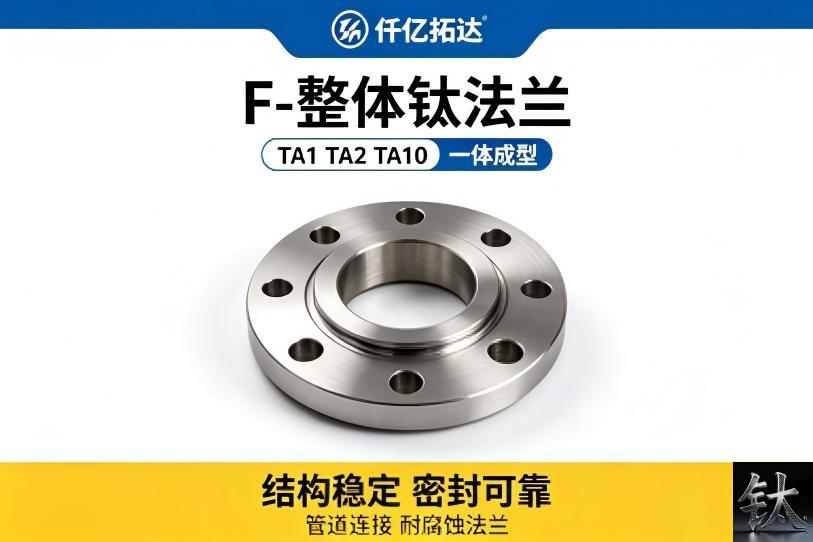
Titanium Flanges are the connection points in piping systems where corrosion, pressure and temperature all concentrate. They are specified across chemical electrolysis, sea water desalination, pharmaceutical clean service, hydrometallurgy, flue gas desulphurisation and vacuum salt production — anywhere a stainless flange would pit, and anywhere the joint has to survive decades rather than years.
Density is 4.51 g/cm³. Strength ranges from 240 MPa in commercially pure grades to 895 MPa in Ti-6Al-4V. Service temperature spans −253 °C to 600 °C. Available from DN10 to DN800, PN0.25 to PN25, in ASME B16.5, EN 1092-1, HG/T 20592 and GB/T configurations, with RF, FM, TG and RJ facings.
1. Five Structures and Where Each One Belongs
Structure is the first decision, and it is driven by three things: pressure class, temperature range and how often the joint will be opened for maintenance.
| Type | Standard | Pressure Range | Where It Fits |
|---|---|---|---|
| Integral forged | HG/T 20592 | PN0.6 – PN6.0 | Low pressure, ambient temperature, joints rarely opened |
| Weld neck | ASME B16.5 / GB/T 9112 | PN1.0 – PN25 | High pressure, high temperature, frequent thermal cycling |
| Lap joint | GB/T 9112 | PN0.25 – PN2.5 | Frequent inspection, cost-controlled projects — the flange rotates free of the pipe |
| Threaded | GB/T 9114 | PN0.6 – PN4.0 | Thin-wall pipe, or where welding is not possible on site |
The lap joint type is the one buyers underuse. Because the backing flange is free to rotate, bolt holes can be aligned without turning the pipe — which matters on a line that is dismantled every shutdown. The trade-off is a lower pressure rating, so it is not a substitute for a weld neck on a high-class joint.
2. Twelve Applications and the Grade That Suits Each
The grade question is answered by the medium. Below are the twelve duties we quote most often, with the reason each one calls for the grade it does.
| # | Industry | Medium / Condition | Grade |
|---|---|---|---|
| 1 | Chlor-alkali | Saturated brine, electrolyte, wet chlorine, sodium hypochlorite, up to 120 °C | TA2 |
| 2 | PTA (purified terephthalic acid) | Hot acetic acid with cobalt-manganese and bromide catalysts | TA10 |
| 3 | Hydrometallurgy | Dilute sulphuric and hydrochloric acid, ammonium sulphate and chloride liquors | TA9 / TA10 |
| 4 | Sea water desalination | Hot high-salinity brine, MED / MSF / RO evaporator and tube-sheet joints | TA2 / TA10 |
| 5 | Oil and gas completion | H₂S, CO₂ and chlorides together, high temperature and pressure | TC4 |
| 6 | Marine condensers | Flowing sea water, 30–50 °C, 1–3 m/s | TA2 |
| 7 | Power plant condensers | Sea water, demineralised water, secondary-loop condensate | TA2 / TA10 |
| 8 | Aerospace hydraulics | Hydraulic fluid, fuel, lubricant; −54 to 200 °C; 21–35 MPa | TC4 |
| 9 | Food and pharmaceutical | Fermentation media, water for injection, organic solvents; CIP/SIP cleanable | TA2 |
| 10 | Flue gas desulphurisation | Acidic slurry, pH 1–5, 50–80 °C, chloride and fluoride present | TA10 |
| 11 | Vacuum salt production | Saturated sodium chloride brine, 50–130 °C, −0.08 MPa vacuum | TA2 |
| 12 | Electroplating | Chrome, nickel and copper plating baths, pH 0.5–14 | TA1 |
The reasoning behind the less obvious entries
Chlor-alkali (TA2). Saturated brine and wet chlorine are oxidising, and that is precisely where commercially pure titanium performs best — a stable passive film forms and holds. 316L in the same service begins pitting above roughly 80 °C. This is why titanium is the default material for membrane cell anode and cathode chamber flanges and chlorine header connections.
PTA (TA10). Hot acetic acid carrying cobalt-manganese and bromide catalysts is a reducing, halide-bearing environment. Unalloyed titanium is not sufficient here; the molybdenum and nickel in TA10 are what hold the passive film together. This is a genuine grade requirement, not an upsell.
Flue gas desulphurisation (TA10). The slurry is acidic, chloride-bearing and frequently also carries fluoride. TA10 is specified for the chloride resistance. Note that if the fluoride content is significant, titanium ceases to be the right material altogether — fluoride attacks titanium regardless of grade, and the answer becomes a nickel alloy.
Aerospace (TC4). This is the one application where the driver is strength rather than corrosion. At 21–35 MPa with a fatigue requirement and a weight penalty, Ti-6Al-4V at 895 MPa tensile and 4.43 g/cm³ is the only grade in this family that works.
Electroplating (TA1). The requirement here is purity — the flange must not shed metal ions into the plating bath, because contamination changes the deposit. TA1 is the lowest-alloy, highest-purity option, and the load on a tank cover flange is trivial.
3. The Five Grades, Side by Side
| Grade | UNS / ASTM | Density | Tensile | Yield | Specify For |
|---|---|---|---|---|---|
| TA1 | R50250 / Gr1 | 4.51 g/cm³ | ≥ 240 MPa | ≥ 170 MPa | High-purity service, plating baths, low load, easy forming |
| TA2 | R50400 / Gr2 | 4.51 g/cm³ | ≥ 345 MPa | ≥ 275 MPa | Broadest coverage; the default when the duty is unclear |
| TA9 | R52400 / Gr7 | 4.52 g/cm³ | ≥ 345 MPa | ≥ 275 MPa | Reducing acids — dilute hydrochloric and sulphuric |
| TA10 | R53400 / Gr12 | 4.51 g/cm³ | ≥ 485 MPa | ≥ 345 MPa | Wet chlorine, dilute sulphuric acid, crevice corrosion |
| TC4 | R56400 / Gr5 | 4.43 g/cm³ | ≥ 895 MPa | ≥ 825 MPa | High-load structures, high pressure, thermal cycling |
How to choose when the duty is not fully defined: TA2. It covers the widest range of media and is the grade most likely to be in stock, which matters when the line is already down.
How to choose when the duty is defined: wet chlorine or dilute sulphuric acid — TA10. Strongly reducing acid — TA9. High pressure and high load — TC4. High purity — TA1. And if the medium contains fluoride in any meaningful concentration, none of the five — the material changes to a nickel alloy.
One caution worth repeating: TC4 is not a premium version of TA2. It is roughly two and a half times the strength and materially less corrosion resistant in many chemical media, and it is harder to weld. Specify it because a mechanical calculation demands it, not because it sounds safer.
4. Standards and Facings
Four standard systems are in use, and they are not interchangeable — the same nominal pressure class produces different dimensions in each.
| System | Standard | Coverage |
|---|---|---|
| Chinese national | GB/T 9112 – 9114 | General steel pipe flange dimensions; pair with GB/T 21225 for titanium material |
| Chinese chemical | HG/T 20592 – 20635 | Integral, weld neck, lap joint, threaded and blind — full range |
| American | ASME B16.5 | Class 150 – 2500, NPS ½" – 24"; the export default |
| European | EN 1092-1 | PN-designated metric flanges |
Pressure class and PN do not convert reliably. Class 150 and PN16 are close but not identical, and the difference shows up in the bolt circle — an ASME Class 150 and an EN PN16 flange of the same nominal size will not consistently bolt together. Confirm the system and stay in it across the whole spool.
| Facing | Code | Strength | Normally Used For |
|---|---|---|---|
| Raised face | RF | Widest availability, lowest cost | General service — the default |
| Male and female | FM / MFM | Gasket confined, better sealing reliability | Medium and high pressure chemical duty |
| Tongue and groove | TG | Gasket fully enclosed | Toxic or flammable media |
| Ring joint | RJ | Metal-to-metal seal | High temperature, high pressure oil and gas |
RF and FM are the standard stock facings. TG and RJ are made to order. Whichever you specify, state the surface roughness alongside the code — RF at Ra 3.2–6.3 μm, and progressively finer for confined and ring joint facings. A facing code alone does not define the sealing surface.
5. How They Are Made, and Why It Matters
A titanium flange passes through five operations, and each one leaves a defect signature if it is done badly.
- Forging. Open die or closed die, with a forging ratio of 3–5 recommended. The ratio is what breaks up the cast structure and gives the metal continuous flow lines. Under-forged stock retains casting porosity that no machining operation will remove.
- Rough machining. The sealing face is left with 2–3 mm of stock for finish machining. This is the reason a flange cannot be re-faced indefinitely — there is a finite allowance.
- Finish machining. The sealing face is machined to Ra 3.2–6.3 μm for a standard raised face. Bolt holes and location dimensions follow the standard tolerance.
- Surface treatment. Pickling removes the oxide scale from hot working; passivation restores the passive film. A properly finished flange has an even silver-grey appearance — patchy or discoloured surfaces suggest the pickling was incomplete.
- Non-destructive testing. 100% penetrant testing (PT) or 100% ultrasonic testing (UT) as standard; radiographic testing (RT) added for critical duty.
Why the testing line matters commercially. PT finds surface-breaking defects; UT finds what is inside — shrinkage cavity, inclusion, lamination. A flange with an internal void passes every dimensional check and every visual inspection, then fails under pressure at temperature once the line is commissioned. At that point the cost is not the flange, it is the shutdown.
6. Five Things That Go Wrong in the Supply Chain
Grade substitution. TA1 shipped where TA2 was ordered, or another alloy shipped as TC4. The parts are visually identical. Mill test certificates can be photocopied. The only reliable check is a spectrometer reading on a sample from the delivered lot.
Welded-over cracks. A forging crack dressed out and welded flush will pass a visual inspection and fail in service. PT on 100% of the part is what exposes it — this is the single most useful test to require on a forged flange.
Roughness out of specification. A sealing face at Ra 12.5 μm instead of 3.2–6.3 μm looks fine and leaks at temperature. Require a roughness record with the goods, and check it on receipt with a comparator or profilometer.
Dimensional error on the bolt pattern. Bolt circle diameter or hole spacing out of tolerance means the flange will not align with its mating part on site. This is checked in minutes with a caliper against the standard table, and it is the cheapest defect to catch before shipment.
No real non-standard capability. Some suppliers can only modify the dimensions of a standard part. Ask specifically about non-standard geometry — irregular outlines, variable thickness, titanium-steel composite flanges — before placing the order, not after.
We hold Titanium Flanges in TA1, TA2, TA9, TA10 and TC4 across integral, weld neck, lap joint and threaded structures, from DN10 to DN800 and PN0.25 to PN25, in ASME B16.5, EN 1092-1, HG/T 20592 and GB/T configurations. Non-standard flanges, irregular shapes and titanium-steel composite parts are made to drawing. Stock items dispatch in 3–5 working days; custom parts typically 7–15 days.
Send us the medium, temperature, pressure class, standard system and facing code — we will confirm the grade and provide the mill certificate, roughness record and NDT report with the quotation.
Email: sales@sxqytd.com | WhatsApp: +86 188 2967 9311
- 12 октября 2026 г. Спотовый рынок титановых материалов | Актуальные
- Отчёт по ценам на титан — 29 сентября 2026 г. | Цены на плиты, трубы
- Технология обработки и стандарты контроля качества титановых мешалок
- Основные конструкции титановых мешалок и рекомендации по выбору
- Преимущества титановых мешалок при высоких температурах и сильной ко
Контактное лицо: Wang Xiaoning
Телефон: +86-917-355-7966
Эл. почта: sales@sxqytd.com
WhatsApp: +86 188 2967 9311
Компания: Shaanxi Qianyi Tuoda Technology Co., Ltd
Адрес: Floor 4, Building 4, No. 188 Gaoxin Avenue, High-tech Zone, Baoji City, Shaanxi Province, China