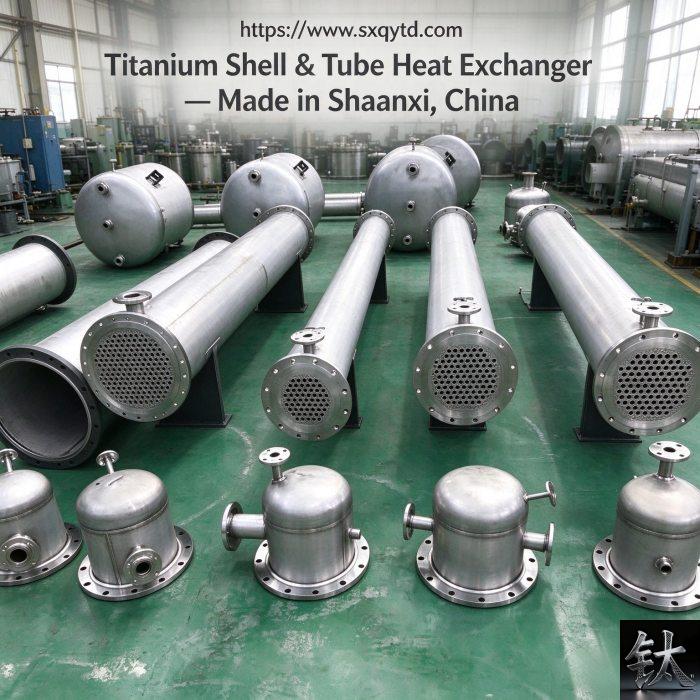
Titanium Tube-to-Tubesheet Welded Heat Exchanger Detail
| Спецификация | Roll+Seal Weld, Argon Backing, ASME VIII, B338/B265, MTC 3.1, Baoji |
|---|
Описание продукции: Titanium tube-to-tubesheet welded detail for shell and tube exchangers — expand-then-seal-weld sequence, ≥3.2mm roll-to-weld clearance, dual-side argon purge, autogenous GTAW, PT + helium leak test. A
Обзор продукции
Titanium Tube Sheet Welded Heat Exchanger Detail | Expand + Seal Weld, Argon Backing, ASME VIII
Meta Description: Titanium tube-to-tubesheet welded detail — expand-then-seal-weld sequence, ≥3.2mm roll-to-weld clearance, dual-side argon purge, autogenous GTAW, PT + helium leak test. ASTM B338 tube / B265 tubesheet, ASME VIII + TEMA, EN 10204 3.1, 3.2 TPI PO-fronted.
The Joint That Decides Whether the Exchanger Leaks
In a titanium shell-and-tube exchanger, the tube-to-tubesheet joint is where most failures start — not the tube body, not the shell. Two reasons:
- Titanium has low elastic modulus → rolled joint alone gives lower pull-out strength than steel; it needs the seal weld for leak integrity.
- Titanium has high oxygen affinity → any trapped gas or dirty fit-up getters into the weld, causing porosity/blowout if you weld before expanding.
So the sequence is not optional: clean → expand → confirm clearance → seal weld with argon backing. Skip the order, and you build a leak path into the most inspected joint in the unit.
Joint Build-Up (what "detail" actually means)
| Step | Detail | Why it matters |
|---|---|---|
1. Fit-up |
Tube protrusion 0.5–1.0mm past tubesheet face; bore cleaned, white-cloth check | No oil/grease/carbon-steel dust = no weld contamination |
2. Expansion |
Hydraulic or calibrated roller expand; Gr2 typical 3–6% (TEMA R/C 5–8% reference band, recalibrate for springback) | Metal-to-metal fit, kills annular gap that breeds crevice corrosion |
3. Clearance control |
≥3.2mm (1/8") from rolled zone to weld toe; same from back face | Prevents residual stress overlap → no weld cracking at expansion boundary |
4. Seal weld |
Autogenous GTAW (no filler for compatible Gr2-Gr2), torch + backside argon ≥99.999% | Full fusion, no undercut, no porosity |
5. Weld color |
Silvery white / light straw = pass; blue/purple/grey = oxidized | Color is the fastest shield-gas verdict — discolored weld is removed and re-welded, not ground and accepted |
6. NDE |
PT (non-chlorinated penetrant) + visual + helium leak (critical duty) | PT finds surface cracks; helium finds micro-leaks ET/hydro miss |
Why "Expand First, Weld Second" Is Physics, Not Habit
- Welding first traps expansion gas → blowout/porosity at root
- Rolling after welding transfers shear into the weld toe → crack risk
- Titanium springback is high → final ID must be measured, not assumed
- Grooved tubesheet holes (0.4–0.8mm deep) + expansion = mechanical interlock; seal weld = chemical barrier
Result: the annular gap that would otherwise acidify to pH 1–2 in hot brine never forms. That is how you stop crevice corrosion before it starts.
Crevice Corrosion — Killed at the Joint, Not After
Hot chloride (brine, wet Cl₂, seawater) + tight gap + no oxygen = passive film collapse inside the crevice. Grade 2 critical crevice temperature sits around 70–80°C.
Three fabrication defenses, all in the joint detail:
- Tight expansion — no stagnant annulus
- Full-penetration seal weld — smooth convex cap, no undercut (undercut = mini-crevice)
- Grade upgrade where CCT is exceeded — Gr7 (Ti-0.2Pd) for hot deaerated brine; Gr12 for hot pressurized brine. Thicker Gr2 does not raise the crevice threshold.
Material & Code Baseline
- Tube: ASTM B338 Gr1/Gr2/Gr7/Gr9/Gr12
- Tubesheet: ASTM B265 Gr2/Gr7; solid Ti or explosive-clad on CS
- WPS/PQR: ASME IX qualified; GTAW, argon backing documented in WPQ
- Code: ASME VIII Div.1 (UW-20 tube-to-tubesheet joint rules) + TEMA Class R/C/B
- Weld map: every joint numbered, heat numbers cross-linked tube ↔ tubesheet ↔ MTC
- Surface prep: ASTM B600 descale/pickle; ferroxyl free-iron check before service
Weld Acceptance Criteria (written into the ITP)
- No cracks, no porosity, no lack of fusion, no undercut
- Reinforcement ≤1.5mm, not below base-metal surface
- Color: silvery / straw pass; blue/purple/grey → remove + re-weld
- PT per ASME / non-chlorinated penetrant only
- Helium leak ≤1×10⁻⁶ mbar·L/s on critical (chlor-alkali / lithium / marine) duty
- Hydro per ASME VIII at 1.5× design pressure as final integrity check
Clad Tubesheet Note (often mishandled)
- Roller expansion on clad interface → shear/delamination risk
- Preferred sequence for clad: light hydroswage to pin → autogenous seal weld → final expansion
- Ti-clad overlay ring at joint face = common compromise when only the joint zone sees hot brine
QC Chain (per joint, per heat)
- B338 tube MTC 3.1 + B265 tubesheet MTC 3.1, heat cross-linked
- PM (XRF/OES) on tube + tubesheet — grade verified, not tag-trusted
- Fit-up white-cloth + bore cleanliness record
- Expansion parameter log (pressure / torque / wall reduction)
- Seal-weld gas-shield record (flow, dewpoint, backing purge)
- PT + visual color log + helium leak (if specified)
- Weld map + heat-trace dossier in MDR
- 3.2 (SGS/BV/TÜV) TPI witness at hold points, PO-fronted
Hard Boundaries (no overclaim)
- No "weld-only" joint without expansion on titanium — pull-out strength is insufficient
- No chlorinated penetrant on titanium PT (chloride contamination)
- Discolored weld = re-weld, never grind-and-accept
- Gr2 joint >80°C crevice in deaerated brine → upgrade to Gr7, not thicker wall
- Dry Cl₂ / HF excluded — separate alloy review
- 3.2 TPI named at PO; cannot be back-issued
RFQ Detail Checklist (copy-paste)
Tube: ASTM B338 Gr___, OD×wall ___
Tubesheet: B265 Gr___, solid / clad (__mm Ti overlay)
Joint type: expand-only / roll+seal weld / strength-weld ___
Expansion: hydraulic / roller, target wall reduction ___%
Roll-to-weld clearance: ≥3.2mm confirmed Y/N
Weld: autogenous GTAW / filler ___
Backing gas: argon purity ___%, post-flow time ___
NDE: PT (non-chlorinated) / helium leak (target ___ mbar·L/s) / RT ___
Service: brine / wet Cl₂ / caustic / Li brine, max temp ___°C
Code: ASME VIII Div.1 + TEMA Class ___
Cert: 3.1 / 3.2 TPI (SGS/BV/TÜV ___)
FAQ — Titanium Tube Sheet Welded Detail
Q1: Why not weld before expanding?
A: Trapped gas causes blowout; rolling after welding cracks the weld toe. Titanium's low modulus + high oxygen affinity makes expand-first the only safe sequence.
Q2: How much roll-to-weld clearance?
A: ≥3.2mm (1/8") from rolled zone to weld and from back face to expansion zone — keeps residual stresses from overlapping.
Q3: What weld color is acceptable?
A: Silvery white or light straw. Blue/purple/grey = shielding failure; remove and re-weld — never grind and accept.
Q4: Is seal weld enough without expansion?
A: No. Titanium springback gives low pull-out from expansion alone; weld gives leak seal, expansion gives mechanical fit. Both, in order.
Q5: How is crevice corrosion prevented at the joint?
A: Tight expansion removes the gap; full-fusion seal weld removes the stagnation; Gr7 upgrades the alloy where CCT (>80°C) is exceeded.
Q6: PT penetrant choice?
A: Non-chlorinated only. Chloride residue on titanium is a crevice starter.
Q7: Helium leak test worth it?
A: On chlor-alkali / lithium / marine duty — yes. Sensitivity ~1×10⁻⁶ mbar·L/s beats hydro for micro-leaks at the most critical joint.
Q8: Clad tubesheet — roller or hydroswage?
A: Hydroswage preferred; roller extrusion can delaminate the clad interface. Sequence: pin → seal weld → final expand.
Q9: ASME reference?
A: UW-20 covers tube-to-tubesheet joints; WPS/PQR per ASME IX; TEMA class sets expansion grooving.
Q10: Biggest field failure mode?
A: Plain roll joint in hot deaerated brine, no seal weld, no grade upgrade — crevice groove appears at the tubesheet line in 1–2 seasons.
Request a Detail Drawing Review
Email: sales@[yourdomain].com
Send tubesheet DWG + tube spec + service temp/chemistry. We return joint-sequence recommendation, expansion window, and NDE scope — not just a price per joint.
About: Baoji titanium tube-to-tubesheet welding desk — ASTM B338 tube / B265 tubesheet, expand-then-seal-weld sequence, ≥3.2mm roll-weld clearance, dual-side argon GTAW, non-chlorinated PT + helium leak option, ASME VIII + TEMA. Crevice path designed out at the joint; Gr7 upgrade where CCT demands. EN 10204 3.1 default, 3.2 TPI PO-fronted. Heat No. = tube tag = tubesheet = weld map.
Опишите ваши требования — марка, размер и количество. Ответим в течение 24 часов.
Предпочитаете чат? WhatsApp +86 188 2967 9311 или напишите на sales@sxqytd.com.


- Titanium Price Today (26 октября 2026 г.): отчет о рынке Китая
- Цена на титан сегодня (23 октября 2026 г.): пластина, трубка, стерже
- Читайте титановую проволоку и проволоку из титанового сплава: класси
- Титановая проволока: от выбора марки до производственного процесса (
- Читайте титановую трубку и трубку из титанового сплава: классификаци
Контактное лицо: Wang Xiaoning
Телефон: +86-917-355-7966
Эл. почта: sales@sxqytd.com
WhatsApp: +86 188 2967 9311
Компания: Shaanxi Qianyi Tuoda Technology Co., Ltd
Адрес: Floor 4, Building 4, No. 188 Gaoxin Avenue, High-tech Zone, Baoji City, Shaanxi Province, China