Titanium in Hydrochloric Acid: Grade Limits, Failure Modes and Alternatives
| Спецификация | Material Category: Commercially pure titanium / Pd- and Mo-Ni-alloyed titanium |
|---|---|
| Применимый стандарт | Grades Covered: Gr1, Gr2, Gr7, Gr11, Gr12, Gr16, Gr17, Zr702 |
| Состояние материала | Service Media: HCl, H₂SO₄, wet chlorine, dry chlorine, hot chlorides, HF |
| Контроль и упаковка | Referenced Standards: ASTM B265 / B338 / B348 / B363, ASME B16.5 |
Описание продукции: Room-temp HCl limits: ~7% Gr2, ~9% Gr12, ~27% Gr7. Where titanium fails, how oxidising ions change the data, and 9 RFQ fields to send.
Обзор продукции
Titanium in Hydrochloric Acid: Grade Limits, Failure Modes and Alternatives
Commercially pure titanium is not a general-purpose acid material. In reagent-grade hydrochloric acid at 25 °C, published iso-corrosion curves place the useful limit of Grade 2 at roughly 7% HCl, Grade 12 at about 9%, and Grade 7 — Grade 2 with 0.12–0.25% palladium — at about 27%. Raise the temperature and those numbers collapse: near boiling, even a fraction of a percent can drive high corrosion rates. So the decision is never simply "titanium or no titanium". It is concentration, temperature, crevice geometry and, above all, the impurity spectrum of the real process stream. This guide gives the grade-by-grade limits, the five conditions where titanium must be excluded outright, and the nine data fields to send with an enquiry so that a grade recommendation is based on your process rather than on a datasheet.
At a Glance: HCl Limits by Grade at 25 °C
| Item | Grade 2 (CP Ti) | Grade 7 (Ti-0.2Pd) | Grade 12 (Ti-0.3Mo-0.8Ni) |
|---|---|---|---|
| Nominal addition | None | 0.12–0.25% Pd | 0.3% Mo + 0.8% Ni |
| Useful HCl limit at 25 °C | ~7% | ~27% | ~9% |
| Useful H₂SO₄ limit at 25 °C | ~5% (~20% at 0 °C) | ~45% | Not the grade for this duty |
| Crevice risk in near-neutral brine | Possible near 93 °C; unlikely below 70 °C | No crevice attack below 250 °C at pH > 1 | No attack in neutral saturated brine above 316 °C (lab data) |
| Hydrofluoric acid | Excluded | Excluded | Excluded |
| Dry chlorine | Excluded | Excluded | Excluded |
| Wet chlorine / seawater | Excellent | Excellent but unnecessary | Excellent |
| Typical material cost index | 1.0× | ~2–3× | ~1.5–2× |
1. What the Published Limits Actually Cover (and What They Don't)
Every percentage in the table above is a screening value read from published iso-corrosion curves — lines of equal corrosion rate, conventionally the 5 mpy (0.127 mm/y) line — for commercially pure grades in reagent-grade acid under laboratory conditions. That is a narrow definition, and the gaps matter more than the numbers.
Those curves assume a static or mildly agitated, single-phase liquid at a controlled temperature. They do not account for erosion at high velocity, two-phase flow, vapour condensate, deposits on a heat-transfer surface, weld heat tint, galvanic coupling to a more noble alloy, or a crevice. They do not tell you how the material behaves during a cleaning cycle, a startup transient, or an upset in which the acid concentration doubles for two hours. A designer who takes "7% HCl" as an allowable design limit rather than a shortlist filter is using the data outside its scope.
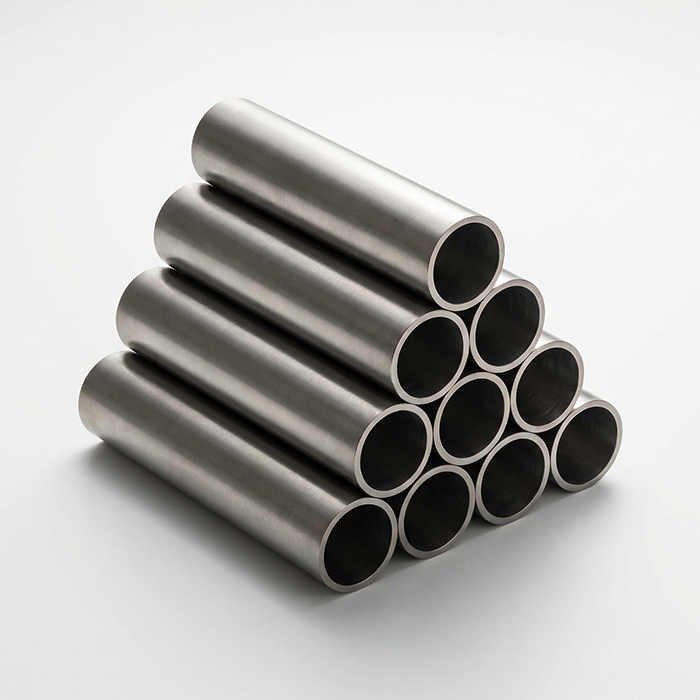
The standards most often quoted on a purchase order do not close that gap either. ASTM B265 Titanium Plate, ASTM B338 Grade 2 tube, ASTM B348 bar and ASTM B363 fittings govern chemical composition, mechanical properties, dimensional tolerances and test methods. ASME B16.5 governs flange dimensions and pressure-temperature ratings. None of them selects a grade for a corrosive medium. A certificate can be fully compliant while the part is entirely unsuitable for the service — which is why the process data, not the certificate, has to come first.
Data note: concentration limits quoted in this article are approximate values from publicly published iso-corrosion data for titanium grades (producer and industry-association corrosion curves), rounded for screening purposes. They are not design allowances and are not a warranty of performance. Confirm by coupon or loop testing in the actual stream, and review the final selection against the applicable pressure-equipment code before releasing a purchase order.
For buyers, the practical consequence is simple: send the medium description with the enquiry, not just the grade. "Grade 2 tube, ASTM B338" is a complete dimensional specification and an incomplete corrosion specification. Our titanium materials pages list the forms and grades we supply; choosing among them still requires the process data in the checklist at the end of this article.
2. The "7% Rule"
: Grade-by-Grade HCl Limits at Room Temperature
At 25 °C in pure HCl, the useful limits separate cleanly: about 7% for Grade 2, about 9% for Grade 12, and about 27% for Grade 7. The spread is not a curiosity — it is the whole basis for paying a premium. What follows is how to read it.
Unalloyed Grades 1 through 4 differ mainly in oxygen and iron content, which raises strength and slightly reduces corrosion resistance in reducing media. Grade 2 is the default for chemical processing because it balances formability, strength and availability; Grade 1 is softer and is often chosen for thin-wall tube and formed parts. Grade 5 (Ti-6Al-4V) is an aerospace alloy, and in reducing acids its corrosion resistance is generally no better — sometimes worse — than Grade 2. Specifying Grade 5 for an acid vessel buys strength the vessel does not need and gives up corrosion margin.
Grade 7 is Grade 2 plus 0.12–0.25% palladium; the related Grade 11 is the same addition to Grade 1, and Grades 16 and 17 use a lower ~0.05% palladium addition as a lower-cost compromise. Grade 12 uses molybdenum and nickel instead. The HCl number for Grade 12 is only about two percentage points above Grade 2 — a useful reminder that Grade 12 is not a reducing-acid grade, even though it is routinely grouped with Grade 7 in supplier catalogues. Where Grade 12 earns its premium is hot chloride and brine service, not hydrochloric acid.
So "7%" is best understood as a shortlist rule, not a threshold to design against. Below roughly 3–5% HCl at ambient temperature with dissolved oxygen present, Grade 2 is usually the economical answer; between that and about 25%, the discussion moves to Grade 7; above it, or at any elevated temperature, the discussion moves away from titanium entirely. If your stream falls in the middle band, the next two sections explain what the alloying additions actually do, so the choice is defensible to your own corrosion engineer.
3. Why Palladium Works — The Electrochemistry
Titanium resists corrosion because of a thin, adherent, self-healing TiO₂ film that reforms in seconds when damaged, provided an oxidising species is available. In oxidising media — nitric acid, wet chlorine, hypochlorite, aerated seawater — that supply is continuous and the film is stable. In a reducing acid such as HCl, there is no oxidising species to repair the film. It dissolves, the corrosion potential falls into the active region, and the metal dissolves with it.
Palladium does not make titanium intrinsically more noble, and 0.2% of anything cannot form a protective layer of its own. It works as a cathodic catalyst. Finely dispersed Pd sites greatly increase the rate of the cathodic hydrogen-evolution reaction, so the mixed potential of the alloy shifts in the noble direction — commonly cited in grade-selection literature as roughly 200 mV — into the passive region. The TiO₂ film can then hold even in deaerated acid. This is a kinetic effect on the electrochemical couple, not a barrier effect, which is why such a small addition produces a three- to four-fold increase in the useful HCl concentration.
The consequence for procurement is that the palladium has to be in the metal, not on it. A Grade 2 component with a palladium-containing coating, or a weld made with unalloyed filler, will not reproduce Grade 7 behaviour at the joint. When you specify Grade 7 seamless tube to ASTM B338, the filler metal, the weld procedure and the PMI check on the finished spool all need to be part of the same requirement. Alloy mixing is the most common quality failure in titanium procurement, and it is invisible without positive material identification.
Grade 16 and Grade 17, at about 0.05% Pd, sit between Grade 2 and Grade 7. They are worth asking about when the chloride crevice risk is real but the reducing-acid demand is modest — you buy most of the crevice resistance without the full palladium premium. Availability is more limited than Grade 2, so confirm size coverage before locking the specification.
4. Why Molybdenum and Nickel Work — Where Grade 12 Earns Its Premium
Grade 12 (Ti-0.3Mo-0.8Ni) takes a different route. Molybdenum stabilises the passive film in hot chloride environments, and nickel improves resistance in hot brine and mildly reducing conditions. It also carries a mechanical advantage: typical ultimate tensile strength is around 480–620 MPa against roughly 345–460 MPa for Grade 2, which can matter in pressure components where wall thickness is set by strength rather than by corrosion allowance.
Its published performance in neutral saturated brine is striking — laboratory work reports no crevice attack above 316 °C — and it retains crevice resistance down to about pH 3. That makes it the natural choice for hot brine, geothermal and salt-lake evaporator duty, and for heat-exchanger tube bundles where chloride concentration rises on the hot side. It is also why condenser and U-bent tube enquiries often turn into a Grade 2 versus Grade 12 discussion once the operating temperature is known.
Be honest about the trade-off, though. In strongly reducing acids Grade 12 is weaker than Grade 7: its room-temperature HCl limit is about 9% against about 27%. Below pH 3, Grade 7 is the better answer. Grade 12 is not a cheap Grade 7, and Grade 7 is not a better Grade 12 — they solve different problems. A specification that simply says "corrosion-resistant titanium alloy" leaves the supplier to choose, and the cheapest interpretation of that phrase is Grade 2.
For non-standard equipment, the same logic applies at component level: a titanium reactor or heat exchanger may legitimately use Grade 2 for the shell, Grade 12 for hot-brine tube bundles and Grade 7 for a small reducing-acid section. Mixed-grade fabrication is common in our shop, but it must be drawn, welded and documented as such.
5. The "Temperature Trap"
: What Changes as HCl Approaches Boiling
Every limit quoted so far is a 25 °C limit. Temperature is the variable that most often invalidates a grade selection made from a room-temperature table, and the fall-off is not linear. In boiling sulfuric acid, published data show high corrosion rates from as little as 0.5% acid for unalloyed titanium, with Grade 12 usable to roughly 1% and Grade 7 to roughly 7%. Hydrochloric acid behaves the same way: the useful concentration band narrows sharply as the acid approaches its boiling point, and a stream that is harmless at ambient temperature can be aggressive at 80 °C.
There are four temperatures worth putting on an enquiry, and they are rarely the same number: normal operating temperature, maximum design temperature, startup or shutdown transient temperature, and cleaning-in-place temperature. The last one is the most frequently omitted. Plant maintenance teams often clean with uninhibited HCl at elevated temperature, and published failure investigations repeatedly link severe titanium equipment damage to cleaning procedures that used pure acid without an oxidising inhibitor. A vessel that survives ten years of production can be destroyed in one cleaning cycle.
Heat-transfer surfaces add a second temperature problem: the metal wall can be significantly hotter than the measured bulk fluid. A tube carrying cooling water on one side and a hot acid stream on the other sees the skin temperature, and the skin is where the passive film fails first. If you are selecting tube for a reboiler or condenser, give us wall temperature rather than bulk temperature.
Finally, temperature and concentration interact with aeration. Warm, deaerated, stagnant acid in a drain leg or a dead-ended branch is a worse environment than the bulk analysis suggests. Where the design allows, drainable geometry and circulation during shutdown do more for material life than a one-grade upgrade.
6. The "Clean Acid" Problem
: Why Real Streams Often Behave Better
Here is the counter-intuitive part, and the reason a datasheet alone cannot settle the question. Small concentrations of multivalent metal ions — Fe³⁺, Cu²⁺, Ni²⁺, Ti⁴⁺, Mo⁶⁺ — act as oxidising inhibitors and passivate titanium against HCl. Oxidising agents including sodium hypochlorite, nitric acid, dissolved chlorine and chromates do the same. Titanium's own corrosion product, dissolved Ti⁴⁺, is a powerful inhibitor, which is why recirculating process streams often stabilise after an initial period.
In practice this means a real process stream containing ferric or cupric ions can be far milder than the pure-acid curve predicts, and published data note that in the presence of adequate ferric ion, Grades 2, 7 and 12 can show similar corrosion resistance. Conversely, a "clean" reagent-grade acid, deaerated and hot, is the worst case — the exact condition under which laboratory limits were measured, and the exact condition created by many cleaning procedures. If sulfuric or hydrochloric acid is used to clean titanium surfaces, published practice calls for sufficient ferric chloride to be added as an inhibitor.
For buyers, there is a direct instruction hidden in this: do not describe your medium as "10% HCl". Describe it as "10% HCl at 60 °C with approximately X ppm Fe³⁺, aerated, with trace organics". If you do not have the impurity spectrum, say so — a supplier who quotes a grade without asking for it is guessing. Our applications page shows the industries these questions typically come from; the answers still have to come from your process.
One more reason the impurity spectrum matters is that it can reverse the material choice entirely. The next-but-one section on zirconium explains why the same ferric ions that protect titanium can disqualify Zr702. That single piece of information decides whether you are buying a titanium tube or a zirconium one.
7. When Titanium DOES Corrode
: Five Hard Exclusions
Every titanium grade has conditions where it must not be specified. Listing them costs nothing and prevents the expensive kind of mistake. These are the five we check before accepting an order for acid or halide service.
Hydrofluoric acid and fluoride contamination
The fluoride ion dissolves the TiO₂ film and forms soluble TiF₆²⁻ complexes. No commercially available titanium grade is suitable for HF service, and the risk extends to mixed acids: nitric acid contaminated with even a few hundred ppm of HF behaves very differently from clean nitric acid. Where fluorides are present, specify zirconium only with care, PTFE-lined equipment, or a suitable nickel alloy — and say so on the enquiry.
Dry chlorine
Titanium is outstanding in wet chlorine and hypochlorite, but dry chlorine is a hard exclusion: published corrosion tables report rapid attack and ignition in dry chlorine at around 30 °C, while wet chlorine from 10 to 88 °C gives corrosion rates from nil to about 0.02 mpy. The water content maintains the passive film. Any design where chlorine can dry out — a dead leg, a startup before steam injection, a failed moisture seal — needs to be reviewed as a dry-chlorine case.
Red fuming nitric acid
Titanium is excellent across most nitric acid concentrations, but red fuming nitric acid can form a pyrophoric reaction product and has caused serious accidents. Published investigations associate the risk with water content below about 1.34% and NO₂ above about 6%. Oxidising is normally good for titanium; this is the exception.
Hot reducing acids above the grade limit
HCl, H₂SO₄ and H₃PO₄ beyond the concentration/temperature envelope in section 2 — particularly when hot, deaerated and free of oxidising ions. Grade 7 extends the envelope; it does not remove it.
Hot chloride crevices
Unalloyed Grade 2 can suffer localised crevice attack in hot chloride solutions even when general corrosion is negligible. The threshold and the design remedies are the subject of the next section, because this is the failure mode most often missed at the specification stage.
These exclusions are not an argument against titanium. They are the boundary conditions that make a titanium specification credible. If your medium falls into one of them, we would rather tell you at enquiry stage than after the first shutdown.
8. The "Crevice Problem" in Flanges and Tube-to-Tubesheet Joints
General corrosion data assume a freely exposed surface. Real equipment is full of narrow gaps where oxygen is depleted, chlorides concentrate and pH falls: under a gasket, between a tube and its tubesheet, in a threaded connection, beneath a deposit, behind a support baffle. In those gaps, the passive film on Grade 2 can break down locally at temperatures well below those that would cause general attack.
Published data put the onset of crevice corrosion for unalloyed titanium in near-neutral brine at approximately 93 °C, with attack unlikely below 70 °C; in seawater the threshold is above roughly 82 °C. Lower pH and high calcium or magnesium concentrations pull the onset temperature down. Grade 7 does not suffer crevice corrosion in chloride solutions below about 250 °C at pH above 1, and Grade 12 shows no attack in neutral saturated brine above 316 °C in laboratory tests — which is why the upgrade decision is usually driven by crevice risk, not by general corrosion rate.
| Location | Why it is a crevice | Practical response |
|---|---|---|
| Gasketed titanium flange face | Gasket shields the face; stagnant chloride film concentrates | Welded joint where possible; otherwise Grade 7/12/16 facing or a qualified gasket system |
| Tube-to-tubesheet expansion joint | Annular gap, highest wall temperature in the bundle | Seal weld plus controlled expansion; upgrade tube grade at the hot end |
| Threaded fittings and fasteners | Thread roots are natural crevices and are hard to inspect | Avoid threads in hot chloride; use welded or flanged connections |
| Under deposits or support baffles | Deposit creates a differential aeration cell | Design for drainage and cleanability; specify periodic cleaning chemistry |
The cheapest solution is often geometric rather than metallurgical. Eliminating the crevice lets you stay on Grade 2 and its 1.0× cost index. When the geometry cannot be changed — and in shell-and-tube exchangers it usually cannot — the grade upgrade is the right spend. Our earlier article on what a titanium flange is and which standards apply covers the dimensional side; this section covers the corrosion side of the same joint.
9. Beyond the Price Tag
: Cost, Availability and When Not to Upgrade
Published industry estimates put Grade 7 at roughly two to three times and Grade 12 at roughly 1.5 to two times the material cost of Grade 2. These are indicative multiples, not quotations — palladium pricing moves, and small-batch, non-standard sizes carry a different premium from stocked mill products. Ask for a current figure against your actual size list.
The purchase price is rarely the largest number in the calculation. A heat-exchanger bundle that has to be replaced costs the tube, the shutdown, the labour, the lost production and the requalification. Against that, a doubled material cost on a small tube bundle is often trivial. The same arithmetic does not hold for a large Grade 7 shell, where the tonnage is high and the corrosion benefit may be zero.
There are three situations where paying for Grade 7 is a genuine waste. First, clean seawater, wet chlorine or neutral chloride service below 70 °C, where Grade 2 is already effectively immune and crevice attack is unlikely. Second, oxidising acids such as nitric acid, where the medium itself maintains the passive film. Third, short-duration or one-off duty where replacement is planned and downtime is not a constraint. In all three, the money is better spent on dimensional inspection, PMI and documentation.
Availability is the other half of the decision. Grade 2 in common plate, tube and bar sizes is widely stocked; palladium-bearing grades in odd diameters are typically made to order, and lead time depends on mill schedule rather than on fabrication. Check our current stock list before fixing a delivery date, and tell us early if the requirement is a small batch or a repeat call-off — the two are sourced differently. Documentation requirements such as EN 10204 3.1 mill certificates, PMI reports and third-party inspection should be stated at enquiry stage as well; see the certifications page for the document set we can supply.
10. Choose Grade 2, Grade 7, Grade 12 — or Something Else?
Choose Grade 2 if: the medium is seawater, wet chlorine, hypochlorite, nitric acid or neutral chlorides; the metal temperature stays below about 70 °C in chloride service; crevice geometry has been designed out; and you need the widest choice of stocked sizes at the lowest material cost. This covers the majority of industrial titanium enquiries.
Choose Grade 7 if: the medium is a reducing acid within roughly 25–27% HCl at ambient temperature; the stream is deaerated or oxygen-depleted; hot chloride crevices cannot be eliminated; or an unplanned shutdown is expensive enough to justify the palladium premium. Specify the filler metal and PMI at the same time.
Choose Grade 12 if: the dominant problem is hot brine, geothermal fluid or chloride crevice risk above 80 °C rather than reducing acid; you also want higher strength than Grade 2; and the pH stays above about 3.
Choose zirconium 702 or a lined vessel if: the HCl concentration or temperature exceeds the Grade 7 envelope, or HF is present. In non-oxidising hydrochloric acid, Zr702 is resistant across essentially the full concentration range up to boiling and is one of the most resistant metals available for HCl. There is a critical condition attached: oxidising species — ferric or cupric ions, aqua regia, coupling to a noble metal, or an applied anodic potential — can push zirconium past its pitting potential and cause pitting or stress corrosion cracking. Published work shows the effect of 500 ppm ferric ions in 20% HCl at 100 °C. So the very ions that protect titanium can disqualify zirconium. If your stream contains oxidising chloride contaminants, titanium is the safer family; if it does not and the acid is hot or strong, zirconium is the stronger candidate. PTFE lining and suitable nickel alloys are the remaining options where neither metal fits.
That inversion is why the first question in any HCl enquiry should be about impurities, not about price. Our Grade 2 flange price reference and titanium price index are useful once the grade is settled; they cannot settle the grade.
11. Frequently Asked Questions
Can Grade 2 titanium handle 10% hydrochloric acid at room temperature?
Not as a rule. Published iso-corrosion curves put the useful limit of unalloyed Grade 2 at roughly 7% HCl at 25 °C in pure acid, and the limit falls quickly as temperature rises. At 10% HCl, Grade 7 (about 27% at 25 °C) is the normal titanium candidate, provided the stream is not near boiling. If oxidising ions such as Fe3+ are present, Grade 2 may perform better than the pure-acid curve suggests, but that requires confirmation by coupon testing in the actual stream.
Why does adding 0.2% palladium make such a large difference?
Palladium does not form a protective layer of its own. It acts as a cathodic catalyst, increasing the hydrogen-evolution reaction rate and shifting the alloy's mixed potential into the passive region — commonly cited as roughly 200 mV in the noble direction. The TiO2 film can then remain stable in deaerated reducing acid. This is why Grade 7 reaches about 27% HCl at 25 °C where Grade 2 reaches about 7%.
Is Grade 7 always better than Grade 2?
No. In seawater, wet chlorine, hypochlorite and nitric acid, Grade 2 is already effectively immune, so the palladium adds corrosion performance you will never use while roughly doubling or tripling material cost. Grade 7 earns its premium in reducing acids, deaerated streams, and hot chloride crevices. Grade 12, not Grade 7, is often the better upgrade for hot brine above 80 °C.
Can titanium be used for hydrochloric acid cleaning or pickling?
Only with inhibition. Severe damage to titanium equipment has been reported from cleaning procedures using pure HCl or acid containing amines. Published practice calls for sufficient ferric chloride to be added so the acid remains oxidising enough to maintain the passive film. Cleaning temperature and duration should be treated as separate design cases and included in the enquiry, because a vessel can survive years of production and fail in one cleaning cycle.
What happens if the process stream contains ferric or cupric ions?
Multivalent metal ions including Fe3+, Cu2+, Ni2+, Ti4+ and Mo6+ act as oxidising inhibitors and passivate titanium against hydrochloric acid; published data note that with adequate ferric ion, Grades 2, 7 and 12 can show similar corrosion resistance. The same ions are a problem for zirconium, where they can raise the potential above the pitting potential. Report the impurity spectrum with your enquiry — it can change which material family is correct.
At what temperature does crevice corrosion become a risk in chloride service?
For unalloyed Grade 2 in near-neutral brine, published thresholds put possible crevice attack at approximately 93 °C and unlikely below 70 °C; in seawater the threshold is above roughly 82 °C. Lower pH and high calcium or magnesium concentrations pull the onset temperature down. Grade 7 resists crevice attack below about 250 °C at pH above 1, and Grade 12 shows no attack in neutral saturated brine above 316 °C in laboratory tests.
When should I specify zirconium 702 instead of titanium?
When hydrochloric acid concentration or temperature exceeds the Grade 7 envelope and the stream is non-oxidising. Zr702 is resistant across essentially the full HCl concentration range up to boiling, where titanium grades are not. Do not choose zirconium if oxidising chloride contaminants such as ferric or cupric ions, aqua regia, or anodic polarisation are present, since these can cause pitting or stress corrosion cracking. Hydrofluoric acid excludes both metals.
12. Summary and Request a Quotation
Titanium is an outstanding material in oxidising and chloride media and a conditional one in reducing acids. At 25 °C in pure HCl, work to roughly 7% for Grade 2, 9% for Grade 12 and 27% for Grade 7, then discount heavily for temperature, deaeration and crevice geometry. Oxidising ions such as Fe³⁺ and Cu²⁺ widen the window for titanium and narrow it for zirconium, which is why the impurity spectrum belongs on the enquiry. Five conditions remain hard exclusions for every titanium grade: HF, dry chlorine, red fuming nitric acid, hot reducing acid beyond the grade limit, and hot chloride crevices on unalloyed grades.
To get a grade recommendation rather than a generic offer, send these nine fields with your enquiry:
- Acid and concentration in wt%, including the maximum reached during upsets or cleaning
- Normal, maximum, startup/shutdown and cleaning temperatures in °C — use wall temperature for heat-transfer surfaces
- Full impurity spectrum: Fe³⁺, Cu²⁺, Ni²⁺, dissolved chlorine, fluorides, oxidants, organics
- pH, aeration or dissolved-oxygen condition, and whether the stream is stagnant or circulating
- Crevice geometry: gasketed joints, tube-to-tubesheet expansion, threads, deposits, support baffles
- Product form and governing standard: ASTM B265 plate, B338 tube, B348 bar, B363 fittings, ASME B16.5 flanges
- Dimensions, quantity, and whether this is a one-off small batch or a repeat call-off
- Required documents: EN 10204 3.1 mill certificate, PMI report, NDT, third-party inspection
- Target delivery date and destination port
Send those nine fields through our contact page and we will come back with a grade recommendation, the sizes currently available and a quotation — or tell you plainly that titanium is the wrong material for the duty.
Опишите ваши требования — марка, размер и количество. Ответим в течение 24 часов.
Предпочитаете чат? WhatsApp +86 188 2967 9311 или напишите на sales@sxqytd.com.
- Что такое титан фланец| ASME B16.5 ASTM B381 Gr2 Gr5 титановые флажк
- ASME B16.5 титановая флажка класса 2 DN100-DN600 Класс 150/300 FOB
- Gr2 Titanium Sheet Price FOB Shanghai | ASTM B265 In Stock
- Titanium Price Today (26 октября 2026 г.): отчет о рынке Китая
- Цена на титан сегодня (23 октября 2026 г.): пластина, трубка, стерже
Контактное лицо: Wang Xiaoning
Телефон: +86-917-355-7966
Эл. почта: sales@sxqytd.com
WhatsApp: +86 188 2967 9311
Компания: Shaanxi Qianyi Tuoda Technology Co., Ltd
Адрес: Floor 4, Building 4, No. 188 Gaoxin Avenue, High-tech Zone, Baoji City, Shaanxi Province, China