Titanium Plate, Gr1 to Gr12 — Rolled in Baoji, Cut to the Size You Order
Titanium Plate Gr1 Gr2 Gr5 Supplier | Cut to Size, Baoji ChinaTitanium Plate · stock & cut-to-size
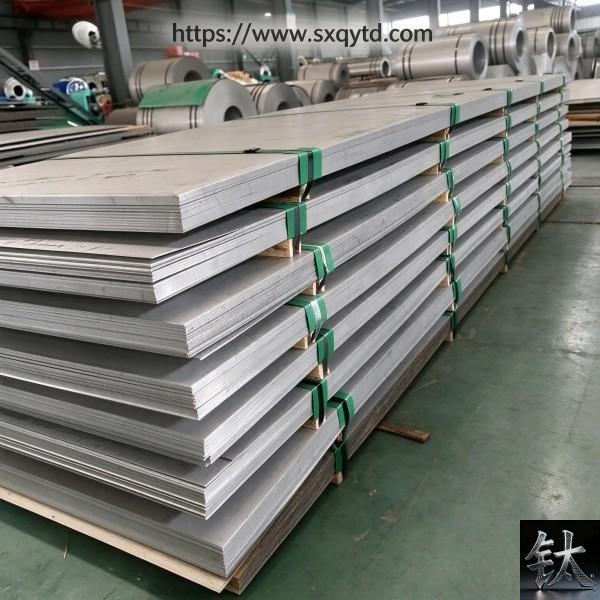
Around 400 tonnes of Titanium Plate and sheet on the floor, from 0.5 mm sheet to 100 mm heavy plate. We shear, plasma and saw to your finished dimension, so a 20 kg order is as workable as a two tonne one. Every lot ships with MTC to EN 10204 3.1.
What Titanium Plate actually is
Titanium Plate is not one product. The same grade name covers material with completely different rolling history, and the rolling history decides how the plate behaves under a welder, a press or a machining centre.
By manufacturing route
| Route | Thickness | Good for | What to watch |
|---|---|---|---|
| Hot rolled + annealed | 3–100 mm | Vessel shells, tube sheets, structural parts | Scale must be removed by pickling; check for alpha case |
| Cold rolled + annealed | 0.5–4.75 mm | Sheet for forming, gaskets, linings, cladding | Higher residual stress; flatness after cutting |
| Slab / forged block | 60–300 mm | Machined components, valve bodies, thick tube sheets | Ultrasonic test is essential — internal defects are invisible |
| Cross rolled | 6–60 mm | Wide plate beyond normal coil width | Anisotropy — specify the test direction |
By form and standard definition
ASTM B265 splits the product by thickness: sheet 0.4–4.75 mm, plate 4.76–100 mm, strip in coils. That line is commercial, not academic — sheet is priced per coil width, plate per piece plus cutting. Ask three suppliers for "2 mm titanium plate" and two of them will quote you a different product.
Why titanium, and when it is the wrong answer
Titanium earns its price through a passive titanium dioxide film that re-forms in milliseconds after scratching. That film is why titanium survives chlorides that destroy stainless steel. It is also why titanium fails in media where the film cannot form.
| Medium | Gr2 behaviour | Correct grade |
|---|---|---|
| Seawater, chloride brine | Excellent; no pitting even at high velocity | Gr2 |
| Wet chlorine, hypochlorite | Excellent | Gr2 |
| Nitric acid, oxidising media | Good to about 65% at moderate temperature | Gr2 / Gr7 |
| Hydrochloric acid, sulphuric acid | Attacked — film cannot stabilise | Gr7 (Ti-0.2Pd) or Gr12 |
| Formic and acetic acid | Good dilute; hot concentrated attacks | Gr7 |
| Dry chlorine gas above 200 °C | Ignition risk | Not recommended |
| H₂S, cathodic service | Hydride embrittlement possible | Gr2 with caution |
Cleanliness matters as much as corrosion. For medical and semiconductor work the interstitial content is specified, not just the grade: Gr2 at 0.08% max oxygen and Gr4 at 0.40% are the same alloy family, but one bends and the other machines. Extra-low interstitial grades hold oxygen at 0.13% max for cryogenic and implant duty, where ductility at temperature is the design driver.
Technical standards we work to
| Scope | Standard | Notes |
|---|---|---|
| Plate, sheet, strip | ASTM B265 / ASME SB265 | Base material specification; SB265 is the version accepted for pressure vessels |
| Pressure vessels | ASME Section VIII Div. 1 | SB265 material under U-stamp design; UT and impact per design |
| Aerospace Gr5 | AMS 4911 | Tighter chemistry and mechanical limits than B265 |
| Aerospace Gr2 | AMS 4902 | Annealed sheet, strip and plate |
| Chinese national | GB/T 3621 | TA1, TA2, TA9 (Gr7 equivalent), TA10 (Gr12 equivalent) |
| European | DIN 17860 · EN 10204 | Certificate type 3.1 or 3.2 |
| Testing | ASTM E8/E8M · E290 · A578 | Tensile, bend, ultrasonic |
Where a drawing cites a standard we do not normally stock to, we quote the gap rather than substituting silently. Gr7 versus Gr12 is the classic case: both are "corrosion titanium", but Gr7 carries palladium and costs 30–40% more. If your medium allows Gr12, we will say so and save you the difference.
From sponge to your loading dock
Melt
Sponge titanium plus master alloy, double or triple VAR melted to ingot.
Forge
Ingot converted to slab or bloom, surface conditioned.
Roll
Hot rolled to thickness, cross rolled where width demands.
Anneal
Vacuum or atmosphere anneal to relieve rolling stress.
Pickle
HNO₃/HF bath removes scale and the oxygen-rich alpha case.
Level
Stretcher levelling, then UT and dimensional check.
Cut
Shear, plasma, waterjet or saw to finished size.
Document
MTC 3.1, PMI, UT report, export packing.
The step buyers underestimate is pickling. A hot-rolled plate that was merely descaled by grinding keeps a hard, oxygen-rich surface layer that behaves differently under machining and can crack when formed. If your machinist says "this plate cuts like glass", the plate was not pickled properly. We specify pickled and annealed as the default, not as an upgrade.
Key performance and how we verify it
| Property | Gr1 | Gr2 | Gr5 / TC4 | Gr7 |
|---|---|---|---|---|
| Tensile strength, min | 240 MPa | 345 MPa | 895 MPa | 345 MPa |
| Yield strength, min | 138 MPa | 275 MPa | 828 MPa | 275 MPa |
| Elongation, min | 24% | 20% | 10% | 20% |
| Max oxygen | 0.18% | 0.25% | 0.20% | 0.25% |
| Density / melting point | 4.51 g/cm³ · 1,668 °C | |||
- Chemistry — every lot tested for Fe, O, N, H, C against B265 limits. Hydrogen above 150 ppm is a rejection in our book, not a note on the file.
- Thickness tolerance — held to B265 permissible variation, checked at four corners and the centre line, not one random point.
- Flatness — measured after cutting, because plate that was flat on the mill can bow once rolling stress is released by trimming.
- Surface — pickled, no visible alpha case, no embedded iron. Iron from a shared shear is the number one hidden cause of "titanium that rusts".
- Ultrasonic testing — ASTM A578 Level II or III for pressure and thick-section work.
- PMI — positive material identification on request, with alloy and residual elements reported.
Where this plate ends up
| Industry | Medium | Component | Grade & thickness |
|---|---|---|---|
| Heat exchangers | Seawater, brine, process water | Tube sheets, baffles | Gr2, 20–80 mm |
| Chemical / chlor-alkali | Wet chlorine, hypochlorite, HCl | Cell covers, reactor shells | Gr7 / Gr12, 3–30 mm |
| Desalination | Seawater, brine at 70–120 °C | Evaporator shells, partitions | Gr2, 3–20 mm |
| Aerospace | — | Structural brackets, fittings | Gr5 AMS 4911, 6–60 mm |
| Medical | Body fluid, sterilisation | Implant blanks, instrument bodies | Gr2 / Gr23 ELI, 3–25 mm |
| Electrochemical | Acid electrolyte, anodic current | Anode plates, cell frames | Gr1 / Gr2, 1–10 mm |
Selection guide
Grade selection by duty
| If the duty is | Choose | Because |
|---|---|---|
| General chemical, seawater, no strong reducing acid | Gr2 | Best balance of corrosion, strength and price |
| Deep drawing, explosive bonding, linings | Gr1 | Lowest strength, highest ductility |
| Structural, high stress, weight critical | Gr5 / TC4 | 2.6× the strength of Gr2 |
| HCl, H₂SO₄, hot reducing acids | Gr7 | Palladium stabilises the passive film |
| Mild reducing media, cost sensitive | Gr12 | Mo-Ni addition, far cheaper than Pd |
Size selection by application
| Application | Thickness | Note |
|---|---|---|
| Gaskets, linings, cladding | 0.5–2 mm | Cold rolled; check flatness after cutting |
| Vessel shell, small diameter | 3–8 mm | Formability matters more than strength |
| Vessel shell, large diameter | 8–25 mm | Specify UT and test direction |
| Tube sheet | 25–120 mm | Through-thickness UT mandatory |
| Machined block | 60 mm + | Allow 3–5 mm per face for clean-up |
What we can change for you
| Option | Available | Typical use |
|---|---|---|
| Cut to size | Shear ≤6 mm · plasma/waterjet 6–60 mm · saw >60 mm | Direct to fabrication, no in-house cutting |
| Edge condition | Sheared, machined, bevelled | Weld prep on shell courses |
| Surface | Pickled, sandblasted, ground | Coating adhesion, lining prep |
| Testing | UT, PMI, hardness, third party (SGS / BV / TÜV) | Project QA requirements |
| Documentation | MTC 3.1 / 3.2, test coupons, heat traceability | Pressure vessel and export files |
| Forming | Rolled shells, cut rings, drilled tube sheets | Reduce site work |
Lead time, inspection and warranty
| Item | Commitment |
|---|---|
| Stock sizes | Dispatched within 1–2 working days of order confirmation |
| Cut to size | 3–5 working days depending on cutting method and quantity |
| Non-standard grade | Quoted with a mill lead time before the order is accepted — never a guess |
| Documents | MTC EN 10204 3.1 as standard; 3.2 and third-party on request |
| Warranty | 12 months against material defects; non-conformance replaced or credited |
| Packing | Wooden case, edge protected, moisture barrier, shipping marks applied |
Questions buyers actually ask
One kilogram. Plate is charged on actual cut weight plus a cutting fee, not on a full mill sheet.
Can you supply plate to my drawing?Yes. Send the drawing or a dimensioned sketch. We confirm grade, thickness tolerance, cut plan and edge condition before quoting, so the price you receive is the price that ships.
Why does my titanium plate rust after machining?Iron contamination, almost always, from a shear or machining centre that also processes carbon steel. Titanium has to be cut with dedicated or thoroughly cleaned tooling. The rust is embedded steel, not the titanium corroding.
Gr7 or Gr12 for hydrochloric acid?Gr7 is safer across concentration and temperature. Gr12 works in mildly reducing media at moderate temperature and costs less. Send the concentration, temperature and chloride level and you will get a specific recommendation rather than a general one.
Do you supply ASME SB265 material?Yes. SB265 is the ASME version of B265 and is what a U-stamp vessel needs. Specify SB265 on the purchase order and the certificate will reference it.
Send your plate size list
Tell us grade, thickness, width, length and quantity — or send the drawing. We reply with stock availability, cut plan and price, usually the same working day.
Shaanxi Qianyi Tuoda Technology Co., Ltd. · Baoji, Shaanxi, ChinaMaterial on the floor. Ready when you are.
- Что такое титан фланец| ASME B16.5 ASTM B381 Gr2 Gr5 титановые флажк
- ASME B16.5 титановая флажка класса 2 DN100-DN600 Класс 150/300 FOB
- Gr2 Titanium Sheet Price FOB Shanghai | ASTM B265 In Stock
- Titanium Price Today (26 октября 2026 г.): отчет о рынке Китая
- Цена на титан сегодня (23 октября 2026 г.): пластина, трубка, стерже
Контактное лицо: Wang Xiaoning
Телефон: +86-917-355-7966
Эл. почта: sales@sxqytd.com
WhatsApp: +86 188 2967 9311
Компания: Shaanxi Qianyi Tuoda Technology Co., Ltd
Адрес: Floor 4, Building 4, No. 188 Gaoxin Avenue, High-tech Zone, Baoji City, Shaanxi Province, China