Custom Titanium Equipment Manufacturer — Reactors, Heat Exchangers & Tanks Built to Drawing
Around 100 sets of non-standard equipment a year: reactors, shell-and-tube exchangers, columns, tanks, agitators, coils, separators and pipe spools. We are a material supplier first, so plate, tube, fittings and flanges can be coordinated from our stock.
Product definition
Around 100 sets of non-standard equipment a year: reactors, shell-and-tube exchangers, columns, tanks, agitators, coils, separators and pipe spools. We are a material supplier first, so plate, tube, fittings and flanges can be coordinated from our stock.
| Form / structure | Function | Typical choice |
|---|---|---|
| Reaction duty | Reactor, jacketed or coil | Residence time and heat removal |
| Heat duty | Shell-and-tube exchanger | Area, approach temperature, fouling |
| Mass transfer | Packed or tray column | Stage, pressure drop |
| Mixing | Top or side-entry agitator | Viscosity, shear and suspension |
| Storage | Vertical or horizontal tank | Volume, cleanability, drainage |
Why choose this material
Titanium Gr2 resists seawater, brine, wet chlorine and many oxidising media. Gr7 adds palladium for reducing acid; Gr12 adds Mo-Ni at lower cost. Nickel alloys handle caustic, high temperature and mixed acid where titanium cannot. Weld shielding, crevice design and cleanliness decide whether the passive film survives fabrication.
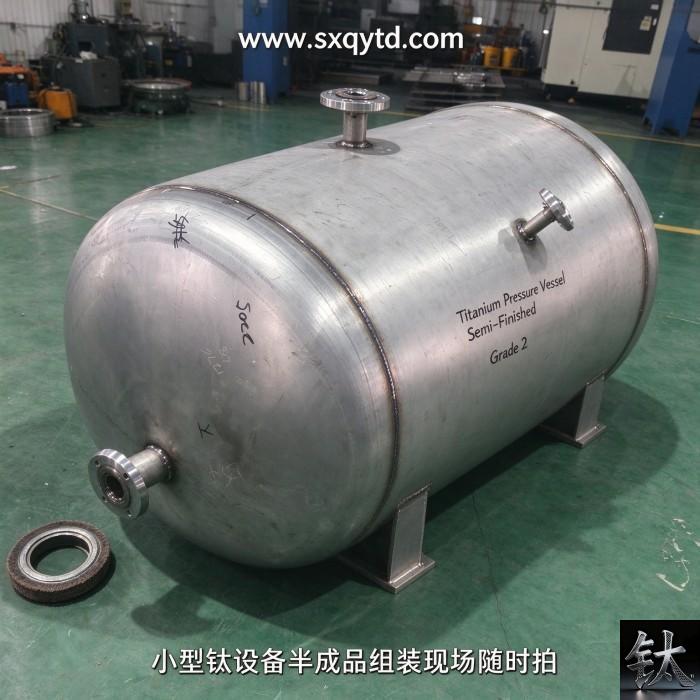
Fabrication is where titanium equipment succeeds or fails. A vessel made from certified Gr2 plate can still be rejected because a weld went blue, because the purge gas was insufficient, or because iron was embedded during a fit-up. Material certificates prove what arrived at the workshop; weld colour and NDT prove what left it.
Crevice design deserves early attention. Titanium is immune to chloride pitting in open seawater but vulnerable in tight gaps where the passive film cannot renew. Gasket grooves, lap joints and unvented support contacts need review at the drawing stage, when geometry is still cheap to change.
Nickel alloy cladding and titanium lining are often cheaper than solid titanium for large vessels. They also move the risk from the material to the fabrication, which puts the emphasis on weld overlay quality and NDT coverage. We will quote both routes and state which one we would choose for the duty.
Technical standards
| Scope | Standard | Use |
|---|---|---|
| Pressure vessel | ASME Section VIII Div.1 | Design and fabrication |
| Heat exchanger | GB/T 151 | Shell-and-tube equipment |
| Non-ferrous vessel | NB/T 47003 | Domestic pressure equipment |
| General design | GB/T 150 | Pressure vessel principles |
| Welding | ASME IX / NB/T | WPS, PQR and welder qualification |
| NDT | RT, UT, PT, MT | Per ITP and governing code |
Manufacturing process
Review
Drawing, datasheet and operating conditions.
Design
Material, thickness and calculation.
Material
Heat traceability, MTC and PMI.
Fabricate
Cutting, forming, fit-up.
Weld
Argon-shielded titanium welding.
NDT
RT/UT/PT, leak and hydro tests.
Inspect
Dimensions, balance and finish.
Pack
Dossier, skid, export crate.
Every order follows the same discipline: drawing or schedule review, material and standard confirmation, controlled fabrication, inspection, documents and export packing. A short lead time is useful only when the specification is correct.
Key performance and inspection
| Parameter | Control | Why it matters |
|---|---|---|
| Weld colour | Silver to light straw | Blue/grey means oxygen contamination |
| Penetration | Full penetration where specified | Pressure integrity |
| NDT | RT, UT, PT as ITP | Hidden defects |
| Hydrotest | Per design pressure | Leak integrity |
| Agitator balance | Agreed ISO balance grade | Vibration and seal life |
| Filtration accuracy | Micron rating by process | Separation performance |
The inspection matrix follows the code, not the shop's habit. A pressure-retaining titanium weld normally sees visual and PT on the root, RT or UT on a defined percentage of the seam, and a hydrostatic test at 1.3–1.5 times design pressure. Where cyclic duty is specified, the percentage goes up rather than staying at the code minimum.
Agitators are inspected differently from vessels. The mechanical checks are runout of the shaft, impeller pitch, hub fit and dynamic balance to an agreed grade. A balanced agitator runs quietly and protects the mechanical seal; an unbalanced one destroys the seal in months and gets blamed on the seal supplier.
Application industries
| Industry | Medium | Equipment / process | Material choice |
|---|---|---|---|
| Chlor-alkali | Wet chlorine, brine | Cooler, reactor, cell | Gr2 / Gr7 |
| Lithium | High-chloride brine | Exchanger, crystalliser | Gr2 / Gr12 |
| Chemical | Acid and chloride | Reactor, column | Gr7 / nickel |
| Desalination | Seawater, brine | Evaporator, condenser | Gr2 |
| Pharma | Clean water, solvent | Tank, mixer | Gr2 / polished |
| Marine | Seawater | Separator, piping | Gr2 |
Selection guide
| Selection point | What to confirm | Why it matters |
|---|
Structure follows the process, not the drawing template. A jacketed reactor suits moderate heat duty with clean product; a coil reactor suits high heat-transfer area with viscous product; a shell-and-tube exchanger suits high area with clean fluids; a packed column suits low pressure drop with corrosive service. Getting this wrong is expensive to fix later because it changes the whole equipment envelope.
Where the process data is incomplete, we say so rather than filling the gaps. A budget price built on assumed heat duty is worse than no price, because it anchors a decision that later needs a redesign.
Accessories and custom options
| Option | Available | Purpose |
|---|---|---|
| Nozzles | Orientation, size, flange class | Match site piping |
| Internals | Baffles, coils, spray balls, demisters | Process performance |
| Agitation | Impeller, seal, motor and balance | Mixing and reliability |
| Surface | Pickle, polish, lining, insulation | Corrosion and cleanliness |
| Documents | Design calc, WPS/PQR, NDT, hydro | Project handover |
Custom does not mean undefined. Nozzle orientation, manway size, lifting points, drain slope, instrument ports, surface finish and insulation are all decided at drawing review and recorded on an approved drawing set. That set is the contract for both sides.
Export packing for equipment is a design task. A column that flexes in transit arrives out of tolerance; a vessel with unprotected nozzles arrives with damaged flange faces. Skidding, bracing and moisture protection are specified per item, not left to a generic crate.
Lead time, inspection and warranty
| Item | Commitment |
|---|---|
| Technical review | About 2 working days |
| Fabrication | Schedule confirmed after design approval |
| Dossier | MTC, WPS/PQR, welder, NDT, hydro and dimensional reports |
| Warranty | 12 months against fabrication defects under approved operation |
| Packing | Sea-worthy crate, skid, moisture barrier |
Questions buyers ask
Yes. PDF, DWG, material take-off and marked-up sketches are accepted. We confirm grade, dimensions, standards and inspection before quoting.
Can you supply small quantities?Yes. Stock products can be supplied by piece, cut length or mixed package.
What documents are included?MTC EN 10204 3.1 as standard. PMI, NDT, dimensional and third-party reports are available on request.
Send your drawing, schedule or size list
Tell us the material, dimensions, medium, temperature, pressure and quantity. We will confirm the selection and delivery before quoting.
Shaanxi Qianyi Tuoda Technology Co., Ltd. · Baoji, Shaanxi, ChinaMaterial on the floor. Ready when you are.
- Что такое титан фланец| ASME B16.5 ASTM B381 Gr2 Gr5 титановые флажк
- ASME B16.5 титановая флажка класса 2 DN100-DN600 Класс 150/300 FOB
- Gr2 Titanium Sheet Price FOB Shanghai | ASTM B265 In Stock
- Titanium Price Today (26 октября 2026 г.): отчет о рынке Китая
- Цена на титан сегодня (23 октября 2026 г.): пластина, трубка, стерже
Контактное лицо: Wang Xiaoning
Телефон: +86-917-355-7966
Эл. почта: sales@sxqytd.com
WhatsApp: +86 188 2967 9311
Компания: Shaanxi Qianyi Tuoda Technology Co., Ltd
Адрес: Floor 4, Building 4, No. 188 Gaoxin Avenue, High-tech Zone, Baoji City, Shaanxi Province, China