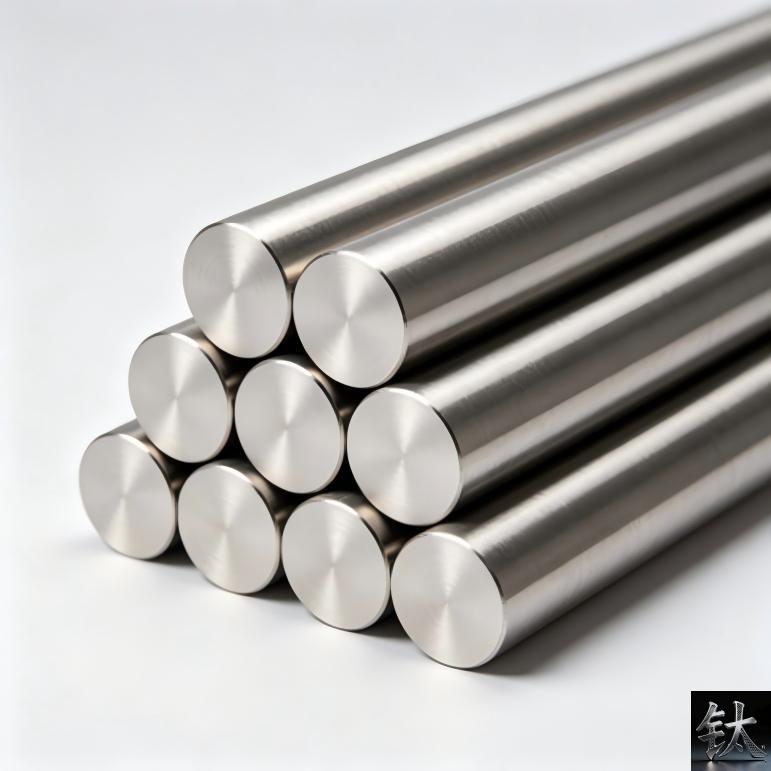
AMS 4928 Grade 5 Titanium Bar — Ti-6Al-4V (R56400) Aerospace Bar from Baoji
Titanium Grade 5 bar · AMS 4928 · Ti-6Al-4V · UNS R56400
AMS 4928 is the SAE aerospace specification for Ti-6Al-4V (Grade 5, UNS R56400) bar — double vacuum-arc remelted, fracture-toughness controlled and fully traceable to the melt. Where an aerospace or defence drawing calls out AMS 4928, a commercial ASTM B348 bar will not pass. SXQYTD supplies AMS 4928 Grade 5 bar with double-VAR melt certification, UT to AMS 2631 and a 3.1 / 3.2 material certificate. Below is the detail that decides form, condition and inspection before you issue a PO.
| Material | Grade 5 (UNS R56400, Ti-6Al-4V) | Principle | Double-VAR aerospace bar |
| Type & stock | Round / square / hex / forged bar | Industry | Aerospace, defence, high-end medical |
| Standard | AMS 4928 (SAE) · annealed | Lead time | 1–2 weeks stock; 3–5 weeks custom |
1. What an AMS 4928 bar is — by grade and by form
By grade, it is Ti-6Al-4V (Grade 5, UNS R56400) — the alpha-beta alloy that carries most airframe and engine loads. By specification, AMS 4928 is the SAE aerospace issue of that bar (annealed), covering round, square, hexagon, flat and forged bar plus wire, forgings and rings. It is the document an aerospace drawing references; ASTM B348 is the commercial/industrial equivalent and is not a substitute where AMS 4928 is mandated. (STA condition, when needed, is covered by AMS 4965.) By form, we stock round bar from Ø6 mm up to large section, plus square, hex and forged billet for subsequent forging.
2. Why AMS 4928 — not just any Grade 5 bar
The metal chemistry looks the same as B348, but the controls around it are what an aerospace buyer pays for. Match the spec to the duty:
| Duty | Spec to specify | Why |
| Aerospace drawing | AMS 4928 | Double-VAR, fracture toughness, UT Class A. |
| Commercial / industrial | ASTM B348 Gr5 | Same alloy, lighter documentation. |
| High strength STA | AMS 4965 | Solution-treated and aged. |
| Implant | ASTM F136 (ELI) | Lower interstitials, biocompatible. |
Three things an AMS 4928 buyer must verify: (1) the bar must come from a double vacuum-arc remelted (VAR) ingot — single-melt or EB/hearth-melt stock is rejected on melt records; (2) ultrasonic acceptance is to AMS 2631 Class A (tighter than commercial UT), so a "clean" B348 bar can still fail; and (3) the certificate must trace to the heat and melt source — a generic 3.1 without melt practice will not clear first-article review.
3. Technical standards we build to
- Spec: AMS 4928 (SAE), Ti-6Al-4V, annealed; certificate EN 10204 3.1 (3.2 on request).
- Melt practice: double vacuum-arc remelted (VAR), melt-source documented.
- Chemistry (R56400, AMS): Al 5.50–6.75 %, V 3.50–4.50 %, Fe ≤ 0.25 %, O ≤ 0.20 %, C ≤ 0.08 %, N ≤ 0.05 %, H ≤ 0.015 %, Y ≤ 0.005 %.
- Mechanical (annealed): tensile 895–930 MPa (130–135 ksi), yield ≥ 828 MPa (120 ksi), elongation ≥ 10 %, reduction of area ≥ 25 %.
- Inspection: UT to AMS 2631 Class A, PT to AMS 2644, chemistry & grain per spec.
4. Manufacturing flow — from double-VAR ingot to your bar
1) Double-VAR ingot with melt certificate → 2) Forge / roll to bar → 3) Anneal per AMS 4928 → 4) Pickling / passivation (remove α-case) → 5) Straightening → 6) Band-saw cutting to length → 7) UT (AMS 2631 Class A) + PT (AMS 2644) → 8) Dimensional and grain check → 9) Chemistry / PMI and heat-treat record → 10) Material certificate (3.1 / 3.2) and export packing. Every heat carries a melt-and-heat-treat package so the bar clears first-article and NADCAP-style review.
5. Key performance
| Item | Control value | Note |
| Tensile strength | 895–930 MPa | 130–135 ksi. |
| Yield strength | ≥ 828 MPa | 120 ksi minimum. |
| Elongation / RA | ≥ 10 % / ≥ 25 % | Ductility margin. |
| Iron limit | ≤ 0.25 % (AMS) | Tighter than B348 0.40 %. |
| Density | 4.43 g/cm³ | ~60 % lighter than steel. |
6. Application industries
| Industry | Part | Why AMS 4928 |
| Aerospace airframe | Fittings, spars, brackets | Traceability + toughness. |
| Aero engine | Shafts, discs, blades | Double-VAR cleanliness. |
| Defence | Structural members | Melt + UT acceptance. |
| High-end medical | ELI Grade 23 on request | Clean, documented stock. |
7. Selection guide
By spec: drawing says AMS 4928 → take this bar; says B348 → the commercial Grade 5 bar is enough and cheaper; says AMS 4965 → STA condition. By form: round for shafts and blanks, square / hex for wrench and fastener stock, forged bar for your own forgings. By certificate: ask for 3.2 (with a named surveyor / third party) if your QA requires it, otherwise 3.1 clears most first-article reviews. Send the drawing note, size, length, condition and cert level; we confirm in one reply.
8. Customizable items & accessories
- Form and size (Ø6 mm to large section; square / hex / forged bar to order).
- Condition: annealed (AMS 4928) or STA (AMS 4965) on request.
- Length: random mill length or cut to your dimension.
- Surface: peeled, ground, polished; rough-turned to save machining.
- Certificate: EN 10204 3.1 or 3.2; PMI, UT (AMS 2631 A) and PT reports.
9. Lead time, test reports & warranty
| Item | Commitment |
| Lead time | 1–2 weeks from stock; 3–5 weeks custom / large section. |
| Test reports | Melt cert, UT (AMS 2631 A), PT, PMI, 3.1/3.2 certificate. |
| Warranty | 12 months against material and workmanship defects from shipment. |
10. FAQ
AMS 4928 or ASTM B348 — which do I need?
If the drawing or purchase order names AMS 4928, you need this bar — the double-VAR melt, AMS 2631 Class A ultrasonic acceptance and full melt traceability are called out there, and a B348 bar will fail first-article review even though the alloy is the same. If no aerospace spec is named, ASTM B348 Grade 5 is the lower-cost, fully adequate commercial choice.
Why does double vacuum-arc remelting matter?
Titanium's fatigue and fracture behaviour are set by inclusion cleanliness and chemical homogeneity. A second VAR pass removes hard-alpha inclusions and even out the melt, lifting fracture toughness and fatigue life to the level aerospace structures require. We supply the melt certificate showing two remelts — that is the line between aerospace and commercial stock.
Annealed or solution-treated-and-aged (STA, AMS 4965)?
AMS 4928 is the annealed condition and suits most machined and forged parts with the best ductility. AMS 4965 (STA) raises strength past ~1100 MPa for high-load components but at the cost of elongation and machinability. Unless the drawing calls for STA, take annealed.
Request a quote
Send the spec (AMS 4928 or 4965), form, size, length, condition and certificate level (3.1 / 3.2). We return melt-source confirmation and a stock-backed price within 8 hours.
Phone / WeChat: +86 188 2967 9311
Email: sales@sxqytd.com
Or leave a message on the contact page with your drawing attached.
- Что такое титан фланец| ASME B16.5 ASTM B381 Gr2 Gr5 титановые флажк
- ASME B16.5 титановая флажка класса 2 DN100-DN600 Класс 150/300 FOB
- Gr2 Titanium Sheet Price FOB Shanghai | ASTM B265 In Stock
- Titanium Price Today (26 октября 2026 г.): отчет о рынке Китая
- Цена на титан сегодня (23 октября 2026 г.): пластина, трубка, стерже
Контактное лицо: Wang Xiaoning
Телефон: +86-917-355-7966
Эл. почта: sales@sxqytd.com
WhatsApp: +86 188 2967 9311
Компания: Shaanxi Qianyi Tuoda Technology Co., Ltd
Адрес: Floor 4, Building 4, No. 188 Gaoxin Avenue, High-tech Zone, Baoji City, Shaanxi Province, China