How to Verify Titanium Flange Stock: 5 Red Flags and a 5-Step Check Before You Pay
When a titanium flange is needed for a shutdown, "in stock, ships today" is the most attractive sentence a supplier can say — and the most commonly unverified. A flange that arrives three weeks late, or arrives in the right size but the wrong facing, costs far more than the price difference that made the order look attractive.
This is a practical checklist for verifying whether a stock claim is real, drawn from common procurement problems in Titanium Flanges. It is written for buyers, not against any particular supplier.
Why stock claims are hard to verify in this product
Titanium Flanges come in a very large matrix: diameter, pressure class, facing, grade and surface condition all vary independently. Holding genuine stock across that matrix ties up a lot of capital.
The normal business consequence is that most suppliers hold a narrow range and manufacture the rest to order. That is a legitimate model — the problem only arises when an order-to-manufacture quote is presented as stock, because the lead time difference between the two is four to six weeks and that difference is what the buyer is actually paying for.
Five warning signs
1. Stock claimed across every size
A supplier that shows large quantities available in every diameter and pressure class is either very heavily capitalised or describing capability rather than inventory. The tell is not the claim, it is the response when you ask for the list: a genuine stockist can produce a dated inventory sheet with quantities, and can explain which sizes are short.
When this goes wrong, it goes wrong expensively: the order is confirmed and paid, a fraction ships, and the balance goes into a production queue nobody mentioned. On a shutdown, the delay cost exceeds the flange cost by an order of magnitude.
2. Incomplete specification — the most easily missed problem
Quotes frequently state diameter and pressure class and stop there. Five parameters decide whether the part actually works:
- Grade — Gr2 quoted where Gr7 or Gr12 was needed
- Facing — RF quoted where the drawing specifies FF, or vice versa
- Condition — annealed specified, hard temper supplied
- Standard — ASME B16.5 substituted for GB/T 9124, which will not fit
- Surface — pickled supplied where machined was specified
If a quotation cannot state all five clearly, the "stock" claim behind it should be treated as unconfirmed. This is not usually dishonesty — it is often a quote written from a price list rather than a warehouse.
3. Substitution after payment
The most damaging failure mode: the quoted size is confirmed, payment is made, and the shipment contains a nearby size or a different facing, explained as "the original was sold out". By then the equipment is open and the part does not fit.
Prevention is entirely contractual. Lock five parameters in the purchase order — DN, PN or Class, facing, grade, quantity — and state that any change requires a new quotation and a new confirmation. A supplier unwilling to accept that clause is telling you something.
4. Manufacturing lead time presented as stock
A verbal "in stock, ships immediately" against an order that will actually take 15–25 days to produce is the most common form of this problem, and the one that most often catches buyers under time pressure.
Three questions separate the two quickly:
- Can you send the mill test certificate for this specific batch, now?
- What is the heat number, and does it match the marking on the flange body?
- Can we do a live video call at the warehouse and look at the parts?
A stockist answers all three without friction. An order-to-manufacture supplier cannot answer the first two at all, because the certificate is issued after production.
5. Contract terms that leave the delivery date open
A verbal three-day promise, with a contract that says "delivery per order cycle", gives the buyer no remedy when the parts arrive on day thirty. On a critical repair that difference is usually covered by air freight and lost production.
What the purchase order should carry: a specific delivery date, a late-delivery penalty, explicit confirmation that the goods are from stock rather than production, and a pre-shipment video inspection.
The verification checklist
| Check | What to ask for | How it should look |
|---|---|---|
| MTR certificate | The mill test certificate for the specific batch, before payment | Issued and dated already — not "will be provided after production" |
| Heat number | The heat number on the certificate, and where it is marked on the part | Matches the laser marking or steel stamp on the flange body |
| Live warehouse video | A scheduled video call showing the parts | Real parts, real shelves, quantity visible — not stock photography |
| Inventory sheet | A dated list with sizes and quantities | Itemised, with short items identified rather than everything "available" |
| Trial order | A small first order of the same specification | Ships on the stated date, matches the certificate |
| PO terms | Fixed DN / PN / facing / grade / quantity, plus delivery date and penalty | Substitution requires a new quotation and written confirmation |
Five steps before you place the order
- Get every stock commitment into the purchase order — verbal commitments have no remedy.
- Verify the MTR certificate number and the heat number against the physical part, before payment.
- Write the five fixed parameters into the PO: diameter, pressure class, facing, grade, quantity.
- Add a delivery date and a late-delivery penalty clause.
- Complete a video inspection 24 hours before dispatch, and keep the photographs and certificate on file.
Questions buyers ask
Is real titanium flange stock common?
For standard sizes — common diameters, PN16 to PN40, RF facing, Gr2 — genuine stock is normal. Non-standard diameters, very high pressure classes, special facings and non-standard grades are almost always made to order. A supplier who claims stock on a special facing is worth questioning.
How much does stock cost compared with made-to-order?
Stock typically carries a 5–15% premium, reflecting the capital and storage cost of holding it. Against that, on an urgent repair the alternative is four to six weeks of downtime. For scheduled projects, made-to-order is usually the better buy; for a shutdown, stock is almost always cheaper overall.
Can stock and made-to-order items be combined in one order?
Yes, but quote and ship them separately and keep the documents separate. Combining them into one shipment makes responsibility ambiguous if only part of the order fails inspection.
How should Titanium Flanges be stored?
Dry, stable temperature, out of direct light, away from acids and alkalis. Store face up on timber battens rather than directly on concrete or steel, to avoid impact damage and surface contamination. Titanium does not rust, but a damaged facing is a scrapped flange.
What we can show you
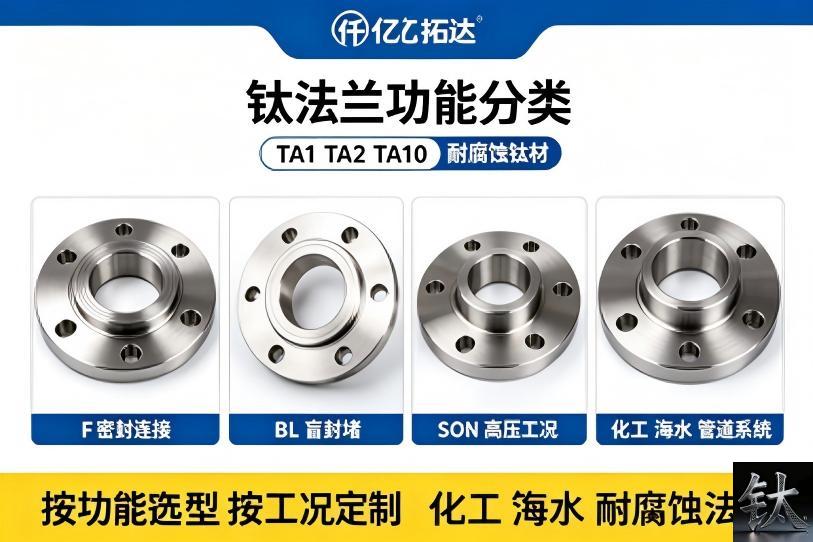
We hold 1,500 Titanium Flanges in stock in Baoji, China's Titanium Valley — PL, WN, threaded and blind; Gr2, Gr7, Gr12 and Gr5; DN15 to DN600; PN10 to PN40 and Class 150/300; to GB/T 9112, HG/T 20592, ASME B16.5, EN 1092-1 or JIS B2220.
Everything on this checklist is available on request: dated inventory list with quantities, MTR certificates for the specific batch before you pay, heat numbers matched to the marking on the part, and a live video call at the warehouse. If a size is short, we will tell you before you order rather than after.
Send the size, pressure class, facing and standard. We confirm stock, price and shipping date within 4 hours.
Email sales@sxqytd.com · WhatsApp +86 188 2967 9311
This article is a procurement reference based on common industry practice. It does not refer to any specific company. Purchase decisions should rest on the signed contract and physical verification.
- Oct 12, 2026 Titanium Material Spot Market | Latest Price of TA1 TA2
- Titanium Price Report – 29 September 2026 | Gr2 Gr5 Plate, Tube, Bar
- Processing technology and quality inspection standards for titanium
- Common structural types and selection guidelines for titanium stirre
- Advantages of titanium alloy agitator in adapting to high temperatur
Contact Person: Wang Xiaoning
Tel: +86-917-355-7966
Email: sales@sxqytd.com
WhatsApp: +86 188 2967 9311
Company: Shaanxi Qianyi Tuoda Technology Co., Ltd
Address: Floor 4, Building 4, No. 188 Gaoxin Avenue, High-tech Zone, Baoji City, Shaanxi Province, China