Titanium Flange Grades Compared: Gr2, Gr7, Gr12, Gr5 — Selection Tree for PL, WN, Threaded and Blind
Titanium Flanges are the most specified connection in corrosive process piping, and also the most frequently got wrong. Two flanges described as "DN100 titanium flange" can differ in price by a factor of two or three, and the more expensive one is not always the right answer.
More importantly, about 80% of titanium flange failures are not a titanium material problem. They are a problem with the combination of sealing face, gasket and bolting. That distinction is where the money is.
Market structure: what buyers actually specify
Among Titanium Flanges used in Chinese chemical projects, weld neck (WN) accounts for roughly 65%, plate / slip-on (PL) about 25%, and threaded and blind flanges about 5% each. By grade, Gr2 (TA2) takes around 60% of the market, Gr7 (TA9) and Gr12 (TA10) about 15% each, and Gr5 (TC4) about 8%.
That distribution tells you something useful: selection is driven by service conditions and sealing reliability, not by grade preference. Most applications genuinely are Gr2. The expensive mistakes are the ones where Gr2 was used and Gr7 was needed.
What a grade error costs. A plate-type slip-on flange specified in Gr2 for a steam line above its pressure range developed fatigue cracking at the fillet weld after roughly seven months, forcing a full line shutdown. Slip-on flanges are rated to PN16; above PN25 a weld neck is mandatory. The flange that would have been correct cost a fraction of the shutdown.
Five questions that decide the selection
1. What is the pressure rating?
| Rating | Type | Reason |
|---|---|---|
| PN ≤ 6 (≤ 0.6 MPa) | Plate / slip-on (PL) | Lowest cost for low pressure |
| PN10–16 (1.0–1.6 MPa) | PL or slip-on with hub | General medium-low pressure |
| PN25–40 (2.5–4.0 MPa) | Weld neck (WN) — required | Hub carries the bending load |
| PN63–100 (6.3–10 MPa) | WN, forged integral | High pressure |
| PN ≥ 160 (≥ 16 MPa) | WN with upgraded alloy | Ultra-high pressure |
| Vacuum service | WN with spiral wound gasket | Vacuum sealing requirement |
2. What is the temperature?
| Temperature | Grade | Note |
|---|---|---|
| ≤ 150 °C | Gr2 | Fully adequate; the economic general-purpose choice |
| 150–250 °C | Gr2 | Still usable; welding procedure needs control |
| 250–350 °C | Gr7 / Gr12 | Pd or Mo-Ni alloyed grades are more stable |
| ≥ 350 °C | Gr5 (Ti-6Al-4V) | Higher high-temperature strength |
| ≥ 400 °C continuous | Consider nickel alloy | Titanium is no longer the right answer |
3. What is the medium? This is the decisive question
Titanium resists most media extremely well, but its behaviour in reducing acids (dilute hydrochloric, dilute sulphuric) and in strong oxidising acids (concentrated nitric, hot concentrated sulphuric) is completely different. The alloy additions exist precisely for this.
| Medium | Grade | Why |
|---|---|---|
| Dilute sulphuric acid (≤ 10%) | Gr7 (TA9) | Palladium addition resists reducing acids |
| Dilute hydrochloric acid (≤ 5%) | Gr12 (TA10) | Molybdenum and nickel resist chlorides |
| Concentrated nitric acid (≥ 65%) | Gr2 | Commercially pure titanium is strongly oxidising-resistant |
| Wet chlorine | Gr12 | Better crevice corrosion resistance |
| Seawater, brine | Gr2 / Gr12 | Titanium is essentially immune to seawater |
| Acetic acid, organic acids | Gr2 | Stable in general organic acids |
| Wet FGD (Cl⁻ + F⁻) | Gr12 | Mo-Ni resists combined attack |
| Caustic soda (NaOH) | Gr2 with caution — nickel preferred | Titanium is not ideal in concentrated alkali |
4. What pipe is it connecting to?
| Pipe | Connection | Key point |
|---|---|---|
| Titanium pipe | Titanium flange with titanium stub end | Dissimilar metal contact accelerates corrosion |
| Titanium-clad steel pipe | Titanium / steel composite flange | The transition section must be properly made |
| Stainless steel pipe | Permitted, with insulating gasket | Prevents galvanic corrosion |
| Carbon steel pipe | Titanium / steel composite flange — mandatory | Direct connection is not acceptable |
5. Is this an export order?
Roughly 90% of export projects draw to ASME B16.5, while domestic projects use HG/T 20592 or GB/T 9112. The two systems differ in dimensions (inch versus millimetre), facing designations (RF / RTJ / LM versus RF / FM / M / T / RJ) and pressure classification (Class versus PN). They will not bolt together. A supplier can make either — but the enquiry has to say which.
Grade cross-reference: Chinese, US and UNS designations
| Chinese | ASTM | UNS | Nominal composition | Flange usage |
|---|---|---|---|---|
| TA1 | Grade 1 | R50250 | Commercially pure titanium | Occasional (high ductility) |
| TA2 | Grade 2 | R50400 | Commercially pure titanium | Mainstream, ~60% |
| TA3 | Grade 3 | R50550 | Commercially pure titanium | Minor (slightly higher strength) |
| TA9 | Grade 7 | R52400 | Ti-0.2Pd | Reducing acids |
| TA10 | Grade 12 | R53400 | Ti-0.3Mo-0.8Ni | Wet chlorine, FGD |
| TC4 | Grade 5 | R56400 | Ti-6Al-4V | High pressure, high temperature |
If you are replacing a Gr2 flange that failed in dilute sulphuric acid after a few years of service, note that the replacement cost — material, labour and downtime combined — typically runs several times the price difference between Gr2 and Gr7. That is the cheapest insurance in the plant.
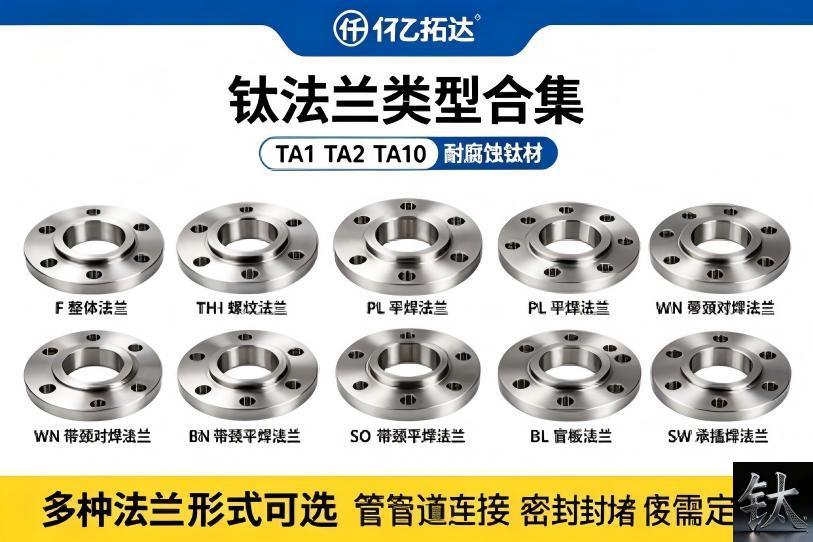
The four flange types and where each one stops being appropriate
| Type | Pressure | Temperature | Max size | Limitation |
|---|---|---|---|---|
| Plate / slip-on (PL) | PN ≤ 16 | ≤ 200 °C | DN600 | Fillet weld fatigues; not for cyclic or high pressure |
| Weld neck (WN) | PN16 – PN160 | ≤ 600 °C (grade dependent) | No practical limit | Higher cost — 1.4 to 1.8 times PL |
| Threaded (Th) | PN ≤ 16 | ≤ 200 °C | DN150 | Difficult to machine in titanium; sealing less reliable than welded |
| Blind (BL) | Matches mating flange | Depends on grade | DN2000+ | Requires a gasket — never bolt a blind dry |
Two practical notes on the less common types. Threading titanium is harder than threading steel — the material is gummy and wears tooling — which is why threaded Titanium Flanges are rarely specified. Where "removable plus high pressure" is the requirement, a weld neck flange with a mating blind is usually the better solution. And blind flanges perform very well in low temperature, high pressure and corrosive service: a Gr2 blind on a DN600 PN40 spare line at LNG temperature has run for eight years without leakage.
Standards across regions
| Application | China | US | Europe | Japan |
|---|---|---|---|---|
| General pipe flanges | GB/T 9112-2010 | ASME B16.5 | EN 1092-1 | JIS B2220 |
| Chemical service | HG/T 20592-2009 | ASME B16.5 Class | EN 1092-1 PN | JIS B2220 |
| Pressure vessel flanges | JB/T 4702-2007 | ASME B16.5 | — | — |
| Large diameter | GB/T 13402-2010 | ASME B16.47 | EN 1092-1 | JIS B2220 |
| Pressure class basis | PN (MPa) | Class (lb) | PN (bar) | PN (kgf/cm²) |
Class to PN conversion worth memorising: Class 150 ≈ PN20, Class 300 ≈ PN50, Class 600 ≈ PN100. ASME B16.5 is what almost every European and North American customer inspects against, so confirm the basis before quoting — this is the single most common cause of a flange that arrives correct and does not fit.
Facings and gaskets — where leaks actually start
| Facing | Code | Pressure | Service | Gasket |
|---|---|---|---|---|
| Raised face | RF | PN ≤ 40 | General | Non-asbestos / flexible graphite |
| Male-female | M/F | PN16 – PN63 | Flammable, explosive | Spiral wound with inner and outer ring |
| Tongue-groove | T/G | PN16 – PN63 | Highly corrosive | Spiral wound or PTFE |
| Ring joint | RJ | PN ≥ 63 | High pressure, high temperature | Metal ring joint gasket |
| Flat face | FF | PN ≤ 10 | Low pressure | Non-asbestos / rubber |
RF is used on more than 80% of Titanium Flanges. RF with a flexible graphite gasket and inner/outer steel rings covers PN16 to PN40 and most media. Two exceptions worth remembering: for strongly oxidising acids such as concentrated nitric, use PTFE; for high temperature high pressure (≥ 400 °C with ≥ 4 MPa), use a spiral wound gasket with inner and outer rings.
Five causes of sealing failure — and how to prevent each
1. Wrong gasket. Non-asbestos rubber sheet specified on a steam line above 200 °C will age and leak within months. Above 150 °C, specify flexible graphite or spiral wound. Asbestos gaskets have been phased out and should not appear on a new specification at all.
2. Insufficient or uneven bolt load. Hand tightening distributes load unevenly and the joint leaks at the weakest point. Use a hydraulic torque wrench and tighten in a cross pattern in three to four passes to the specified torque. Critically: Titanium Flanges need 30–40% less bolt load than steel flanges because of the lower elastic modulus. Applying steel-flange torque to a titanium flange crushes the gasket and can deform the facing.
3. Surface roughness out of specification. A Ra of 6.3 μm leaves micro-grooves for the medium to travel along. The requirement is Ra ≤ 3.2 μm for RF and ≤ 1.6 μm for male-female or tongue-groove. Machined flanges should arrive at Ra 1.6 μm by default.
4. Eccentric alignment between flange and pipe. A 5 mm offset when welding leaves the facing unevenly loaded and the weld fatigue-cracked in service. Coaxiality should be within 1 mm for a weld neck, 2 mm for a slip-on, with a jig holding the parts during welding.
5. Galvanic corrosion from mixed metals. A titanium flange with carbon steel bolts and washers in a chloride-bearing medium will corrode the bolts quickly, and a failed bolt is a failed joint. Use titanium bolts and washers, or isolate with insulating sleeves and washers. Where Titanium Fasteners are unavailable, Monel 400 is an acceptable transition.
Five selection misconceptions
"Thicker is safer." Flange thickness is set by the standard. A DN100 PN16 flange is 18 mm because that dimension has been calculated and verified. Machining it to 25 mm adds cost and weight and no reliability.
"Gr2 works everywhere." Gr2 is corroded in wet chlorine, dilute hydrochloric acid and wet FGD service. Its cost advantage exists only in mild service; in aggressive service it is the most expensive choice you can make.
"Any weld will do." A weld neck flange requires full penetration and full-coverage RT or UT, weld quality not below grade B of GB/T 12469-2018, plus post-weld PT and visual inspection.
"A blind flange does not need a gasket." It does. Without one, bolt load acts directly on the facing and damages it.
"Go one pressure class higher to be safe." Stepping up a class increases thickness, bolt size and facing dimensions, and adds 50–100% to cost. Design pressure plus safety factor determines the class — 2.5 MPa means PN25, not PN40.
Questions buyers ask most
Slip-on or weld neck? PN ≤ 16 favours slip-on on cost; PN ≥ 25 requires weld neck. Where the service involves cyclic loading, temperature swings above 100 °C, or a corrosive medium, weld neck is usually cheaper over five years even at low pressure.
Gr7 or Gr12? Gr7 contains 0.2% palladium and is for reducing acids — dilute sulphuric and hydrochloric. Gr12 contains 0.3% molybdenum and 0.8% nickel and is for chloride-fluoride combined attack — wet chlorine and wet FGD. Both cost 30–50% more than Gr2.
Can a titanium flange bolt directly to a stainless flange? Yes, but only with an insulating gasket and insulating sleeves on the bolts. Direct contact accelerates corrosion of the less noble material — usually the stainless — and can cut its service life by half or more.
What goes wrong most often in titanium flange welding? Three things: wrong filler (match ERTi-2 to Gr2, ERTi-7 to Gr7, ERTi-12 to Gr12, ERTi-5 to Gr5); insufficient argon shielding — the face, back and root all need shielding because titanium is highly oxygen-sensitive; and no post-weld stress relief, which is advisable for weld neck flanges of 10 mm and above, at 550–650 °C.
Ordering
We hold 1,500 titanium flanges in stock in Baoji, China's Titanium Valley, and machine to drawing for non-standard sizes. Gr2, Gr7, Gr12 and Gr5; PL, WN, Th and BL; DN15 to DN800; to GB/T 9112, HG/T 20592, ASME B16.5, EN 1092-1 or JIS B2220 as you specify.
Mill test certificates with every shipment, PT and RT reports on request, third-party inspection available, and small batch orders accepted. Send the medium, pressure, temperature, size and standard — we confirm selection, price and shipping date within 4 hours.
Email sales@sxqytd.com · WhatsApp +86 188 2967 9311
This article is technical reference material. Final selection must be confirmed against the project's actual service conditions, drawings and governing standards.
- Oct 12, 2026 Titanium Material Spot Market | Latest Price of TA1 TA2
- Titanium Price Report – 29 September 2026 | Gr2 Gr5 Plate, Tube, Bar
- Processing technology and quality inspection standards for titanium
- Common structural types and selection guidelines for titanium stirre
- Advantages of titanium alloy agitator in adapting to high temperatur
Contact Person: Wang Xiaoning
Tel: +86-917-355-7966
Email: sales@sxqytd.com
WhatsApp: +86 188 2967 9311
Company: Shaanxi Qianyi Tuoda Technology Co., Ltd
Address: Floor 4, Building 4, No. 188 Gaoxin Avenue, High-tech Zone, Baoji City, Shaanxi Province, China