Titanium Grade 2 Forged Flange, ASTM B381 — R50400 (UNS R50400) Flanges to ASME B16.5 from Baoji
Titanium Grade 2 forged flange · ASTM B381 · ASME B16.5 · UNS R50400
Grade 2 (UNS R50400) forged flanges to ASTM B381 / ASME B16.5 give the corrosion resistance of titanium with the integrity only a forged body provides — no cut-from-plate weak points at bolt load. SXQYTD stocks and machines weld-neck, slip-on, blind, socket-weld, lap-joint and threaded flanges in NPS 1/2–24 in and Class 150–2500, with mill test certificate and PMI. Below is the procurement detail that decides type, class and drilling before you issue a PO.
| Material | Grade 2 (UNS R50400) | Principle | Forged body, not cut from plate |
| Type & stock | WN / SO / BL / SW / LJ / TH, 1/2–24 in | Industry | Chemical, chlor-alkali, seawater, desalination |
| Standard | ASTM B381 / ASME SB-381 · dim. B16.5 | Lead time | 3–7 days stock; 2–4 weeks custom |
1. What a Grade 2 forged flange is — by grade and by type
By grade, Grade 2 (UNS R50400) is unalloyed commercially-pure titanium — the corrosion-resisting workhorse of the family. ASTM B381 also covers Gr1, Gr3, Gr5, Gr7, Gr9 and Gr12 forgings, so the same forging route serves higher-strength or more corrosion-resistant bodies when the medium demands. By type, ASME B16.5 covers these flange forms: weld neck (WN) for high stress and cyclic load, slip-on (SO) for lower pressure and easy alignment, blind (BL) to close a line or vessel nozzle, socket weld (SW) for small-bore high-pressure, lap joint (LJ) with a stub end for frequent dismantling, threaded (TH) where welding is unwanted, and long weld neck (LWN) for vessel connections. The difference between a forged flange and a plate-cut disc matters: forging flows the grain along the contour and closes porosity, so the body holds bolt load without the laminations a sawn plate can hide.
2. Why Grade 2 — grade vs. medium vs. corrosion
Grade 2 is the default where the medium is oxidizing or neutral. Pick the grade by what flows through the line:
| Medium | Recommended grade | Why |
| Seawater, brine | Gr2; Gr12 for hot crevice | Oxidizing chloride; Gr2 resists pitting. |
| Wet chlorine, hypochlorite | Gr2 | Strong oxidizing duty. |
| Dilute HCl, H₂SO₄ (reducing) | Gr7 / Gr12 | Gr2 dissolves; Pd or Mo/Ni needed. |
| High strength / high pressure | Gr5 (Ti-6Al-4V) | ~2× strength of Gr2. |
| vs Grade 7 (R52400) | Gr7 only if spec mandates | Gr7 adds Pd for reducing acid, 30–40 % dearer. |
Three things that sink a titanium flange if ignored: (1) a titanium flange must never share bolts directly with a carbon-steel flange — without insulating sleeves and washers, galvanic corrosion eats the titanium in any electrolyte; (2) the mating bolt-circle diameter and bolt-hole size must match the other flange exactly, and that is not visible on the material certificate — check it before shipping; and (3) titanium is soft and low in stiffness, so bolt torque must be even and to spec, or the flange rotates and the gasket leaks.
3. Technical standards we build to
- Forging spec: ASTM B381 / ASME SB-381, Grade 2, MTC EN 10204 3.1.
- Dimensions: ASME B16.5, NPS 1/2–24 in, Class 150 / 300 / 600 / 900 / 1500 / 2500.
- Chemistry (R50400): Fe ≤ 0.30 %, O ≤ 0.25 %, C ≤ 0.10 %, N ≤ 0.03 %, H ≤ 0.015 %, Ti balance.
- Mechanical (annealed): tensile ≥ 345 MPa, yield ≥ 275 MPa, elongation ≥ 20 %.
- Inspection: UT on forging, PT on machined faces, PMI on the heat, full dimensional.
4. Manufacturing flow — from billet to your flange
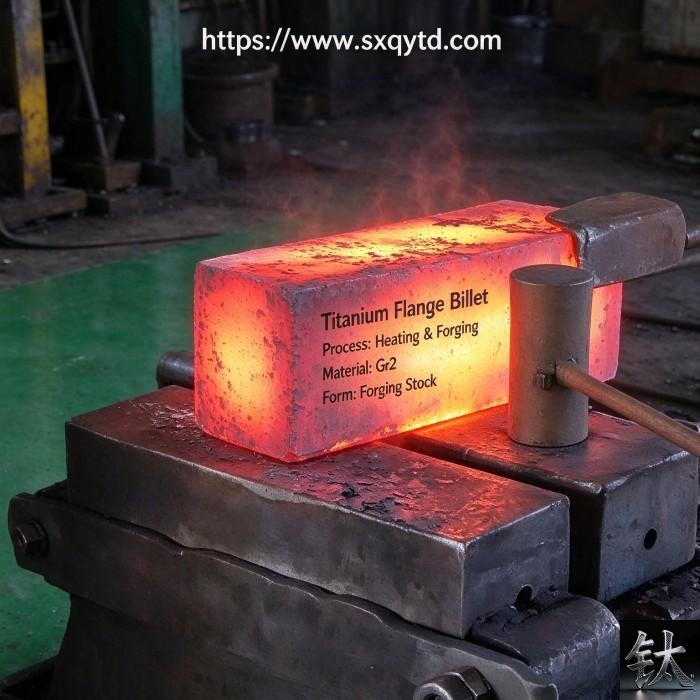
1) Gr2 billet release with MTC & PMI → 2) Induction / furnace heating to forging temperature → 3) Closed-die or open-die forging (grain follows contour) → 4) Trimming and punch → 5) Stress-relief anneal → 6) Pickling / passivation (remove α-case) → 7) CNC machining: facing, boring, bolt holes, RTJ groove → 8) Dimensional + UT/PT → 9) PMI and marking (grade, size, class, heat) → 10) Export packing. Stock flanges are forged and rough-machined ahead; final bore, drilling and facing are done to your class and drilling pattern on order.
5. Key performance
| Item | Control value | Note |
| Tensile strength | ≥ 345 MPa | CP-Ti Grade 2. |
| Yield strength | ≥ 275 MPa | Good for pressure class. |
| Face finish | 125–250 RMS (RF serrated) | Per B16.5 raised face. |
| Bolt-hole tolerance | ± 0.8 mm on circle & size | Must match mating flange. |
| Density | 4.51 g/cm³ | ~60 % lighter than steel. |
6. Application industries
| Industry | Medium | Typical flange |
| Seawater / desalination | Seawater, brine | WN / SO, Class 150–300. |
| Chlor-alkali | Wet Cl₂, bleach | WN, Class 300–600. |
| Chemical process | Oxidizing acids, salts | WN / BL, Class 150–600. |
| Marine / offshore | Seawater, splash | LJ / TH for service. |
7. Selection guide
By medium: oxidizing / seawater → Gr2; reducing acid → Gr7 or Gr12; high pressure → Gr5. By type: WN for stress and thermal cycling, SO for low-pressure economy, BL to close, SW for small high-pressure bore, LJ for frequent opening, TH for no-weld joints. By class: pick the ASME B16.5 pressure class from design pressure and temperature — Class 150 / 300 cover most seawater and chemical lines, 600+ for high duty. Send medium, NPS, class, face (RF/FF/RTJ) and drilling pattern; we confirm grade and stock in one reply.
8. Customizable items & accessories
- Type and NPS (1/2–24 in), Class 150–2500, RF / FF / RTJ face.
- Drilling: standard ASME B16.5 pattern or custom bolt circle / hole count.
- Surface: pickled, bright-annealed; isolating gaskets and sleeves available.
- Bolting: titanium, Monel or insulated carbon-steel sets to avoid galvanic.
- PMI report, heat-number marking, third-party inspection (SGS / TUV).
9. Lead time, test reports & warranty
| Item | Commitment |
| Lead time | 3–7 days from stock; 2–4 weeks custom / exotic grade. |
| Test reports | MTC 3.1, UT, PT, PMI, full dimensional. |
| Warranty | 12 months against material and workmanship defects from shipment. |
10. FAQ
Grade 2 or Grade 7 flange — which should I specify?
For oxidizing media, seawater and wet chlorine, Grade 2 is correct and cheapest. Reach for Grade 7 (R52400, with palladium) only when the line carries a reducing acid with no oxidizer — that is where Gr2 is attacked. Grade 7 costs 30–40 % more, so don't pay for it unless the medium needs it. We stock both.
ASTM B381 or ASME B16.5 — which governs my flange?
Both, for different things. ASTM B381 is the material and forging-quality specification (grade, chemistry, mechanicals, tests). ASME B16.5 is the dimensional standard (NPS, class, facing, bolt circle, drilling). A flange is bought against B381 for the metal and B16.5 for the shape — check you have both on the certificate and drawing.
Can I bolt a titanium flange straight to a carbon-steel flange?
Not without isolation. Titanium and steel are far apart on the galvanic series; in any conductive fluid the titanium becomes the anode and corrodes fast. Use insulating sleeves and washers on the bolts (and an isolating gasket), or bolt up with titanium / Monel fasteners. We can supply the insulated bolting set with the flange.
Request a quote
Send the medium, flange type, NPS, class, face and drilling pattern. We return grade confirmation, stock status and a stock-backed price within 8 hours.
Phone / WeChat: +86 188 2967 9311
Email: sales@sxqytd.com
Or leave a message on the contact page with your drawing attached.
- What is Titanium Flange | ASME B16.5 ASTM B381 Gr2 Gr5 Titanium Flan
- ASME B16.5 Titanium Flange Grade2 DN100-DN600 Class150/300 FOB
- Gr2 Titanium Sheet Price FOB Shanghai | ASTM B265 In Stock
- Titanium Price Today (Oct 26, 2026): China Market Report
- Titanium Price Today (23 Oct 2026): Plate, Tube, Rod & Wire
Contact Person: Wang Xiaoning
Tel: +86-917-355-7966
Email: sales@sxqytd.com
WhatsApp: +86 188 2967 9311
Company: Shaanxi Qianyi Tuoda Technology Co., Ltd
Address: Floor 4, Building 4, No. 188 Gaoxin Avenue, High-tech Zone, Baoji City, Shaanxi Province, China