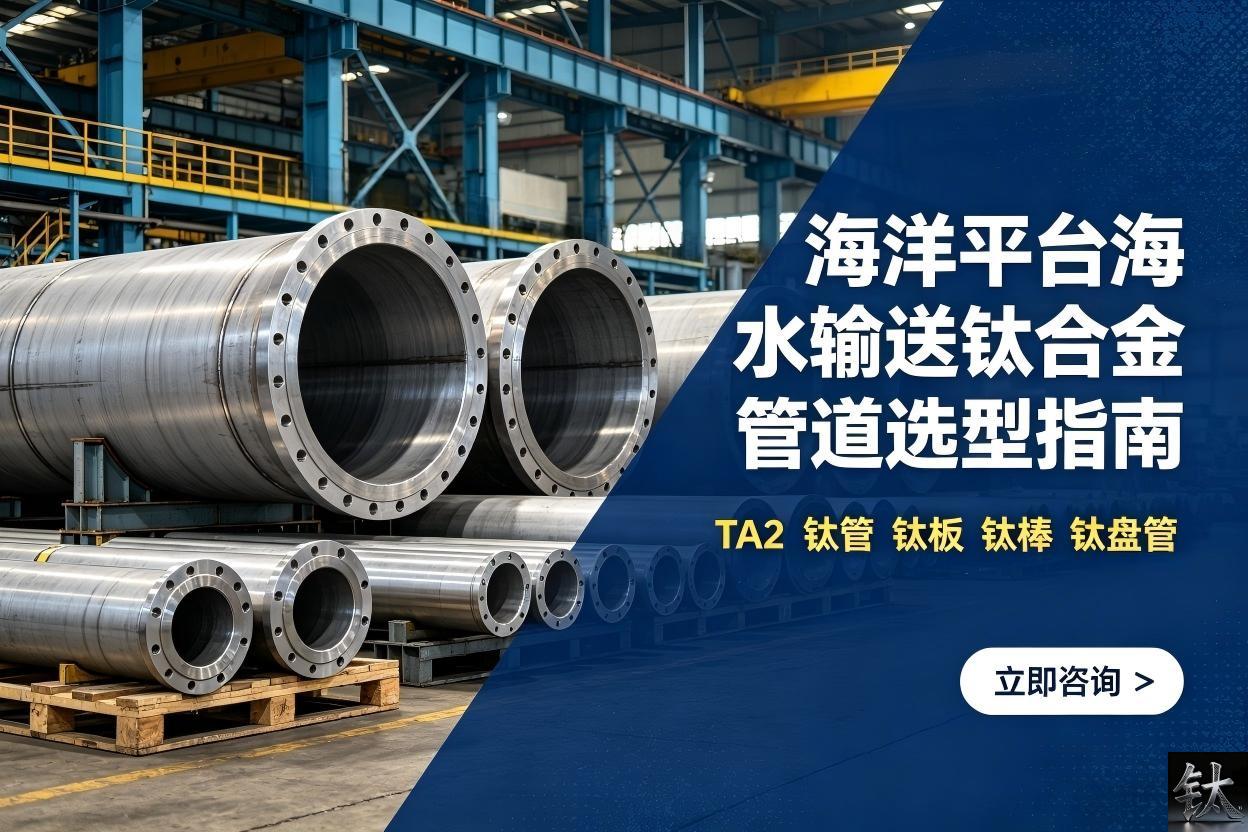
Titanium Tube --ASTM B338 Welded vs Seamless Guide
| Спецификация | STM B338 (heat exchanger tube), B861 (seamless pipe), B862 (welded pipe) |
|---|---|
| Применимый стандарт | Gr1, Gr2, Gr3, Gr7, Gr9, Gr12, Gr16 — baseline Gr2 (UNS R50400, TA2) |
| Состояние материала | Heat exchangers, condensers, MSF/MED desalination, surface condenser tubing |
| Контроль и упаковка | Seamless for high-pressure/cyclic; welded for clean fluid below 60C; PMI each lot if Gr7/Gr12 |
| Справочная цена | $20.00 – $25.00 |
Описание продукции: ASTM B338 titanium tube guide: seamless vs welded, average vs minimum wall, NDT ET/UT levels, Gr2/Gr7/Gr12 selection, 7 procurement traps, cost economics.
Обзор продукции
| Standards | ASTM B338 (heat exchanger & condenser tube); B861 (seamless pipe); B862 (welded pipe) |
| Grades | Gr1, Gr2, Gr3, Gr7, Gr9, Gr12, Gr16 — baseline Gr2 (UNS R50400, TA2) |
| Service | Heat exchangers, condensers, MSF/MED desalination, surface condenser tubing |
| Core distinction | Seamless vs welded is a service decision, not a quality tier. Average wall (B338) vs minimum wall (B861) tolerance systems differ fundamentally. |
The Case: An 8-Month Surface Condenser Tube Failure
In 2021, a Middle Eastern refining complex replaced a 12,000-tube seawater surface condenser bundle with what was specified on the purchase order as "ASTM B338 Gr2 titanium tube, 25.4 mm OD × 0.7 mm wall." Eight months later, the bundle was leaking at thirty-four tubes. The failure investigation found two procurement decisions, neither of which violated the letter of the purchase order, that together caused the failure.
First, the mill furnished welded tube — permitted under B338, which covers both seamless and welded product. The internal weld bead was not trimmed flush; it stood roughly 0.15 mm proud of the bore. Second, the wall tolerance was furnished to average wall, meaning the minimum wall at any point could fall to 0.56 mm. The original pressure design assumed minimum wall and a smooth bore. The proud bead generated local turbulence, the thinned wall accelerated erosion, and the combined effect produced through-wall perforation in less than one operating cycle.
This case is not exotic. It is representative. The failure was not a material failure — the titanium was genuine Gr2, correctly certified. The failure was a specification failure. The buyer wrote a grade and a dimension and assumed that was a complete purchase order. It was not. This guide exists so that your next B338 purchase order does not end the same way.
ASTM B338 Scope: What This Standard Actually Covers
ASTM B338 is titled "Standard Specification for Seamless and Welded Titanium and Titanium Alloy Tubes for Condensers and Heat Exchangers." Three words in that title do the heavy lifting: condensers, heat exchangers, and tubes. B338 is a tube standard for heat transfer duty. It is not a pressure piping standard. For pressure piping — process lines, headers, distribution — the governing standards are ASTM B861 (seamless titanium pipe) and B862 (welded titanium pipe).
The distinction matters because the tolerance systems, NDT defaults, and acceptance criteria are different. A tube furnished to B338 is not automatically compliant with B861, and vice versa. A purchase order that simply writes "titanium tube Gr2" without naming the standard leaves the mill free to furnish whichever is cheaper to produce — which is rarely the one your design engineer assumed.
Within B338, the standard covers both seamless and welded product in the same document. This is the second common misunderstanding: buyers read "B338" and assume a single product. They assume wrong. A B338 purchase order must specify whether seamless, welded, or either-is-acceptable — and if welded, whether the internal bead is to be trimmed, scarfed, or left as-rolled.
Seamless vs Welded: Not a Quality Tier, a Service Decision
The most persistent myth in titanium tube procurement is that seamless is "better" and welded is "the cheap option." This framing is wrong, and it produces bad specifications. Seamless and welded are two legitimate manufacturing routes, each suited to a different set of service conditions.
Seamless tube is produced by piercing a solid billet and reducing it over a mandrel. There is no longitudinal weld. The grain structure is uniform around the circumference. Seamless is specified when the tube will see high pressure, pressure cycling, vibration, or fatigue service — conditions under which a longitudinal weld would be a crack-initiation site. The cost premium is 25 to 60 percent over welded, depending on size.
Welded tube is produced by roll-forming strip into a tube and longitudinally TIG-welding the seam. The weld is full-penetration autogenous TIG. For heat exchanger service, the internal weld bead is typically trimmed (also called scarfed or planished) flush with the bore so that the tube interior presents a smooth surface to the process fluid. Welded tube is the baseline choice for clean-fluid, low-pressure heat transfer — surface condensers, MSF evaporator tubing, single-pass exchangers on non-aggressive duty.
The decision is driven by service. A tube in a vibrating compressor aftercooler with cyclic pressure must be seamless. A tube in a steady-state seawater surface condenser at 40 °C may be welded, provided the internal bead is trimmed. Specifying seamless for the condenser wastes 25 to 60 percent of the tube cost for no engineering benefit. Specifying welded for the aftercooler courts fatigue failure at the weld.
| Service condition | Recommended product | Cost premium |
| Steady-state, clean fluid, < 60 °C, low pressure | Welded, internal bead trimmed | Baseline |
| Seawater, > 60 °C, or with crevice zones | Welded Gr7 or Gr12, trimmed | +30 to 80% (alloy) |
| Cyclic pressure, vibration, fatigue service | Seamless | +25 to 60% |
| High-pressure process piping | Seamless B861 (not B338) | B861 baseline |
The Wall Thickness System: Average vs Minimum
The 8-month failure at the start of this guide turned on a wall thickness tolerance system that the buyer did not know existed. ASTM B338 permits tube to be furnished on an average wall basis. ASTM B861 and B862 require minimum wall. The two systems are not interchangeable, and a design engineer who assumes one while the mill furnishes the other will get a tube that is non-compliant with the design even though it is compliant with the purchase order.
Average wall means the measured average of the wall around the circumference meets the specified nominal, with a permitted minus tolerance. Individual points on the circumference may fall below the nominal, down to a floor defined in the standard. For B338, the permitted under-tolerance on average wall is typically 12 to 15 percent of nominal. On a 0.7 mm wall, that permits the thinnest point to fall to roughly 0.56 mm.
Minimum wall means no point on the circumference may fall below the specified nominal. The mill must hold tighter cross-sectional control, which means more material and tighter process windows. Minimum wall tube costs 5 to 12 percent more than average wall of the same nominal size. The premium buys you a tube whose wall is never thinner than what your pressure calculation assumed.
The rule is simple. If the tube is in pressure service — even low-pressure heat exchanger service where the wall is also doing heat-transfer duty — specify minimum wall. If the tube is in pure heat-transfer duty with negligible pressure, average wall is acceptable. Never let the mill choose for you by default; the default is whichever is cheaper to produce.
NDT Levels: ET, UT, and the Hydraulic Test
Every B338 tube receives nondestructive testing at the mill. The default NDT method is eddy current (ET) for tube outside diameters up to approximately 63 mm. For larger diameters or thicker walls, ultrasonic testing (UT) is the standard method. Both methods detect longitudinal and transverse discontinuities; UT is more sensitive to laminar defects and to wall-thickness variations.
The key point is that "B338 NDT" is a floor, not a ceiling. The standard defines a reference notch — a machined groove of specified depth and geometry — against which the ET or UT system is calibrated. Tube that produces a signal below the reference notch is accepted; tube that produces a signal at or above the reference notch is rejected. For most heat exchanger service on clean cooling water, this floor is adequate.
For aggressive service — seawater above 60 °C, chloride-bearing process fluids, sour service, cyclic duty — the default B338 NDT level is not enough. The buyer should specify a higher notch-sensitivity class (a smaller reference notch) and require both ET and UT on the same tube. The cost increment is typically 3 to 8 percent of tube price. The benefit is the detection of defects that the default level would pass and that would become leak sites in service.
The hydraulic test is a separate requirement, applied per lot, in which a tube section is pressurized to a proof pressure and held for a specified time. The hydraulic test catches through-wall defects that ET and UT miss. For surface condenser and desalination service, require a hydraulic test certificate per lot. For process condensers in chloride service, require both the higher NDT class and the hydraulic test.
Heat Exchanger Tube vs Pressure Pipe: B338 vs B861
Buyers who do not realize B338 and B861 are different standards routinely order the wrong one. The most common pattern is the buyer who writes "titanium tube Gr2" on a purchase order for a process line, receives B338 tube (the cheaper of the two), and is then surprised when the tubing fails a B31.3 pressure piping code calculation.
The two standards diverge on three points. First, scope: B338 is heat transfer tubing, B861 is seamless pressure pipe, B862 is welded pressure pipe. Second, tolerance: B338 permits average wall, B861 and B862 require minimum wall. Third, NDT default: B338 defaults to ET, B861 and B862 default to a more stringent combination reflecting pressure service.
For a heat exchanger bundle, order B338. For process piping, order B861 or B862. Never mix the two on one purchase order. If your scope includes both a heat exchanger bundle and connecting piping, those are two separate line items with two separate standards, two separate MTRs, and two separate NDT certificates. Combining them is the single most common cause of a non-compliant delivery on a titanium tube purchase.
Grade Selection Within B338: Gr2, Gr7, Gr12, Gr9
B338 lists nine grades. Four dominate heat exchanger procurement: Gr2, Gr7, Gr12, and Gr9. The selection is governed by the same corrosion logic that applies to plate and bar, but the geometry of tubing — long, small-bore, with crevices at tubesheet expansions — makes the grade decision more sensitive to crevice conditions than flat product.
Gr2 is the baseline. Commercially pure titanium, UNS R50400, broadly equivalent to Chinese TA2. Gr2 is specified for clean cooling water, fresh-water service, and seawater below roughly 60 °C in the absence of crevice zones. The majority of surface condenser tubing worldwide is Gr2.
Gr7 is Ti-0.15Pd, UNS R52400. The 0.15 percent palladium shifts the cathodic reaction potential and prevents the pH drop inside a crevice from reaching the TiO₂ film breakdown threshold. Gr7 is specified wherever the tube has crevice zones — tubesheet expansions, gasket faces, deposits — in chloride service above 60 °C. The cost premium over Gr2 is 1.8 to 2.5 times for the tube itself; the palladium tracks the open market.
Gr12 is Ti-0.3Mo-0.8Ni, UNS R53400. Molybdenum and nickel stabilize the passive film without the cost of palladium. Gr12 is specified for mildly reducing acid service and for seawater crevice service where the duty is not aggressive enough to justify Gr7. The cost premium over Gr2 is roughly 1.4 to 1.8 times.
Gr9 is Ti-3Al-2.5V, UNS R56400. A high-strength alpha-beta alloy used where weight or pressure rating demands a thinner wall than Gr2 can supply at the same OD. Gr9 is the standard choice for hydraulic and chemical tubing on aircraft and for high-pressure heat exchangers where wall must be minimized. The cost premium over Gr2 is 2 to 3 times.
The negative judgment: do not specify Gr7 for clean seawater below 60 °C without crevices. The palladium buys you nothing in the absence of a crevice, and you pay 1.8 to 2.5 times for the tube. Do not specify Gr12 in strongly reducing acid service; it is a crevice-corrosion inhibitor, not an acid-resistant alloy. For reducing acids, the answer is zirconium, not a titanium grade.
| Grade | Composition | Service | Cost vs Gr2 |
| Gr2 | CP titanium | Clean cooling water, fresh water, seawater < 60 °C no crevice | 1.0× |
| Gr7 | Ti-0.15Pd | Seawater crevice > 60 °C, chloride process | 1.8-2.5× |
| Gr12 | Ti-0.3Mo-0.8Ni | Mild reducing acid, moderate seawater crevice | 1.4-1.8× |
| Gr9 | Ti-3Al-2.5V | High-pressure, thin-wall, aerospace hydraulic | 2.0-3.0× |
Tolerance and Dimensional Control
B338 dimensional tolerances are tight by the standards of steel tubing but not as tight as stainless precision tube. The buyer who assumes "B338" implies precision tolerances will be disappointed. The standard specifies OD tolerance, wall tolerance, length tolerance, straightness, and cut-end squareness — and the mill is free to furnish anywhere within these bands unless the buyer tightens them.
For OD, the standard tolerance on a 25 mm tube is plus or minus 0.10 mm. For wall, on average-wall basis, the tolerance is plus 12 percent / minus 12 percent of nominal. For length, standard is plus 6 mm / minus 0 mm on a random-length cut. Straightness is 1.5 mm per meter.
If your design requires tighter control — for example, a tubesheet expansion that depends on a controlled OD to achieve the expansion ratio — specify the required OD tolerance explicitly in the purchase order. Do not rely on the standard tolerance; it is wide enough that a random-length cut may not produce the expansion ratio your tubesheet design assumed.
The same applies to length. If you need fixed-length cuts for a specific bundle layout, specify fixed length plus a zero over-tolerance. Random length is the default; if you do not specify fixed length, you will receive a random distribution within the standard length band, and your layout will not match.
Common Procurement Failures
Seven failures recur in B338 titanium tube procurement. None of them are exotic. All of them are avoidable by writing a complete purchase order.
1. Writing a grade and a dimension without naming the standard. "Titanium tube Gr2, 25.4 × 0.7" is not a purchase order. The mill can furnish B338 average-wall welded, B861 minimum-wall seamless, or anything in between. Name the standard explicitly.
2. Accepting "commercial grade" or "mill grade" language. These are not ASTM designations. They are sales language. Require UNS designation, ASTM standard, and MTR with heat number. If the supplier cannot furnish these, the supplier is not selling ASTM tube.
3. Not specifying seamless or welded. The default depends on the mill and the size. If your design assumes seamless, write "seamless." If welded is acceptable, write "welded, internal bead trimmed."
4. Not specifying wall tolerance basis. The default is average wall for B338. If your pressure design requires minimum wall, write "minimum wall." The premium is 5 to 12 percent; the alternative is a non-compliant tube.
5. Skipping the hydraulic test certificate. For surface condenser and desalination service, the hydraulic test is the only NDT that catches through-wall defects. Require a certificate per lot. The cost is administrative, not material.
6. Assuming TA2 equals Gr2. TA2 is the Chinese GB designation. It is broadly equivalent to Gr2 but not identical in chemistry limits or in tolerance system. Require an ASTM B338 MTR showing UNS R50400; do not accept a re-labelled GB/T MTR.
7. Not requiring PMI on Gr7 and Gr12 lots. The only difference between Gr2 and Gr7 is 0.15 percent palladium. The only difference between Gr2 and Gr12 is 0.3 percent molybdenum plus 0.8 percent nickel. A mix-up at the mill is invisible to the eye. PMI catches it. The cost of PMI is trivial against the cost of a crevice-corrosion failure on a 12,000-tube bundle.
Cost Economics: Seamless vs Welded, Gr2 vs Gr7/Gr12
The cost structure of B338 tube is driven by three variables: manufacturing route (seamless vs welded), wall tolerance (average vs minimum), and grade (Gr2 baseline vs Gr7/Gr12/Gr9). Each variable carries a cost premium that is predictable and that the buyer should model before issuing the purchase order.
Welded tube is the baseline. Seamless carries a 25 to 60 percent premium, driven by the piercing and mandrel-reduction process and by lower yields on smaller sizes. For a 25 mm × 0.7 mm Gr2 tube, welded may run $18 to $24 per meter; seamless of the same size may run $26 to $38 per meter. The premium narrows on larger sizes where the piercing process becomes more efficient.
Minimum wall over average wall adds 5 to 12 percent. On a 0.7 mm wall, the material increment is small in absolute terms — perhaps $1 to $3 per meter — but the assurance that no point on the wall falls below nominal is what makes the tube compliant with a pressure design.
Grade premium is the largest single variable. Gr7 over Gr2 is 1.8 to 2.5 times; the palladium content tracks the open market and can spike. Gr12 over Gr2 is 1.4 to 1.8 times; molybdenum and nickel are more stable. Gr9 over Gr2 is 2 to 3 times, driven by the vanadium and aluminum alloying and the heat-treatment cycle.
The composite effect on a 12,000-tube bundle is dramatic. A Gr2 welded average-wall bundle at $22 per meter and 6 meters per tube runs $1.58 million. The same bundle in Gr7 welded average-wall runs $2.9 to $3.9 million — a $1.3 to $2.3 million increment. The decision to use Gr7 is not a material decision; it is a service decision. If the service has crevices above 60 °C in chloride, the $1.3 million increment buys you a 20-year bundle. If it does not, the $1.3 million buys you nothing.
Supplier Verification Checklist
Before issuing a B338 purchase order, verify the supplier on eight points. A supplier that fails any of these is not a supplier for a 12,000-tube bundle.
1. Does the MTR show UNS designation, ASTM standard, heat number, chemistry, mechanicals, and NDT results? Require a sample MTR before order.
2. Can the supplier furnish dual certification (ASTM plus GB) or a cross-referenced MTR? If only a GB/T MTR is available, the supplier is not producing to ASTM.
3. What is the supplier's seam-trimming capability on welded tube? Ask for a cross-section sample showing the internal bead condition. A supplier that cannot trim flush is a supplier that cannot furnish heat exchanger welded tube.
4. What NDT equipment does the supplier operate in-house? ET and UT should both be available on-site. A supplier that outsources NDT is a supplier that cannot furnish lot-traceable certificates.
5. Can the supplier furnish a hydraulic test certificate per lot? Require it as a line item on the MTR.
6. What is the supplier's PMI capability for Gr7 and Gr12 lots? If the supplier cannot PMI every bundle, the supplier is not equipped to ship Gr7 or Gr12.
7. What is the supplier's minimum wall capability? A supplier that cannot furnish minimum wall is a supplier that cannot supply pressure service.
8. What is the supplier's fixed-length cutting capability? If the supplier can only cut random length, the supplier cannot furnish a bundle that matches your layout.
Summary: The 8-Field Purchase Order
A complete ASTM B338 titanium tube purchase order contains eight fields, and only eight. Writing these eight fields — no more, no less — eliminates every failure mode described in this guide.
1. Standard
: ASTM B338 (heat exchanger tube). If pressure piping, ASTM B861 or B862.
2. Grade
: UNS designation (R50400 for Gr2, R52400 for Gr7, R53400 for Gr12). Not the common name; the UNS.
3. Manufacturing route
: Seamless, or welded with internal bead trimmed.
4. Dimensions
: OD × wall × length, with wall tolerance basis (average or minimum).
5. NDT
: ET to B338 reference notch, or ET plus UT for aggressive service. Hydraulic test certificate per lot.
6. Surface condition
: Mill pickled, or pickled and annealed, or as-required by your fabricator.
7. Certification
: MTR with UNS, heat number, chemistry, mechanicals, NDT, hydraulic test. Dual certification if cross-referenced to GB.
8. PMI
: Sample per lot for Gr2; every bundle for Gr7 and Gr12.Eight fields. The purchase order that opened this guide had two. The difference between those two purchase orders is the difference between a 20-year bundle and an 8-month failure.
Frequently Asked Questions
Q1: Is welded titanium tube inferior to seamless?
No. Welded B338 tube is a legitimate product for clean-fluid heat exchanger service below roughly 60 degrees Celsius. Seamless is specified for high-pressure, cyclic, or vibrating service where the longitudinal weld could be a fatigue initiation site. The decision is driven by service conditions, not by a quality hierarchy.
Q2: Can ASTM B338 tube be used for high-pressure piping?
No. B338 covers heat exchanger and condenser tubing only. For pressure piping, use ASTM B861 (seamless) or B862 (welded). The wall thickness tolerance systems also differ: B338 uses average wall thickness, B861 and B862 use minimum wall thickness. Mixing the two in one purchase order is a common cause of non-compliant deliveries.
Q3: What is the difference between average wall thickness and minimum wall thickness?
Average wall (B338) permits minus tolerance on the measured average around the circumference, but no single point may fall below a floor. Minimum wall (B861/B862) guarantees that no point on the tube falls below the specified nominal value. Minimum wall costs 5 to 12 percent more because the mill must hold tighter cross-sectional control. For pressure design, specify minimum wall; for non-pressure heat transfer, average wall is acceptable.
Q4: Do I need both eddy current (ET) and ultrasonic (UT) testing on B338 tubes?
Not always. B338 requires ET as the baseline NDT method for tube up to about 63 mm outside diameter. UT is added for larger diameters, thicker walls, or when the buyer specifies notch-sensitivity levels above the default. For surface condenser tubing in cyclic service, specifying both ET and UT is standard practice; for clean single-pass exchangers, ET alone is usually sufficient.
Q5: Which NDT level should I specify for condenser service?
For seawater-cooled surface condensers, specify ET to the standard B338 reference notch plus UT for any tube over 25 mm outside diameter. For process condensers handling chlorides or sour service, add a higher notch-sensitivity class and require a hydraulic test certificate per lot. The default B338 NDT level assumes clean cooling water; it is not sufficient for aggressive service.
Q6: How do I verify that a Chinese TA2 tube meets ASTM B338 Gr2?
TA2 is the Chinese designation (GB/T 3625) and is broadly equivalent to Gr2, but equivalence is not identity. Require the supplier to furnish an MTR (Mill Test Report) showing UNS R50400, the heat number, chemistry, mechanicals, and NDT results to ASTM B338. Do not accept a GB/T MTR re-labelled as ASTM; require dual certification or a cross-referenced MTR. A PMI (positive material identification) check on the delivered lot confirms the grade at the dock.
Q7: Should I require PMI on every tube lot?
For Gr2, PMI on a sample per lot is adequate because Gr2 is commercially pure titanium with no alloying element to misidentify. For Gr7, Gr12, and Gr16, require PMI on every bundle because the only difference from Gr2 is a trace addition (0.15 percent Pd, 0.3 percent Mo plus 0.8 percent Ni, or 0.05 percent Pd). A mix-up at the mill is invisible to the eye and only PMI catches it. The cost of PMI is trivial against the cost of a crevice-corrosion failure.
Summary
ASTM B338 is a heat exchanger tube standard, not a pressure piping standard. Seamless and welded are two legitimate manufacturing routes chosen by service condition, not by quality tier. Average wall (B338) and minimum wall (B861/B862) are two tolerance systems that cannot be mixed in one purchase order. The default B338 NDT level is a floor, not a ceiling; aggressive service demands a higher class and a hydraulic test. Grade selection — Gr2, Gr7, Gr12, Gr9 — is driven by crevice and temperature conditions, not by a quality hierarchy. The eight-field purchase order eliminates every failure mode described in this guide. Write all eight.
Опишите ваши требования — марка, размер и количество. Ответим в течение 24 часов.
Предпочитаете чат? WhatsApp +86 188 2967 9311 или напишите на sales@sxqytd.com.
- Цена на титан сегодня (23 октября 2026 г.): пластина, трубка, стерже
- Читайте титановую проволоку и проволоку из титанового сплава: класси
- Титановая проволока: от выбора марки до производственного процесса (
- Читайте титановую трубку и трубку из титанового сплава: классификаци
- Титановые трубы: выбор тройников и переходов в 5 шагов
Контактное лицо: Wang Xiaoning
Телефон: +86-917-355-7966
Эл. почта: sales@sxqytd.com
WhatsApp: +86 188 2967 9311
Компания: Shaanxi Qianyi Tuoda Technology Co., Ltd
Адрес: Floor 4, Building 4, No. 188 Gaoxin Avenue, High-tech Zone, Baoji City, Shaanxi Province, China