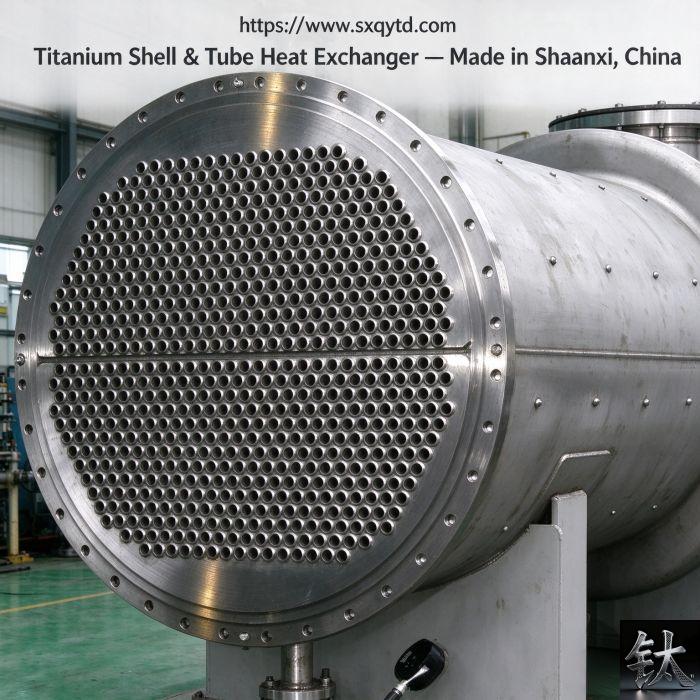
Offshore Titanium Heat Exchanger for Oil & Gas Project
| Specification | Our offshore titanium heat exchanger is designed to withstand harsh marine working conditions for oil & gas projects. It resists salt spray, brine and chloride-induced corrosion that easily damages ca |
|---|---|
| Applicable Standard | Every unit undergoes strict NDT inspection: hydrostatic pressure test, helium leak test and weld radiographic examination to avoid failure under continuous offshore operation. 2. Complete documentatio |
| Material Condition | Gr2/Gr7/Gr12, Seawater Cooling & Process Duty, ASME VIII + TEMA, NORSOK-Aligned MDS, MTC 3.1, Baoji |
Product Description: Offshore titanium shell-and-tube heat exchanger for oil & gas projects — seawater cooling, utility and process-stream duty. Gr2 for aerated seawater; Gr7 for >80°C stagnant/deaerated crevices; Gr12 fo
Product Overview
Offshore Titanium Heat Exchanger for Oil & Gas Project | Gr2/Gr7/Gr12, ASME VIII + TEMA, MTC 3.1
Meta Description: Offshore titanium shell-and-tube heat exchanger for oil & gas projects — seawater cooling, utility and process-stream duty. Gr2 for aerated seawater; Gr7 for >80°C stagnant/deaerated crevices; Gr12 for hot high-pressure brine. ASME VIII + TEMA, roll+seal weld, galvanic isolation designed in, CP potential controlled. EN 10204 3.1, PMI per heat, 3.2 TPI PO-fronted.
Offshore Is a Different Procurement Logic
On a platform, the tube price is the smallest line item. The real cost drivers are:
- Topside weight (every tonne = hull + buoyancy + crane capacity)
- Retube access (crane windows, confined-space entry, production deferment)
- Unplanned shutdown (one day offstream > whole exchanger delta, Gr2 vs Gr7)
- Audit trail (NORSOK-style MDS, heat-number closure, TPI hold points)
So offshore titanium is specified on lifecycle risk, not kg-price. North Sea operators report 20+ year service with no corrosion-related retube when grade and CP are right. [2,8](@ref)
Grade Call by Offshore Duty
| Duty | Tube grade | Reason |
|---|---|---|
| Seawater cooler (aerated, <80°C crevice) | Gr2 (R50400) | Standard CP-Ti seawater choice |
| Warm stagnant seawater / dead legs / >80°C | Gr7 (R52400, Ti-0.2Pd) | Crevice threshold raised; hydrogen pickup suppressed |
| Hot process brine / high-pressure heater | Gr12 (R53400) | Mo-Ni adds strength + hot-crevice margin |
| High-pressure U-bundle, weight-sensitive | Gr9 (R56320) | Thinner wall, higher yield |
| Utility condenser, oxidizing chloride | Gr2 / Gr7 by crevice temp | Same rule as seawater |
Rule of thumb: Gr2 up to ~80°C aerated seawater; above that in stagnant/deaerated conditions → Gr7, not thicker Gr2. [5](@ref)
Three Offshore Failure Modes Designed Out Up Front
1. Crevice corrosion in hot seawater
- Full-penetration roll+seal weld at tubesheet — no annular gap
- U-bend PT + extrados wall check
- Gr7 where CCT exceeds Gr2 envelope; no "add wall" shortcut
2. Galvanic corrosion (titanium is noble)
- Isolation flanges / non-conductive gaskets where Ti meets CS/Cu-Ni
- No direct bolting Ti-to-carbon-steel in seawater
- Anode scheme designed for the coupled system, not titanium alone (Ti needs no anode, but the steel partner does)
3. Hydrogen pickup under cathodic protection
- CP potential controlled — typical offshore practice keeps potential from going overly negative vs Ag/AgCl
- Common design control ≈ -0.80 V vs Ag/AgCl reference to limit hydrogen generation
- Gr7/Pd grade reduces crevice-initiated hydrogen absorption risk in warm seawater
Design & Fabrication Baseline
- Code: ASME VIII Div.1 + TEMA Class R/C/B; PED/EN 13445 on request
- Tube: ASTM B338 Gr2/Gr7/Gr9/Gr12, seamless or welded-annealed
- Tubesheet: ASTM B265 Gr2/Gr7, solid or Ti-clad CS
- Joint: hydraulic roll + autogenous GTAW seal weld, dual-side argon ≥99.999%
- Roll-to-weld clearance ≥3.2mm; non-chlorinated PT; silvery/straw weld color only
- Topside optimization: compact bundle, low weight, lift-eye + sea-fastening points
- Velocity 1.5–2.5 m/s tube-side (biofouling/chlorination strategy confirmed with licensor)
Documentation Stack (EPC-audit ready)
- NORSOK-M-630-aligned Material Data Sheet (grade, UNS, melt route, heat)
- ASTM B338 / B265 EN 10204 3.1 MTC — heat-number cross-linked
- PMI (XRF/OES) per heat; Gr7 Pd verified in matrix
- WPS/PQR ASME IX; weld map (tube heat × tubesheet heat)
- ET/hydro per B338 election; PT on seal welds; helium leak option
- Galvanic-isolation dwg + CP potential design note
- ASME VIII calc + TEMA sheet + U-1A (coded units)
- 3.2 TPI (SGS/BV/TÜV/DNV) PO-fronted, hold points planned
- As-built MDR + seaworthy pack (Ti segregated from CS, ISPM-15)
Scope Flexibility
- New-build topside cooler / condenser / process exchanger
- Retube kit: tubes + tubesheet + baffles, matched to existing shell
- One-for-one replacement: same nozzle/flange/bolt circle, upgraded internals
- Bundle-only supply for platform MRO window
Hard Boundaries (no overclaim)
- Gr2 not for >80°C deaerated stagnant seawater — Gr7, not thicker wall
- Ti needs no sacrifice anode, but coupled steel does — isolation is a design item, not an option
- Over-negative CP potential → hydrogen risk; potential envelope stated in design note
- HF / fluoride excluded; dry Cl₂ separate review
- 3.2 cannot be back-issued; TPI named at PO
- Biofouling still occurs on Ti — chlorination/velocity must be in the basis of design
RFQ Template (copy-paste)
Location: platform / FPSO / jacket / onshore coastal ___
Duty: seawater cooler / process cooler / condenser / retube ___
Tube side fluid: seawater / hydrocarbon / glycol / brine ___
Cl⁻ ___ppm, DO ___ppb, pH ___, sulfate-reducer/sulfide Y/N ___
Max tube-wall temp: ___°C (upset ___°C)
Crevice condition: aerated / stagnant / deaerated ___
CP system: impressed / galvanic, design potential ___V vs Ag/AgCl
Galvanic partners: CS / Cu-Ni / SS ___ → isolation required Y/N
Tube: ASTM B338 Gr___, OD×wall ___, straight / U-bend ___
Tubesheet: B265 Gr___, solid / clad ___
Code: ASME VIII Div.1 + TEMA Class ___
Joint: roll+seal weld, argon backing ___
NDE: ET / hydro / PT(non-Cl) / helium (__ mbar·L/s)
Cert: 3.1 / 3.2 TPI (SGS/BV/TÜV ___)
MDS: NORSOK M-630 aligned Y/N
Topside constraints: max weight ___kg, lift point ___, skid dim ___
Incoterm: FOB / CIF / DAP / DAT port ___
FAQ — Offshore Titanium Exchanger
Q1: Why not just use super duplex?
A: Super duplex is good to ~40–50°C in seawater; above that, chloride SCC sensitivity returns. Titanium (Gr2/Gr7) is immune to chloride SCC and preferred for warm/hot seawater cooling. [1,5](@ref)
Q2: Does titanium need cathodic protection?
A: Titanium itself does not need an anode in seawater. But when coupled to steel/Cu-Ni, the partner needs CP — and the CP potential must be controlled so titanium avoids hydrogen pickup.
Q3: Gr2 or Gr7 for platform seawater cooler?
A: Aerated, <80°C crevice → Gr2. Warm stagnant legs, deaerated bypass, or >80°C → Gr7. PO must name crevice temp, not just bulk temp.
Q4: Can you match an existing platform exchanger for retube?
A: Yes — nozzle centerline, flange, bolt circle, tube count/pitch matched; internals upgraded (Gr2→Gr7) with written justification.
Q5: What documents satisfy EPC/material review?
A: NORSOK-style MDS + 3.1 MTC + PMI + weld map + ASME calc + U-1A. 3.2 only if TPI named at PO.
Q6: Weight savings real?
A: Ti is ~4.51 g/cm³ vs CS ~7.85 — 40–45% lighter; Gr9 allows thinner wall still. Topside lift and buoyancy cost drop accordingly.
Q7: Biofouling on titanium?
A: Yes, biofilm still forms. Mitigation = velocity + chlorination/dechlorination strategy, defined in BAS of design — titanium resists corrosion, not growth.
Q8: Biggest offshore spec mistake?
A: Writing "titanium, ASME" with no crevice temp, no CP potential, no galvanic isolation note. Grade survives; the joint/coupling doesn't.
Request an Offshore Grade-Fit Quote
Email: sales@[yourdomain].com
Send duty + seawater DO/temp/crevice + CP scheme + coupling metals + code/MDS level. We return grade-per-pass + galvanic/CP note + document scope — not a blind kg quote.
About: Baoji offshore titanium exchanger desk — shell-and-tube units and replacement bundles for platform/FPSO seawater cooling and process duty. ASTM B338 Gr2/Gr7/Gr9/Gr12, B265 tubesheet, ASME VIII + TEMA, roll+seal-weld joints, galvanic isolation and CP-potential control designed in. EN 10204 3.1 default, NORSOK-M-630-aligned MDS, PMI per heat, 3.2 TPI PO-fronted. Grade chosen by crevice temp and DO — not by catalog. Heat No. = tube tag = MTC = weld map.
Tell us your requirement — grade, size and quantity. We reply within 24 hours.
Prefer chat? WhatsApp +86 188 2967 9311 or email sales@sxqytd.com.


- Titanium Price Today (Oct 26, 2026): China Market Report
- Titanium Price Today (23 Oct 2026): Plate, Tube, Rod & Wire
- Read titanium wire and titanium alloy wire: diameter classification
- Titanium wire: from brand selection to manufacturing process (2026 r
- Read titanium tube and titanium alloy tube: OD classification + comm
Contact Person: Wang Xiaoning
Tel: +86-917-355-7966
Email: sales@sxqytd.com
WhatsApp: +86 188 2967 9311
Company: Shaanxi Qianyi Tuoda Technology Co., Ltd
Address: Floor 4, Building 4, No. 188 Gaoxin Avenue, High-tech Zone, Baoji City, Shaanxi Province, China