Titanium Flange Types: A Selection Guide to 9 Designs, Facings and Pressure Classes
Titanium Flanges are the joints in a piping system, and the joint is where corrosion failures and leaks actually happen. Choosing the wrong flange type does not usually show up at delivery — it shows up during hydro test, or two years later at the gasket face. This guide covers the nine types in common industrial use, the facing codes that go with them, and which one to specify for a given service.
All nine are available in Gr2 and Gr7 from stock in Baoji, DN15 to DN600, PN10 to PN40 and Class 150/300.
Start with two basics: facing and connection
Facing codes. The face is what seals. The standard codes are FF (flat face), RF (raised face), FM (female / recessed), M (male / raised tongue), T (tongue), G (groove), MFM (male-female), TG (tongue-and-groove) and RJ (ring joint). RF is the default for most general service. For flammable, explosive or highly hazardous media, RF is not the right choice — specify MFM or TG, which confine the gasket in a groove and hold far better under thermal cycling.
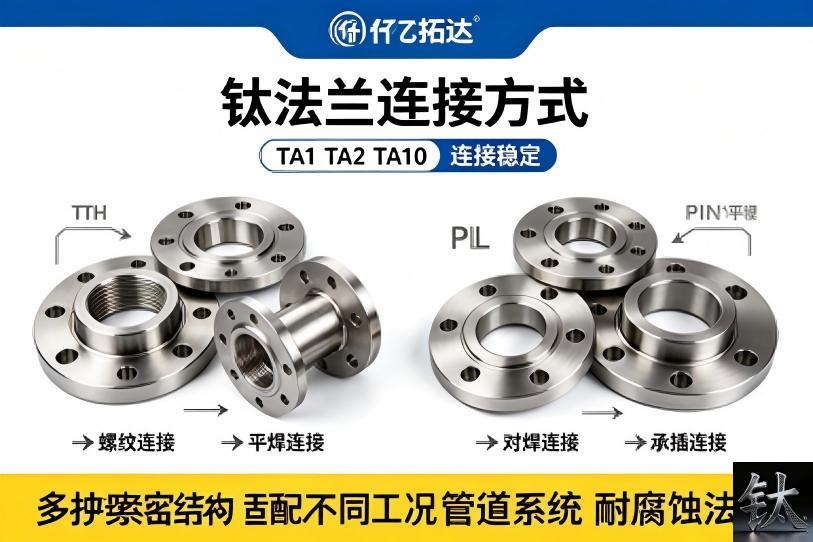
Connection methods.
- Slip-on (SO / PL) — pipe passes through the bore and is fillet welded. Simple to make, economical, suitable for low-pressure lines.
- Weld neck (WN) — long tapered hub, full-penetration butt weld to the pipe. High rigidity, handles pressure and temperature fluctuation.
- Socket weld (SW) — pipe sits inside a socket and is fillet welded externally. Small bore, medium to high pressure.
- Threaded (Th) — no welding; threads engage the pipe. For locations where hot work is prohibited.
- Lap joint (LJ) — the flange ring rotates free on a stub end. Only the wetted stub end needs to be titanium.
The nine types, with honest trade-offs
1. Plate / slip-on flange (PL / SO)
Connection: pipe inserted into the bore, fillet welded.
Advantages: material is easy to source, machining is straightforward, high production efficiency, best cost-to-performance in the range.
Limitations: low structural rigidity. Not suitable for vibration, flammable or explosive service, high vacuum, or media classified as highly or extremely hazardous. Available with FF or RF facing.
2. Slip-on with hub (SO)
Connection: short hub with the pipe inserted and fillet welded, giving more stiffness than the plate type.
Advantages: easy field assembly; radiographic examination of the weld can often be waived in routine service, which speeds up construction.
Limitations: the hub is short, so load capacity is moderate. Compared with a weld neck it needs more welding and more consumables, and it is not suited to high temperature, high pressure, repeated bending, or frequent thermal cycling.
3. Weld neck flange (WN)
Connection: long tapered hub, full-penetration butt weld — a dense weld and a structurally continuous joint.
Facings available: RF, FM, M, T, G, FF.
Advantages: stress is distributed evenly through the taper, deformation is small and sealing is stable. Handles wide swings in temperature and pressure, high and low temperature service, and lines carrying high-value, flammable, explosive or toxic media.
Limitations: larger and heavier, more raw material and machining hours, higher cost. Field alignment is more demanding and the bore and face are easily damaged in transit.
4. Integral flange (IF)
Connection: forged or cast as one piece with the equipment or pipe — a weld-neck family design used on medium and high pressure systems, most often produced as a single casting.
Facings: RF for general service; MFM or TG for flammable, explosive or highly hazardous media to reinforce sealing.
5. Socket weld flange (SW)
Connection: pipe inserted into a socket and fillet welded outside, with no through-wall weld. Compact.
Facings: RF, MFM, TG, RJ.
Where it is used: boiler and pressure vessels, petrochemical, shipbuilding, pharmaceutical, metallurgy and food processing — typically small bore high-pressure lines at PN ≤ 10 MPa and DN ≤ 40.
6. Threaded flange (Th)
Connection: standard pipe thread machined into the bore; the joint is made by the threads alone.
Advantages: fast to assemble, dismantle and inspect, and suited to locations where hot work is prohibited. Also usable where the pipe alloy has poor weldability.
Limitations: narrow temperature window. Not recommended above 260 °C or below –45 °C, or where the pipe temperature changes abruptly — leakage risk rises sharply.
7. Lap joint flange with weld-neck stub end (LJ / SE)
Connection: split design. A titanium stub end is welded to the pipe and forms the wetted surface; the backing flange rotates free and can be carbon steel or stainless.
Advantages: large material saving on titanium lines. Also suits plastic and GRP pipe that needs a welded reinforcement. Bolt holes align easily, installation is fast, and later dismantling or replacement is simple.
Limitations: limited pressure capability. The stub end is the weak point — below 3 mm wall thickness, strength and stability drop noticeably.
8. Lap joint flange with flared stub end (LJ / SE, flared)
Connection: the pipe end is flared, and a loose backing flange clamps over the flare to seal the joint.
Advantages: suits non-metallic pipe requiring welded reinforcement; easy alignment, low maintenance and replacement cost; saves titanium on high-value lines.
Limitations: low pressure rating, not for medium or high pressure severe service. The thin flared wall is a structural weak point — where thickness is insufficient, corrosion resistance and impact resistance both fall.
9. Blind flange (BL)
Description: no bore; closes the end of a line. Preferred over a welded cap or threaded plug because it can be removed at any time for inspection or pigging.
Facings: FF, RF, MFM, TG, RJ to match the mating flange.
Lined variant: a custom blind with a corrosion-resistant weld overlay on the wetted face, for closing lines carrying aggressive media. Better corrosion performance than a standard blind.
Comparison table
| Type | Code | Connection | Pressure | Cost | Typical use |
|---|---|---|---|---|---|
| Plate / slip-on | PL / SO | Fillet weld | Low | Low | Routine low-pressure process piping |
| Slip-on with hub | SO | Fillet weld | Medium | Medium | General chemical process lines |
| Weld neck | WN | Butt weld | High | High | High pressure/temperature, thermal cycling, toxic or flammable media |
| Integral | IF | Forged / cast in one piece | High | High | High pressure, equipment nozzle connections |
| Socket weld | SW | Socket weld | Medium-high | Medium-high | Small bore high pressure, DN ≤ 40, PN ≤ 10 MPa |
| Threaded | Th | Threaded | Medium | Medium | No hot work permitted, ambient service |
| Lap joint, weld-neck stub | LJ / SE | Loose ring + butt-welded stub | Low | Medium (saves titanium) | High-value pipe, plastic or GRP reinforced lines |
| Lap joint, flared stub | LJ / SE | Loose ring + flare | Low | Medium (saves titanium) | High-value pipe, frequent dismantling |
| Blind | BL | Bolted closure | Matches mating flange | By size and material | Removable end closure on any line |
Pressure and cost ratings are relative, for comparison only. Final selection must be checked against design pressure, temperature and medium, and against the governing standard — HG/T, GB or ASME B16.5.
Selection by service condition
- High temperature, high pressure, cycling, or toxic / flammable media: weld neck (WN). Even stress distribution and stable sealing under alternating duty.
- Routine low pressure, standardised piping in volume: plate / slip-on (PL). Fast to make and cost-controlled.
- Small bore high pressure (DN ≤ 40, PN ≤ 10 MPa): socket weld (SW). Compact and reliable.
- No welding permitted, frequent dismantling: threaded (Th) — but keep within –45 °C to 260 °C.
- Cost control on titanium lines: lap joint with a titanium stub end and a carbon steel or stainless backing ring.
- Equipment nozzle at high pressure: integral (IF), forged or cast with the body.
- Removable end closure: standard blind (BL) for general service; lined blind where the medium is aggressive.
Facing pairing rule of thumb: RF for mild service; MFM or TG for flammable, explosive or highly hazardous media; RJ for high pressure, high temperature joints where leakage cannot be tolerated.
Four questions buyers ask most
How is a titanium flange different from a stainless one?
Titanium resists seawater, chlorides, acids and alkalis far better, and its strength-to-weight ratio is high. It suits marine, chlor-alkali, hydrometallurgy and fine chemical service where long run times and aggressive media are the norm. Stainless is usually the more economical choice for atmospheric, fresh water and mild media. The decision should follow corrosion severity, expected service life and budget — not habit.
Why does a lap joint save material?
Because the split design puts titanium only where the medium touches. The wetted stub end or flare is titanium or zirconium; the backing ring that does the clamping can be carbon steel or stainless. On a large titanium line, that is a substantial saving on the most expensive component.
Why is a weld neck more expensive?
The tapered hub has to be forged or rolled, which consumes more raw material and machining time. The weld preparation must be accurate and the welding procedure tightly controlled, so production hours and inspection costs are both higher. What you pay for is an even stress distribution, resistance to deformation and fatigue, and better long-term reliability in severe cyclic service.
Does the flange standard matter as much as the price?
Yes — this is the most common and most expensive mistake in export orders. A DN100 PN16 flange can be drilled to ASME B16.5 or to EN 1092-1, and the bolt circles are different: the two will not bolt to the same pipe. Both are correctly described as "DN100 PN16 flanges". Confirm the standard, the facing and the pressure rating in writing before you compare prices.
Ordering Titanium Flanges
We hold 1,500 Titanium Flanges in stock in Baoji, China's Titanium Valley — weld neck, slip-on and blind, Gr2 and Gr7, DN15 to DN600, PN10 to PN40, Class 150 and 300. Standard and non-standard sizes are both available, machined to GB, HG or ASME B16.5 as you specify. Every shipment carries an EN 10204 3.1 mill test certificate and is open to third-party re-inspection.
Send the type, grade, size, pressure rating and facing — or send the drawing. We confirm stock, price and shipping date within 4 hours.
Email sales@sxqytd.com · WhatsApp +86 188 2967 9311
This article is technical reference material. Actual design and installation must comply with the governing national and industry standards.
- Oct 12, 2026 Titanium Material Spot Market | Latest Price of TA1 TA2
- Titanium Price Report – 29 September 2026 | Gr2 Gr5 Plate, Tube, Bar
- Processing technology and quality inspection standards for titanium
- Common structural types and selection guidelines for titanium stirre
- Advantages of titanium alloy agitator in adapting to high temperatur
Contact Person: Wang Xiaoning
Tel: +86-917-355-7966
Email: sales@sxqytd.com
WhatsApp: +86 188 2967 9311
Company: Shaanxi Qianyi Tuoda Technology Co., Ltd
Address: Floor 4, Building 4, No. 188 Gaoxin Avenue, High-tech Zone, Baoji City, Shaanxi Province, China