Titanium Flange Selection Guide: Types, Grades, Pressure Classes and Cost
A titanium flange is a low-cost component that causes high-cost failures. Wrong structure, wrong grade or wrong pressure class shows up as leakage, cracking or deformation — usually during a production campaign, never during commissioning. This guide covers the four decisions that actually determine whether a flange works: structure, grade, pressure class and the application itself.
It is written for design engineers, procurement engineers and project leads who need to specify correctly without re-reading the standards.
1. The Four Main Structures
Structure determines pressure capability, fatigue behaviour and how the gasket seats. Getting it wrong is the most common cause of weld failure and joint weeping.
| Type | Code | Where It Fits | Limits |
|---|---|---|---|
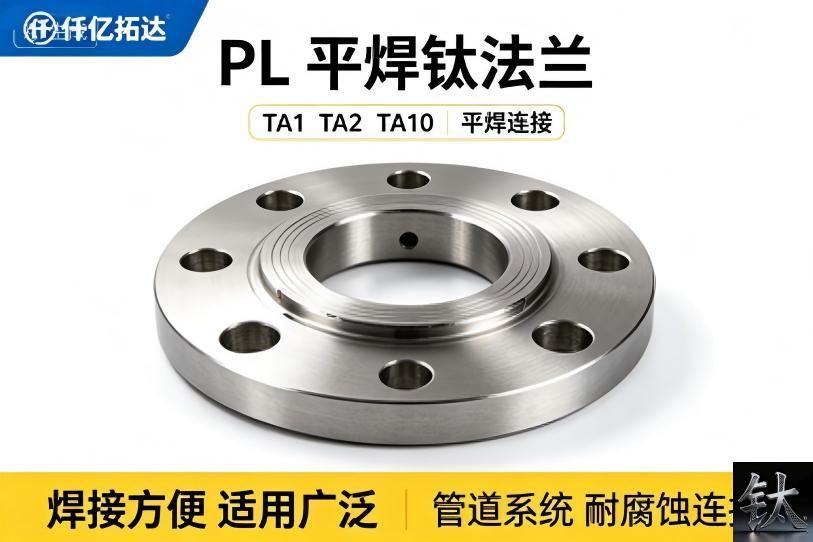
| Plate flange | PL | Ambient temperature, low pressure, low vibration, general utility lines | Lowest cost, lowest fatigue resistance |
| Slip-on flange | SO | Medium pressure, general chemical service — the workhorse type | Neck strength below WN, not for severe thermal cycling |
| Weld neck flange | WN | High temperature, high pressure, frequent thermal cycling | Higher cost, requires accurate pipe fit-up |
| Integral forged flange | IF | High pressure gas, extreme high or low temperature, severe duty | Highest cost, longest lead time |
The rule of thumb: ambient and low pressure — PL. Medium pressure and general — SO. High temperature and pressure with thermal cycling — WN. Extreme duty — IF.
The mechanical reason is the weld. On a WN flange the weld is a full-penetration butt weld and the neck thickness tapers gradually into the pipe wall, so thermal expansion produces a smooth stress distribution. On a PL or SO flange the weld is a fillet, and the stress concentration at the toe of that fillet is what cracks under cycling. This is why the same line that runs fine at steady state will fail at the flange after a few hundred temperature swings.
2. The Five Grades and What Each One Is For
The grade determines corrosion resistance and service life. Price differences between grades are small relative to the cost of an unplanned shutdown, so the grade decision should be made purely on the medium.
| Grade | UNS | Key Characteristic | Specify For |
|---|---|---|---|
| TA1 | R50250 (Gr1) | Good ductility, moderate strength, stable corrosion resistance | Low pressure, strongly corrosive but static service |
| TA2 | R50400 (Gr2) | Best balance of strength, corrosion resistance and cost | The default for general chemical service |
| TA9 | R52400 (Gr7, Ti-0.2Pd) | Palladium addition greatly improves crevice corrosion resistance | Dilute hydrochloric and sulphuric acid, reducing media |
| TA10 | R53400 (Gr12, Ti-0.3Mo-0.8Ni) | Resists chloride pitting and salt spray | Sea water, brine, high-chloride service |
| TC4 | R56400 (Gr5, Ti-6Al-4V) | Roughly double the strength of commercially pure grades | High-load structural and high-pressure joints |
The rule of thumb: general chemical — TA2. Dilute hydrochloric acid — TA9. Sea water and high chloride — TA10. High-strength structural — TC4.
Where this goes wrong in practice: TA1 being supplied where TA2 was ordered, because both are unalloyed titanium and both look the same. TA1 is the lower-strength grade; in cyclic service above roughly 200 °C the substituted part can crack well inside its expected life. Verify by spectrometer on the delivered lot, not on the certificate.
3. Pressure Class and Nominal Bore: What Actually Fits
Pressure class and diameter are not independently selectable. Above a certain size, a given class is either not covered by the standard or no longer commercially produced, and the answer is to change structure rather than force the combination.
| Nominal Bore | PN16 (Class 150) | PN25 (Class 300) | PN40 (Class 300/600) |
|---|---|---|---|
| DN15 – DN100 | Standard | Standard | Standard |
| DN150 | Standard | Standard | Available, SO/WN only |
| DN200 – DN300 | Standard | Available as WN | Not standard |
| DN500 and above | Available as IF | Not standard | Not standard |
How to read this table: the constraint is not metallurgical, it is dimensional. Higher classes require thicker walls, and the wall thickness that a given class demands at large diameter exceeds what PL and SO geometry can carry. That is why the practical answer above DN300 is to move to a WN or integral forged flange rather than to search for a plate flange in a high class.
Three working points:
- PN40 in sizes up to DN150 is routine; beyond that, confirm availability before committing the design.
- DN500 and above in any elevated class means integral forged construction.
- High temperature combined with thermal cycling means WN regardless of what the pressure class alone would allow.
4. Five Application Decision Trees
These are the five most common duties we quote. Each line gives the grade, the structure and the class together, because the three decisions are not independent.
| Duty | Specification | Reasoning |
|---|---|---|
| Dilute sulphuric acid, 5–15%, 60–80 °C | TA2 + SO + PN16 | TA2 passive film is stable in dilute acid at moderate temperature. TA1 would be under-strength here. |
| Sea water desalination, 70 °C | TA10 + WN + PN25 | TA10 resists chloride pitting; WN handles the thermal cycling. TA2 is the wrong grade for this duty. |
| Dilute hydrochloric acid, 3–8%, 50 °C | TA9 + WN + PN16 | Palladium stabilises the passive film in reducing acid and resists crevice attack under the gasket. |
| Chlor-alkali plant, wet chlorine gas | TA2 + IF + PN40 | Commercially pure titanium suits wet chlorine; forged construction gives the pressure stability. |
| Pharmaceutical GMP steam, 121 °C | TA2 + WN + PN16 | Good biocompatibility, no harmful leaching, passes clean-service audit. Alloy grades are unnecessary risk here. |
Note the pattern: the two duties where buyers most often default to TA2 — dilute hydrochloric acid and sea water — are precisely the two where TA2 is wrong. Both fail by localised attack at the gasket crevice, which is invisible from outside until the joint leaks.
5. Five-Year Cost Comparison
Comparison basis: DN100 PN16 slip-on flange, one joint position, five years of service.
| Material | Service Life | Replacements in 5 Years | Relative 5-Year Cost |
|---|---|---|---|
| 304 stainless steel | ~2 years | 2 | 1.0× (baseline) |
| 316L stainless steel | ~4 years | 1 | 0.8× |
| TA2 titanium | 15+ years | 0 | 1.7× |
What this table does and does not say. Over five years, titanium still costs more in pure part price — the advantage is not visible inside a five-year window. It appears in year six and every year after, because the titanium flange does not need replacing while the stainless ones are on their third or fourth cycle.
The table also excludes the cost that actually dominates: the labour, scaffolding, gasket sets and production downtime of each replacement. Once one shutdown is counted, the titanium flange is typically paid back inside the first replacement cycle it avoids. On a line that runs continuously, that is usually within two to three years.
The honest framing for a project justification: titanium is not the cheaper flange, it is the flange you stop thinking about.
6. What to Verify Before You Buy
Standards to cite on the order:
- Dimensions: ASME B16.5, EN 1092-1, JIS B2220 or HG/T 20592 — pick the one your piping system is built to, and state the pressure class or PN in the same line.
- Material: GB/T 21225 for Titanium Flanges, plus the grade designation (TA2 / Gr2). Naming the grade and the material standard together is what closes the substitution loophole.
Documentation: third-party test reports covering chemical composition and mechanical properties, with the lot number traceable to the delivered goods. For critical duty, add PT on the sealing faces and UT or RT on a defined sampling basis. Agree the sampling rate and acceptance criteria before the order is placed — after delivery there is no leverage.
Facing and fasteners: select the facing to suit the gasket — RF, MFM, TG or RJ — and state the surface roughness, not just the code. Pair with titanium or Hastelloy bolts and a spiral wound graphite gasket for corrosive or clean service. Buying flange, bolts and gasket separately is how a joint that was individually correct fails as an assembly.
Three selection errors worth naming:
- Choosing on unit price and ignoring service life — the cheapest flange that has to be replaced twice costs more than the expensive one that does not.
- Treating TA1 and TA2 as interchangeable — they are not, and the difference is strength, which is exactly what cyclic service tests.
- Choosing the structure on price rather than on pressure and vibration — a PL flange on a vibrating line fails at the fillet weld, not at the gasket.
We hold Titanium Flanges in TA1, TA2, TA9, TA10 and TC4 across PL, SO, WN and IF structures, in ASME B16.5, EN 1092-1, JIS B2220 and HG/T 20592 configurations, from DN15 upward and in non-standard sizes to drawing. Stock items ship in 7 days; custom orders typically within 15 days. Send us the medium, temperature, pressure class and facing code and we will confirm the grade, the structure and the inspection method before quoting.
Email: sales@sxqytd.com | WhatsApp: +86 188 2967 9311
- Oct 12, 2026 Titanium Material Spot Market | Latest Price of TA1 TA2
- Titanium Price Report – 29 September 2026 | Gr2 Gr5 Plate, Tube, Bar
- Processing technology and quality inspection standards for titanium
- Common structural types and selection guidelines for titanium stirre
- Advantages of titanium alloy agitator in adapting to high temperatur
Contact Person: Wang Xiaoning
Tel: +86-917-355-7966
Email: sales@sxqytd.com
WhatsApp: +86 188 2967 9311
Company: Shaanxi Qianyi Tuoda Technology Co., Ltd
Address: Floor 4, Building 4, No. 188 Gaoxin Avenue, High-tech Zone, Baoji City, Shaanxi Province, China